

Biophilic lighting design lights a room the way nature lights the outdoors — daylight first, artificial light that changes with the day, organic forms, natural textures, and light that falls in layers rather than a flat wash. This guide covers the five principles behind it, how to apply them room by room, and ten nature-inspired fixture forms, from tree-branch chandeliers to mushroom lamps, that bring the approach into a home.
Key Takeaways
| Question | Answer |
|---|---|
| What is biophilic lighting design? | Lighting that behaves like outdoor light: daylight first, circadian change through the day, organic fixture forms, natural materials, and layered, dappled light. |
| Which fixtures best mimic trees and branches? | Tree-branch chandeliers with asymmetrical arms and light at the tips — rustic versions for farmhouse rooms, linear or sculpted versions for modern ones. See the branch chandelier collection. |
| How do I bring floral forms into lighting? | Flower-branch chandeliers, petal-shaded pendants over islands, and leaf-shaped wall sconces that diffuse light softly. |
| Are there biophilic options for staircases? | Cascading petal or leaf fixtures and vertical branch pieces that read like hanging vines in a two-story foyer. |
| What light color is biophilic? | Warm white 2700–3000K in living spaces, warm-dim toward 2200K at night, neutral 3000–3500K in work areas by day; never 5000K+ indoors. |
| Do nature-inspired fixtures work in modern rooms? | Yes — linear branches, sculpted arms, and minimalist mushroom lamps read as natural through silhouette, not rustic texture. |
| Where should I start? | One statement fixture in the main room on a warm-dim dimmer, one supporting organic piece, and better daylight. |
Quick Facts
- Biophilic lighting design has five levers: daylight, circadian change, organic form, natural material, and layered/dappled light.
- Nature-inspired fixture forms: branch, flower, leaf, mushroom, bubble/bud, wood, antler, wave, cascade.
- Color: 2700–3000K in living spaces; warm-dim LEDs shift toward 2200K as they dim; CRI 90+.
- Layer from three heights: ceiling (statement fixture), wall (sconce), surface (table or floor lamp).
- A skylight or light tube is the most direct biophilic lighting; tunable LED is the substitute.
- Outdoor: warm 2700K low-level path and plant lighting on a schedule, sky kept dark.
Biophilic Lighting Design: The Five Principles
Biophilia is the idea that people are drawn to nature and do better in environments that reference it. Applied to lighting, it produces five principles. The fixtures in the rest of this guide serve the third and fourth; the first, second, and fifth are about how light is brought in, changed, and layered, and they cost little to get right.
1. Daylight first
No fixture matches daylight for spectrum, intensity, or the way it moves across a room through the day, so biophilic lighting design starts by getting more of it in and letting it be seen. That means clearing window sills and swapping heavy drapes for sheers, placing mirrors and pale finishes where they bounce daylight deeper into the room, and keeping the area nearest the window for the activities that benefit most — reading, working, eating breakfast. A skylight, light tube, or clerestory window is the most direct biophilic ceiling design there is. The daylighting guide covers the practical steps.
2. Light that follows the day
Outdoor light is bright and blue-white at noon and dim and amber at dusk, and the body's clock is set by that change. Indoor lighting that stays one color and brightness from morning to midnight works against it. The biophilic answer is warm-dim and tunable LEDs: warm-dim bulbs shift from about 3000K toward 2200K as they dim, so an evening setting reads like firelight; tunable fixtures run cooler by day in kitchens and offices and warm in the evening. The practical rule is 2700–3000K in living spaces, 3000–3500K in work areas by day, dimmers everywhere, and no 5000K–6000K light indoors, which flattens organic textures and undoes the calm the fixtures create. The lighting and mood guide covers the wellness side.
3. Organic form
Fixtures whose shapes come from nature — branches, leaves, flowers, mushrooms, antlers, waves, cascades — are the visible layer of biophilic lighting and the subject of the ten sections below. What makes a form read as natural is asymmetry, repetition with variation (many similar leaves, no two identical), and light placed where nature places it: at branch tips, inside petals, under a cap.
4. Natural material and texture
Wood grain, brass that will age, blown glass, rattan, linen, ceramic, and stone-like finishes give a fixture tactile presence even from across the room. Plated plastic and mirror chrome do the opposite. Texture also shapes light: a wood or rattan shade throws pattern, frosted or petal glass diffuses, and a warm metal reflects warmly.
5. Layered, dappled light
Sunlight through leaves is never uniform; it arrives from above, from the side, and reflected off the ground, in patches. A single bright overhead fixture is the least natural lighting possible. Biophilic rooms take light from three heights — a ceiling statement fixture, wall sconces, and table or floor lamps — each on its own dimmer, and choose fixtures that scatter light in several directions rather than one downward cone. Branch chandeliers with tip lights, bubble clusters, and petal shades all do this by design. The layered lighting guide explains the three layers.
Ten Nature-Inspired Fixture Forms

1. Tree-branch chandeliers: the forest canopy indoors
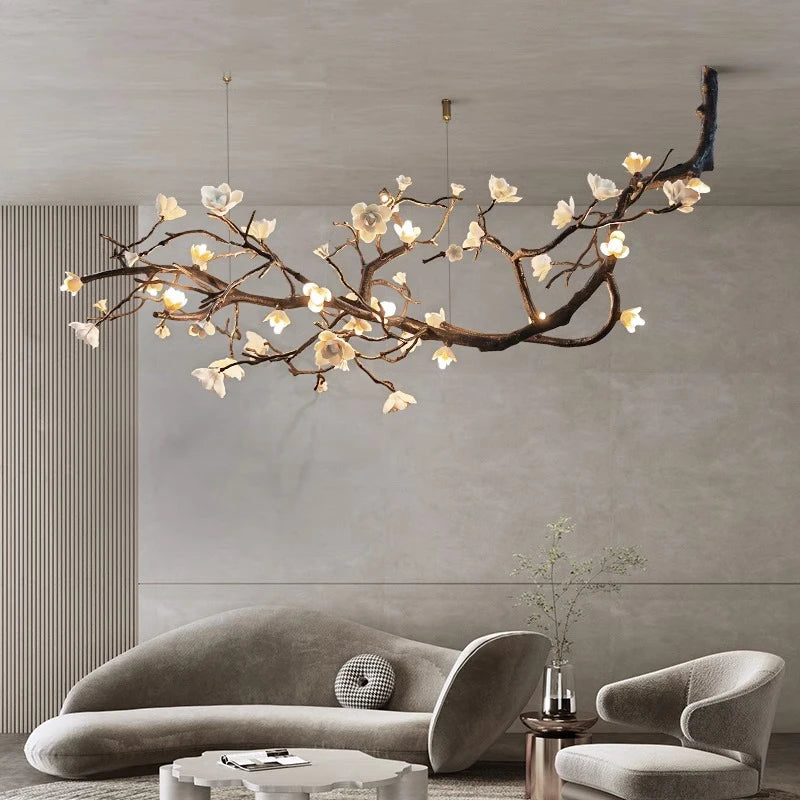
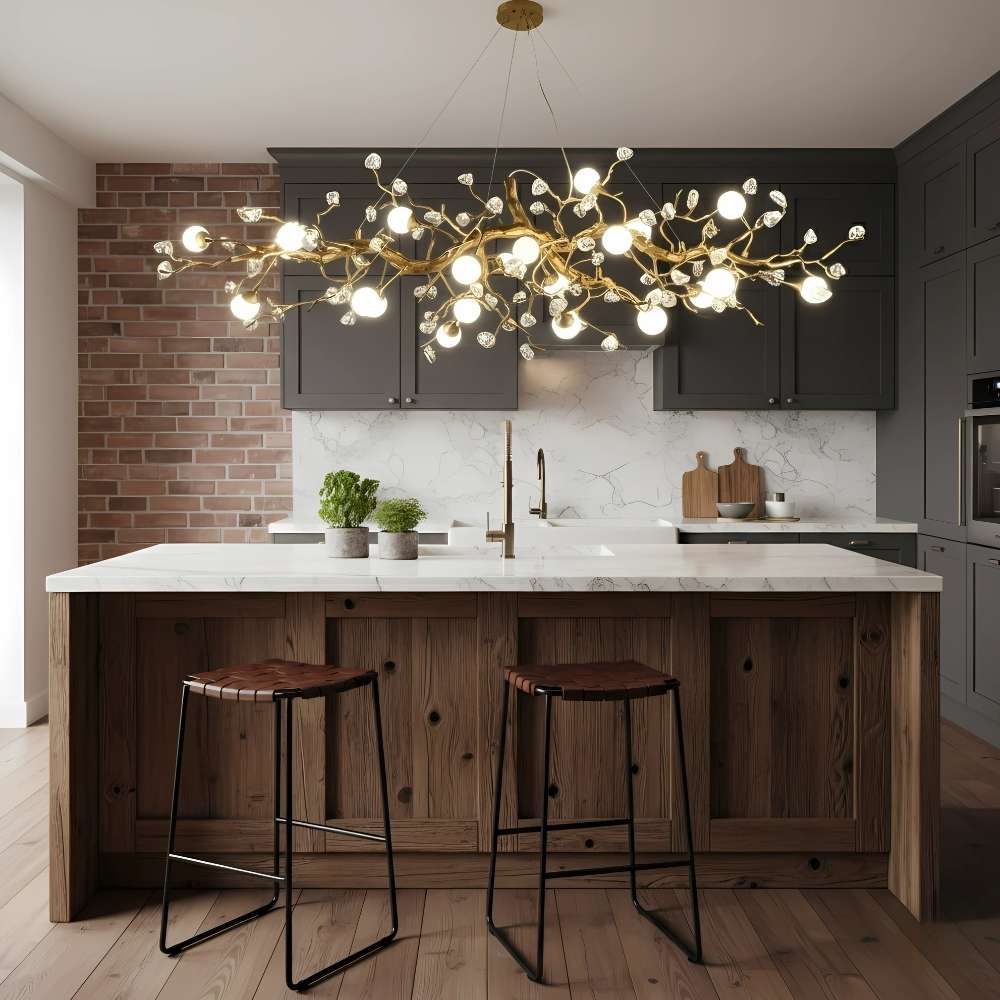
No biophilic lighting idea is as direct as a tree-branch chandelier: irregular arms spreading overhead with light at the tips, the way light filters through a canopy. The Minas Dimmable Rustic Tree Branch Chandelier is the rustic version — intertwined, bark-textured arms that read as a section of woodland floating over the table, dimmable for the evening layer. The Orgi Statement Linear Branch Chandelier stretches the same idea into a line for long dining tables and kitchen islands.
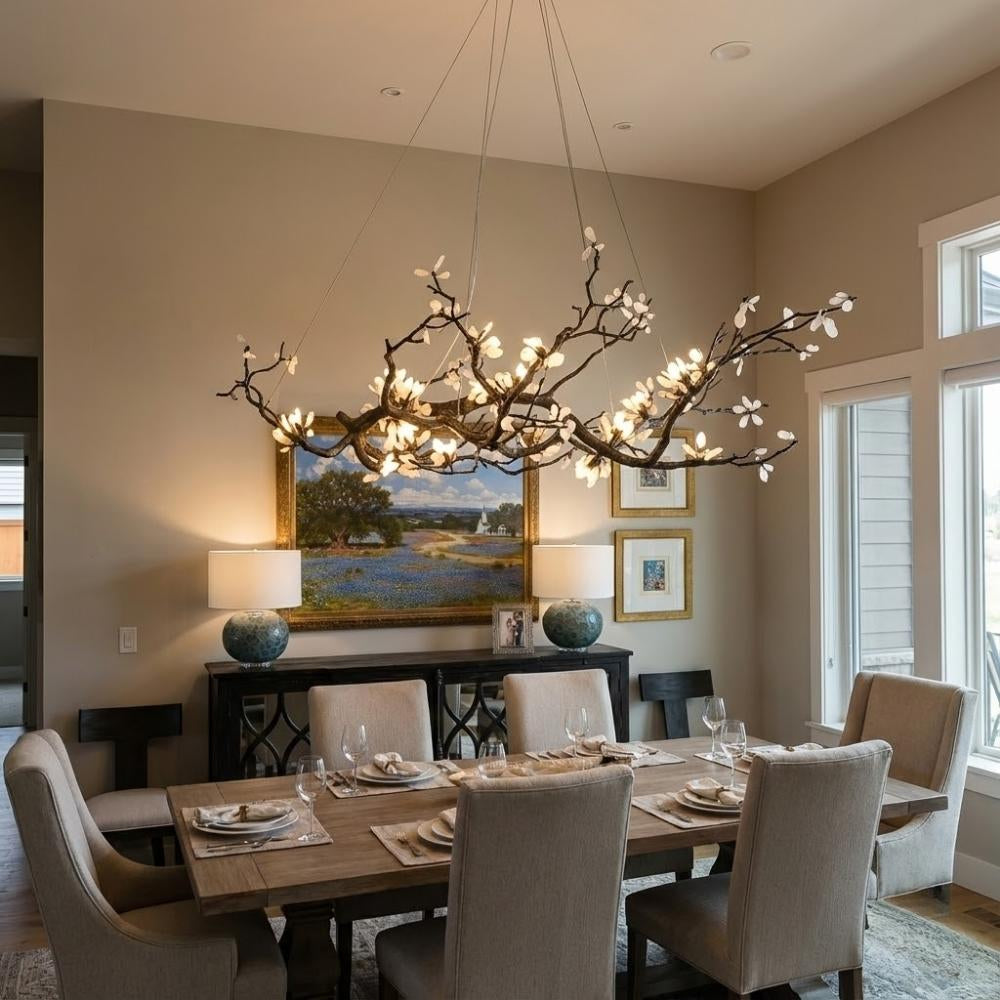
For living rooms and foyers the Alba Tree Branch Chandelier refines the branch into a fluid, curving composition, and for a standard-height ceiling the Lio Tree Branch Ceiling Light Fixture keeps the branching silhouette on slimmer arms mounted close to the ceiling. The tree branch chandelier guide covers sizes and hanging heights, and the branch chandelier collection has the full range.
2. Flower and leaf forms: petals, clusters, and natural diffusion
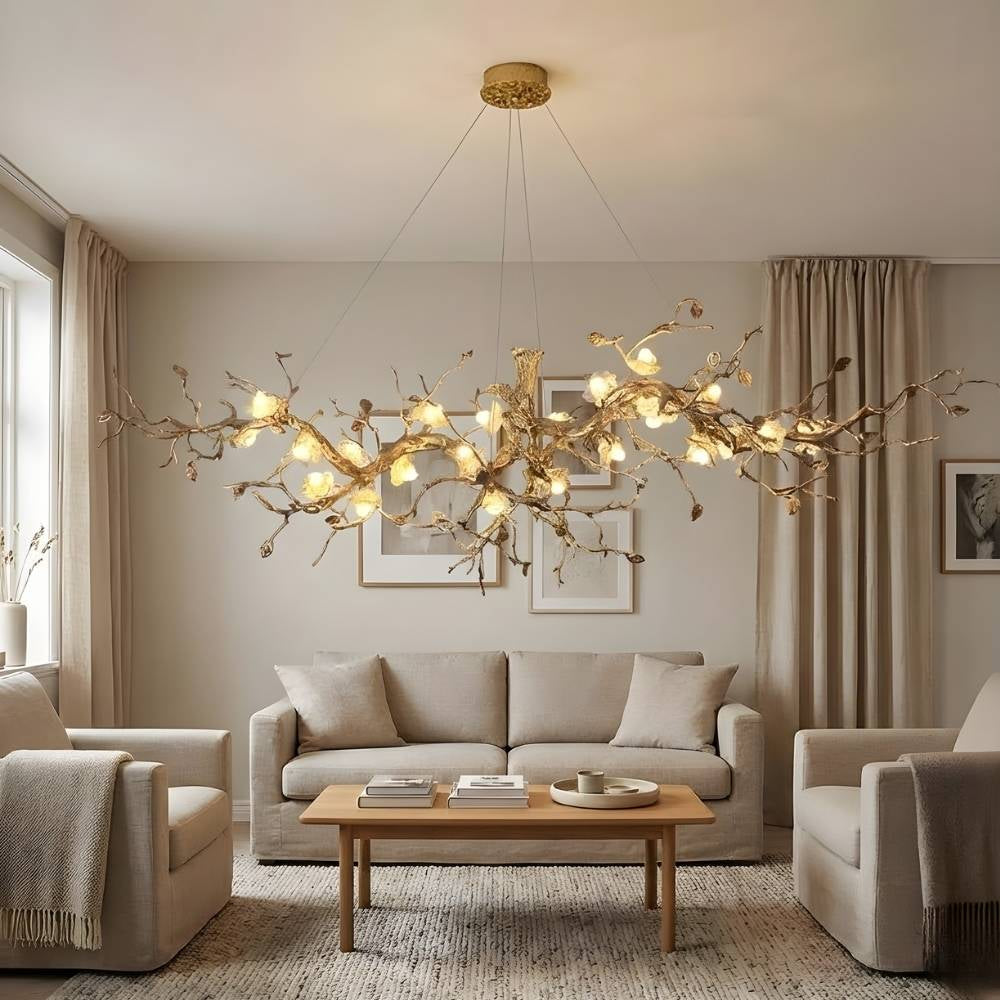
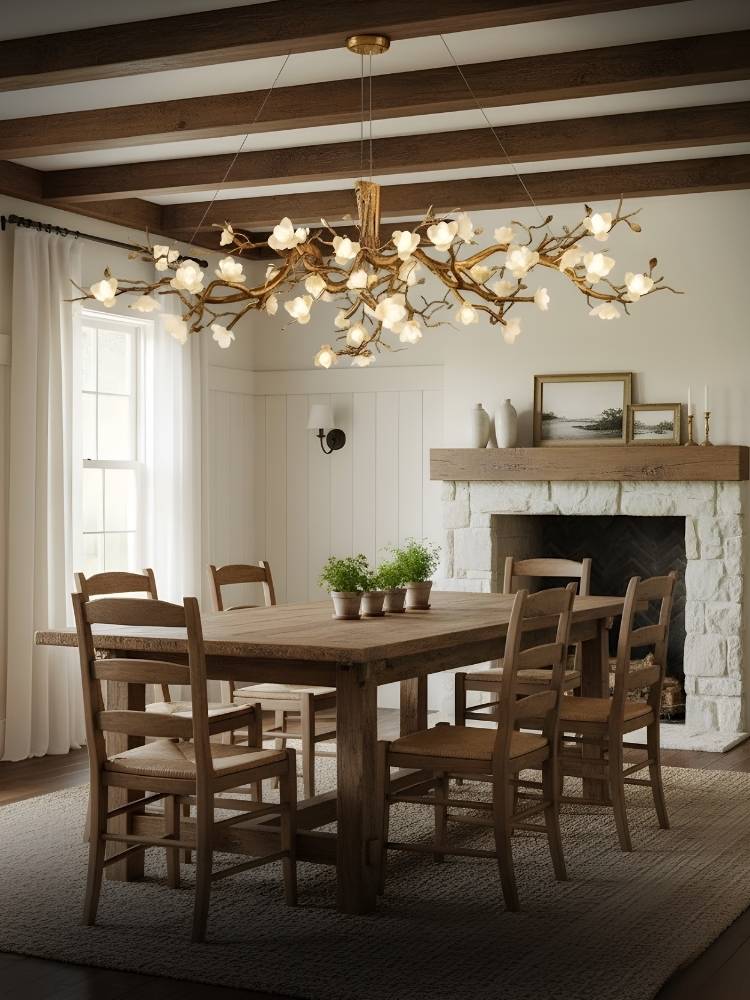
Petal shapes diffuse light the way nothing geometric does: each flower head both decorates and softens. The Noa Flower Branch Chandelier pairs branch arms with clusters of flower-like shades, a blossoming bough over a table or seating group. The Zenth Vintage Flower Chandelier layers flower heads in warm finishes that read like dried blossoms — an organic focal point for a room with older furniture.
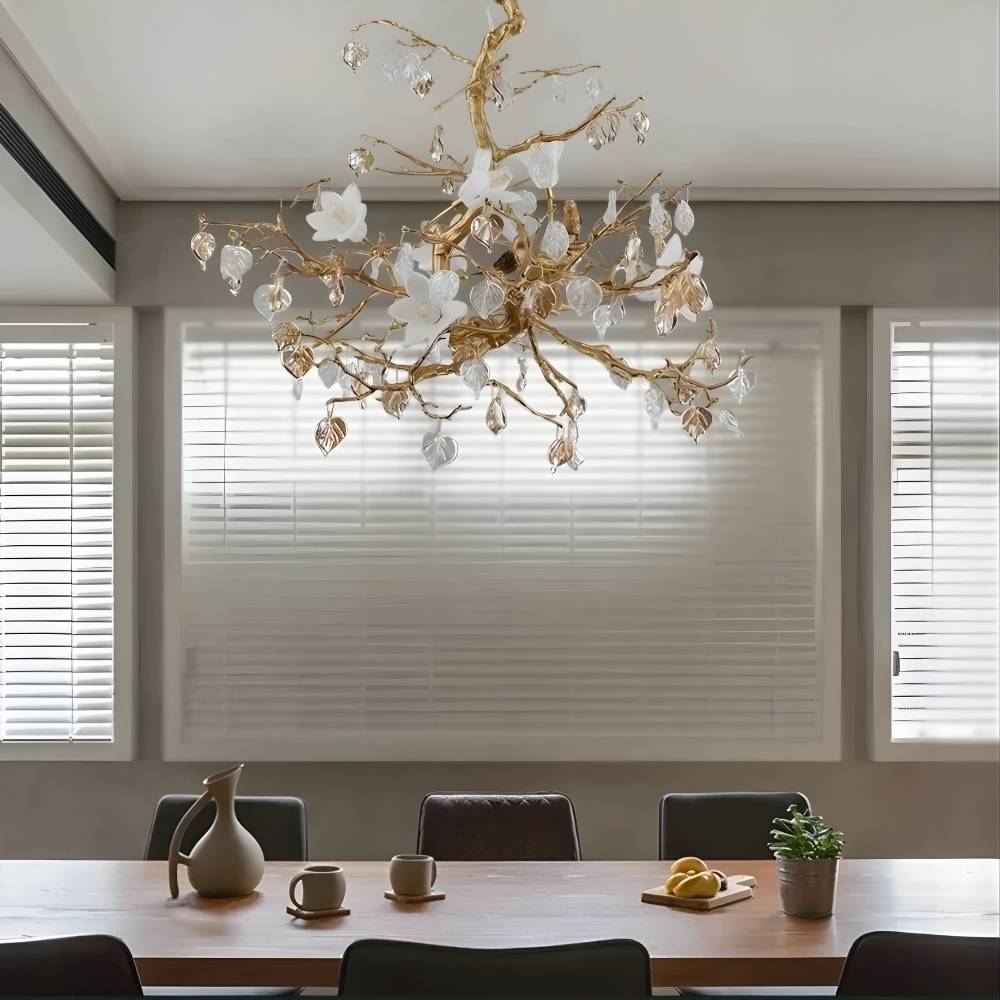

Over a kitchen island or work surface, the Eryx Flower Pendant Light brings a detailed flower head to task height — choose the warm-white option for living spaces, keeping to the color principle above. On the wall, the Calla Modern Leaf Wall Lamp is the supporting piece: a slender leaf silhouette in a metallic finish that catches light like foliage, the second layer in a hallway, bedroom, or stairwell.
3. Sculptural branch lines: organic geometry with modern edges
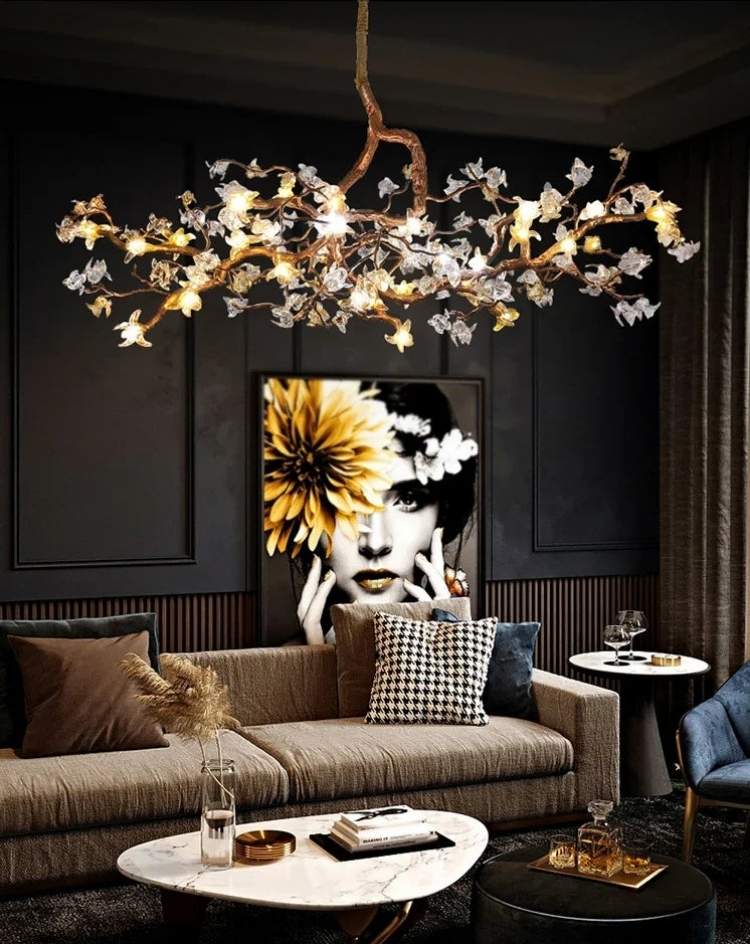
Biophilic lighting can be fully contemporary when organic lines are distilled into sculpture. The Asut Sculptural Branch Chandelier uses clean, angular branches that read as a winter tree's outline — right for long dining tables and meeting rooms in modern interiors. The Madelyn Rustic Branch Chandelier softens the same geometry with glass spheres at the tips that suggest buds or dew. Both spread light in several directions at once, which is the layered-light principle built into one fixture: ambient light across the ceiling, gentle downlight on the table, no single harsh cone.
4. Nature-inspired staircase lighting: vertical light sculptures
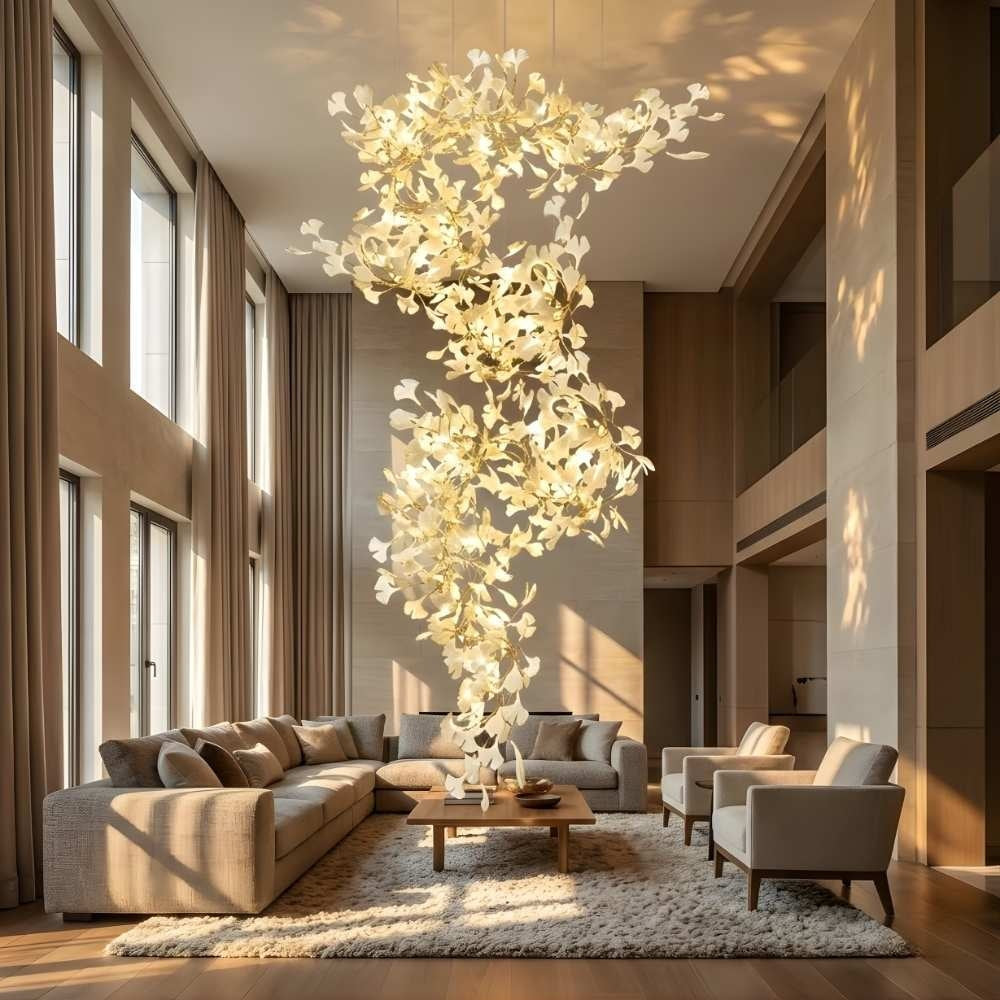
Stairwells and double-height foyers are the one place a fixture can be vertical, and vertical organic forms — vines, waterfalls, falling leaves — belong there. The Calla Luxury Staircase Chandelier spirals calla-like forms downward like petals caught in a breeze, and reads from the landing, the stairs, and the door. Size it by the stairwell's drop and keep 7 feet of clearance over every tread; the stairwell chandelier size guide has the numbers.
Supporting the stairwell with walls
A vertical centerpiece looks isolated without wall fixtures that repeat its language more quietly. Leaf-shaped sconces at landing height, or glass wall lights shaped like dewdrops, carry the organic theme down the stair so the whole well reads as one composition rather than a lone chandelier.
5. Mushrooms and soft domes: organic accents at eye level


Mushroom caps are the natural shape for diffuse, low-level light, and mushroom lamps supply the surface layer of a biophilic scheme — bedside, on a shelf, on a desk. The Modern Mushroom Table Lamp sets a glossy curved dome over a simple stem for a soft glow; the Mush LED Rechargeable Table Lamp is the cordless version, movable to a windowsill, a terrace, or a nightstand with no outlet. On the ceiling, the Branching Bubble Chandelier clusters rounded glass globes along a branch — mushroom caps and buds in one piece — for dining and living rooms that want an organic fixture that still feels calm.
6. Wood, antler, and rustic textures: tactile statements

Material is the fourth principle, and wood is its clearest expression. The Rose Wooden Large Rustic Chandelier hangs bold timber elements in a circular profile, a beam structure over a tall foyer or large dining room; the Neva Round Rustic Chandelier brings the same wood texture into a compact ring for entries and dining tables. Antler forms belong here too: the Brielle Modern Antler Chandelier sculpts antlers rather than copying them, in a finish refined enough for a living room, and the Ivy Rustic Wagon Wheel Chandelier adds a barn-derived wheel with organic detailing. The vintage rustic chandelier guide shows how to keep these looking current; browse rustic and antler chandeliers.
7. Bubble and dewdrop glass: buds, rain, and water
Clear and frosted glass spheres — clustered, cascading, or strung along a branch — read as dew, rain, and buds, and they scatter light in every direction, which makes them the most naturally layered ceiling fixtures. They also bridge organic and modern: a bubble cluster sits as easily in a flat-panel kitchen as a branch chandelier does in a cabin. The bubble chandelier styles guide sorts them by layout; the bubble chandeliers collection has the range.
8. Waves, ripples, and water forms
Water is the other landscape people respond to, and wave-shaped linear fixtures, rippled glass shades, and cascading pendants bring its movement indoors — most often over a kitchen island or a long table where a horizontal form fits. The rule is the same as for branches: one water-form statement, supported by simpler pieces, in warm light.
9. Outdoor and landscape biophilic lighting

Outdoors, biophilic lighting is about lighting nature itself rather than imitating it: low, warm light on paths, steps, and plantings, fixtures that sit among plants, and a sky left dark. The Zenlum LED Landscape Lights are plant-like stakes with compact heads and soft beams that accent foliage and stone without flooding the yard. Run them at 2700K on a dusk-to-dawn or motion schedule; the outdoor lighting ideas guide and solar lights guide cover the wider plan.
10. The foyer as an indoor garden edge
The entry is where inside meets outside, and botanical fixtures there make the transition read. The Petunia Rustic Foyer Lighting puts flower-like profiles and a rustic finish at the door, so the foyer feels like an extension of the planting outside it. Pair it with a leaf sconce and a mushroom lamp on the console for the three-height layer, and the entry becomes the first biophilic room rather than a corridor to them.
Matching Forms, Textures, and Rooms
Biophilic lighting works across scales, from a mushroom lamp to a timber chandelier. The reliable approach is one or two statement nature-inspired fixtures and several quieter organic accents, matched by form to the room.
| Fixture | Nature-inspired element | Typical use |
|---|---|---|
| Minas / Alba / Asut branch chandeliers | Branch arms, tip lights, canopy spread | Dining tables, living rooms, foyers |
| Orgi linear branch | Branch form in a line | Long tables, kitchen islands |
| Noa / Zenth flower chandeliers | Petal clusters, diffused glow | Dining and living rooms |
| Eryx flower pendant | Single flower head | Islands, work surfaces |
| Calla leaf wall lamp | Leaf silhouette, metallic texture | Hallways, bedrooms, stairwells |
| Calla staircase chandelier | Cascading petals | Two-story foyers, stairwells |
| Mushroom / Mush lamps | Mushroom cap dome | Bedside, shelves, desks, terraces |
| Branching Bubble chandelier | Branch arms with glass buds | Dining tables, large islands |
| Rose Wooden / Neva rustic | Wood grain, timber ring | High foyers, dining rooms |
| Brielle antler / Ivy wagon wheel | Sculpted antler, barn wheel | Living rooms, great rooms |
| Zenlum landscape lights | Plant-like stakes, low warm beams | Paths, garden edges |
| Petunia foyer lighting | Flower profiles, rustic finish | Entryways |
Applying Biophilic Lighting Design Room by Room
| Room | Daylight | Statement form | Supporting layers | Light color |
|---|---|---|---|---|
| Living room | Sheers, mirror opposite window | Branch or flower chandelier centered on seating | Leaf sconces, mushroom or dome lamps | 2700K warm-dim on dimmers |
| Dining room | Table near the window | Linear branch over rectangular table; round branch or bubble over round | Buffet lamp, wall sconce | 2700K, dimmed for dinner |
| Kitchen | Clear the sill; light counters | Flower or bubble pendants over the island | Under-cabinet strip, warm | 3000K by day, warmer by evening |
| Bedroom | Blackout at night, sheers by day | Soft organic ceiling light or none | Mushroom bedside lamps, leaf sconces, wake-up ramp | 2700K, warm-dim to 2200K |
| Home office | Desk beside, not facing, the window | Sculpted branch pendant | Task lamp with natural shade | 3000–3500K day, tunable down at night |
| Foyer & stairwell | Glazed door or sidelights | Cascading vertical fixture or botanical foyer light | Leaf sconces at landing height, console lamp | 2700–3000K |
| Bathroom | Frosted window or light tube | Damp-rated organic flush mount | Vertical sconces at the mirror | 3000K day, dimmable |
| Outdoor | — | Path and plant lights among the planting | Wall lantern at the door, on schedule | 2700K, sky kept dark |
A biophilic lighting plan in four steps
1. Fix daylight first: sheers, cleared sills, a mirror or pale wall to bounce it • 2. Choose one organic statement per main room: branch for dining, flower or bubble for the island, cascade for the stairwell, mushroom lamps for the bedroom • 3. Add one supporting piece in the same language — leaf sconce, dome lamp — so light comes from three heights • 4. Set the light to follow the day: 2700K warm-dim in living spaces, cooler by day where you work, everything on a dimmer.
Branch and antler chandeliers, flower pendants, rustic wood, and mushroom lamps.
Branch Chandeliers Rustic Antler Table Lamps
Frequently Asked Questions
What is biophilic lighting design?
Biophilic lighting design is the practice of lighting interiors the way nature lights the outdoors: prioritizing daylight, letting artificial light change over the day (brighter and cooler in the morning, warmer and dimmer at night), using fixtures with organic forms such as branches, leaves, and mushrooms, choosing natural materials and textures, and layering light so it falls in soft, dappled patterns rather than a flat overhead wash. The goal is a room that feels calmer and more comfortable because its light behaves like light people evolved under.
What is the difference between biophilic lighting and nature-inspired light fixtures?
Nature-inspired light fixtures are the objects — branch chandeliers, flower pendants, mushroom lamps, wood or antler chandeliers. Biophilic lighting design is the whole approach those fixtures belong to: daylight, circadian light, organic form, natural materials, and layered, dappled light. A branch chandelier is nature-inspired; a branch chandelier on a warm-dim bulb, over a table near a window, with a leaf sconce and a mushroom lamp for the evening layer, is biophilic lighting design.
How do I use biophilic lighting in my home?
Start with daylight: clear the windows, use sheer rather than heavy window coverings, and place mirrors and light finishes where they bounce daylight in. Then set the artificial light to follow the day — warm-dim or tunable LEDs at 2700K for evenings, cooler in work areas by day, all on dimmers. Add one organic statement fixture per main room (a branch chandelier over the dining table, a flower pendant over the island, a cascading fixture in the stairwell), and layer it with smaller nature-inspired pieces — a leaf sconce, a mushroom lamp — so light comes from several heights. Keep materials natural: wood, brass, glass, rattan, ceramic.
Which fixtures best mimic trees and branches?
Tree-branch chandeliers with irregular, asymmetrical arms and small light points at the tips read most like a canopy — rustic, bark-textured versions for farmhouse and cabin rooms, and sleek linear or sculpted-branch versions for modern dining rooms and offices. A compact branch ceiling light does the same job on a standard-height ceiling. The best ones put the light at the branch ends so it scatters upward and outward the way light filters through leaves.
What color temperature is best for biophilic lighting?
Follow the day. In living, dining, and bedroom areas use warm white, 2700K to 3000K, and prefer warm-dim LEDs that shift toward 2200K as they dim, which mimics sunset and firelight. In kitchens, offices, and bathrooms a neutral 3000K to 3500K by day is fine, ideally on tunable fixtures that warm up in the evening. Avoid 5000K–6000K in any living space — it flattens organic textures and works against the calming effect the fixtures are there to create. CRI 90 or higher keeps wood, brass, and foliage looking true.
Is a skylight biophilic lighting?
Yes — a skylight, a light tube, or a clerestory window is the most direct form of biophilic lighting because it brings real daylight, with its natural changes in intensity and color, into the room. Biophilic ceiling design pairs that daylight with fixtures that don't fight it: organic ceiling lights, branch chandeliers, and dimmable warm LEDs that take over as the daylight fades. Where a skylight isn't possible, a large tunable LED panel set to follow the daily cycle is the closest substitute.
Do nature-inspired fixtures work in modern interiors?
Yes. The modern versions distill organic forms into clean geometry — a linear branch chandelier in black or brass, a sculpted branch with angular arms, a minimalist mushroom lamp, a slim leaf sconce. They read as natural because of their silhouette and the way they spread light, not because of rustic texture, so they sit comfortably beside flat-panel cabinets, steel, and glass. Pick one organic statement piece and keep the supporting fixtures simple.
What is the best biophilic lighting for a bedroom?
Low, warm, and layered. Skip a bright overhead fixture in favor of a soft organic ceiling light or none at all, and put the useful light at bedside: mushroom or dome table lamps, or leaf-shaped wall sconces, on dimmers or with rechargeable low settings. Use 2700K or warm-dim bulbs, and if the fixtures allow it, a wake-up ramp in the morning and a dim-down in the evening. Natural materials — wood, linen, ceramic, frosted glass — matter more here than anywhere else.
Where should I start if I'm new to biophilic lighting?
With one statement fixture in the room you use most: a branch chandelier over the dining table, a flower or bubble pendant over the kitchen island, or a cascading organic fixture in a two-story foyer. Put it on a dimmer with a warm-dim bulb. Then add one supporting piece in the same natural language — a leaf sconce, a mushroom lamp — and work outward room by room. Daylight improvements (sheers, mirrors, clearing windows) cost the least and do the most, so do those at the same time.
Can outdoor lighting be biophilic?
Yes, and it is where the principles are easiest to see. Biophilic outdoor lighting uses low, warm (2700K) light that traces paths and plantings from below, so foliage and stone are lit and the sky stays dark; fixtures that sit among plants rather than above them; and control by dusk-to-dawn schedule or motion so the garden isn't lit all night. Solar path lights and low-voltage LED stake lights are the two common tools.
Bringing the Landscape Indoors, One Fixture at a Time
Biophilic lighting connects a home to the outdoors through the way light arrives and the shapes it arrives from: daylight through working windows, artificial light that warms as evening comes, and fixtures — branch, flower, leaf, mushroom, wood, antler — that carry nature's forms and textures. The ten fixture forms above are the visible half of that; the daylight, color, and layering principles are the half that makes them feel right.
Start with the branch chandelier collection for the most direct nature-inspired statement, and see the tree branch chandelier guide for sizing and hanging. For the daylight side of the plan, the daylighting guide is the companion to this one.


