

The phrase “chandelier that looks like tree branches” gets searched more than “branch chandelier” itself — which tells you something about how people actually shop for these fixtures. They're not looking for a category, they're looking for a specific visual effect: light points sitting at the tips of organic, asymmetric forms, the way leaves catch sunlight at the ends of real branches. Get that right and the fixture works as both lighting and quiet sculpture. Get it wrong and you end up with a chandelier that's just a chandelier with twigs glued on.
This guide covers what makes a chandelier read as branch-like, why the wood-versus-metal question matters more than most buyers realize, and 8 curated picks from our branch chandelier collection — ranging from the rustic Minas at 6.5 ft (198 cm) wide to the sculptural Sputnik Branch Firefly with 54 individual light points. Free worldwide shipping and 20-day returns on everything below.
Why People Search for Chandeliers That Look Like Tree Branches
The biggest entry point for this category isn't the term “branch chandelier.” It's variations of branch like chandelier, tree like chandelier, or chandelier that looks like tree branches — phrasings that suggest the buyer doesn't have a fixed category name in mind, they have a visual reference. They've seen a chandelier somewhere (a hotel lobby, a Pinterest board, a friend's foyer) and they're trying to find the equivalent without knowing what it's called.
The visual effect those buyers are looking for comes from three things working together:
- Asymmetric branching geometry. Real branches don't grow at equal angles or equal lengths. A chandelier reads as branch-like when the framework breaks symmetry deliberately — some arms longer, some shorter, some angling up while others angle down.
- Light points at the tips. Bulbs or LED points placed at the ends of branches read as flowers, blossoms, or fireflies. The same fixture with bulbs at branch midpoints loses the effect entirely and just looks like a metal abstraction.
- Material that suggests bark or growth. Black powder-coated metal, copper with patina, or matte gold all carry organic associations. Polished chrome or shiny chrome-plated metal undermines the effect because it reads as industrial rather than natural.
Every fixture in the picks below hits at least two of those three signals. The strongest picks (Alba, Minas, Modern Tree Branch) hit all three.
Wood vs Metal Branch Construction: What Lasts and What Sags
Buyers searching for wood branch chandelier or wooden branch chandelier are usually picturing something more rustic than what a metal-framed branch chandelier delivers. The trade-offs between the two materials are real and worth understanding before you order.
| Factor | Real wood branches | Metal branch fixtures |
|---|---|---|
| Visual authenticity | High — reads as actual branch | Stylized — reads as branch reference |
| Long-term stability | Cracks, warps, dries over 5+ years | Stable indefinitely with proper finish |
| Fire safety | Risk near light sources without fire treatment | Inherently non-flammable |
| Weight | Heavy — often exceeds ceiling box rating | Weight-balanced for residential mounts |
| Light placement | Limited — wood splits when drilled | Precise tip-light arrangement possible |
| Certification | Rare — mostly artisan craft pieces | UL/CE rated, residential-compliant |
Almost every commercial branch chandelier you'll find — including all 8 picks below — uses metal for the framework with finish treatments (matte black, copper patina, brushed gold) that simulate wood or bark. The exception is artisan rustic fixtures sold through specialty galleries, which can run $5,000 to $20,000+ and require professional installation with reinforced ceiling support.
For most homes, metal-framed branch chandeliers deliver the visual effect of wood branches without the stability and safety trade-offs. The picks below are all metal-framed.
Branch Spread, Ceiling Height, and the Sizing Math
Branch chandeliers don't follow standard chandelier sizing rules. The asymmetric form means horizontal spread can be twice the vertical drop, or vice versa — you can't apply the “diameter equals room length plus width in inches” formula that works for round chandeliers.
The working rules:
- Branch spread: Roughly 25–40% of the longer room dimension. A 14 × 16 ft (4.3 × 4.9 m) room calls for a 4–5.5 ft (122–168 cm) spread.
- Lowest tip clearance: 7 ft (213 cm) minimum from the floor in walking spaces; 30–36" (76–91 cm) above dining tables; 8 ft+ (244 cm+) in two-story foyers, with the bottom roughly aligned with the second-floor ceiling line.
- Vertical drop in foyers: Two-story spaces benefit from cascading branches that fill vertical mass rather than spreading horizontally. The Modern Spiral (#7) is built specifically for this.
Confirm with our chandelier size calculator before ordering, especially for asymmetric fixtures where the dimensional listing only captures one dimension.
Rustic Tree Branch Picks: When You Want the Black Branch Look
Rustic branch chandeliers reference real branches more directly than modern ones — darker finishes, more visible texture, asymmetric arrangements that feel found rather than designed. Buyers searching for rustic tree branch chandelier or rustic tree branch light fixture are usually pairing the fixture with wood beams, stone walls, or natural fiber accents.
Minas Dimmable Rustic Tree Branch Chandelier

The Minas is the strongest pure rustic pick. Black finish with branch silhouettes that read authentically irregular — not stylized or stamped from symmetric metal forms. Sizes from 4 ft to 6.5 ft (122–198 cm), with app and remote dimming and adjustable hanging height. The hanging height range matters in transitional homes where ceilings vary 9–12 ft (274–366 cm) across rooms. Pairs especially well with wood beams, exposed stone, and warm interior palettes (terracotta, ochre, oxblood).
Modern Tree Branch Designs: Sleek Silhouettes for Contemporary Homes
Modern branch chandeliers translate the organic form into cleaner architectural silhouettes — the branch reference is still there, but the framework reads as design object rather than literal nature. Buyers searching for modern tree branch chandelier are usually working with contemporary palettes, cleaner architectural lines, and metal-finish hardware they want the chandelier to coordinate with.
Alba Tree Branch Chandelier
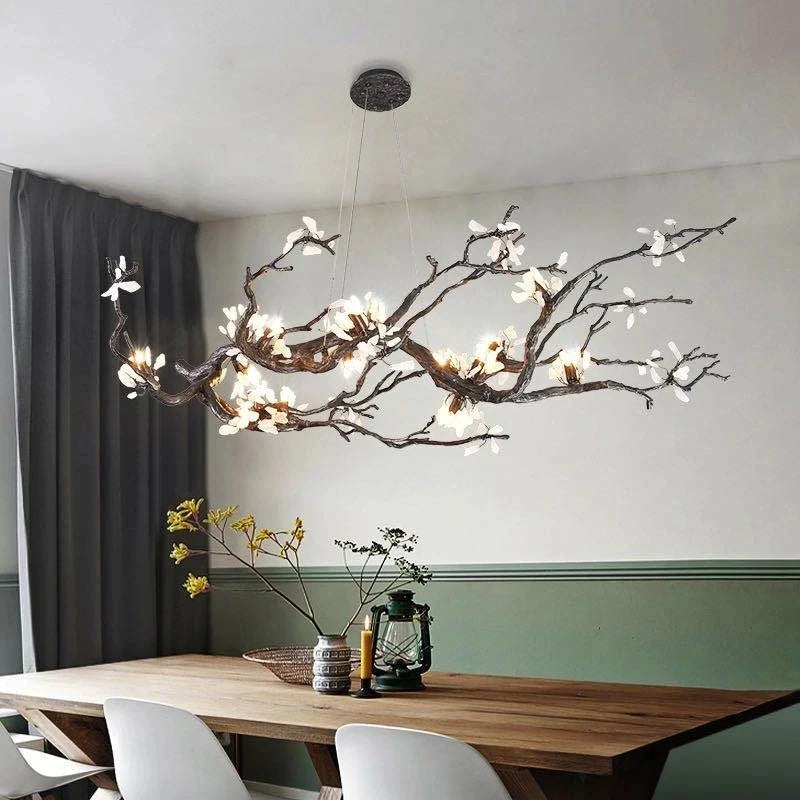
The Alba is the luxury pick of the category. Copper-finished framework with stone “blossom” light points that reference floral forms rather than utilitarian bulbs. Roughly 3 ft (91 cm) long and 2 ft (61 cm) wide. Each piece is hand-finished with selectable warm-to-cool color temperature and smart-home compatibility. The copper-and-stone combination reads expensive without the fragility of crystal — suited to modern luxury interiors that already mix metallic finishes throughout.
Modern Tree Branch Ceiling Light Fixture
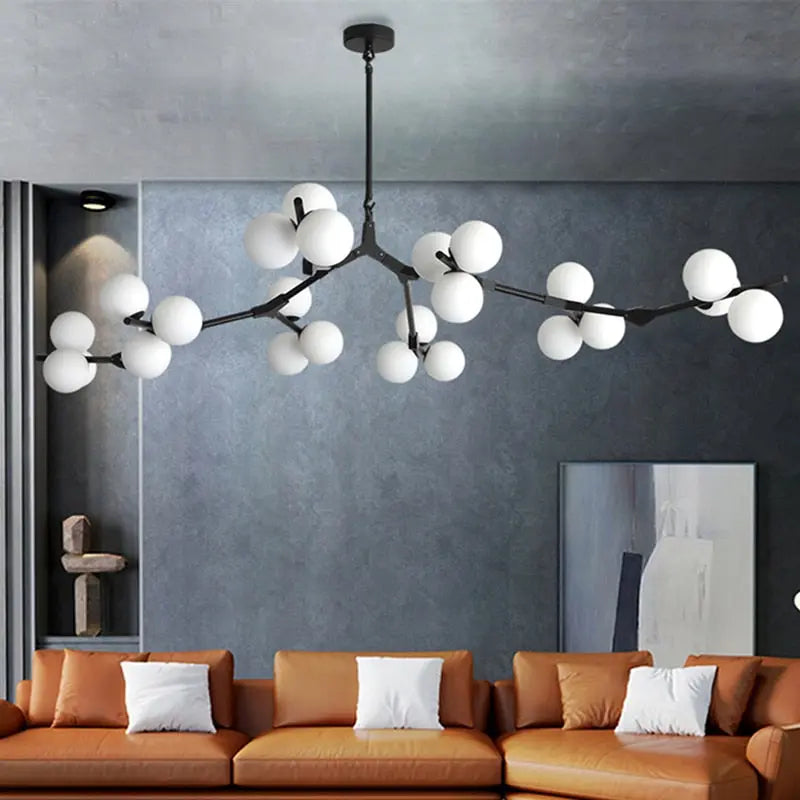
The Modern Tree Branch Ceiling Light Fixture takes the branch silhouette into pure modern territory. 5.5 ft (168 cm) long, available in gold or black finish, with remote-controlled dimming and integrated LED. The cleaner profile reads contemporary rather than rustic — suited to modern interiors where the branch reference should be subtle rather than dominant. The black variant specifically answers the black modern tree branch chandelier search query.
Reading the Black Finish in Branch Chandeliers
Black is the dominant finish for branch chandeliers — about 70% of the category ships in matte black, satin black, or oil-rubbed bronze that reads as black under most light conditions. The black tree branch chandelier search reflects how strongly this finish dominates buyer expectations.
Three reasons black works particularly well for branch chandeliers:
- Silhouette emphasis. Black against a white ceiling reads as pure silhouette — the asymmetric branch form is the entire visual statement. Lighter finishes blur into the ceiling and weaken the effect.
- Pairs with most palettes. Black is functionally neutral and doesn't compete with wall colors, furniture, or accent metals. Gold or copper branches require palette coordination; black doesn't.
- References real branches. Tree bark in winter reads as nearly black against snow or sky. Black branch chandeliers tap into that visual memory.
If you want black specifically: the Minas (#1) ships in matte black; the Modern Tree Branch (#3) is available in black; the Sputnik Branch Firefly (#5) ships in black framework with gold accents. The Bessa (#4) is gold-only.
When Crystal Joins the Branch: The Bessa Approach
Crystal-on-branch is a niche sub-category — most buyers picture either a clean branch or a traditional crystal chandelier, not the fusion. But for formal dining rooms and grand entryways where the design palette already mixes metallic and crystal finishes, the combination reads as intentional luxury rather than visual conflict.
Bessa Modern Large Gold Crystal Branch Chandelier
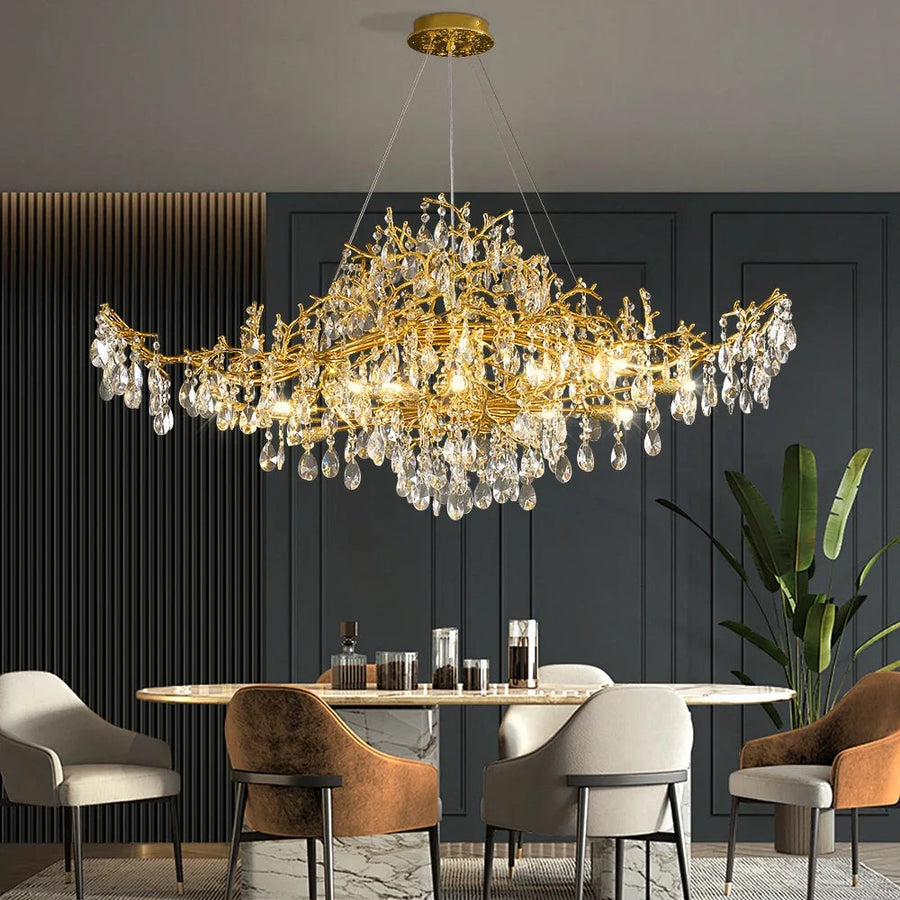
The Bessa uses gold-finished branches as the framework, with crystal accents at the branch tips and along secondary nodes. 4.5 ft (137 cm) long with selectable color temperature and adjustable hanging height. The crystal-on-branch combination works especially well in formal dining rooms because the dining-table viewing distance lets the eye separate the branch architecture from the crystal sparkle — in close-up viewing they can read as visually busy. Browse our crystal chandeliers collection for additional crystal options.
Sculptural Branch Fixtures: Beyond Recognition Into Statement
The buyers searching for tree branches on ceiling (currently ranking position 1.0 for the term) and branch ceiling lamp (position 1.29) are usually past the recognition phase of branch chandelier shopping. They want the branch reference taken further — into pure sculpture, into fixtures that define the design direction of the room rather than blend in.
Sputnik Branch Firefly Chandelier
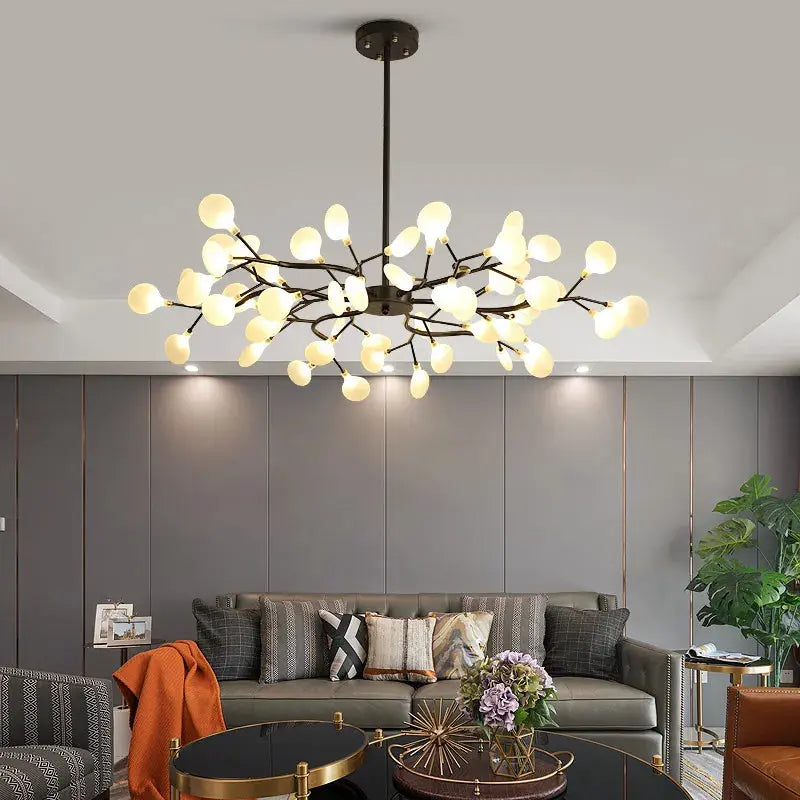
The Sputnik Branch Firefly sits at the intersection of two design traditions — the sculptural sputnik with radial light points, and the asymmetric branch with organic spread. 45 or 54 individual light tips arranged across a branching framework, sized 2.5–3.5 ft (76–107 cm) wide. Adjustable arms allow customization of the spread shape. Gold-and-black finish reads contemporary and substantial. For more sputnik-format options, see our complete sputnik chandelier guide.
Branching Bubble Chandelier
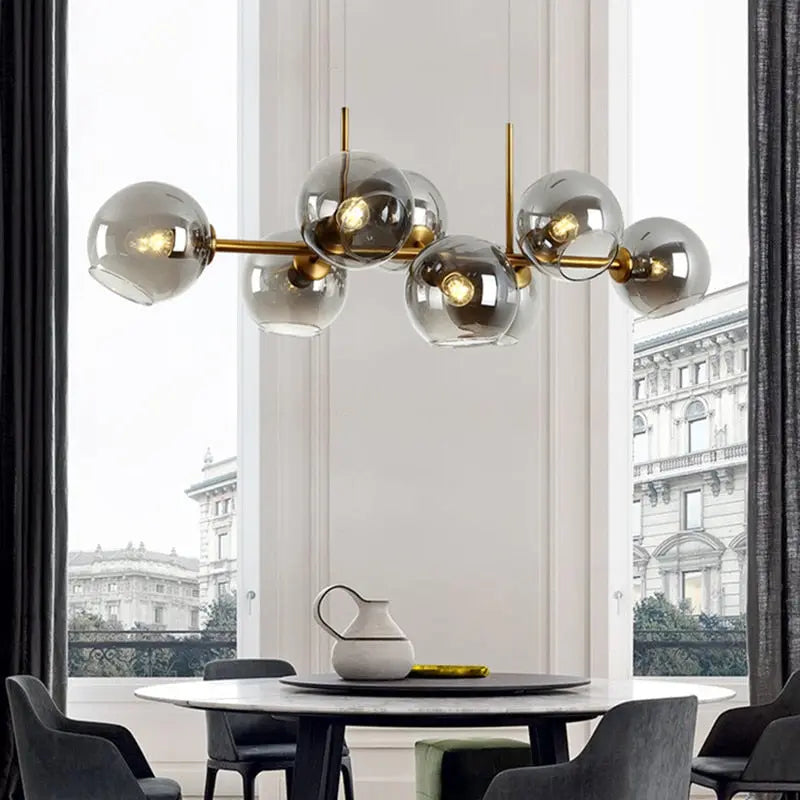
The Branching Bubble fuses branching architecture with bubble-cluster aesthetics — glass bubbles arranged across an asymmetric branching framework. 33" or 44" (84 or 112 cm) diameters with 45 or 54 individual lights. The high light output and soft diffusion through the glass bubbles makes it practical for larger rooms that lack natural light. Browse our bubble chandeliers collection for additional bubble formats.
Modern Spiral Chandelier
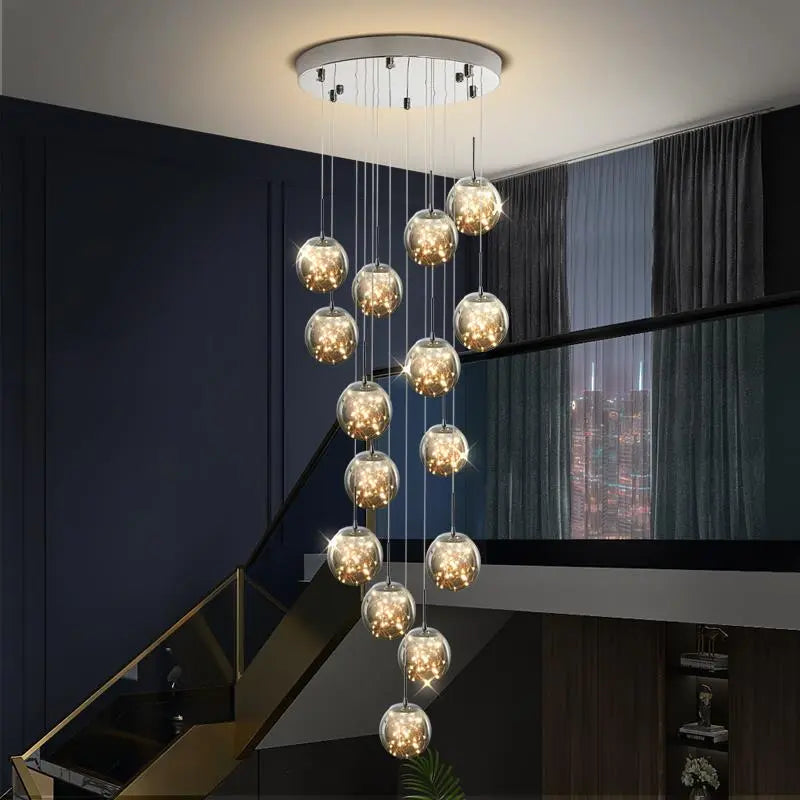
The Modern Spiral takes the organic-form approach into pure vertical territory — a spiral framework that creates upward visual movement, particularly strong in two-story foyers and staircase voids. Available in multiple finishes with glass or crystal orb options. For more staircase-specific options, see our staircase chandelier collection.
Pendant, Ceiling Light, or Chandelier — Which Term Fits
The terminology around branch fixtures gets confused. Buyers search for tree branch pendant light, tree branch ceiling light, branch ceiling lamp, and tree branch chandelier almost interchangeably — but in the lighting industry these terms describe different fixture types:
- Branch chandelier: Multi-light fixture suspended from the ceiling on a chain, rod, or cable. Most fixtures in this guide are technically chandeliers.
- Branch pendant light: Single-source fixture suspended from the ceiling, typically smaller than a chandelier. The Susi (#8 below) and similar fixtures fall here.
- Branch ceiling light: Flush-mount or semi-flush fixture mounted directly to the ceiling without significant drop. Less common in branch designs because the asymmetric form needs vertical space to read.
- Branch ceiling lamp: Generic term sometimes used regionally for any ceiling-mounted branch fixture. Often a translation artifact.
For practical purposes, when you're shopping for a hanging branch fixture above a dining table, foyer, or living room, you want a chandelier (most picks above) or a large pendant (the Susi below). Avoid flush-mount “branch ceiling lights” for primary branch installations — the form needs vertical drop to read correctly.
Susi Modern Linear Pendant Lamp
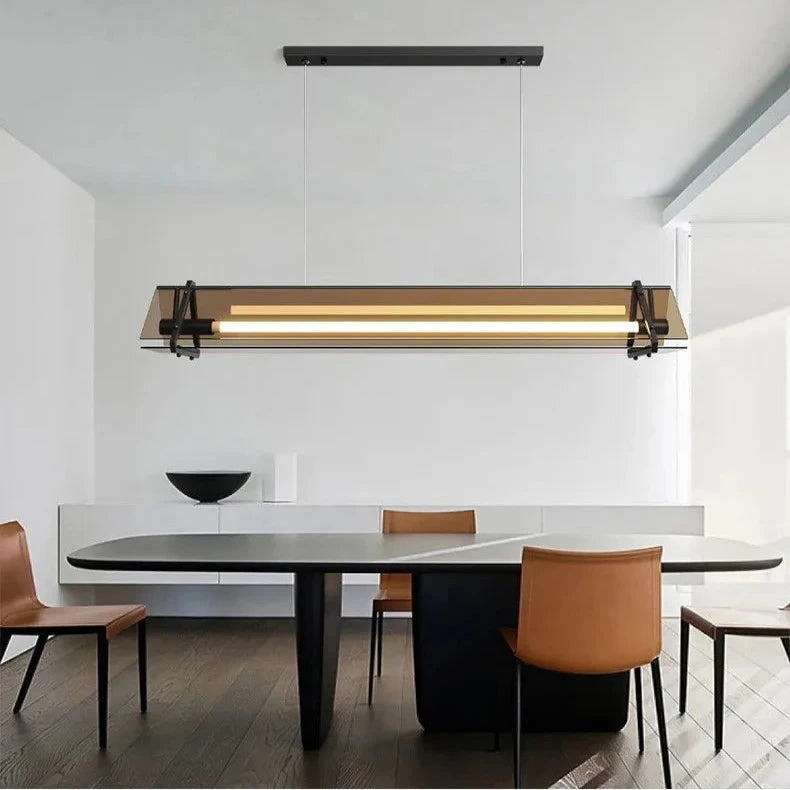
The Susi isn't a branch chandelier — it's the modern complement pick. In open-plan layouts where you want a branch chandelier in the living area but a cleaner fixture over the dining table or kitchen island, the Susi's minimalist linear form provides the visual contrast. Available in 39" (100 cm) and 51" (130 cm) sizes with frosted glass diffuser. Pair the Susi over the dining table with the Minas (#1) or Sputnik Branch Firefly (#5) in the living area for layered visual interest across an open plan.
Lampu Pohon vs Lampu Cabang — Indonesian Terminology Notes
For Indonesian and Southeast Asian readers searching for lampu pohon, lampu cabang, or lampu gantung kayu, the terminology distinction matters because the phrases describe different fixture categories that English search collapses together.
- Lampu pohon (literally “tree lamp”): A free-standing fixture shaped like a small tree, typically floor-mounted or table-mounted rather than ceiling-mounted. Closer to a sculptural floor lamp than a chandelier. Popular in Bali and Java for outdoor garden lighting.
- Lampu cabang (“branch lamp”): A ceiling-mounted fixture with branching arms, equivalent to what English speakers call a branch chandelier. The picks in this guide map to this category.
- Lampu gantung kayu (“wood hanging lamp”): A pendant or chandelier specifically using wood material. Less common in modern manufacturing because metal fixtures with wood-finish treatments deliver the visual effect with better stability.
- Lampu hias pohon (“decorative tree lamp”): Often refers to seasonal decorative tree lighting (Christmas trees, holiday displays) rather than permanent branch chandeliers.
If you're searching for a hanging ceiling fixture with branching arms, this guide covers the strongest options. If you're looking for a free-standing tree-shaped floor lamp, our table lamps collection covers floor and table options. International orders ship free worldwide; contact us via the contact page for shipping timelines to specific Indonesian regions.
When DIY Branch Chandeliers Make Sense (And When They Don't)
The diy tree branch chandelier search lands at position 2.18 in our GSC data — meaning Google sees this guide as a relevant resource for DIY-curious buyers, even though the picks above are commercial fixtures. That match is appropriate, because the realistic answer to “should I DIY a branch chandelier?” is conditional rather than absolute.
DIY makes sense when:
- You want a fixture under 25 lbs (11 kg) total weight, which is well below the 50 lb (23 kg) ceiling junction box rating.
- You're using fire-rated lighting components (UL/CE-certified bulbs, sockets, and wiring) throughout.
- You're treating real wood with fire-retardant coating before installation.
- You're hiring a licensed electrician to handle the actual wiring and ceiling mount.
- You want a specific aesthetic (driftwood, found-branch, vintage industrial) that no commercial fixture replicates.
DIY usually fails when:
- Real wood near light bulbs. Even LED bulbs run warm; wood near sustained heat eventually dries, cracks, and accumulates dust that becomes a fire hazard. Treated wood is safer but reads as plastic-coated rather than authentic.
- Light placement at wrong points. The visual effect of a branch chandelier depends on lights at branch tips, not midpoints. DIY versions almost always cluster lights wherever wiring is easiest, which breaks the firefly or starburst effect entirely.
- Excess weight. Real branches are heavier than they look. A 5 ft (152 cm) branch chandelier using actual wood can exceed 30 lbs (14 kg) before adding sockets and wiring. Standard ceiling boxes don't support that without reinforcement.
- Ceiling box rating mismatches. Most residential ceiling junction boxes are rated 50 lbs (23 kg) maximum, but only when fixture weight is properly distributed. A horizontally asymmetric DIY branch can leverage that rating with rotational forces standard boxes weren't designed for.
For most buyers, the metal-framed commercial fixtures above deliver the visual effect of a branch chandelier without the structural and safety trade-offs. For buyers committed to DIY: keep total weight under 25 lbs (11 kg), use UL/CE-rated electrical components throughout, hire an electrician for the install, and place lights at branch tips rather than midpoints.
Branch Lighting Ideas at a Glance: The 8 Picks Compared
| Pick | Style read | Spread / size | Best fit |
|---|---|---|---|
| Minas Rustic | Black rustic branch | 4–6.5 ft | Farmhouse, transitional |
| Alba | Copper modern luxury | 3 ft | Modern luxury |
| Modern Tree Branch | Modern minimalist gold/black | 5.5 ft | Modern living rooms |
| Bessa | Gold crystal-on-branch | 4.5 ft | Formal dining |
| Sputnik Branch Firefly | Sculptural sputnik | 2.5–3.5 ft | Statement dining |
| Branching Bubble | Bubble-on-branch | 2.75–3.7 ft | Open-plan large |
| Modern Spiral | Vertical spiral | Vertical drop | Two-story foyer |
| Susi (complement) | Linear modern | 39–51" | Open-plan dining |
Common Questions Branch Chandelier Buyers Ask
What's a chandelier that looks like tree branches called?
Branch chandelier or tree branch chandelier — both terms describe ceiling fixtures with branching frameworks and light points at or near the branch tips. Sputnik branch fixtures combine the branching architecture with sputnik-style radial light points; branching bubble fixtures combine branches with glass bubble clusters.
What's the difference between a branch chandelier and a branch ceiling lamp?
“Branch ceiling lamp” is a generic term sometimes used regionally for any ceiling-mounted branch fixture. Strictly, branch chandeliers hang on a chain or rod with significant drop; branch ceiling lights are flush-mount or semi-flush with minimal drop. Branch designs read better as chandeliers because the asymmetric form needs vertical space.
Are wooden branch chandeliers safe?
Real wood branch chandeliers carry fire risk because wood near sustained heat (even from LED bulbs) eventually dries and accumulates dust. Most commercial “wood” branch chandeliers actually use metal frames with wood-finish treatments that deliver the visual effect without the safety concerns. Treated authentic wood fixtures exist but require fire-retardant coating and are typically high-end artisan pieces.
How wide should a tree branch chandelier be?
Branch spread should be roughly 25–40% of the longer room dimension. A 14 by 16 ft (4.3 by 4.9 m) room calls for a 4–5.5 ft (122–168 cm) branch spread. For dining-table installations, the spread can be wider — up to 75% of table length is acceptable.
How high should a tree branch chandelier hang?
Bottom of the lowest branch tip 7 ft (213 cm) minimum from the floor in walking spaces. Above dining tables, 30–36" (76–91 cm) from the table top. In two-story foyers, 8 ft+ (244 cm+) from the floor with the bottom roughly aligned with the second-floor ceiling line.
Can I put a branch chandelier in a kitchen?
Yes — over kitchen islands and dining areas adjacent to kitchens. For direct cooking-zone installation, choose powder-coated metal finishes that resist grease accumulation. The Modern Tree Branch Ceiling Light Fixture and Branching Bubble are practical kitchen choices. Avoid open-textured rustic fixtures (like the Minas) directly over cooking zones because grease accumulates in the texture.
What's the largest tree branch chandelier available?
The Minas Rustic (#1) reaches 6.5 ft (198 cm) at its largest size; the Modern Tree Branch (#3) reaches 5.5 ft (168 cm). For applications requiring more vertical mass — including two-story foyers and staircase voids — the Modern Spiral (#7) extends vertically rather than spreading horizontally.
Should I get a black tree branch chandelier or gold?
Black for most homes — functionally neutral, reads as pure silhouette, and pairs with most palettes. Gold or copper for warm-palette luxury homes that already mix metallic finishes throughout. Avoid mixing finishes (black framework with gold accents reads conflicted unless deliberately designed that way, like the Sputnik Branch Firefly).
Are branch chandeliers still in style in 2026?
Yes. Branch chandeliers have moved from rustic specialty fixtures into mainstream design over the last decade, driven by biophilic design trends emphasizing natural forms in built environments. The category continues to grow, particularly in luxury and modern-transitional segments.
What color temperature works best for branch chandeliers?
2700–3000K. The warm-to-neutral range complements the organic forms and reads as residential rather than commercial. Avoid 4000K and higher in branch chandeliers; cool light undermines the warm biophilic atmosphere they create.
Should branch chandeliers be on a dimmer?
Yes. Branch chandeliers benefit especially from dimming because the visual effect of light points at branch tips changes character at different brightness levels — full brightness reads as starburst, dim reads as firefly cluster. Match the dimmer type (TRIAC, ELV, or 0–10V) to the LED driver listed on the product specifications.
Do branch chandeliers work in small rooms?
Yes, with size matching. Smaller rooms (under 12 by 12 ft / 3.7 by 3.7 m) work best with branch chandeliers in the 2.5–3 ft (76–91 cm) spread range — the Sputnik Branch Firefly at its smaller size (#5) fits this range. Avoid 5 ft+ (152 cm+) fixtures in small rooms; the asymmetric spread overwhelms the available ceiling area.
Where to Go From Here
Most buyers arrive at this guide having seen a branch chandelier somewhere and trying to find the equivalent. The shortcut path: if your home is rustic or transitional, the Minas (#1) is the strongest pure-rustic pick; if you're working with modern luxury palettes, the Alba (#2) delivers copper-and-stone luxury without crystal fragility; if you want sculptural statement, the Sputnik Branch Firefly (#5) sits at the strongest intersection of branch geometry and sputnik radial light.


