

A large pendant light carries a room's or a surface's light from a single point — one big globe over a round table, a sculptural shape in an entry, a cluster over a living room, a cascade in a stairwell. It reads calmer than a row of small pendants and lighter than a chandelier of the same width. This guide covers what counts as large, when one large pendant beats several small ones, how to size it over islands, tables, entries, living rooms, and beds, the main large forms, and the light and mounting checks to make before buying.
Key Takeaways
| Question | Answer |
|---|---|
| What counts as large? | About 18 in+; extra large 24 in+; oversized 30 in+ or a long drop. |
| One or several? | One over round tables, short islands, entries, beds; two or a linear over long surfaces. |
| Island size? | Single pendant ⅓–½ of island width; pairs ~¼ each, ~30 in apart. |
| Table size? | ½–⅔ of the table's width for a single round pendant. |
| 8 ft ceiling? | Fine over a surface; in a walkway keep the fixture under ~12 in tall. |
| Mounting? | Over 50 lb needs a brace or structural mount. |
Quick Facts
- Large 18–24 in · extra large 24–30 in · oversized 30 in+.
- Single pendant over island ≤ 6 ft; two or linear for 7–10 ft islands.
- Height: 30–36 in above surfaces; 7 ft in walkways; second-floor line in two-story spaces.
- Open/glass forms can run larger; solid drums smaller.
- Light: 2700K over tables, 3000K over islands, dimmable; frosted bulbs at eye level.
- Standard ceiling box: 50 lb.
What Counts as a Large Pendant?
"Large" is relative to the surface or room the pendant serves, but the categories are useful when browsing: from about 18 inches in diameter or length a pendant reads as large, from about 24 inches as extra large, and from about 30 inches — or with a drop long enough to fill a double-height void — as oversized. A large pendant is the single-point alternative to a chandelier: one shape, one canopy, carrying a room's or a surface's light. It reads calmer and more sculptural than a row of small pendants, and lighter than a chandelier of the same width.
One Large Pendant or Several Small Ones?
| Situation | One large pendant | Two or three smaller / linear |
|---|---|---|
| Round or square table | Yes — centered, ½–⅔ of table width | Rarely |
| Rectangular table ≤ 72 in | Possible in a near-square room | Often better |
| Rectangular table > 72 in | No — lights only the middle | Yes — two large or one linear |
| Island ≤ 6 ft | Yes | Two small also works |
| Island 7–10 ft | No | Two or three, or one linear |
| Entry / foyer | Yes | Only in long gallery halls |
| Living room seating group | Yes | No |
| Over a bed | Yes, shallow form | Pair of bedside pendants instead |
A single large pendant suits any surface or space that is round, square, or compact. Once the surface is long — a rectangular table over about 72 inches or an island over about 6 feet — split the light into two large pendants or switch to a linear fixture so both ends are lit. The island pendant spacing rules cover multi-pendant layouts, and the multi-light pendant guide covers cluster pendants on one canopy.
Sizing a Large Pendant by Surface and Room
| Where | Size rule | Example | Height |
|---|---|---|---|
| Kitchen island ≤ 6 ft (single) | ⅓–½ of island width; 6 in in from the ends | 14–20 in for a 40 in island | 30–36 in above counter |
| Kitchen island (pair) | Each ~¼ of island width, ~30 in apart | 10–14 in each | 30–36 in above counter |
| Round dining table | ½–⅔ of table width | 24–32 in over a 48 in table | 30–36 in above the top |
| Entry / foyer | Entry L + W (ft) = in | 18 in for an 8×10 ft entry | 7 ft clearance |
| Living room | Room L + W (ft) = in | 30 in for a 14×16 ft room | 7 ft clearance; centered on seating |
| Over a bed | About ⅓ of the bed width, shallow | 18–24 in over a queen | Over the foot of the bed; 7 ft clear |
| Tall room / two-story | L + W plus 2–3 in per ft over 8 ft | 36 in+ or a long drop | Bottom at the second-floor line |
Two adjustments. Visual weight: an open or glass pendant can run to the top of each range; a solid drum or dense metal shade belongs at the bottom. And shape: on an 8-foot ceiling in a walkway, choose a wide, shallow form — the whole fixture plus canopy within about 12 inches — rather than a tall globe.
Large Pendant Forms
Large globes and spheres

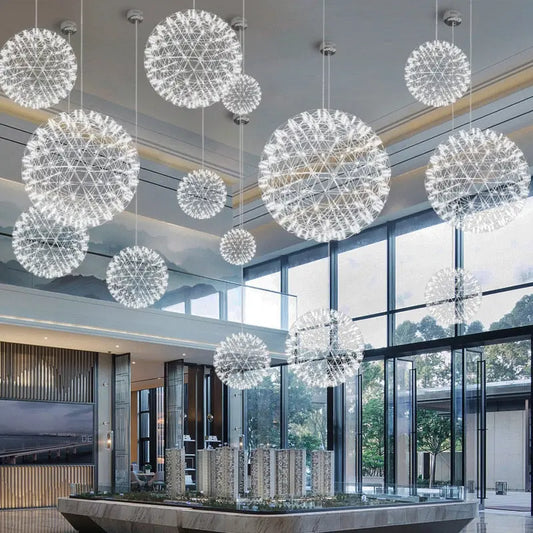
A single large sphere is the cleanest large pendant: over a round table, a short island, or in an entry, it reads as one calm shape. The Moon Bubble Pendant is the soft version — frosted glass that glows without glare, suited to neutral and Scandinavian rooms; the Spark Ball Stainless Steel Pendant is the sharp version, a reflective sphere that reads as sculpture against dark cabinets or a black door.
Large flower and organic forms

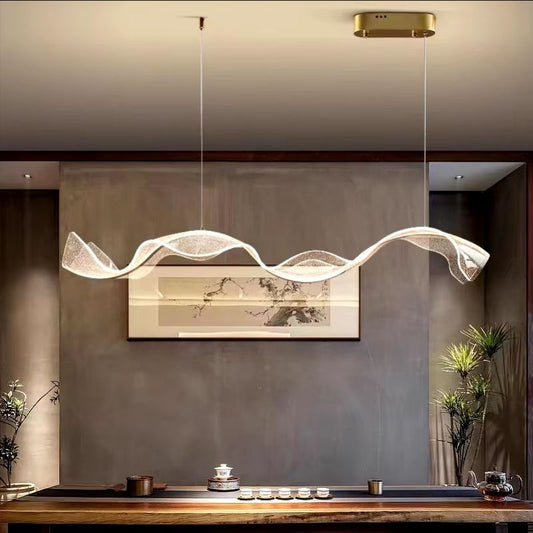
Organic shapes — petals, leaves, waves — make a large pendant read as decor even with the light off. The Eryx Flower Pendant Light brings a sculptural flower head to an island or bedside; the Modern Ocean Wave Pendant Chandelier stretches into a large wave over a long island or table, where it doubles as the linear option.
Large cluster pendants

Many globes on one canopy give a large pendant the presence of a chandelier. The Pearl Black Glass Grape Pendant gathers black glass spheres into a dense cluster for a formal living room, dining room, or lobby where the fixture is the room's feature.
Large multi-ring and cascade pendants
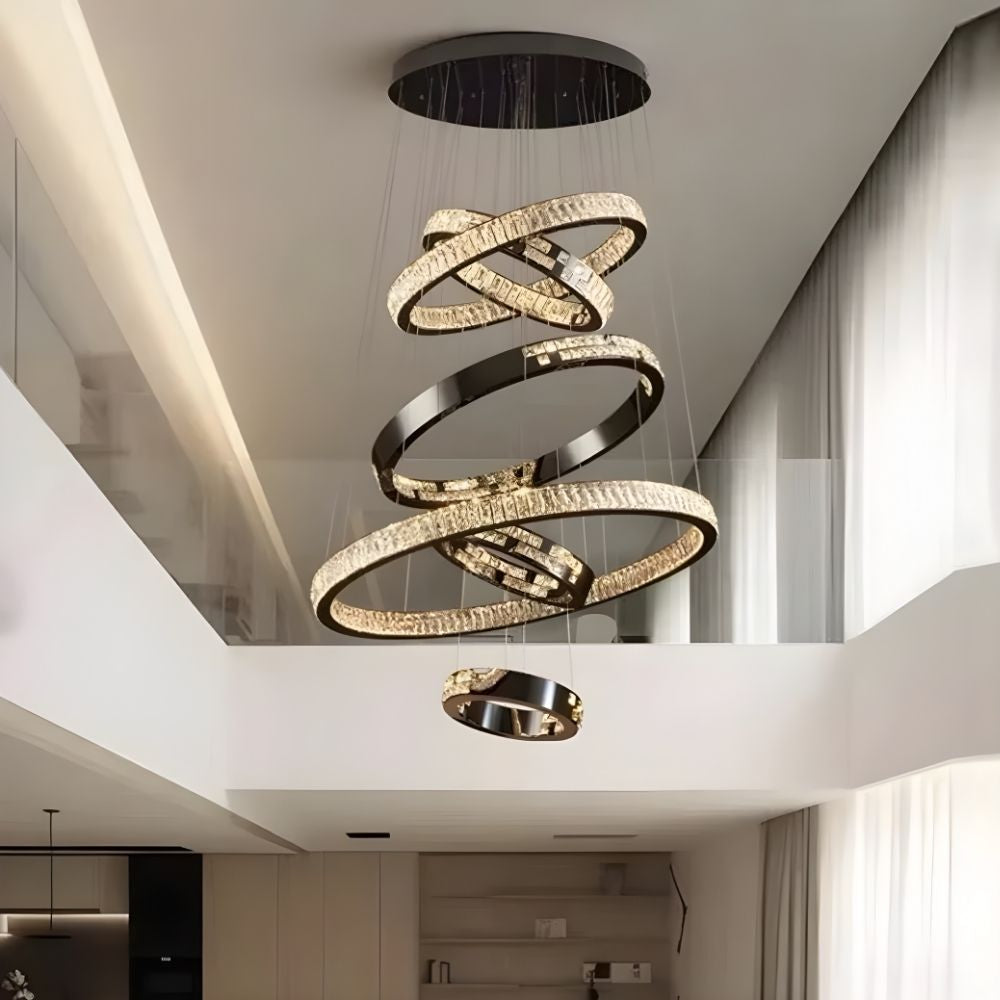

For high ceilings and stairwells the large pendant goes vertical. The Malen Multi Ring Pendant Light stacks remote-dimmable rings at different heights; the Cleo Bubble Staircase Chandelier cascades globes down a full-story drop. The high ceiling pendant lights guide goes deeper on tall spaces, and the ring chandelier guide covers ring forms.
Light, Mounting, and Practical Checks
- Lumens: a single large pendant over an island or table should carry most of the surface light — aim for 30–40 lm/sq ft over dining tables and work zones; add lamps or sconces for the rest of the room.
- Glare: clear globes show the bulb — use frosted or filament LEDs where the pendant hangs at seated eye level.
- Color: 2700K over dining tables and in living rooms, 3000K over islands; dimmable.
- Weight: large glass and cluster pendants can exceed the 50 lb box rating — use a brace or structural mount.
- Drop: check the adjustable cord or cable range against the height you need.
- Sightlines: over an island, keep the bottom high enough that people standing on the far side can see each other.
For bulbs and dimming, see the dimmable chandeliers guide; for installation, the pendant installation guide.
Quick decision: which large pendant
Round table or short island: one large globe (Moon or Spark Ball) • Long island or table: Ocean Wave linear, or two large globes • Bedside or island accent: Eryx flower • Formal living or dining feature: Pearl black glass cluster • High ceiling or stairwell: Malen rings or Cleo cascade • 8 ft walkway: wide, shallow form under 12 in tall.
Globes, sculptural shapes, clusters, rings, and cascades.
Pendant Lighting Kitchen Dining Room Oversized
Frequently Asked Questions
What size counts as a large pendant light?
A pendant is usually called large from about 18 inches in diameter or length, extra large from about 24 inches, and oversized from about 30 inches — or any pendant whose drop is long enough to fill a double-height space. In practice 'large' is relative to where it hangs: a 16-inch globe is large over a bistro table and small in a two-story foyer, so size from the surface or room, not a label.
When should I use one large pendant instead of several small ones?
Use one large pendant over a round or square table, in an entry, centered over a living-room seating group, over a bed, and over a short island (under about 6 feet). Use two or three smaller pendants, or one linear fixture, over a long island or rectangular table, where a single large shape lights only the middle. One large pendant reads calmer and more sculptural; a row reads more functional and spreads light evenly.
How big should a large pendant be over a kitchen island?
For a single pendant over an island up to about 6 feet, choose roughly one-third to one-half of the island's width — 14 to 20 inches for a 40-inch-wide island — and keep it at least 6 inches in from each end. For longer islands, two large pendants at about one-quarter of the island's width each, 30 inches apart, or one linear fixture at two-thirds of the length. Hang 30 to 36 inches above the counter.
How big should a large pendant be over a dining table?
One-half to two-thirds of the table's width for a single round or globe pendant — 21 to 28 inches over a 42-inch round table, 24 to 32 inches over a 48-inch one — hung 30 to 36 inches above the top on an 8-foot ceiling. Over a rectangular table longer than about 72 inches, use two large pendants or a linear fixture instead of one.
Can I use a large pendant with an 8-foot ceiling?
Yes, if it hangs over a table, island, or bed, where it can sit lower than walkway height; there the drop is set by the surface, not the floor. In a walkway on an 8-foot ceiling, the pendant plus canopy must fit within about 12 inches to keep 7 feet of clearance, so choose a wide, shallow shape — a flat drum or shallow dome — rather than a tall globe.
How high should a large pendant hang?
30 to 36 inches above a table or counter on an 8-foot ceiling, about 3 inches higher per extra foot; 7 feet above the floor in walkways and entries; and in a two-story space, with the bottom at or slightly above the second-floor line. A large pendant reads heavier than a small one, so it often looks best at the upper end of each range.
Do large pendant lights need special mounting?
Often. Large glass, metal, and cluster pendants can exceed the 50-pound rating of a standard ceiling box; check the fixture weight and use a fan-rated brace or a structural mount above that. Even lighter large pendants should hang from a box securely fixed to framing, with the cord, cable, or rod — not the canopy — carrying the load.
Which large pendant suits a high ceiling?
A form with vertical presence: a multi-ring pendant, a cascade of globes, or a large cluster, sized to the room's length plus width in inches plus 2 to 3 inches per foot of ceiling above 8 feet. For high-ceiling ideas in depth, see the high ceiling pendant lights guide; for two-story entries, the grand foyer and staircase guide.
One Shape, Scaled Right
A large pendant succeeds when it is sized to what it serves — the table, the island, the entry, the room — and hung so it reads from every seat without blocking a view. Choose the form for the room's style, check weight and light, and one big shape can do the work of a row of small ones.
Browse pendant lighting for globes and sculptural forms, and oversized chandeliers when the room needs more than a pendant. For entries specifically, see foyer pendant lights.


