

Key Takeaways
| Question | Answer |
|---|---|
| What is it? | Several pendants on separate cords from one canopy, wired to one ceiling box, heights set at installation. |
| Four layouts? | Round cluster, linear row, staggered cascade, spread canopy. |
| Cluster or chandelier? | Cluster: adjustable, sculptural, follows the surface. Chandelier: fixed outline, more even light, simpler install. |
| How many heads? | 3–5 small table; 5–8 dining table or island; 9–15 large room or foyer; 15–30 stairwell. |
| How to size? | Spread of heads = ½–¾ of table length or 60–70% of island; lowest head 30–36 in above the table. |
| Light? | 2700–3000K (3000–3500K over an island), CRI 90+, opal glass where heads sit near eye level. |
Quick Facts
- Canopy: round 12–24 in or linear 30–60 in; the spread of the heads, not the canopy, is what you size.
- Cord length as shipped: 6–16 ft on most models; cut to length on site, longest first.
- Stagger between heads: 4–8 in over a table, 12–24 in in a stairwell cascade.
- Clearance: lowest head 30–36 in above a tabletop, 28–34 in above an island, 7 ft over any walkway or stair tread.
- Output: plan 300–400 lumens per LED head; 8 heads ≈ 2,400–3,200 lumens, enough for a 100–130 sq ft dining area.
- Weight: 3–8 heads ~8–20 lb; 10–30 heads 20–60 lb — check the box rating above 50 lb.
What a Multi-Light Pendant Is
The definition is mechanical. A chandelier carries its lights on a rigid frame — arms, a ring, tiers — and hangs that frame from one stem, so its shape is fixed. A multi-light pendant carries its lights on separate flexible cords or cables from a single canopy, so the heads hang independently, at whatever lengths the installer sets, in whatever footprint the canopy allows. The fixture is wired like a chandelier, from one ceiling box, but reads like a group of pendants.
That difference is what the type is for. Three or more separate pendants need three or more ceiling boxes, or a track; a multi-light pendant gives the same effect from one. It also gives a composition a rigid frame cannot: heads at different heights that follow a table's length, a stairwell's drop, or a room's furniture, adjusted on site rather than at the factory. The trade-off is that the composition is set once — cords are cut to length at installation — and that a loose cluster spreads light less evenly than a frame with the same number of lights. For the single pendant against the chandelier, the chandelier vs pendant light guide is the reference; this article covers the cluster.
The Four Multi-Light Pendant Layouts
Round cluster
Three to nine heads on a round canopy of 12 to 24 inches, hung at slightly different lengths so the cluster reads as a loose sphere. It sits over a round or square table, in a breakfast nook, or in the center of a living room, and sizes to half to two-thirds of a round table's diameter. This is the layout closest to a chandelier and the easiest to install.
Linear row
Five to eight heads along a linear canopy 30 to 60 inches long, at alternating heights. It follows a rectangular dining table or a kitchen island from one ceiling box — the island problem that separate pendants cannot solve without extra wiring — and sizes to half to three-quarters of the table length or 60 to 70 percent of the island length. Over an island the heads want downward-throwing shades and 3000–3500K; the island pendant spacing rules apply to head spacing along the row.
Staggered cascade
Ten to thirty heads on cords stepped 12 to 24 inches apart, so the cluster falls vertically through a stairwell or two-story foyer. It is the layout that made the type popular in tall entries: the heads read from the landing and the floor, the cords are cut so the lowest head clears 7 feet over the treads, and the composition follows the stair's slope. The stairwell pendant size guide covers drop and clearance for this layout.
Spread canopy
Six to fifteen heads on a wide canopy — 30 to 50 inches, round or rectangular — hung at similar heights to cover a large open floor rather than one surface. It replaces a large chandelier in a great room or lobby where a fixed frame would read heavy, and gives more even coverage than a tight cluster because the heads are dispersed.
Multi-Light Pendant or Single Chandelier?
| Multi-light pendant | Single chandelier | |
|---|---|---|
| Structure | Separate cords from one canopy; heights set on site | Rigid frame on one stem; shape fixed |
| Composition | Sculptural, follows table, island, or stair | Defined outline, symmetrical |
| Light spread | Less even in tight clusters; good in spread layouts | Even, predictable |
| Ceiling height | Works from 8 ft (short cords) to 30 ft (cascade) | Fixed drop per model |
| Installation | Plan layout, cut each cord; more time | Hang and level; less time |
| Re-arranging later | Cords are cut — not easily changed | Chain or rod can be shortened |
| Cleaning | Each head separately; more surfaces | One frame |
| Best for | One box under a long island, tall stairwells, loose modern rooms | Formal dining, traditional rooms, even light |
The choice usually settles on two questions. Does the surface below need to be followed — a long island, a rectangular table, a stair — with one box above it? Then a multi-light pendant does what a chandelier cannot. Is the room formal or traditional, or does it need the most even light from one fixture? Then a chandelier's fixed frame does the job with less installation. Where the two fixtures share a house, the matching chandeliers and pendants guide covers how to coordinate them.
Sizing: Heads, Spread, and Drop
Three measurements replace the single diameter used for a chandelier. Head count sets both the fixture's presence and its output: three to five heads for a small round table or bedside, five to eight for a dining table or island, nine to fifteen for a large room or standard-ceiling foyer, fifteen to thirty for a stairwell. Spread — the footprint the heads cover once hung — is what you size to the surface: half to three-quarters of a rectangular table's length, half to two-thirds of a round table's width, 60 to 70 percent of an island's length, and the room's length plus width in inches over open floor. The canopy is smaller than the spread and does not need to match the table.
Drop is set head by head. The lowest head lands 30 to 36 inches above a dining table or 28 to 34 above an island counter, and the rest stagger 4 to 8 inches above it so no head blocks a sightline across the table; in a walkway or over a stair the lowest head keeps 7 feet of clearance and the cascade steps 12 to 24 inches. Output follows head count: plan 300 to 400 lumens per LED head, so an eight-head fixture delivers 2,400 to 3,200 lumens, enough for a dining area of 100 to 130 square feet at 20 to 30 lumens per square foot. The room lumens guide has the room-by-room targets.
Quick decision: which multi-light pendant
Round table or living room center: round cluster, 5–9 heads, ½–⅔ of table width • Rectangular table: linear row, 5–8 heads, ½–¾ of table length • Island with one center box: linear row, 60–70% of island length, 28–34 in above counter • Stairwell or two-story foyer: staggered cascade, 10–30 heads, 7 ft clearance over treads • Great room: spread canopy, 6–15 heads • Heads near eye level: opal or frosted glass, 2700–3000K, dimmer.
Glass, Shade, and Finish
Because the heads hang at different heights, some are close to eye level and the shade material matters more than on a chandelier overhead. Opal and frosted globes diffuse the LED and are the default over a dining table and in a bedroom. Clear glass shows the bulb and reads brighter; it belongs in a stairwell or foyer where the heads are above the eye line, and it pairs with a decorative filament bulb. Crystal drops on a multi-light canopy give a transitional or formal room sparkle without a traditional frame. Wood, metal, or ceramic shades throw light downward and are the island choice, where task light on the counter matters more than glow. Finish follows the room's hardware as with any fixture — black, brass, or chrome repeated once elsewhere — and the cords should match the canopy so the composition reads as one piece. Bubble-glass clusters have their own guide in bubble, globe and frosted styles guide.
Multi-Light Pendants by Layout
Six fixtures across round cluster, linear, cascade, and spread layouts.
Round and linear clusters
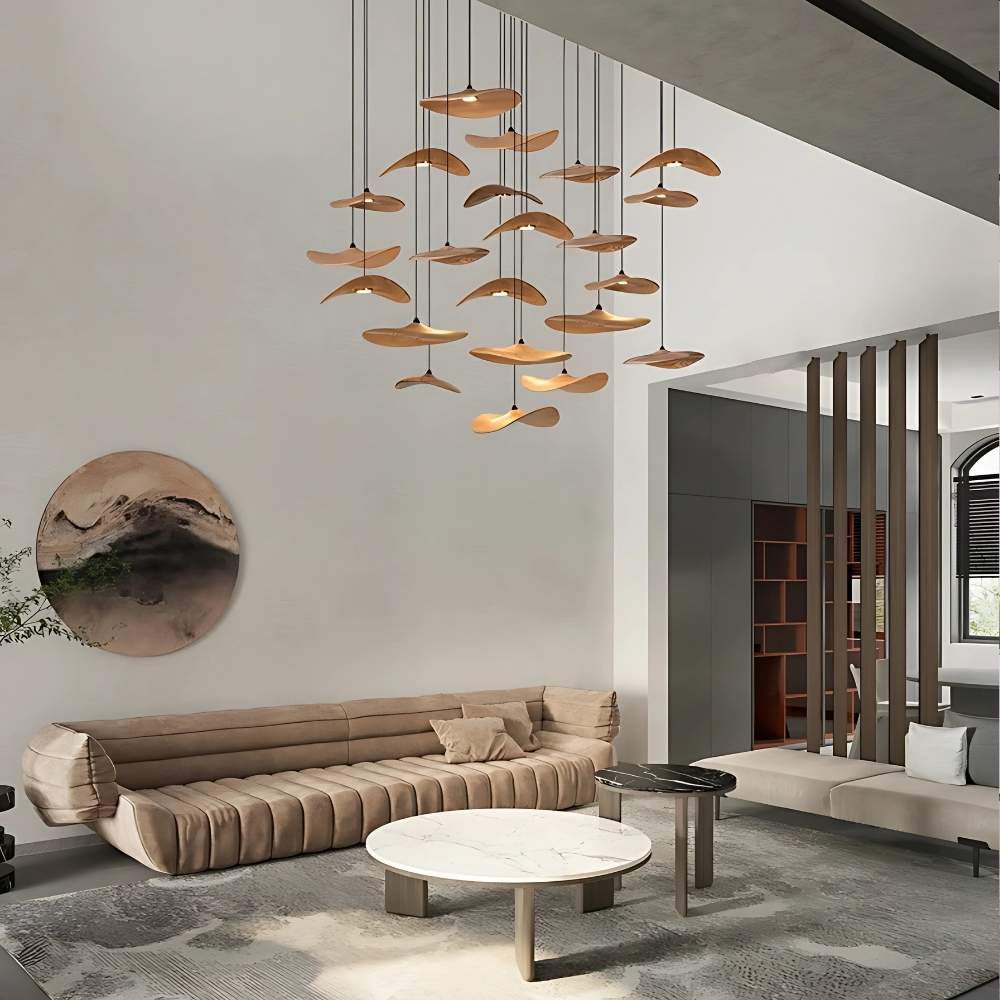
The Bidi Multi Light Pendant Chandelier is the type in its most direct form: glass heads on staggered cords from one canopy, sized for a dining table, a breakfast area, or a standard-ceiling foyer. Hung as a round cluster it suits a round table; with the cords set along one axis it follows a rectangular one.

The Elor Contemporary Wood Multi Light Pendant, in black, light wood, or dark wood, is the island and kitchen-table version: downward-throwing wood shades that put task light on the surface, in a finish that repeats oak or walnut cabinetry. Run its heads along an island at 60 to 70 percent of the length.
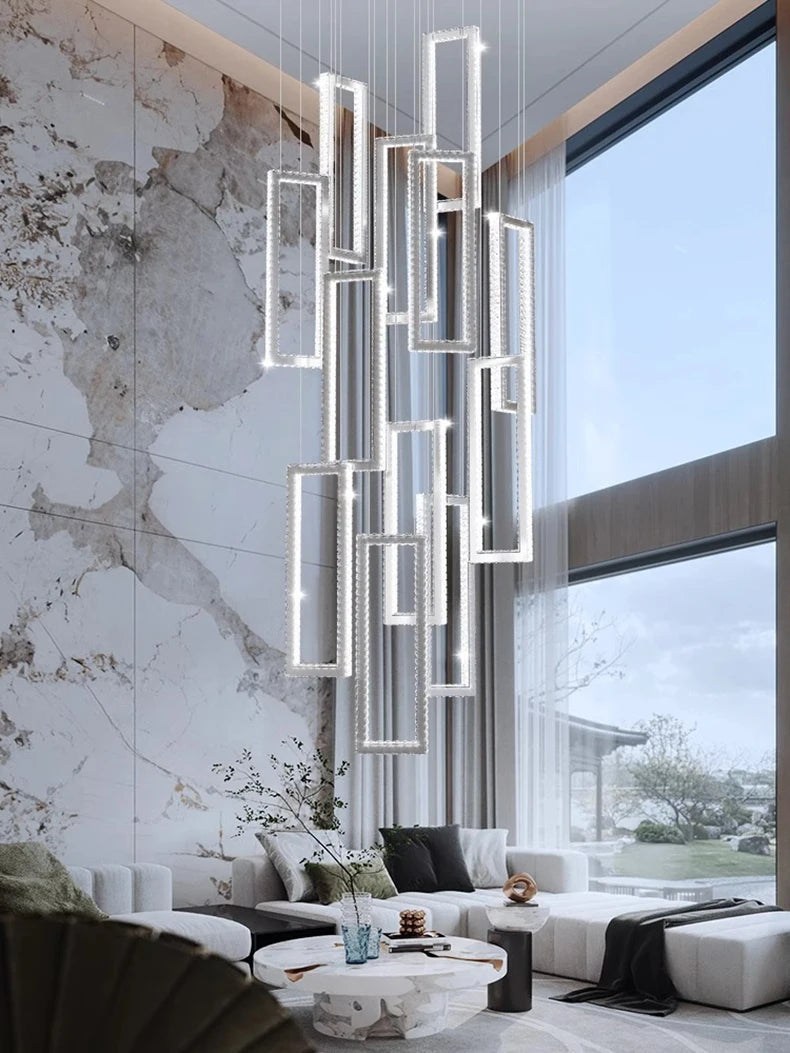
The Acai Crystal Multi Pendant Chandelier, in silver or gold, puts crystal heads on the cluster format — the choice for a transitional dining room that wants sparkle without a traditional multi-arm frame. Hang the lowest crystal 32 to 36 inches above the table so the drops catch light without blocking sightlines.
Cascades and spread canopies
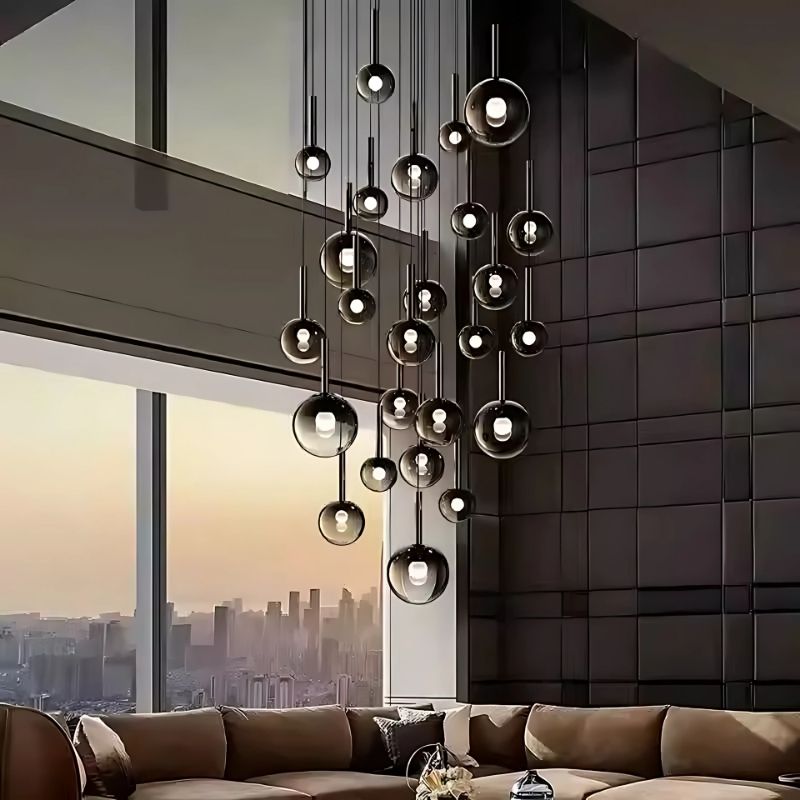
The Cleo Bubble Staircase Chandelier is the staggered cascade: glass globes on long cords stepped down through a stairwell or two-story foyer, cut on site so the lowest globe clears the treads by 7 feet. Its clear glass suits the above-eye-line position of a tall entry.
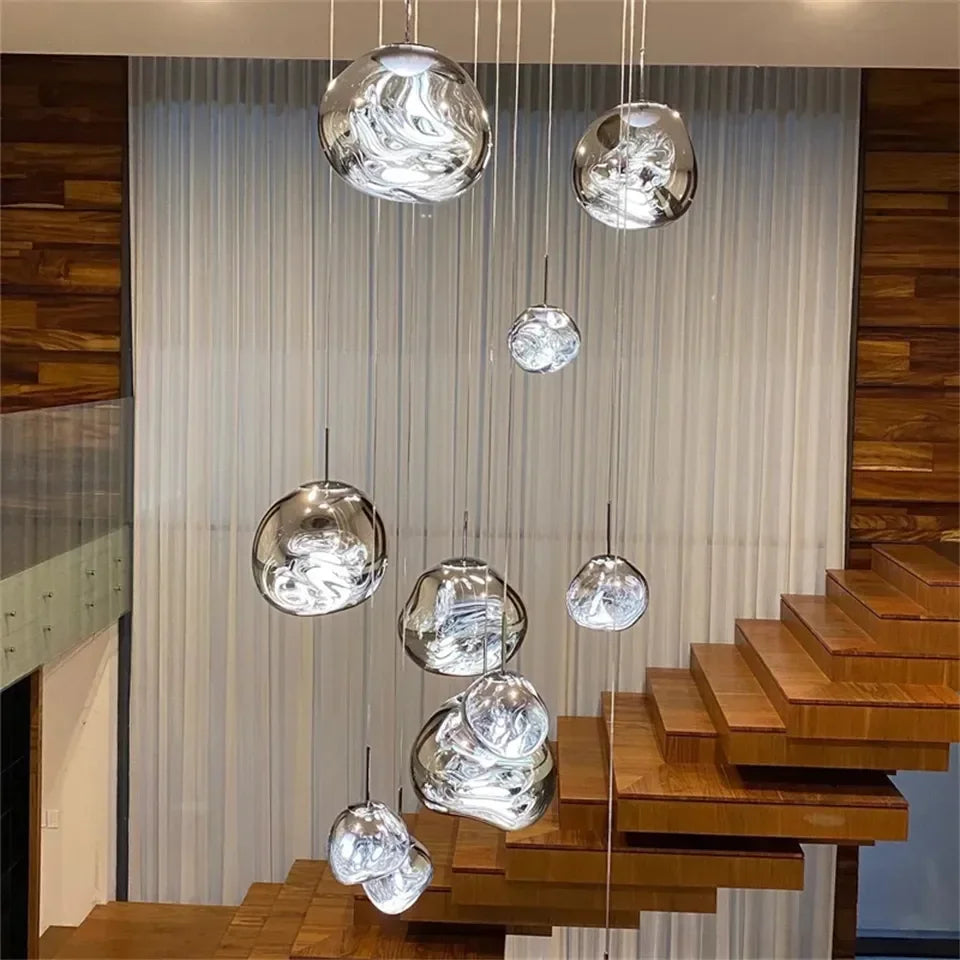
The Ruby Contemporary Bubble Pendant Chandelier is the colored-glass cluster, in blue, green, amber, rose gold, gray, and a mixed set: a spread of tinted globes for a living room, a landing, or a dining room that wants color rather than sparkle. Mixed tints read best on a wide canopy where each globe has space.
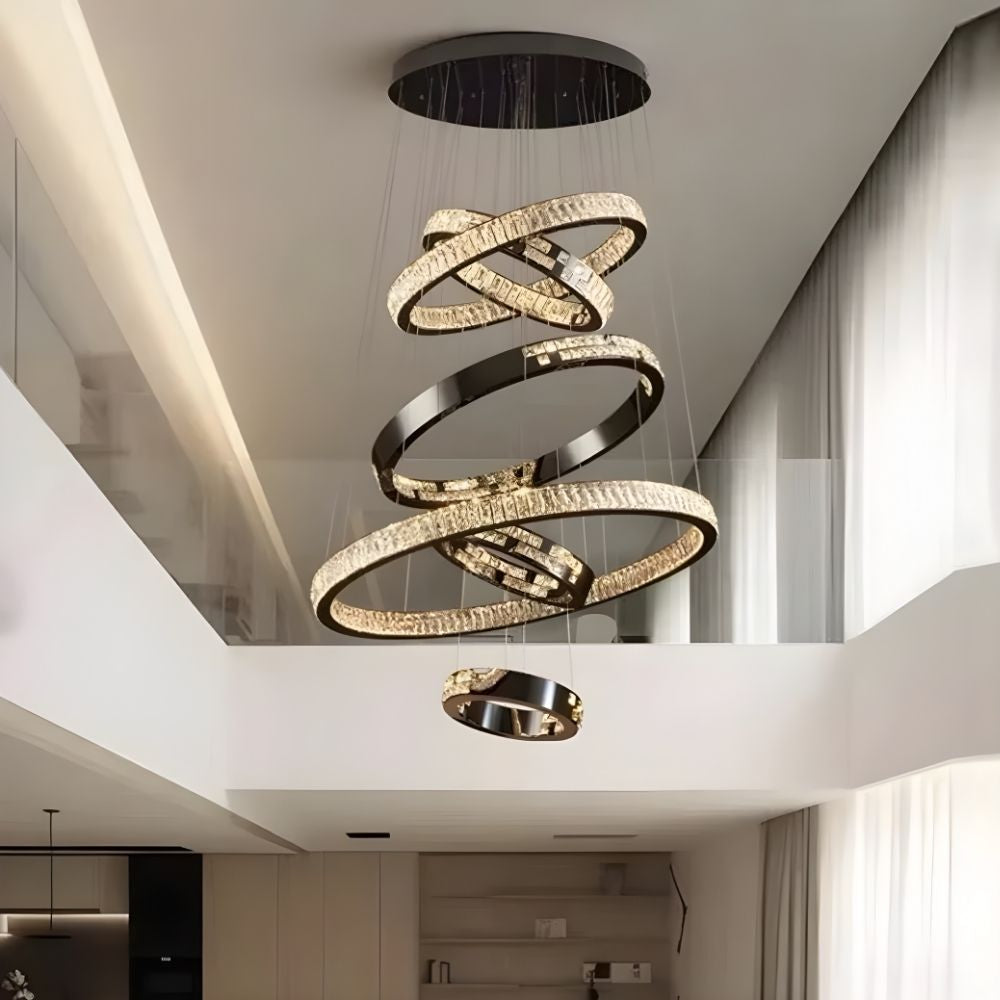
The Malen Multi Ring Pendant Light, in 6- or 8-ring versions with remote dimming, applies the multi-pendant idea to LED rings instead of globes: rings at staggered heights from one canopy, for a great room, a tall living room, or a two-story foyer that wants a large, even spread of light without a rigid frame.
Round clusters, linear rows, stairwell cascades, and spread canopies in glass, crystal, wood, and LED.
Pendant Lighting Staircase Chandeliers Bubble Chandeliers Kitchen
Installing a Multi-Light Pendant
The fixture is wired like a chandelier — one ceiling box, one connection — but the cords are cut and set on site, which is where the planning goes. Mark the layout before anything goes up: where each head should land relative to the table edges, the island ends, or the stair treads. Cut and set the longest cord first, hang its head at the target height, then work up through the shorter ones; the canopy goes on last. A 3- to 8-head fixture weighs 8 to 20 pounds and mounts to a standard box; a 10- to 30-head cascade can reach 60 pounds and needs a box rated for the load, fastened to structure, and a scaffold or lift in a stairwell. Sloped ceilings are easier than with a chandelier because each cord hangs plumb on its own, but the canopy still needs a slope adapter to sit flat. The pendant installation guide covers the wiring steps.
Frequently Asked Questions
What is a multi-light pendant?
A multi-light pendant is a fixture with several individual pendants — globes, cylinders, shades, or crystals — hung from one shared canopy on separate cords or cables, usually at different lengths. It is wired to a single ceiling box like a chandelier but reads as a cluster of pendants. Common versions have three to fifteen heads; large stairwell versions run to thirty or more. Because each cord is separately adjustable, the shape of the fixture is set at installation.
What is the difference between a multi-light pendant and a chandelier?
A chandelier holds its lights on a rigid frame — arms, tiers, a ring — so its shape is fixed and it hangs from one stem. A multi-light pendant holds its lights on separate flexible cords from one canopy, so its heads can be set at different heights and its footprint can be round, linear, or scattered. Chandeliers give a defined outline and even spread; multi-light pendants give a looser, more sculptural composition that can follow a table, an island, or a stairwell.
How many lights do I need in a multi-light pendant?
Three to five heads over a small round table, breakfast nook, or bedside; five to eight over a standard rectangular dining table or a 6- to 8-foot island; nine to fifteen over a large table, in a living room, or in a standard-ceiling foyer; fifteen to thirty for a two-story foyer or stairwell. The count also sets output — plan on 300 to 400 lumens per head with LED and check the fixture's rated total against 20 to 30 lumens per square foot for a dining area.
How do I size a multi-light pendant for a dining table?
Size the spread of the heads, not the canopy. Over a rectangular table the cluster should cover half to three-quarters of the table length in a linear layout; over a round table, half to two-thirds of the diameter in a round layout. Set the lowest head 30 to 36 inches above the tabletop and stagger the others 4 to 8 inches above it. The canopy itself is usually 12 to 40 inches and does not need to match the table.
Can a multi-light pendant go over a kitchen island?
Yes, and it solves a common problem: an island with one center ceiling box that cannot take three separate pendants. A linear multi-light pendant with a long canopy runs its heads along the island from one box. Size the spread at 60 to 70 percent of the island length, hang the heads 28 to 34 inches above the counter, and keep the lowest head above eye level for anyone standing at the far side.
Are multi-light pendants good for high ceilings and stairwells?
They are the standard answer for them. A staggered cascade of ten to thirty heads on cords of different lengths fills a two-story foyer or stairwell vertically, reads from the landing as well as the floor, and is adjusted at installation so the lowest head keeps 7 feet of clearance over treads. The heads' cords are usually 6 to 16 feet and are cut to length on site.
How is a multi-light pendant installed?
Like a chandelier, from one ceiling box, with one difference: each cord is cut and set at installation, which takes planning. Decide the layout first — mark where each head should land relative to the table, island, or stair — then set cord lengths from the longest down, and hang the canopy last. Fixtures with ten or more heads usually weigh 20 to 40 pounds; confirm the box rating. In a stairwell, a scaffold or lift is needed to set the heads.
Which glass or shade works best in a multi-light pendant?
Opal or frosted globes give the softest light and are the choice over a dining table or in a bedroom where heads sit near eye level. Clear glass shows the bulb and reads brighter and more decorative; it suits a stairwell or foyer where the heads are above the eye line. Crystal drops add sparkle for a transitional or formal room. Wood or metal shades throw light downward and suit kitchen islands where task light matters.
Can I dim a multi-light pendant?
Yes. Integrated-LED versions dim from the wall when the fixture's driver type (TRIAC, ELV, or 0–10V) matches the dimmer, or from a remote or app when built in. Bulb versions dim with dimmable LED bulbs and a compatible wall dimmer. Because all heads share one circuit, they dim together; there is no per-head control.
What color temperature should a multi-light pendant use?
2700K to 3000K in dining rooms, living rooms, bedrooms, and foyers; 3000K to 3500K over a kitchen island. Because several heads sit at different heights and some are close to eye level, warm white and a diffused shade matter more than with a single chandelier overhead. Use CRI 90 or higher and keep every head at the same value.
Choosing a Multi-Light Pendant
Start with the surface below and the ceiling box above: if a long island, a rectangular table, or a stairwell has to be lit from one point, a multi-light pendant is the fixture built for the job, and its layout is decided for you. Then count the heads for the output the room needs, size the spread rather than the canopy, and plan the cord lengths before the fixture goes up. Set that way, the cluster reads as a single composed piece rather than a handful of pendants.
Compare clusters, rows, and cascades in the pendant lighting collection, stairwell cascades in staircase chandeliers, and glass-globe clusters in bubble chandeliers. For sizing a cascade in a tall entry, read the stairwell pendant size guide.


