

Glass sputnik chandeliers replace exposed bulbs with diffusing globes — clear, frosted, opal, or tinted — and that single change shifts the fixture from sharp graphic statement to softer, more livable light. The starburst silhouette stays. The glare goes.
Three style families dominate the modern glass sputnik category: bubble clusters, globe arrays, and frosted-finish designs. They look related on first glance, but each one solves a different problem in a different room. This guide covers what separates them, where each one belongs, and how to size and pair them with the rest of your interior. If you want to skip ahead and shop, the full sputnik chandelier collection and the dedicated bubble chandelier collection hold every fixture mentioned in this article.
What Makes a Glass Sputnik Different from a Classic Sputnik
A classic sputnik chandelier — the kind that defined the late 1950s — uses thin metal arms tipped with exposed bulbs. The light source is visible, the geometry reads sharp, and the room registers a strong graphic shape on the ceiling. (For the full historical context on that era, see our pillar guide: What Is a Sputnik Chandelier?)
A glass sputnik chandelier keeps the radial geometry but replaces the exposed bulb with a glass enclosure — a sphere, a teardrop, or a rounded "bubble." The glass does three things at once:
- Diffuses light. The bulb's filament becomes invisible. Bright pinpoints turn into soft glowing orbs.
- Adds visual mass. A 1.5" bulb tip becomes a 4" or 6" globe — the fixture reads heavier and more sculptural.
- Removes the period reference. Without exposed bulbs, the shape no longer reads explicitly mid-century — it reads contemporary, transitional, or modern depending on the metalwork.
That third point is why glass sputnik chandeliers have become the default modern interpretation of the form. They keep the silhouette without locking the room into a specific design era.
The Three Main Glass Sputnik Styles
Before getting into individual fixtures, the three style families and what each one is best at:
| Style | Geometry | Light Quality | Best For |
|---|---|---|---|
| Bubble Sputnik | Cluster — globes at varied heights and tight spacing | Soft, multi-point glow | Statement entryways, modern dining rooms, hospitality |
| Globe Sputnik | Radial — equal-length arms, evenly spaced globes | Even, room-filling diffusion | Standard dining rooms, living rooms, kitchen islands |
| Frosted Sputnik | Either — defined by glass finish, not arm layout | Softest, most relaxed | Bedrooms, intimate dining, low-glare zones |
Bubble and globe are structural categories — they describe how the arms are arranged. Frosted is a finish category — it describes the glass itself. The three overlap: a frosted globe sputnik exists, and so does a clear bubble sputnik. The labels matter mostly for shopping language, but understanding the underlying differences makes the buying decision much easier.
Bubble Sputnik Chandeliers: Cluster Geometry and Soft Light
A bubble sputnik chandelier arranges multiple glass spheres at varied heights around a central core, mimicking the way bubbles rise and cluster in water. The arms are usually shorter than on a classic starburst, and the globes are spaced closer together — the result reads dense, sculptural, and three-dimensional rather than flat and graphic.
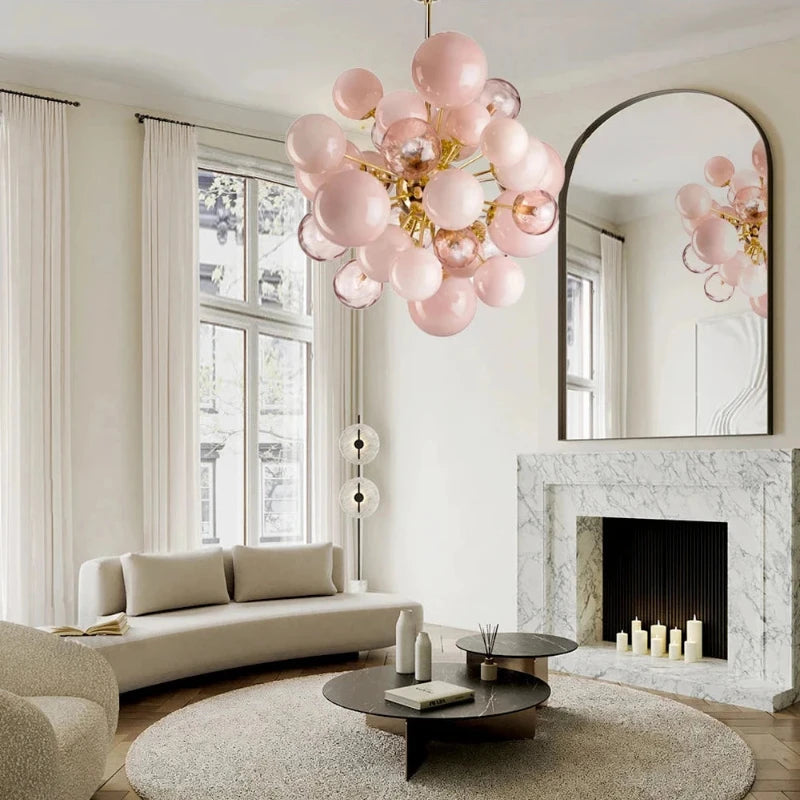
The bubble form is the most recent evolution of the sputnik category. It started appearing widely in residential design around 2015 as a cross-pollination between mid-century sputnik geometry and the 1980s Italian "bubble" pendant lights designed by Pamela Sunday and others. The modern interpretation strips out any period-specific decoration and presents the cluster as a pure sculptural object.
Where Bubble Sputniks Work
- Two-story foyers and entryways. The vertical depth of a clustered bubble fixture suits double-height spaces where a flat starburst would look stranded.
- Modern dining rooms. Bubble clusters draw the eye downward toward the table without dominating it — the globes diffuse light onto food and faces directly.
- Hospitality interiors. Restaurants, hotel lounges, and boutique retail spaces use bubble sputnik chandeliers as anchor pieces because they photograph well and read instantly as "designed."
The Anya Modern Bubble Glass Flush Mount Light is the bubble form adapted to a flush-mount profile — the same clustered globe arrangement compressed for ceilings under 8' (244 cm). For higher ceilings where the cluster can hang freely, the Pearl Black Glass Grape Chandelier shows the same logic with smoked black glass for darker palettes.

For a deeper look at how bubble fixtures work outside the sputnik category, see our complete bubble chandeliers collection.
Globe Sputnik Chandeliers: The Modern Standard
A globe sputnik chandelier uses equal-length arms terminating in identically-sized glass spheres — the most direct translation of the original starburst form into glass. The arms radiate evenly, the globes sit on a single plane (or close to it), and the fixture reads symmetrical and balanced rather than clustered.

This is the shape most people picture when they hear "modern glass sputnik chandelier." It's the workhorse of the category — neutral enough to suit transitional and contemporary interiors, structured enough to anchor a dining room without overwhelming it. The Modern Sputnik Glass Sphere Chandelier ships in 12- and 15-light versions and in five color options including silver, black, red, and beige — covering most palettes a buyer might be working with.
Globe Diameter and Light Coverage
Globe diameter directly affects how the fixture reads in a room. Three common ranges:
- Small globes (2.5–3.5" / 6–9 cm): Read delicate, almost jewel-like. Best for medium-size rooms where you want presence without weight.
- Medium globes (4–5" / 10–13 cm): The most common size — balanced, scaled for standard 10–12 light fixtures over standard dining tables.
- Large globes (6"+ / 15 cm+): Statement-making. Best for high-ceiling foyers, oversized dining rooms, or open-plan great rooms.
The 8 Light LED Glass Ball Chandelier in Black/Gold sits in the medium-globe range and shows how a smaller light count with larger globes reads denser than a higher light count with smaller globes — a useful trick for rooms where you want presence without the visual fragmentation of 15+ small bulbs.
Frosted, Clear, and Opal: Light Diffusion Compared
The single most important variable in any glass sputnik chandelier — more important than arm count or finish — is the glass itself. Three finishes dominate the market, and they perform very differently.
| Glass Type | Filament Visibility | Light Output | Glare Risk | Mood |
|---|---|---|---|---|
| Clear glass | Fully visible | 100% (no loss) | High | Sharp, graphic, contemporary |
| Frosted glass | Hidden, halo visible | 85–90% | Low–medium | Soft, balanced, transitional |
| Opal glass | Hidden, uniform glow | 75–85% | Very low | Soft, calm, intimate |
| Smoked / tinted | Faintly visible | 60–75% | Low | Moody, atmospheric, dramatic |
The most common buyer mistake is choosing clear glass for a dining room because it photographs better, then living with the glare every night for years. If guests sit at the table for two or three hours at a time, frosted or opal is almost always the right choice.
Color and Tinted Glass Sputnik Designs
Beyond clear, frosted, and opal, a smaller subcategory uses colored or tinted glass — smoked grey, amber, aqua, blue, or rose. These work for buyers who want a sculptural sputnik that introduces a color accent rather than reading as a neutral fixture.
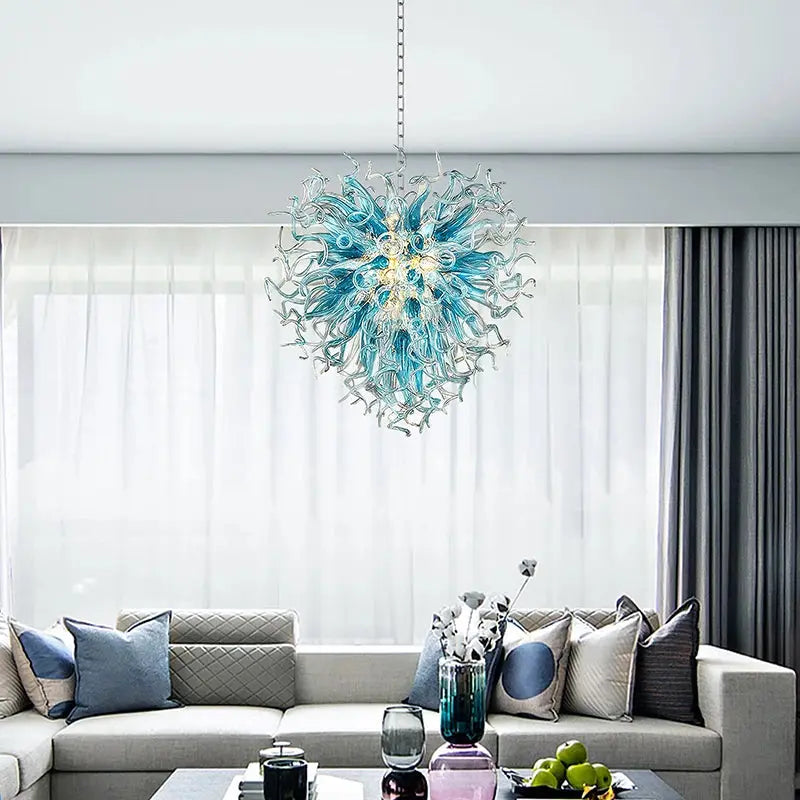
The Modern Aqua Blue Glass Chandelier is the clearest example of how a tinted glass sputnik changes the math: instead of being a neutral element that pairs with anything, the fixture becomes a deliberate color accent that has to be coordinated with the room's palette. This is a stronger design choice — and a riskier one for resale-value-focused renovations — but it's also one of the few ways to make a modern sputnik feel genuinely personal rather than catalog-default.
A useful rule for tinted glass sputnik chandeliers: the color should already appear somewhere else in the room — a rug, a piece of art, throw pillows, kitchen tile. If it appears only in the chandelier, the fixture reads stranded. If it echoes one or two other elements, it reads intentional.
Sizing Glass Sputnik Chandeliers
Glass sputnik chandeliers follow the same sizing rules as standard sputniks, but with one important adjustment: glass globes add visual weight. A 32" (81 cm) glass globe sputnik reads larger than a 32" exposed-bulb sputnik, even though the diameter measurement is identical. Adjust the formula slightly downward to compensate.
| Room / Space | Recommended Diameter | Globe Size | Light Count |
|---|---|---|---|
| Breakfast nook | 18–24" (46–61 cm) | 3–4" (8–10 cm) | 6–8 globes |
| Standard dining room | 26–36" (66–91 cm) | 4–5" (10–13 cm) | 10–12 globes |
| Large dining / open plan | 36–44" (91–112 cm) | 5–6" (13–15 cm) | 12–15 globes |
| Two-story foyer | 32"+ (81 cm+) | 5–8" (13–20 cm) | 15–20+ globes |
| Bedroom (over bed) | 20–28" (51–71 cm) | 3–4" (8–10 cm) | 6–10 globes (frosted only) |
For dining rooms specifically, hang the bottom of the lowest globe 30–36" (76–91 cm) above the tabletop. For bedrooms, raise the clearance to at least 32" (81 cm) above the bed surface — anyone sitting up should clear the fixture comfortably.
Our Chandelier Size Calculator handles room dimension math automatically.
Light Quality: Bulbs, LEDs, and Dimming for Glass Sputniks
Glass sputnik chandeliers behave differently from exposed-bulb sputniks when it comes to lighting. Three factors matter:
Color Temperature
Glass globes warm the perceived color slightly — a 3000K bulb in a frosted globe reads closer to 2900K because the diffusion masks the cooler tones in the spectrum. For dining rooms, this means 3000K is almost always the right choice. Stepping up to 3500K can push the room into "office cafeteria" territory, especially with frosted or opal glass.
For more on color temperature in residential lighting, see our complete color temperature guide.
Bulb Wattage and Heat
Enclosed glass globes trap more heat than exposed bulbs. Always check the maximum wattage rating on the product spec sheet, and never exceed it. For LED bulbs this is rarely an issue (LEDs run cool), but for any incandescent or halogen replacement bulbs, run the math: a 60W incandescent inside a 4" frosted globe will heat the glass beyond 150°F (65°C), which over time can crack the seal and shorten bulb life.
Dimming Compatibility
Most glass sputnik chandeliers in our collection ship with dimmable LED drivers. Match the dimmer type to the driver listed in the spec sheet — TRIAC, ELV, or 0–10V. Mismatched dimmers cause flicker that's especially visible through frosted glass, where the slightest pulse becomes a glowing shimmer instead of steady light.
Where Glass Sputnik Chandeliers Work Best, Room by Room
Dining Room
The single best use case. Glass globes diffuse light onto the table without casting harsh shadows on faces. Frosted or opal globes are kinder to long dinners than clear glass. Round globe sputniks suit round and square tables; linear glass sputniks suit rectangular tables. Browse the broader dining room lighting collection for related fixtures.
Two-Story Foyer
Bubble cluster sputniks shine here — the vertical depth of a multi-globe cluster fills the height of a two-story space without the awkwardness of a single oversized starburst. The Sputnik Gold Glass Dandelion Chandelier shows how a wider-spread glass design reads at scale.

For more two-story-specific options, see our two-story foyer chandeliers collection.
Living Room
Mid-size globe sputniks (10–15 lights, 28–32" / 71–81 cm diameter) work well as a centered focal piece, especially in open-plan rooms where the chandelier needs to anchor a seating zone without being tied to a specific piece of furniture.
Kitchen Island
Linear glass sputniks are the strongest choice over rectangular islands. Two smaller globe pendants paired side by side also works for islands over 8' (244 cm) long. Keep frosted or opal globes here — clear glass over a kitchen island puts the bulb directly in the eye line of anyone seated at the counter.
Bedroom
Smaller frosted globe sputniks (6–10 lights, 20–28" / 51–71 cm) over the bed work surprisingly well in modern bedrooms, replacing the more typical drum shade or flush mount. Always frosted or opal here — clear glass directly above the bed reads harsh.
Bathroom (Vanity Area)
Smaller bubble sputniks in 4–6 light configurations work over double vanities or freestanding tubs. Confirm the fixture is rated for damp locations before installing in any bathroom.
Care and Maintenance for Glass Sputnik Chandeliers
Glass sputnik chandeliers need slightly more maintenance than exposed-bulb versions because the globes collect dust and the diffusion makes any film visible. Three habits keep them looking new:
- Dust monthly. A microfiber cloth on each globe takes about three minutes for a 12-light fixture. Skipping this for six months turns frosted globes from soft glow to grey-tinted.
- Deep clean twice a year. Remove globes individually, wash with mild soap and warm water, dry with a lint-free cloth, reinstall. Never spray cleaner directly onto a fixture while it's mounted — liquid runs down the arms into the hub and damages the wiring.
- Avoid ammonia-based cleaners on metal. Brass and gold finishes have a thin lacquer that ammonia strips. Use water and mild soap on the metal too — anything stronger shortens the finish life.
Glass Sputnik vs. Other Glass Chandeliers
Glass sputnik chandeliers are part of a broader glass chandelier category. The differences matter when you're shopping:
| Type | Distinguishing Feature |
|---|---|
| Glass sputnik chandelier | Radial arms with glass globes at tips |
| Bubble chandelier (non-sputnik) | Globes cluster freely without radial structure — no central hub-and-arm system |
| Crystal chandelier | Faceted crystal pieces (not globes) catch and refract light |
| Glass pendant cluster | Multiple glass pendants drop downward from a canopy — no radial geometry |
| Globe pendant | Single glass globe on a stem — no multiple arms |
If you're cross-shopping, our bubble chandeliers, crystal chandeliers, and modern chandeliers collections cover the neighboring categories.
Frequently Asked Questions
What is a bubble sputnik chandelier?
A bubble sputnik chandelier arranges multiple glass spheres at varied heights around a central core, mimicking the way bubbles rise and cluster. The arms are usually shorter and the globes more densely spaced than on a classic radial sputnik, giving the fixture a three-dimensional, sculptural look rather than a flat starburst.
What's the difference between a globe sputnik and a bubble sputnik chandelier?
Globe sputniks have equal-length arms and identically-sized globes arranged radially on roughly a single plane — the fixture reads symmetrical and structured. Bubble sputniks vary arm length and globe spacing to create a clustered, multi-layer cascade.
Are glass sputnik chandeliers good for dining rooms?
Yes — they're often the best chandelier choice for dining rooms because the glass globes diffuse light onto faces and the table without harsh glare. Frosted or opal globes work better than clear glass in dining rooms where guests sit for long periods.
Do clear glass globes cause glare?
They can. Clear glass globes hide the bulb visually but still produce sharp light points that can be uncomfortable at eye level. For dining rooms and any space where guests sit close to the fixture, frosted or opal globes are usually better choices.
What size globes work best on a sputnik chandelier?
4–5" (10–13 cm) globes are the most common size and suit standard 10–12 light fixtures over standard dining tables. Smaller globes (3" / 8 cm) suit medium rooms; larger globes (6"+ / 15 cm+) suit foyers and oversized spaces.
Can I use LED bulbs in a glass sputnik chandelier?
Yes, and you should. LEDs run cool, fit inside enclosed globes safely, and last 15–25 times longer than incandescent bulbs. Confirm the bulb base type (E12 or E26) on the product page before ordering.
Are bubble sputnik chandeliers dimmable?
Most are. Match the dimmer type — TRIAC, ELV, or 0–10V — to the LED driver listed in the product specs. Mismatched dimmers cause flicker that's especially visible through diffusing glass.
Where can I buy a glass sputnik chandelier?
Our sputnik chandelier collection and dedicated bubble chandelier collection cover bubble, globe, frosted, and tinted designs. Free worldwide shipping and 20-day returns on every order. Contact us for custom sizing or finish requests.
Choosing Your Glass Sputnik Chandelier
Glass sputnik chandeliers solve a specific problem better than any other lighting category: they give you the sculptural impact of a classic starburst without the glare that makes exposed-bulb fixtures uncomfortable in living spaces. Bubble clusters add depth for foyers; globe arrays provide even diffusion for dining rooms; frosted finishes soften the light for bedrooms and intimate zones; tinted glass adds personality where neutral fixtures would feel anonymous.


