

A foyer pendant light is the entry fixture for a house that doesn't want a chandelier at the door — a single globe, a lantern, a cluster, a cascade, or a row — and the choice between those forms comes down to the foyer's size, its ceiling height, and whether the entry is a room or a passage. This guide covers when a pendant beats a chandelier or a flush mount in a foyer, the five pendant forms and where each belongs, sizing and hanging by ceiling height, finish, and six fixtures.
Key Takeaways
| Question | Answer |
|---|---|
| Pendant or chandelier? | Pendant for small to medium entries, 8–10 ft ceilings, passages, modern homes; chandelier for large, formal, two-story rooms; flush under 8 ft. |
| Which pendant form? | Single globe (small/standard), lantern (traditional/farmhouse), cluster (medium), cascade or multi-ring (two-story), linear row (long hall). |
| What size? | L + W (ft) = diameter (in); +2–3 in per foot of ceiling over 8 ft in tall entries. |
| How high? | 7 ft clearance everywhere; bottom at the second-floor line in a two-story foyer; 7 ft over stair treads. |
| How bright? | 10–20 lm/sq ft; single globes need a sconce or console lamp alongside. |
| Which finish? | Match the door hardware and stair rail; glass is the neutral. |
Quick Facts
- Five foyer pendant forms: single globe/drum, lantern, cluster, cascade, linear row.
- 8 ft ceiling: fixture height ≤ 12 in including canopy to keep 7 ft clearance.
- Size: 6×8 ft entry → ~14 in; 8×10 → ~18 in; 10×12 → ~22 in.
- Two-story: size by drop; bottom at or above the second-floor line.
- Light: 2700–3000K, dimmable; 1,000–2,000 lm for a standard entry, 2,000–4,000 for a two-story one.
- The foyer pendant sets the metal finish for the visible rooms beyond it.
Pendant, Chandelier, or Flush Mount: Which Does a Foyer Need?
Three fixture types compete for the entry ceiling, and the foyer's dimensions decide. A flush or semi-flush mount is right under 8 feet of ceiling, where nothing can hang. A chandelier — multi-arm, tiered, or a large sculptural form — is right in a large, formal, or two-story foyer that is the house's central room. A pendant is right in the wide middle: entries under about 10 by 10 feet, ceilings of 8 to 10 feet, passage-style entries that lead somewhere rather than gathering people, and modern houses that want one clean form at the door rather than a traditional fixture. The cluster and cascade pendants blur the line upward — a cascade in a two-story entry does a chandelier's job in a modern form — which is why "foyer pendant" covers more entries than it sounds. The foyer fixture type guide covers the full type decision; this page covers the pendant side of it.
The Five Foyer Pendant Forms
1. Single globe and drum pendants

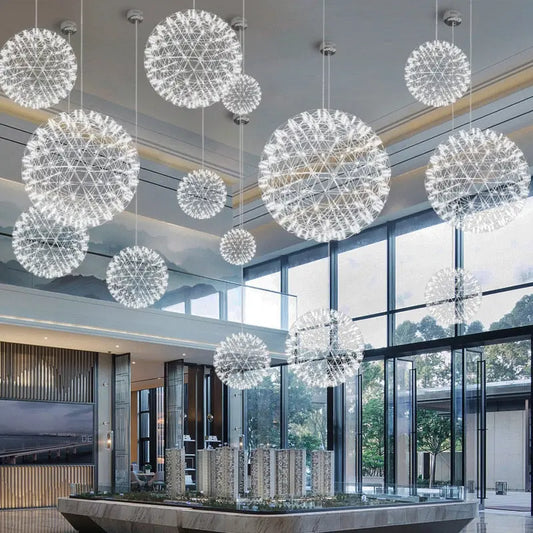
One globe or drum on a stem is the foyer pendant for most houses: a small or standard entry with an 8- to 10-foot ceiling, centered on the entry floor or on the door if the entry is a corridor. The Moon Bubble Pendant is the soft version — a frosted sphere that glows rather than sparkles, for a neutral or Scandinavian entry; the Spark Ball Stainless Steel Pendant is the sharp version, a reflective sphere that reads as a small sculpture against a black door and nickel hardware. Sizes run 10 to 16 inches; on an 8-foot ceiling the whole fixture, canopy included, must fit within about 12 inches to keep 7 feet of clearance, which the short-stem versions of both do. A single globe at 800 to 1,200 lumens wants a sconce pair or a console lamp alongside.
2. Lantern pendants
The lantern — glass panels in a metal frame, square, hexagonal, or cylindrical — is the traditional, farmhouse, and transitional foyer pendant, and the one that reads correctly from outside through a glazed door. It suits standard and tall entries alike: a 12- to 16-inch lantern on a short stem for an 8- to 9-foot ceiling, a 16- to 20-inch lantern on a longer chain for 10 to 12 feet. Black frames with clear glass are the current default; brass with seeded glass for warmer, older houses. The farmhouse foyer lighting collection carries the lantern end, and the farmhouse foyer guide covers the style.
3. Cluster pendants

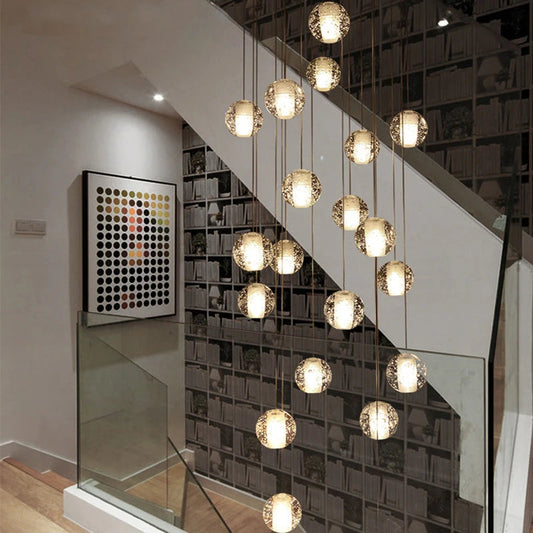
A cluster — several globes on one canopy, at the same or staggered heights — gives a medium entry the presence of a chandelier in a pendant's form. It carries the entry's light alone (five or six globes reach 2,000 lumens), reads from several angles, and suits modern and transitional houses. The Modern Crystal Glass Bubble Chandelier for Foyer is the clear-glass cluster built for the entry — sparkle without a traditional chandelier's tiers; the Pearl Black Glass Grape Pendant is the dark, dense version for a formal modern entry or a lobby. Size a cluster at the foyer's length plus width in inches — 18 to 28 inches for most medium entries — on a 9- to 14-foot ceiling. The multi-light pendant guide covers the cluster type across rooms.
4. Cascade and multi-ring pendants

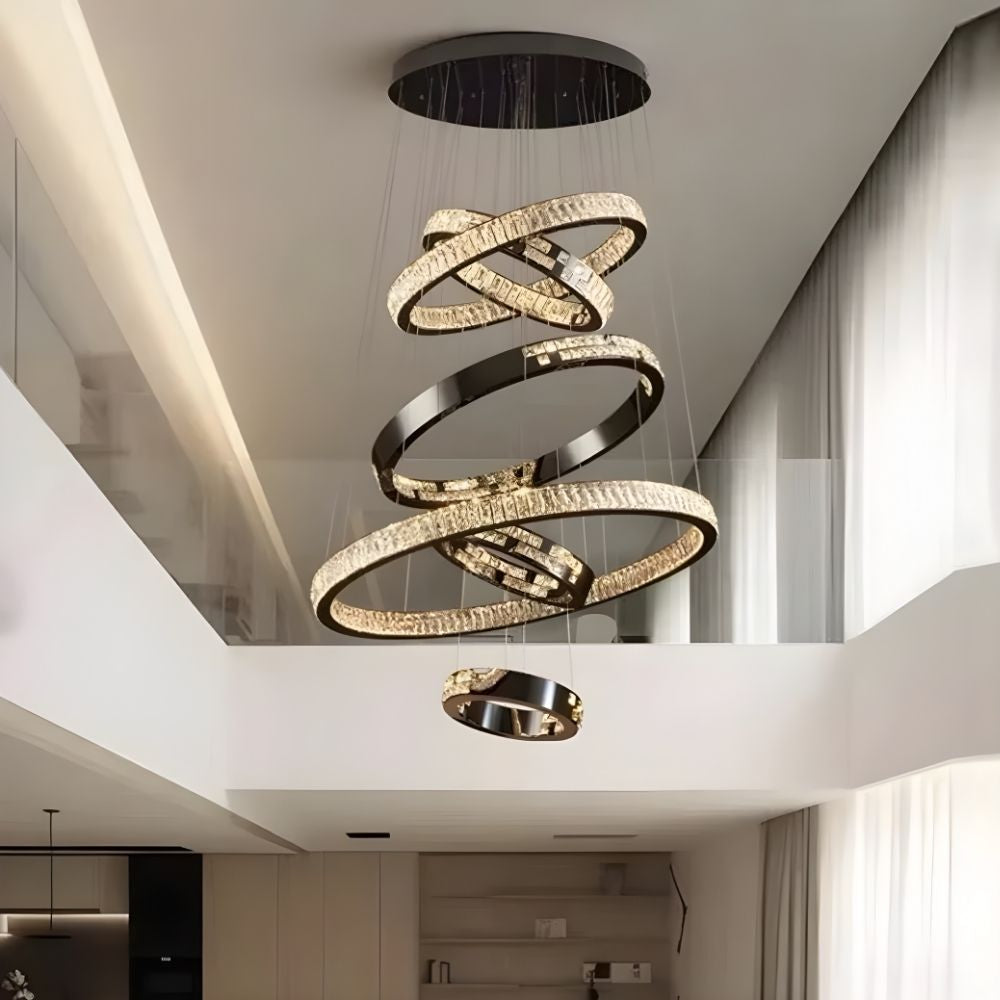
In a two-story foyer or a stairwell the pendant becomes vertical: globes or spheres on cords at staggered heights, or LED rings stacked down a stem. The Cleo Bubble Staircase Chandelier is the glass cascade sized to a full-story drop; the Malen Multi Ring Pendant Light is the geometric version, remote-dimmable rings that read from the landing and the door. Size by the drop rather than the floor: set the lowest element at or slightly above the second-floor line, keep 7 feet over every stair tread, and plan lift or lowering access for cleaning. The stairwell pendant size guide works the drop math; the two-story foyer collection has more vertical forms.
5. Linear rows
A long, gallery-style entry hall — the kind that runs 12 feet or more from the door — takes two or three matched pendants in a line, 36 to 48 inches apart, each 8 to 12 inches wide, rather than one fixture that lights only the middle. Single globes, small lanterns, or flower-form pendants such as the Eryx Flower Pendant Light work in a row; keep them identical and at the same height so the hall reads as one gesture. On an 8-foot hall ceiling, short-stem or semi-flush versions keep the clearance.
Sizing and Hanging a Foyer Pendant by Ceiling Height
| Ceiling | Pendant form | Size | Hanging |
|---|---|---|---|
| Under 8 ft | Flush or semi-flush instead | L + W (ft) = in | At the ceiling — see the Lyla Crystal Flush Mount for the crystal version |
| 8 ft | Single globe, drum, shallow lantern, flush cluster | 10–16 in wide; ≤ 12 in tall with canopy | 7 ft clearance; door swing checked |
| 9–10 ft | Single globe, lantern, small cluster | L + W (ft) = in; 12–20 in | 7–7.5 ft clearance |
| 10–14 ft | Cluster, large lantern, short cascade | L + W plus 2–3 in per ft over 8 ft | 7.5–8 ft clearance; judge from across the entry |
| Two-story / stairwell | Cascade, multi-ring | By drop; reads from the landing | Bottom at the second-floor line; 7 ft over treads |
| Long hall, any height | Linear row of 2–3 | 8–12 in each, 36–48 in apart | 7 ft clearance; same height |
Two foyer-specific checks beyond the table: the front door's swing must clear the fixture when the door opens fully, and if the door or its sidelights are glazed, the pendant should look centered from the porch as well as from inside. The foyer light size guide works the diameter math in detail, and the small entryway guide covers tight and low entries.
Brightness and Light Color for an Entry
An entry is used at every hour — bright at a morning departure, low for a late return — so the pendant needs both output and a dimmer. Plan 10 to 20 lumens per square foot: about 1,000 to 2,000 lumens for an 8 by 12 foot entry and 2,000 to 4,000 for a two-story one that also lights a stair. A single globe or lantern at 800 to 1,200 lumens is the ambient layer and wants a sconce pair flanking the door or mirror, or a console lamp, to finish the room; a cluster or cascade can carry the entry alone. Keep the color at 2700 to 3000K so the entry matches the rooms beyond it and skin, wood, and brass read warm; a motion or dusk-to-dawn schedule on the entry circuit is a convenience worth adding.
Finish: The Foyer Sets the House's Metal
The pendant at the door is often the first finish a visitor sees, and it should agree with the door hardware and the stair rail: black pendant with black handles and a black rail, brass with brass, nickel with nickel. Glass — clear, frosted, smoked, or crystal — is the neutral that sits with any metal, which is why most foyer pendants are glass on a metal canopy. The finish chosen here then repeats in the dining or living fixture visible from the entry; the forms can differ, the metal should not. The modern vs traditional foyer lighting guide covers the style decision the finish follows.
Six Foyer Pendant Lights
| Fixture | Form | Entry and ceiling | Finish |
|---|---|---|---|
| Moon Bubble Pendant | Single frosted globe | Small/standard entry, 8–10 ft | Frosted glass |
| Spark Ball Stainless Steel Pendant | Single reflective sphere | Modern entry or hall, 8–10 ft | Stainless |
| Modern Crystal Glass Bubble Chandelier for Foyer | Clear-glass cluster | Medium entry, 9–14 ft | Clear glass, metal canopy |
| Pearl Black Glass Grape Pendant | Dense dark cluster | Formal modern entry, lobby, 10–14 ft | Black glass |
| Cleo Bubble Staircase Chandelier | Glass cascade | Two-story foyer, stairwell | Clear glass |
| Malen Multi Ring Pendant Light | Stacked LED rings | Tall entry, stairwell | Metal, remote dimmable |
Quick decision: which foyer pendant
Small or standard entry, 8–10 ft: Moon (soft) or Spark Ball (sharp) • Traditional or farmhouse entry: lantern • Medium entry, 9–14 ft, wants presence: Modern Crystal Glass Bubble cluster • Formal modern entry or lobby: Pearl Black Glass Grape • Two-story foyer or stairwell: Cleo cascade or Malen rings • Long hall: a row of 2–3 Moon or Eryx • Under 8 ft: Lyla flush instead.
Single globes, clusters, cascades, and ceiling-mount fixtures for entries of every height.
Entryway Ceiling Lights Foyer Lighting Pendants Two-Story
Frequently Asked Questions
Pendant or chandelier for a foyer?
Pendant when the foyer is small to medium (under about 10 by 10 feet), the ceiling is 8 to 10 feet, the entry is a passage rather than a room, or the house is modern and wants one clean form; chandelier when the foyer is large or two-story, formal, or the central feature of the house. A cluster or cascade pendant covers the middle ground — a two-story entry that wants a modern form rather than a traditional chandelier. Under 8 feet, a flush or semi-flush beats both.
What are the types of foyer pendant lights?
Five: the single globe or drum pendant for a small or standard entry; the lantern pendant — glass panels in a metal frame — for traditional, farmhouse, and transitional entries; the cluster pendant — several globes on one canopy — for a medium entry that wants presence without a chandelier; the cascade — pendants on cords at staggered heights — for stairwells and two-story foyers; and the linear row — two or three matched pendants in a line — for a long gallery-style hall.
What size pendant light for a foyer?
Add the foyer's length and width in feet and read the sum as inches of diameter: a 6 by 8 foot entry suggests about 14 inches, an 8 by 10 foot entry 18 inches, a 10 by 12 foot entry 22 inches. A single pendant can sit a little under the figure; a cluster or lantern at it. In a two-story foyer add 2 to 3 inches per foot of ceiling height above 8 feet and choose a cascade or tall cluster so the fixture reads from the landing.
How high should a foyer pendant hang?
Bottom of the pendant at least 7 feet above the floor in any foyer, since the whole floor is a walkway; on an 8-foot ceiling that leaves 12 inches of fixture plus canopy, which is why single globes, drums, and semi-flush pendants are the standard-ceiling picks. On 9- to 10-foot ceilings, hang to 7 to 7.5 feet of clearance. In a two-story foyer, set the bottom at or slightly above the second-floor line, and in a stairwell keep 7 feet over every tread. Check the door swing and any sidelight sightline from outside.
What foyer pendant works on an 8-foot ceiling?
A short-drop or semi-flush pendant: a single globe or drum on a 6- to 10-inch stem, a shallow lantern, or a flush-mount cluster. The fixture's total height, canopy included, has to fit within about 12 inches to keep 7 feet of clearance. Width can be generous — 14 to 18 inches — because width doesn't cost headroom. If the entry opens onto a stair, the first tread is the controlling clearance, not the entry floor.
Which pendant suits a two-story foyer?
A cascade — pendants on cords or rods at staggered heights, often glass globes or crystal spheres — or a tall multi-ring pendant, sized by the drop rather than the floor area so it reads from the landing and the door. Set the lowest element at or slightly above the second-floor line, keep 7 feet over the stair treads, and plan a lowering system or lift access for cleaning. A single large globe on a long stem works only in a narrow, tall entry.
How bright should a foyer pendant be?
Plan 10 to 20 lumens per square foot for the foyer: about 1,000 to 2,000 lumens for an 8 by 12 foot entry, 2,000 to 4,000 for a two-story one that also lights a stair. A single globe pendant at 800 to 1,200 lumens needs a sconce pair or a console lamp alongside; a cluster of five or six globes can carry the entry alone. Use 2700 to 3000K warm white and a dimmer, since an entry is used at every hour.
What finish should a foyer pendant be?
Whatever the door hardware and stair rail already are. Black pendants match black hardware and read graphic against light walls; brass pendants suit brass handles and warm wood floors; nickel and chrome suit cooler modern entries. Glass — clear, frosted, smoked, or crystal — is the neutral that works with any metal. The foyer pendant is often the first finish a visitor sees, so it sets the metal for the rooms beyond.
Can I use a pendant light in a small entryway?
Yes — it is the right choice there. A single 10- to 14-inch globe, drum, or lantern pendant centered on the entry (or on the door if the entry is a corridor), hung to 7 feet of clearance, gives a small entry a focal point without the width of a chandelier. Pair it with one sconce or a slim console lamp so the light isn't all from above.
Should the foyer pendant match the dining or living room fixture?
Relate, don't match. Keep the same metal finish and a related glass or material — a brass-and-glass globe pendant in the entry with a brass-and-glass linear over the dining table — and let the forms differ. Matching fixtures room to room looks like a builder set; a repeated finish with different shapes reads as a planned house.
The Right Pendant at the Door
A foyer pendant does the chandelier's job at a scale most entries actually have: one clean form at the door, sized to the floor and the ceiling, hung clear of heads and door swings, in the finish the hardware already set. Choose the form by the entry's size and height, let the glass stay neutral and the metal agree with the house, and the first fixture a visitor sees reads as planned.
Browse entryway ceiling lights and foyer lighting for every form above. For the chandelier side of the decision, see best entryway chandeliers; for the fixture-type overview, what type of lighting is best for a foyer.


