

The foyer fixture is the first light anyone sees in your home, and its style tells them what to expect from the rest of the house. This guide compares traditional and modern foyer lighting — what defines each, how they differ in materials, light, cost, and fit — and shows when a transitional fixture is the better answer.
Key Takeaways
| Question | Answer |
|---|---|
| What defines traditional foyer lighting? | Historical fixture forms — multi-arm chandeliers, crystal tiers, lanterns — in crystal, brass, bronze, or wrought iron, with warm, diffused light. |
| What defines modern foyer lighting? | Clean geometric forms in glass, steel, and black or brushed metal, often with integrated LEDs, dimming, and smart control. |
| Which one fits my home? | Traditional for homes with classic detail; modern for open-plan or minimalist homes; transitional when the house mixes both. |
| Which is more energy efficient? | Modern fixtures more often ship with LEDs built in, but a traditional chandelier with LED candelabra bulbs uses about the same power. |
| Which costs more? | Ranges overlap: modern roughly $200–$1,500+, traditional roughly $150–$2,000+, with crystal and hand-finished metal at the top. |
| What stays the same in both? | Sizing (2–3 in of diameter per foot of foyer dimensions), 7 ft floor clearance, and 2700–3000K warm white light. |
Quick Facts
- Traditional foyer lighting materials: crystal, brass, bronze, wrought iron; forms: candle-style arms, tiers, lanterns.
- Modern foyer lighting materials: glass, steel, aluminum, matte black and brushed finishes; forms: linear, sputnik, cluster, ring, geometric.
- Both styles size the same way: add the foyer's length and width in feet — that number in inches is the fixture diameter.
- Both styles hang the same way: bottom at least 7 ft above the floor; in a two-story foyer, at or slightly above the second-floor line.
- Warm white (2700–3000K) suits both; aim for 10–20 lumens per square foot of foyer.
- Transitional fixtures — crystal in a square frame, arms in matte black — fit homes that mix eras.
What Makes Foyer Lighting "Traditional"?
Traditional foyer lighting takes its shapes from fixtures that predate electricity: the candle chandelier, the gas lantern, the oil lamp. The forms are symmetrical, the detail is layered, and the fixture is meant to be looked at as much as lit. In an entryway this reads as a multi-arm chandelier with candle-style sockets, a tiered crystal chandelier, a hanging lantern with glass panes, or an ornate flush mount for a lower ceiling.

Materials and finishes
Four materials define the style. Crystal — cut glass prisms, drops, and chains — refracts light into small points across the walls and ceiling, which is why crystal foyer chandeliers still dominate large entries. Brass, in polished, satin, or aged form, carries the candle-chandelier tradition. Bronze, usually oil-rubbed, gives a darker, older look that suits Tudor and Mediterranean homes. Wrought iron, with its hand-forged scrollwork and matte black finish, is the traditional choice for rustic, Spanish, and farmhouse-influenced entries. Fabric shades on the arms, candle sleeves, and ceiling medallions are the supporting details.
Light quality
Traditional fixtures spread light rather than direct it. Many small sockets on arms, crystal that scatters the beam, and shades that soften it all produce a warm, even glow with soft shadows — the quality people describe as "welcoming." That works well as a foyer's ambient layer but rarely delivers focused light, so a traditional entry usually adds a table lamp on a console or a pair of sconces to fill the corners.
Which homes it suits
Traditional foyer lighting belongs in homes whose architecture is already traditional: colonial, Georgian, Federal, Victorian, Tudor, Craftsman, Mediterranean, and French country. The tells are crown molding, wainscoting or paneling, a curved or turned-baluster staircase, a fireplace mantel visible from the entry, and warm wood floors. Put a crystal or brass chandelier in that setting and it looks like it was always there.
What Makes Foyer Lighting "Modern"?
Modern foyer lighting reduces the fixture to its form. Instead of arms and drops, it uses a line, a ring, a cluster of spheres, or a single geometric volume, and it lets the material and the light source do the work. The best-known modern foyer types are the linear or vertical pendant for a stairwell, the sputnik or branch chandelier, the glass bubble cluster, and the flat LED disc or ring for a standard ceiling.
Materials and finishes
Glass — clear, frosted, smoked, or blown into globes — and metal in matte black, brushed nickel, chrome, or brushed brass are the base. Acrylic and aluminum appear in LED-integrated designs. Marble and concrete show up as accents in newer pieces. Finishes are uniform rather than aged, and there is little applied ornament: the shape is the decoration.
Light quality and technology
Modern fixtures more often ship with integrated LEDs, which brings three things a traditional fixture has to add: built-in dimming, selectable color temperature on some models, and smart control through an app or voice assistant. Light tends to be more directional — a downward-facing pendant, an edge-lit ring — so a modern foyer often needs fewer supporting fixtures, but the color temperature matters more: pick 2700–3000K, because a modern fixture at 4000K makes an entry feel like a lobby.
Which homes it suits
Modern foyer lighting fits mid-century, contemporary, Scandinavian, and industrial homes, and nearly any newly built house with flat trim, open sightlines, large windows, and a straight-run or floating staircase. It also fits a renovated older home where the interior has been opened up, as long as the foyer's own details — the door, the trim — have been simplified too. The modern foyer chandeliers and contemporary foyer lighting collections cover the range.
Traditional vs Modern Foyer Lighting Side by Side
| Feature | Traditional foyer lighting | Modern foyer lighting |
|---|---|---|
| Design language | Symmetrical, layered detail; candle arms, tiers, scrollwork, lantern frames | Reduced geometric forms; line, ring, cluster, single volume |
| Materials | Crystal, brass, bronze, wrought iron, fabric shades | Glass, steel, aluminum, acrylic; matte black, nickel, chrome, brushed brass |
| Light quality | Warm, diffused, scattered by crystal; soft shadows | More directional; even wash from LED discs or rings |
| Light source | Candelabra (E12) or medium (E26) bulbs — your choice of LED | Often integrated LED; sometimes G9 or E26 bulbs |
| Dimming & smart control | Depends on the bulb and wall dimmer you fit | Frequently built in; app or voice control on some models |
| Energy use | Equal to modern once LED bulbs are fitted | Efficient out of the box |
| Maintenance | Crystal needs periodic cleaning; bulbs replaceable | Easy to dust; integrated LED not user-replaceable |
| Best in | Homes with classic architectural detail | Open-plan, minimalist, and new-build homes |
| Typical price | $150 – $2,000+ | $200 – $1,500+ |
Two things in that table decide more foyers than the rest combined. The first is design language against architecture: a fixture whose lines agree with the trim, stair, and door reads as intended; one that fights them reads as a mistake regardless of price. The second is the light source: a traditional fixture's efficiency and dimming are whatever bulb and dimmer you fit, while a modern fixture's are fixed at purchase — which makes it worth reading the specification for lumens, color temperature, and dimmer compatibility before buying either.
Which Style Fits Your Home?
Work through five checks in order. Architecture rules out the wrong style; ceiling height and foyer size rule out the wrong form; light output and budget narrow the rest.
1. Architecture and visible finishes
Stand at the front door and list what you can see: trim profile, stair rail, flooring, door hardware, and any fixture in sightline such as the dining room chandelier. Crown molding, paneling, a turned-baluster or curved stair, and warm wood point to traditional. Flat trim, a cable or glass rail, large-format tile or pale oak, and black hardware point to modern. A foyer fixture should agree with that list, and its finish should repeat at least one thing on it — matte black hardware with a matte black fixture, brass rail with a brass chandelier.
2. Ceiling height
Height decides the form within the style. A standard 8- to 9-foot foyer takes a flush or semi-flush fixture — a crystal flush mount in traditional, an LED disc or short-drop cluster in modern — because a hanging chandelier cannot keep 7 feet of clearance. A 10- to 12-foot ceiling opens up a single-tier chandelier or a pendant with a short drop. A two-story foyer needs vertical presence: tiered crystal or a long lantern in traditional, a cascading pendant cluster or vertical sputnik in modern, sized so it reads from the landing as well as the door. The two-story foyer chandeliers collection is built around that requirement.
3. Foyer size
Size the fixture the same way in either style: add the foyer's length and width in feet, and that number in inches is the target diameter. A 10 by 12 foot foyer wants a fixture about 22 inches across; a 16 by 18 foot two-story entry wants 34 inches or more. Large fixtures in either style live in the large foyer chandeliers collection. Small foyers under 8 by 8 feet are where modern fixtures have an edge — a slim ring or single globe crowds the space less than a multi-arm chandelier of the same diameter.
4. Light output
A foyer needs roughly 10 to 20 lumens per square foot: about 1,500 to 3,000 lumens for a 12 by 12 foot entry, more in a two-story space that must also light the stair. A nine-arm traditional chandelier with 300-lumen LED candelabra bulbs delivers about 2,700; a modern integrated-LED fixture states its lumens on the spec sheet. Whichever style, hold the color temperature at 2700–3000K and CRI 90 or higher. If the fixture is the only light, add a console lamp or sconces; the foyer fixture type guide covers layering.
5. Budget and longevity
Set the budget after the first four checks, not before, so the style is decided by the house rather than the price tag. Within either style, spend on the fixture that is visible from the most rooms and save on supporting lights. If you expect to redecorate within a few years, favor a transitional fixture — it survives a change of sofa and paint that a strongly period fixture would not.
Quick decision: traditional, modern, or transitional
Classic trim, curved stair, wood floors: traditional (crystal, brass, wrought iron) • Flat trim, open plan, black hardware: modern (glass, steel, matte black, LED) • Older house with a renovated interior, or rooms in different styles: transitional • Any style, 8–9 ft ceiling: flush or semi-flush version • Any style, two-story entry: tiered or vertical fixture sized to length + width in inches.
Transitional Foyer Lighting: When to Mix Both
Most homes are not purely one style, and the foyer is where that shows first — an 1920s door and stair opening onto a kitchen renovated last year. Transitional foyer lighting solves it by pairing one traditional element with one modern one. The reliable combinations are crystal in a square, rectangular, or linear frame; a classic multi-arm chandelier in matte black or brushed brass with clear glass instead of crystal; a lantern shape with a slim black frame and no ornament; and a drum or ring that carries crystal drops inside a plain metal band.
The rule for a transitional pick is that the form should come from one era and the finish or material from the other. Crystal drops on a geometric frame work; crystal drops on a scrollwork frame in matte black is still traditional, and a sputnik in aged brass is still modern. The crystal foyer chandeliers collection includes both the traditional tiers and the framed transitional designs, so it is the best place to compare the two side by side.
Foyer Fixtures by Style
Six fixtures that show what each style looks like in an entry, chosen to cover both ceiling heights.
Traditional: wrought iron and crystal
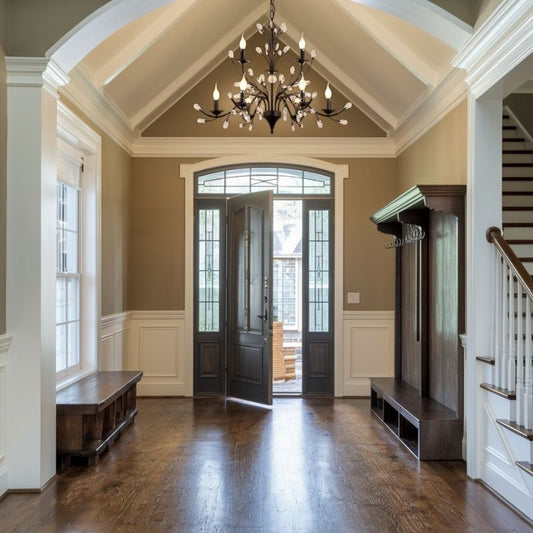
The Wrought Iron Chandeliers, 6–9 Lights is the traditional foyer chandelier in its plainest form: candle-style arms on a forged frame, in black for a rustic or Spanish entry and gold for a more formal one. The 6-light size suits a 10-foot foyer with a standard ceiling; the 9-light version has the spread for a larger or two-story entry. Fit 2700K LED candelabra bulbs and it draws under 50 watts. Related styles sit in the rustic chandeliers and gold chandeliers collections.

The Lyla Crystal Flush Mount Ceiling Light answers the most common traditional-foyer problem: an 8- or 9-foot ceiling that cannot take a hanging chandelier. It keeps the crystal and the warm scatter of light while sitting against the ceiling, which makes it the traditional choice for a single-story entry or the hallway beyond a two-story foyer.
Transitional: crystal in a geometric frame

The Modern Crystal Square Chandelier for Staircase is the textbook transitional foyer fixture: crystal drops for the sparkle of a traditional chandelier, hung from a square frame that reads as modern. At 30 by 30 inches and 45 inches tall with LED lighting, it is sized for a two-story entry or stairwell and works in a house whose foyer is older than its interior.

The Gold Crystal Ball Chandelier for High Ceiling and Staircase mixes the other way: a modern cascading-sphere form in gold with crystal. It suits a two-story foyer where the stair rail or hardware is brass and the rest of the house is contemporary — the finish ties it to the traditional details, the form to the modern rooms.
Modern: linear pendant and ceiling-mounted chandelier
The Jonas Postmodern Style Staircase Pendant Chandelier Light is modern foyer lighting for a tall entry: a vertical pendant of geometric shapes in black, gold, or silver that fills a two-story void or stairwell without the mass of a tiered chandelier. Its drop reads from the landing, and the finish options let it match black, brass, or nickel hardware.
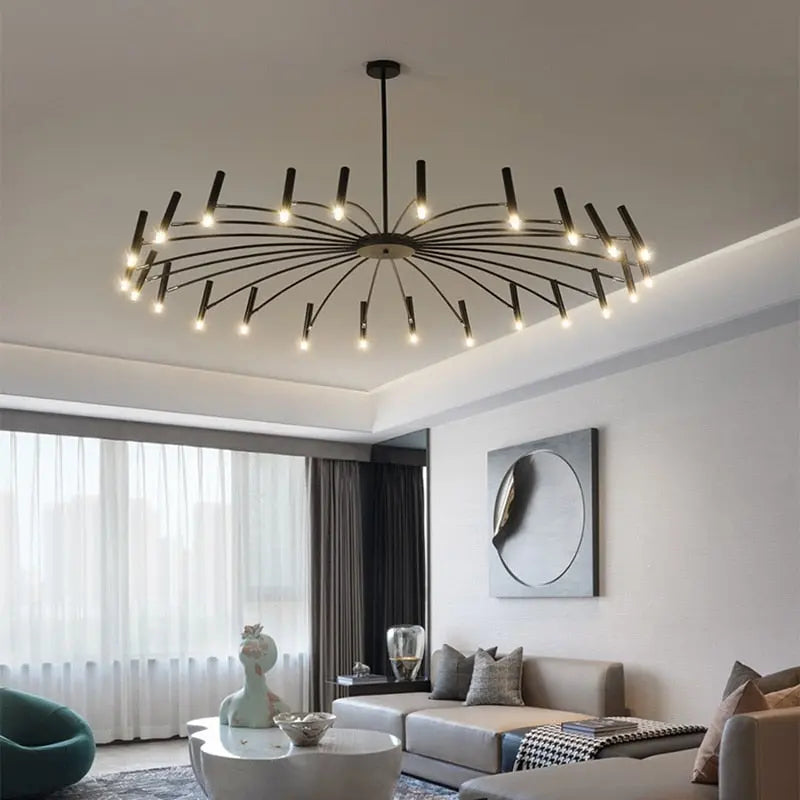
The Berny Ceiling Modern Chandelier, in 12, 18, or 24 lights, is the modern answer to a standard-height foyer. It mounts at the ceiling with a full branching form, so an 8- or 9-foot entry gets a chandelier's presence without a drop that would block the door swing or a walkway.
Sizing, Hanging Height, and Light Color Apply to Both
Style changes the look; it does not change the rules. Whichever you choose, size the fixture to the foyer's length plus width in inches, keep the bottom at least 7 feet above the floor and every stair tread, set a two-story fixture's bottom at or slightly above the second-floor line, and light at 2700–3000K on a dimmer. A ceiling box rated for the fixture's weight — 50 pounds standard, a joist brace above that — matters more for a traditional crystal chandelier, which is usually heavier than a modern fixture of the same diameter. The chandelier installation guide covers the mechanics, and the foyer ceiling lighting ideas post shows more fixtures in each style.
Cost, Energy, and Maintenance by Style
| Traditional | Modern | |
|---|---|---|
| Purchase | $150 for a simple lantern or iron chandelier; $600–$2,000+ for large crystal tiers | $200 for a ring or globe; $800–$1,500+ for statement clusters and linear pendants |
| Bulbs / LED | Bulbs are yours to choose and replace; LED candelabra bulbs cut a 9-arm fixture to ~45 W | Integrated LEDs rated for 25,000–50,000 hours; not user-replaceable on most models |
| Dimming | Needs dimmable bulbs and a compatible dimmer | Often built in; check the driver's dimmer compatibility |
| Cleaning | Crystal dusted monthly, washed once or twice a year | Wiped down; glass globes cleaned as needed |
| Installation | Heavier; may need a braced box | Lighter; standard box usually fine |
On a five-year view the running costs are close to identical once a traditional fixture has LED bulbs. The practical difference is repairability: a traditional chandelier with a failed socket is a $5 part, while a modern fixture with a failed integrated LED module may need a driver or a whole-fixture replacement under warranty. Weigh that against the modern fixture's built-in dimming and control, which a traditional fixture can only approximate with the right bulb and switch.
Traditional crystal and iron, modern pendants and clusters, and transitional designs in between.
Foyer Lighting Crystal Foyer Modern Foyer Two-Story Foyer
Frequently Asked Questions
What is traditional foyer lighting?
Traditional foyer lighting is entryway lighting built on historical fixture forms: multi-arm chandeliers with candle-style sockets, crystal-draped tiers, lanterns, and ornate flush mounts. The materials are crystal, brass, bronze, and wrought iron, the shapes are symmetrical and detailed, and the light is warm and diffused. It suits colonial, Georgian, Tudor, Mediterranean, and other homes with classic architectural detail — crown molding, paneling, a curved staircase.
What is the difference between modern and traditional foyer lighting?
Traditional foyer lighting uses ornate, symmetrical forms in crystal, brass, bronze, or wrought iron with warm, diffused light; modern foyer lighting uses clean geometric forms in glass, steel, black or brushed metal, with integrated LEDs and cooler, more directional light. Traditional fixtures suit homes with classic architectural detail; modern fixtures suit open-plan, minimalist, and newly built homes. Modern fixtures more often include integrated LEDs, dimming, and smart control; traditional fixtures rely on the bulb you choose for those features.
How do I choose between modern and traditional lighting for my foyer?
Match the fixture to the architecture first: crown molding, paneling, and a curved stair point to traditional; flat trim, open sightlines, and large windows point to modern. Then check ceiling height and foyer size — a two-story foyer takes a tiered or vertical fixture in either style, a standard 8- to 9-foot entry needs a flush or semi-flush version. Confirm the light output (a foyer needs roughly 10 to 20 lumens per square foot) and set a budget. If the home mixes eras, or you want a fixture that survives a redecoration, choose transitional: a classic form in a modern finish, or crystal in a geometric frame.
What is transitional foyer lighting?
Transitional foyer lighting blends a traditional element with a modern one so the fixture fits both classic and contemporary interiors. Common combinations are crystal in a square or linear frame, a multi-arm chandelier in matte black or brushed brass, or a lantern shape with clear glass and a slim frame. It is the safest choice for a home whose rooms mix styles, or when the foyer opens onto a modern living space in an older house.
Are traditional foyer chandeliers still in style?
Yes. Crystal, brass, and wrought iron foyer chandeliers remain the standard for homes with classic architecture, and the traditional forms are the basis of most current transitional designs. What has changed is scale and finish: today's traditional fixtures are cleaner, in aged brass or matte black rather than polished gold, and run LED bulbs. A traditional chandelier looks dated only when its scale or finish fights the rest of the house.
Which style is better for a two-story foyer?
Both work; the requirement is vertical presence, not style. A two-story foyer needs a fixture that reads from the ground floor and the landing — a tiered crystal chandelier or long lantern in traditional, a cascading pendant cluster or vertical sputnik in modern. Size it at about 2 to 3 inches of diameter per foot of the foyer's combined length and width, hang the bottom at or slightly above the second-floor line, and keep at least 7 feet of clearance over the floor and every stair tread.
Which foyer lighting style is more energy efficient?
Modern fixtures are more often built with integrated LEDs, so they are efficient out of the box. A traditional fixture can match them: fit LED candelabra or A-shape bulbs at 2700K, and a nine-arm chandelier draws roughly 40 to 55 watts total instead of 360 to 540 with incandescents. The real efficiency difference is in dimming and control — many modern fixtures include dimmable drivers or smart control, while a traditional chandelier needs a dimmer-compatible bulb and a compatible wall dimmer.
What color light should a foyer have?
Warm white, 2700K to 3000K, for both styles. It flatters crystal and brass on a traditional fixture and keeps a modern black-and-glass fixture from feeling clinical. Aim for 10 to 20 lumens per square foot across the foyer, choose CRI 90 or higher so finishes and flooring read true, and put the main fixture on a dimmer for evening use.
Does foyer lighting need to match the rest of the house?
It should relate, not match. The foyer fixture sets the expectation for the rooms beyond it, so its style and finish should agree with what is visible from the entry — the stair rail, the dining room chandelier if in sightline, the hardware. Repeating one finish (matte black, aged brass) across the visible fixtures ties them together even when the forms differ. A foyer fixture that is a different era from every visible room is the one combination to avoid.
Which foyer lighting style costs more?
Ranges overlap widely. Modern foyer fixtures generally run from a few hundred dollars to about $1,500 for statement pieces; traditional fixtures from under $200 for a simple lantern or wrought iron chandelier to $2,000 or more for large crystal tiers. Crystal and hand-finished metalwork push the price of traditional fixtures up; integrated LED arrays and smart drivers push modern ones up. Installation cost is similar for both and depends on weight and ceiling height rather than style.
Choosing the Right Style for Your Foyer
The choice between traditional and modern foyer lighting is made by the house, not the catalog: read the trim, the stair, and the finishes visible from the door, and pick the style that agrees with them, or a transitional fixture when they disagree with each other. Then let ceiling height and foyer size set the form, and check lumens and color temperature before the price. Both styles follow the same sizing and hanging rules, so a well-chosen fixture in either will do its job for years.
Compare fixtures in the foyer lighting collection, or go straight to crystal foyer chandeliers for traditional and transitional designs and modern foyer chandeliers for contemporary ones. For which fixture type a foyer needs before style comes into it, read what type of lighting is best for a foyer.


