

Sculptural lighting is lighting designed as an object first — a fixture that holds a room the way a sculpture does, switched off or on. Sculptural chandeliers are the largest part of it, and this guide sorts them by form, from branches and flowers to rings, belts, abstract and articulating designs, glass, and crystal cascades, then covers sculptural pendants and sconces, project-scale guidance for architects and designers, and how to choose and size one.
Key Takeaways
| Question | Answer |
|---|---|
| What is sculptural lighting? | Fixtures designed as three-dimensional objects first and light sources second — chandeliers, pendants, sconces, and lamps whose form, texture, and composition are the point. |
| What is a sculptural chandelier? | A chandelier composed as an artwork: branches, flowers, rings, belts, abstract lines, articulating rods, blown glass, or crystal cascades. |
| Where do sculptural chandeliers work best? | Dining rooms, living rooms, staircases, and foyers — a branch piece like the Minas Dimmable Rustic Tree Branch Chandelier over a long table, a cascade in a two-story void. |
| Can sculptural chandeliers be modern? | Yes — rings, belts, abstract geometry, and articulating LED rods, such as the Aysan Modern Ring Chandeliers and the Gelman Modern Belt Chandelier. |
| Are sculptural pieces only for large spaces? | No. Compact designs like the Eryx Flower Pendant Light, the Belia Modern Ceiling Chandelier, or a linear branch such as the Orgi Statement Linear Branch Chandelier suit standard ceilings. |
| How do I add sculptural lighting beyond the ceiling? | Sculptural pendants over islands, wall pieces like the Calla Modern Leaf Wall Lamp, and glass or mushroom lamps at eye level, in the same motif or material. |
| How do I choose? | Match the family to the room's language, size to length + width in inches (plus extra for height), light at 2700–3000K on a dimmer, one hero per sightline. |
Quick Facts
- Sculptural lighting = form first, light second; it should look composed with the power off.
- Eight chandelier families: branch, floral, ring, belt, abstract, articulating, glass, crystal/stone cascade.
- Sculptural ≠ statement: statement is about effect and scale; sculptural is about form. Most sculptural pieces are statements; not all statements are sculptural.
- Sizing: length + width (ft) = diameter (in); add 2–3 in per foot of ceiling over 8 ft; 7 ft clearance under walkways.
- Light: 2700–3000K in homes, 3000–3500K in offices and showrooms, CRI 90+, dimmable.
- Rule: one sculptural fixture per sightline; supporting fixtures simple.
What Is Sculptural Lighting?
Sculptural lighting borrows its logic from sculpture: the object is composed for its shape, volume, and material, and the light is one property of that object rather than its purpose. Four traits define it. An expressive form — branches, flowers, rings, belts, bubbles, or abstract geometry — that references art, nature, or architecture. Multi-directional volume, so the piece reads from below, from the side, and from across the room, which is why it suits foyers, stairwells, and open plans where it is seen from many angles. Material contrast: metal with glass, crystal with stone, opaque with transparent. And light that does two jobs, throwing ambient glow into the room while picking out the fixture's own structure. A sculptural chandelier is the most common form; sculptural pendants, wall sconces, and floor and table lamps carry the same idea to other heights.
Sculptural is not the same as statement. A statement chandelier is defined by its effect — it leads the room through scale, contrast, or drama, and a large traditional crystal tier qualifies. A sculptural chandelier is defined by its composition, and can be a statement at 24 inches. The statement chandelier guide covers the traits that make a fixture lead a room; this guide covers the forms. Curved, irregular, and organic shapes dominate current sculptural lighting because interiors have moved toward softer geometry, but the abstract and articulating families show that pure geometry can be just as sculptural. The statement chandeliers collection gathers the pieces designed to lead.
1. Branch and Organic Sculptural Chandeliers
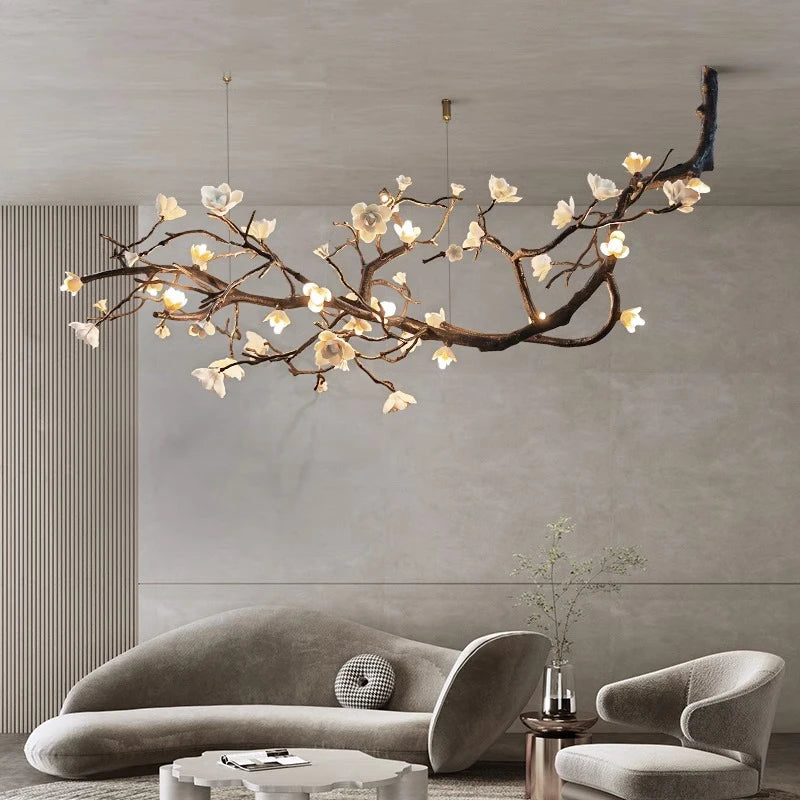
Branch chandeliers are the most approachable sculptural form: their irregular silhouettes echo real limbs, which warms high ceilings and long rooms. The Minas Dimmable Rustic Tree Branch Chandelier wraps a canopy of branches with glass globes for a farmhouse dining table or rustic-contemporary living room; the Orgi Statement Linear Branch Chandelier stretches the branch into a long line for rectangular islands and tables.

The Alba Tree Branch Chandelier spreads its branching arms wider and higher — the centerpiece form for an entry hall or a generous living room — and the Asut Sculptural Branch Chandelier distills the branch into angular, winter-tree lines for modern rooms.

Placement follows shape: a linear branch like Orgi should echo the surface below it, while a radial form like Alba or Minas sits at the center of a room or foyer. The tree branch chandelier guide covers sizing and hanging in detail, the biophilic lighting guide puts branch forms in a wider nature-led scheme, and the branch chandelier collection has the range.
2. Floral Sculptural Chandeliers
Flower-based sculptural chandeliers suit bedrooms, dining rooms, and lounges that want softness without losing presence, and they bridge classic and modern because petals can be stylized or romantic. The Noa Flower Branch Chandelier blends branch lines with blossoms for both directional spread and organic detail.

The Zenth Vintage Flower Chandelier leans vintage with layered floral heads, right above a formal dining table that still wants personality.

The Eryx Flower Pendant Light scales the floral idea to a pendant for grouping over an island or hanging at a bedside.

With several floral pieces in one home, keep the metal finish and the color temperature consistent so the language reads as intended: warm brass at 2700–3000K reads cozy and classic; black or nickel at 3000K reads crisper. Keep 4000K and above out of living spaces on any sculptural fixture — it flattens the material contrast the form depends on.
3. Rings, Belts, and Minimal Geometry
Not every sculptural piece imitates nature. A modern sculptural chandelier often uses pure geometry and crisp LED lines for the same presence. The Aysan Modern Ring Chandeliers stack and tilt lit rings into a floating, architectural composition for foyers and double-height living rooms.

The Gelman Modern Belt Chandelier twists glass and metal into belt-like loops — a sculptural profile that reads rich but firmly contemporary — and the compact Belia Modern Ceiling Chandelier brings structured geometry to a standard-height bedroom or small dining area.

Abstract and articulating chandeliers
Two sub-families deserve their own names. An abstract chandelier depicts nothing — it is composed from loops, planes, scattered rods, or asymmetric clusters for their own sake, like a hanging abstract sculpture; belt and ribbon designs such as Gelman sit here, as do twisted-loop and scattered-tube pieces, and they belong in minimalist and gallery-like rooms where an organic or traditional form would jar. An articulating chandelier has arms, rods, or heads that pivot, so its silhouette and light direction can be adjusted after installation. The Radiel Modern LED Chandelier is the type: multiple rod heads that form a graphic, linear canopy over a long dining table or open kitchen, with the arms angled to suit the room. For articulating designs, check the pivot range and whether the arms lock; for abstract ones, check the piece from every angle it will be seen from, since there is no "front."

In minimal spaces, let one expressive geometric piece lead and keep the rest of the lighting recessed or simple. See the minimalist and modern fixtures guide and the modern chandeliers collection.
4. Sculptural Glass Lighting
Glass is the most sculptural material lighting has, because it is shaped by the light passing through it: blown globes, ribbed or smoked cylinders, and wave-formed panels all change as the room's light changes. The Modern Ocean Wave Pendant Chandelier shapes a linear fixture into a frozen wave over an island or table; bubble and globe clusters from the bubble chandeliers collection read as dew or buds and scatter light in every direction. Sculptural glass suits tight rooms particularly well — it takes up visual space without visual weight. The crystal vs glass guide explains how the two materials differ in sparkle and weight.
5. Staircase Sculptural Chandeliers: Cascades for Vertical Space
Stairwells and double-height foyers give a sculpture room to breathe, and the vertical light also makes the stair safer. The Calla Luxury Staircase Chandelier drops layered, leaf-like forms in a sweeping column — the form for a curved or U-shaped stair.

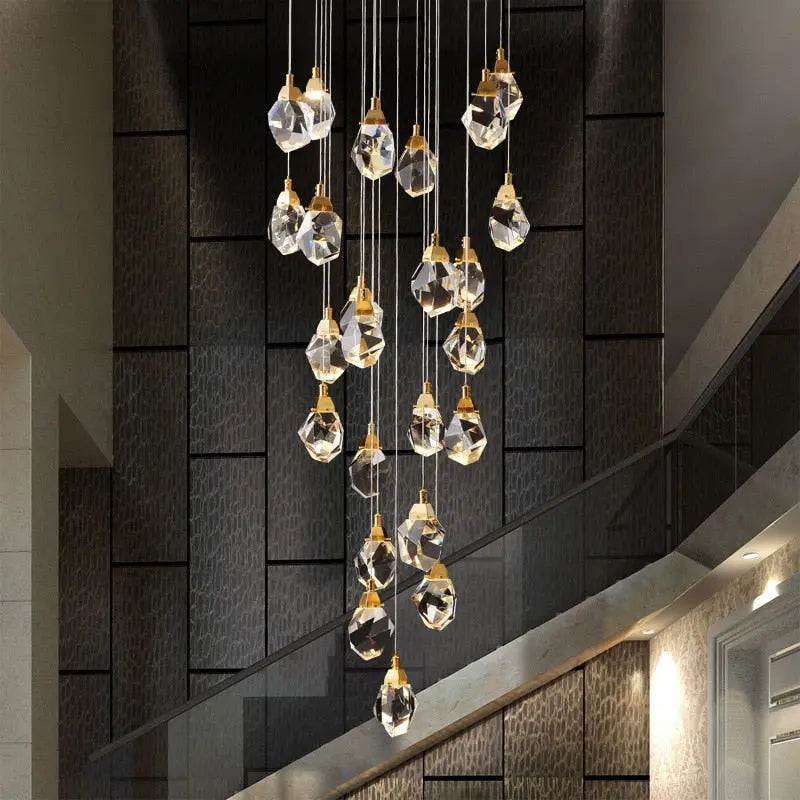
The Aten Crystal Staircase Chandelier combines spiral or olive-shaped crystal strands into a sculptural waterfall for very tall voids, with remote dimming on several configurations.


Large crystal cascades of this kind fill a tall foyer with both light and texture. For any staircase sculpture, measure the total drop, keep 7 feet of clearance over every tread and landing, and set the bottom at or slightly above the second-floor line; height-adjustable suspension and remote dimming make daily use easier. The stairwell chandelier size guide has the numbers, and the oversized chandeliers collection covers extreme heights.
6. Crystal, Stone, and Brass Sculptures for Foyers
A foyer sculptural chandelier sets the tone for the house and is seen from more angles than any other fixture, which is exactly what a three-dimensional design is for. The Art Stone Crystal Chandelier for Entryway hangs stone-like crystal forms as a suspended sculpture that suits classic and modern foyers alike.

The Auric Antique Vintage Brass Crystal Chandelier wraps crystal tiers in warm brass — a more traditional sculptural presence for hotels, restaurants, and formal homes — and answers the sculptural-brass brief directly.

In a smaller entry hall, choose diameter first and drop second so the piece doesn't crowd the space sideways; glass and crystal forgive tight rooms because they read lighter than solid metal. The entryway chandelier guide covers the foyer specifically.
7. Sculptural Lighting Beyond the Chandelier
Sculptural lighting doesn't stop at the ceiling rose, and a scheme reads as designed when the chandelier's idea is echoed at other heights. Sculptural pendants bring it to islands and bedsides: the Eryx flower pendant above, the wave-formed Ocean Wave, or a reflective sphere such as the Spark Ball Stainless Steel Pendant Light, which works as a small sculpture over an island or in a hallway. Sculptural wall pieces carry it through corridors and stairwells: the Calla Modern Leaf Wall Lamp supports a Calla staircase chandelier or any organic ceiling fixture, and in narrow spaces gives a three-dimensional form without costing headroom.

At eye level, sculptural floor and table lamps finish the layer: the Glowlia Glass Shade Floor Lamp is a blown-glass dome on a slim stand, and the Modern Mushroom Table Lamp a glossy cap on a stem — both objects first. The pairing rule: one sculptural chandelier per room, one or two supporting sculptural pieces in the same material or motif (leaf sconce with a branch chandelier, glass lamp with a glass pendant), and everything else plain.
8. Dining and Living Rooms: Matching the Sculpture to Everyday Use
Dining and living rooms see daily use, so a sculptural piece there has to balance presence with function and upkeep. Linear sculptures — Orgi, Gelman, Radiel, a linear crystal — suit long tables and sectionals, keeping visual weight aligned with the furniture; radial or clustered sculptures — Minas, Alba, Aysan — suit centered or circular seating. Dimmable warm light at 2700–3000K keeps the room from turning cold, and a highly reflective crystal piece such as the Modern Crystal Chandelier for High Ceiling Living Room benefits from fabric seating and matte finishes nearby to keep glare down.
For dining specifically, the dining room statement lighting guide covers shape, height, and table pairing; for living rooms, the focal point chandelier guide covers placement in open plans.
9. For Architects, Designers, and Showrooms
Sculptural lighting is specified for lofts, offices, creative workspaces, hospitality, and showrooms more often than for any other fixture type, because it does the decorative work a room without furniture can't. The project considerations differ from a home purchase in six ways.
| Consideration | What to specify |
|---|---|
| Scale for volume | Base diameter = length + width (ft) in inches, plus 2–3 in per foot of ceiling over 8 ft; in double-height lofts and atriums choose forms with vertical presence (cascades, stacked rings, tall branches) that read from the mezzanine and the entry. |
| Family by program | Abstract, articulating, and linear for workspaces and meeting tables; rings and belts for lobbies and open plans; branch and floral for hospitality and residential-feel spaces; crystal and stone cascades for entries and stair voids; sculptural glass for retail and showrooms where the fixture should not block sightlines to product. |
| Light source and control | Integrated LED with stated lumens, 3000–3500K for work and retail, 2700–3000K for hospitality; CRI 90+; dimmable driver on a named protocol (0–10V, phase, DALI) that matches the control system; check whether LED modules are replaceable. |
| Finish coordination | One accent metal repeated across the project's visible fixtures (brass, black, or nickel); glass and crystal read as neutral. Custom finishes and sizes lengthen lead time — confirm before the schedule is fixed. |
| Structure and mounting | Weight against the box or slab, a rated brace or structural anchor for anything over 50 lb, canopy size for the ceiling condition, suspension length adjustable on site, and access for cleaning at height. |
| Hierarchy | One hero sculptural fixture per sightline or zone, with task and ambient layers underneath it; a second sculptural piece only where sightlines don't overlap (a lobby cascade and a meeting-room linear, for example). |
Oversized and long-drop options for atriums and stair voids are in the oversized chandeliers collection; the hospitality and retail chandelier guide and custom chandelier guide cover project-specific work.

10. Buying Checklist for Sculptural Chandeliers
Sculptural fixtures are more involved than a flush mount, and a large piece is hard to return once it arrives, so check these before ordering.
- Measure volume, not just diameter: maximum height, room width, and distance to doors, balconies, and walkways.
- Confirm weight and mounting: the ceiling box or slab must carry the fixture; anything over 50 lb needs a brace or structural anchor.
- Check the light source: integrated LED or bulbs, lumens, color temperature, and dimming compatibility with the controls you have.
- Review assembly: sculptural pieces often ship in parts with a specific order of assembly; read the instructions before delivery day.
- View it from every angle it will be seen from: foyers, stairwells, and open plans see the piece from above and the side, not just below.
- Plan professional installation for staircase, foyer, and heavy crystal pieces — it protects the fixture and makes height and alignment easier to fine-tune.
11. Comparing Sculptural Chandeliers by Type
Cost spreads with scale, material, and craftsmanship — crystal-heavy and tall staircase models sit at the top, compact branch, ring, and pendant designs at the accessible end — and installation, any electrical upgrade, and a compatible dimmer belong in the budget. The table sorts the families by scale and room rather than price; see the chandelier cost guide for current ranges.
| Type | Examples | Scale | Best for |
|---|---|---|---|
| Compact geometric | Belia, Eryx pendant | Small; standard ceilings | Bedrooms, small dining areas, home offices |
| Linear branch / articulating | Orgi, Radiel, Asut | Long; standard to 10 ft ceilings | Rectangular tables, islands, meeting tables |
| Radial branch / floral | Minas, Alba, Noa, Zenth | Medium to large | Dining rooms, living rooms, medium foyers |
| Ring / belt / abstract | Aysan, Gelman | Medium to large; tall rooms | Foyers, double-height living, lofts, lobbies |
| Sculptural glass | Ocean Wave, bubble clusters | Small to medium | Islands, modern dining, showrooms |
| Crystal / stone cascade | Calla, Aten, Art Stone, Auric, Teny | Large; long drop | Stairwells, tall foyers, hospitality |
12. How to Choose the Right Sculptural Chandelier for Your Style
Start from the room's existing language, then pick a chandelier that reinforces it or deliberately contrasts it.
Quick decision guide
Rustic or nature-led room: branch and floral — Minas, Alba, Noa, Asut • Clean, contemporary room: rings, belts, abstract, articulating — Aysan, Gelman, Radiel • Modern kitchen or showroom: sculptural glass — Ocean Wave, bubble clusters • Classic or formal room: crystal, stone, brass — Auric, Art Stone, Teny • Stairwell or two-story foyer: cascades — Calla, Aten • Any room: one sculptural hero per sightline, 2700–3000K on a dimmer, size to length + width in inches.
Branch, floral, ring, belt, glass, and crystal cascade chandeliers, plus sculptural pendants and sconces.
Statement Chandeliers Branch Modern Oversized
Frequently Asked Questions
What is sculptural lighting?
Sculptural lighting is any fixture designed as a three-dimensional object first and a light source second — a piece that holds a room the way a sculpture does, switched off or on. Sculptural chandeliers are the largest category, but the term also covers sculptural pendants, wall sconces, floor lamps, and table lamps. The defining traits are an expressive form (branch, flower, ring, belt, abstract geometry, cascade), volume that reads from several angles, material contrast such as metal with glass, and light that highlights the fixture's own structure as well as the room.
What is the difference between a sculptural chandelier and a statement chandelier?
A statement chandelier is defined by its effect — it is the room's focal point through size, contrast, or drama, and a large traditional crystal tier can be one. A sculptural chandelier is defined by its form — it is composed as an object with shape, volume, and material as the point, and it usually reads as art even at a modest size. Most sculptural chandeliers are statement pieces; not every statement chandelier is sculptural.
What are the main types of sculptural chandeliers?
Eight families cover most sculptural chandeliers: branch and organic forms; floral and petal forms; rings and stacked geometry; belts, ribbons, and twisted lines; abstract compositions that reference nothing literal; articulating designs with adjustable arms or heads; sculptural glass — blown globes, waves, ribbed or smoked glass; and crystal or stone cascades for tall spaces. Each suits different rooms and interior styles, and the choice usually follows the room's existing language: organic forms for rustic and nature-led rooms, geometry and abstraction for contemporary ones, cascades for double-height voids.
What is an abstract chandelier?
An abstract chandelier is a sculptural fixture whose form doesn't depict anything — no branches, flowers, or candles — but is composed from lines, loops, planes, or clusters for their own sake, like a hanging abstract sculpture. Belt and ribbon chandeliers, twisted-loop designs, scattered-rod compositions, and asymmetric clusters of tubes or spheres are the common types. They suit contemporary, minimalist, and gallery-like interiors where an organic or traditional form would feel out of place.
What is an articulating chandelier?
An articulating chandelier has arms, rods, or heads that pivot or rotate, so the fixture's shape and light direction can be adjusted after installation. Multi-rod LED designs with individually angled heads are the typical form. They are useful over long tables, kitchen islands, and workspaces where the light needs to be aimed, and in rooms where the fixture's silhouette should be tuned to the ceiling or furniture rather than fixed at the factory. Check the pivot range and whether the arms lock in position.
Can a sculptural chandelier work in a small room or on a standard ceiling?
Yes. Choose diameter by the room — length plus width in feet as inches — and keep the form open and the drop short. Linear branch chandeliers over a table, compact ring or belt designs, and sculptural pendants scale the idea down to an 8- or 9-foot ceiling; glass and crystal forms suit tight rooms because they read lighter than solid metal. Keep one sculptural piece per sightline and the supporting fixtures simple so the room doesn't feel crowded.
What sculptural lighting works for lofts, offices, and creative workspaces?
Spaces with exposed structure and long sightlines take abstract, articulating, and linear sculptural fixtures best — multi-rod LED chandeliers over worktables, long branch or belt chandeliers over meeting tables, oversized rings in double-height volumes. Specify integrated LED at 3000K to 3500K for work areas, dimmable drivers, and a form that reads from the mezzanine or entry as well as from below. One hero fixture per zone, with task light layered underneath.
How do I size a sculptural chandelier for a double-height space?
Size for volume, not just floor area: add the room's length and width in feet for a base diameter in inches, then add 2 to 3 inches per foot of ceiling height above 8 feet, and choose a form with vertical presence — a cascade, a stacked ring, a tall branch — so it reads from the upper level. Keep the bottom at least 7 feet above the floor and every stair tread, set it at or slightly above the second-floor line in a stairwell, and confirm the ceiling structure can carry the weight.
Is sculptural lighting only chandeliers?
No. Sculptural pendants — single flower heads, reflective spheres, wave-shaped linear pieces — bring the idea to islands and bedsides; sculptural wall sconces such as leaf forms carry it into hallways and stairwells; and sculptural floor and table lamps — glass domes, mushroom shapes — supply it at eye level. A coordinated scheme pairs one sculptural chandelier with one or two of these in the same material or motif.
What color light suits a sculptural chandelier?
Warm white, 2700K to 3000K, in living, dining, and bedroom areas, on a dimmer, so the fixture's structure is lit warmly and the room stays comfortable. Neutral 3000K to 3500K suits offices, showrooms, and gallery-style spaces where the piece should read crisp by day. Avoid 4000K and above in homes; on a sculptural fixture it flattens material contrast and turns the room clinical. Choose CRI 90 or higher so brass, glass, and crystal show true.
Choosing a Sculptural Chandelier That Reads as Art
Sculptural chandeliers are no longer reserved for galleries and hotels; they are working light fixtures that also serve as permanent artworks in homes, offices, and showrooms. Knowing the families — from branches and flowers to rings, belts, abstract and articulating forms, glass, and crystal cascades — makes the choice a matter of matching form to room, and the sizing, light, and mounting rules take care of the rest. A well-chosen sculptural piece does three jobs at once: it shapes the space visually, it gives comfortable, useful light, and it says something about the people who use the room.
Browse the statement chandeliers collection for pieces designed to lead a room, the branch chandelier collection for organic forms, and the modern chandeliers collection for rings, belts, and abstract geometry. For what makes any chandelier lead a room, see what makes a chandelier a statement piece.


