

Crystal and glass chandeliers can look alike in a photo and behave very differently in a room. Crystal bends and splits light into sharp sparkle and rainbow flashes; glass gives a softer glow and relies on shape, color, and finish. This guide covers how to tell the two apart with six simple tests, what each material actually is, the common crystal drop shapes, the practical differences in sparkle, weight, cost, and cleaning, and which material suits which room.
Key Takeaways
| Question | Answer |
|---|---|
| How do I tell crystal from glass? | Rainbow test, weight, facet sharpness, mold seams and bubbles, tap ring, maker's mark — use several together. |
| What's the real difference? | Crystal has a higher refractive index from added minerals: more sparkle and dispersion, more weight, sharper cuts. |
| Which sparkles more? | Crystal — sharp points and rainbow flashes. Glass gives a softer, more even glow. |
| Which is heavier? | Crystal, especially lead crystal; large crystal fixtures often need a brace or structural mount. |
| Which is easier to clean? | Glass. Crystal shows dust and haze on every facet. |
| Which for my room? | Crystal for formal focal points; glass for everyday, modern, and hard-to-reach fixtures. |
Quick Facts
- Crystal = glass + minerals that raise refractive index: lead oxide (lead crystal, typically ~24%+) or barium/zinc/potassium (lead-free, often sold as K9).
- Rock crystal is natural quartz, hand-cut, at the top of the market.
- Six ID tests: rainbow, weight, facet edges, seams/bubbles, tap ring, maker's mark.
- Drop shapes: prism, teardrop/pendeloque, almond, octagon bead, ball, raindrop, icicle, rosette.
- Crystal is heavier: check the box rating (50 lb standard) before hanging a large crystal fixture.
- Light: clear filament LED, 2700–3000K, CRI 90+, brings out crystal; frosted bulbs suit glass globes.
How to Tell If a Chandelier Is Crystal or Glass
No single test proves a chandelier is crystal, but four or five pointing the same way settle it. Work with a single drop or prism where you can — unhook one carefully with the power off — and compare it, if possible, with a piece of ordinary glass of similar size, such as a drinking glass or a glass ornament.
- 1. The rainbow test. Hold a drop in direct sunlight or under a bright clear bulb and look at the wall or a sheet of white paper. Crystal's higher refractive index splits white light into a distinct spectrum — clear bands of red through violet. Glass produces a faint smudge of color or none. This is the most telling quick test, and it works with the fixture still hanging if you shine a strong flashlight through a drop.
- 2. The weight test. Weigh a drop in your palm against a piece of ordinary glass the same size. Lead crystal is markedly denser than standard soda-lime glass and feels heavy for its size; lead-free crystal is usually somewhat heavier than glass too. A whole crystal chandelier is often surprisingly heavy for its diameter.
- 3. Facet edges and clarity. Look along the cut edges with a magnifier or your phone camera zoomed in. Cut-and-polished crystal has crisp, sharp facet lines meeting at clean points and is water-clear. Molded glass has softer, slightly rounded edges and can look faintly gray or green when you look through its thickest part.
- 4. Mold seams and bubbles. Turn the drop slowly against the light. Pressed glass often shows a faint seam line where the mold halves met, and sometimes tiny trapped air bubbles. Quality crystal shows neither. (Hand-blown art glass may have deliberate bubbles — that's a feature of art glass, not a sign of crystal.)
- 5. The tap test. Tap a drop gently with a fingernail or a pencil eraser. Lead crystal gives a short, clear, musical ring; glass gives a dull click or thud. This works best on larger pieces and on lead crystal — lead-free crystal rings less — so treat it as supporting evidence rather than proof.
- 6. Maker's marks and labels. The surest single test. Many quality crystal drops carry a tiny etched logo — Strass (Swarovski's chandelier crystal line) and other makers etch their marks on the drops — and quality fixtures carry a manufacturer's label inside the canopy or on the frame. Check under magnification near the drilled hole of the drop.
Two tests to skip: feeling for coolness (crystal and glass are too close to judge by touch) and scratching (it damages the piece and doesn't separate the two reliably). If the tests disagree and the chandelier may be a valuable antique, a lighting restorer or antiques appraiser can identify the crystal and its maker; the vintage chandelier guide covers rewiring an older piece once you know what it is.
What Is a Crystal Chandelier?
Crystal is glass with added minerals that raise its refractive index — how strongly it bends light — so it splits light into points and rainbow flashes and can be cut with sharper facets than ordinary glass. In a chandelier, the crystal isn't just decoration; it is how the light moves across the walls, ceiling, and table. That is why crystal is chosen for foyers, dining rooms, staircases, and statement living rooms, where the fixture's effect on the room matters as much as its output.
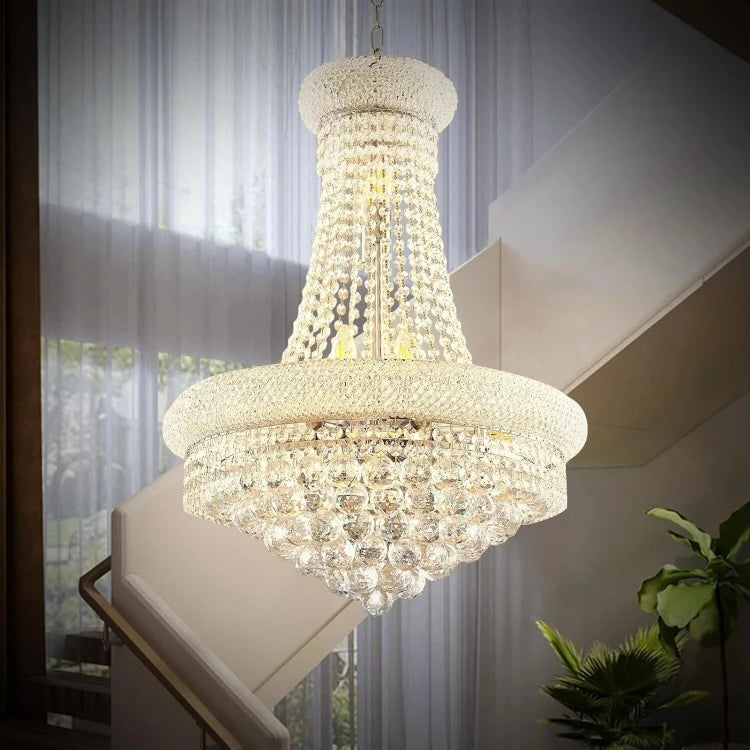
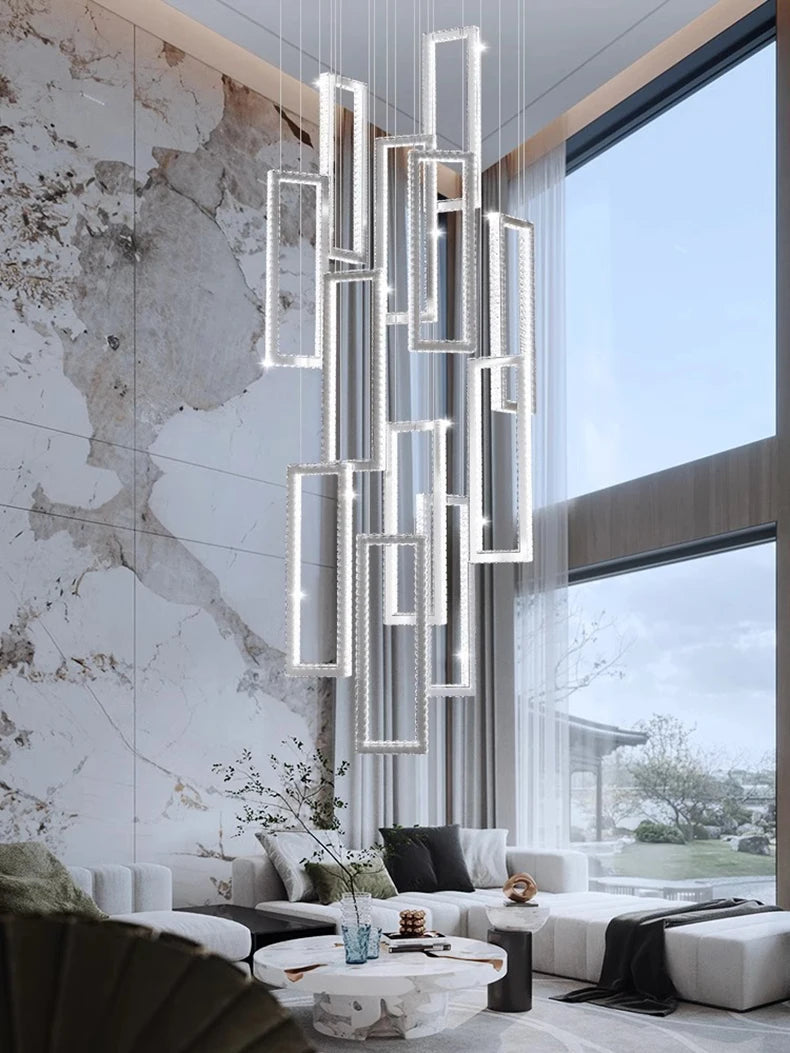
Four types of crystal turn up in chandeliers:
| Crystal type | What it is | Sparkle and weight | Where you find it |
|---|---|---|---|
| Lead crystal | Glass with lead oxide, typically about 24% or more | Highest sparkle and dispersion; heaviest | Vintage and premium fixtures |
| Lead-free crystal | Barium, zinc, or potassium instead of lead; often sold as K9 or similar | High clarity and strong sparkle; somewhat lighter | Most new crystal chandeliers |
| Rock crystal | Natural clear quartz, hand-cut | Soft, deep brilliance; individual character | Highest-end decorative and antique work |
| Machine-cut / molded crystal | Crystal formed and cut by machine | Uniform; sharpness depends on cut and polish quality | Modern fixtures with repeated shapes |
The Sansa Chrome Raindrop Crystal Pendant Chandelier shows crystal at its clearest — smooth raindrops that catch light without a traditional frame — and the Acai Crystal Multi Pendant Chandelier groups crystal pendants on one canopy, the form covered in the crystal pendant lights guide.
Chandelier crystal shapes
Crystal pieces are cut to standard shapes, and knowing the names helps when identifying, replacing, or buying a fixture. Traditional chandeliers combine several; modern ones usually repeat one.
| Shape | Description | Typical use |
|---|---|---|
| Prism | Long faceted bar, often three- or six-sided | Traditional tiers, Hollywood Regency fixtures |
| Teardrop / pendeloque | Pear-shaped drop, faceted | Hanging from arms and tiers; the classic chandelier drop |
| Almond | Flat oval drop with a hole at one end | Swags and strands on traditional frames |
| Octagon bead | Flat eight-sided bead linked with pins into chains | Swag chains and draped strands |
| Ball / sphere | Faceted or smooth crystal ball | Modern cascades and drop finials |
| Raindrop | Smooth or lightly faceted elongated drop | Modern raindrop chandeliers and cascades |
| Icicle / spear | Long tapered point | Mid-century and Regency fixtures |
| Rosette / bobeche | Flat flower-shaped piece under a socket | Candle-arm chandeliers, catching wax originally |
The raindrop form has its own guide in raindrop crystal chandeliers for foyers and staircases.
What Is a Glass Chandelier?
A glass chandelier uses standard decorative glass rather than high-refraction crystal, so it produces a softer, more even glow and relies on silhouette, color, transparency, and surface finish rather than sparkle. That is a design direction, not a lower grade: glass can be minimal, sculptural, colored, or soft, and it fits modern kitchens, casual dining rooms, bedrooms, and mixed-style interiors where crystal can feel too formal or dense.


| Glass type | Light effect | Best in |
|---|---|---|
| Clear glass | Clean, shows the bulb; modest sparkle | Modern dining, kitchens, globe clusters |
| Frosted / opal glass | Soft, diffused, no glare | Bedrooms, halls, family rooms |
| Colored / tinted / smoked | Tints the light; adds tone to the room | Feature rooms, creative spaces, modern glam |
| Textured / seeded / ribbed | Breaks up light into pattern | Farmhouse, coastal, transitional |
| Blown / art glass | Sculptural; each piece varies | Statement pieces in modern homes |
| Recycled glass | Tone variation, small bubbles | Relaxed, rustic, and eco-minded rooms |
The Arcli Contemporary Glass Cluster Chandelier shows clear glass doing the work through form; the Moon Bubble Pendant shows frosted glass at its softest. Glass bubble and globe forms are covered in the bubble chandeliers guide.
Mixed crystal and glass
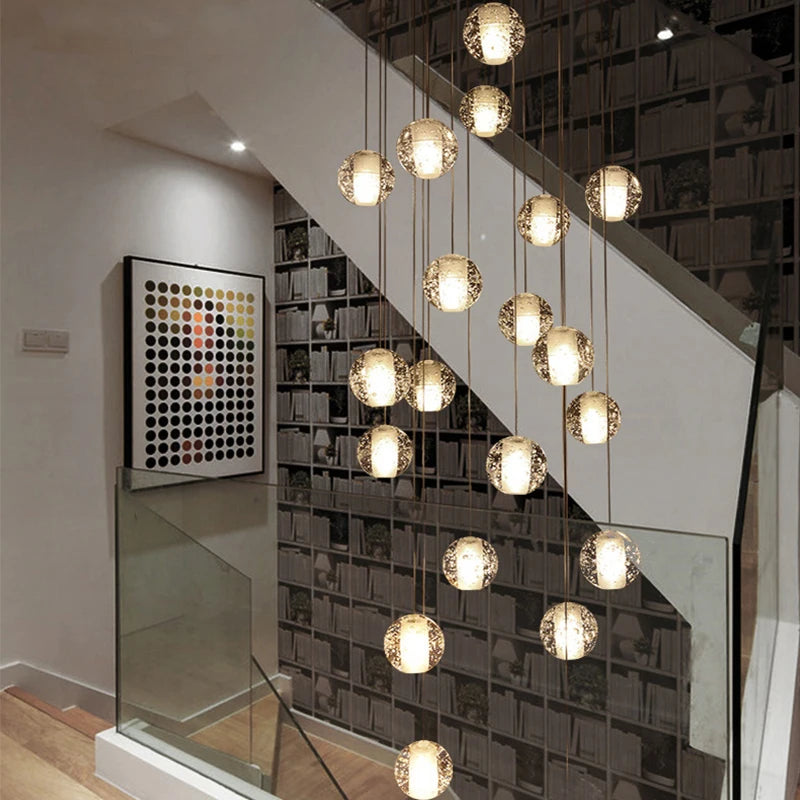
Many modern fixtures combine the two: glass globes or shades for soft, even light with crystal drops or beads for points of sparkle. Listings may call these "crystal glass" fixtures — a term that can mean a mix of materials or simply high-clarity glass — so check the specification if the distinction matters. The Modern Crystal Glass Bubble Chandelier for Foyer is the crossover type: smooth, high-clarity spheres that sparkle more than ordinary glass without crystal's facets.
Crystal vs Glass Chandeliers: Side by Side
| Factor | Crystal | Glass |
|---|---|---|
| Sparkle | Sharp points, rainbow flashes, light thrown across walls | Soft glow, even wash; little dispersion |
| Light in the room | High contrast; the fixture is a light event | Calmer, more even; easier for long evenings |
| Weight | Heavier, especially lead crystal; often needs a brace or structural mount | Lighter; large art glass can still be heavy |
| Cost | Higher; rises with clarity, cut quality, and piece count | Lower at equal size; art glass can match crystal |
| Cleaning | More often; every facet shows dust and haze | Less often; smooth forms wipe quickly |
| Durability | Holds clarity for decades if cleaned; many small parts | Durable; fewer, larger parts |
| Style range | Traditional, transitional, glam, modern crystal | Minimal, sculptural, colored, coastal, farmhouse, modern |
| Best rooms | Formal dining, foyers, stairwells, primary bedrooms | Kitchens, breakfast areas, family rooms, kids' rooms, high fixtures |
Sparkle and light

Crystal's higher refractive index is the whole difference in effect: light entering a cut crystal bends more, splits into colors, and leaves at sharp angles, so a crystal fixture throws points and flashes across the room — strongest at night and on a dimmer. Glass bends light less, so it glows rather than sparkles. Choose crystal when the chandelier should be the room's light event; choose glass when the light should sit quietly in the background. Modern frames like the Zen Modern Round Black and Gold Crystal Chandelier keep crystal's sparkle while dropping the traditional look; the modern vs traditional crystal guide covers that style choice.
Weight and mounting

Crystal's density adds up fast: a large fixture like the Luxury Oversize Crystal Chandelier carries dozens of drops, and multi-tier crystal can exceed the 50-pound rating of a standard ceiling box. Check the fixture weight before buying, use a fan-rated brace or a structural mount above 50 pounds, and have an electrician install large crystal over stairs and in two-story foyers. A glass fixture of the same diameter is usually lighter and simpler to hang. The huge chandelier guide covers heavy-duty mounting.
Cost
Crystal costs more at equal size because of the material, the cutting and polishing, and the weight that adds to shipping and mounting; price climbs with clarity, cut quality, and piece count. Glass is the budget-flexible choice when the design depends on shape rather than sparkle — but hand-blown and colored art glass can cost as much as mid-range crystal, so compare by size, piece count, and finish, not by the material name. The chandelier cost guide covers current ranges.
Cleaning and upkeep
Every crystal facet is a small mirror, so dust, fingerprints, and haze show quickly and dull the sparkle, and a crystal fixture has many more pieces to wipe. Dust crystal monthly and clean each drop every few months with water and a little isopropyl alcohol, drying as you go. Glass globes and shades need less frequent attention and fewer, larger wipes. For a fixture high over a stairwell or foyer, cleaning access becomes part of the material decision: crystal up there wants a lowering system. The crystal cleaning guide and glass cleaning guide cover each.
How to Decide: Crystal or Glass?
| If your room... | Crystal | Glass |
|---|---|---|
| Needs the chandelier as the strongest focal point | Yes | Sometimes, more softly |
| Wants a cleaner, more relaxed effect | Only with a very controlled modern frame | Yes |
| Wants sparkle and light movement | Yes | No |
| Needs easy everyday upkeep | Not usually | Yes |
| Is a formal dining room or grand foyer | Usually yes | Depends on the design direction |
| Is casual, modern, or mixed-style | With the right frame | Usually yes |
| Has a fixture hung very high and hard to reach | Only with a lowering system | Yes |
| Has a ceiling box rated only for 50 lb | Small fixtures only | Most sizes |
Start from the room — its role, ceiling height and support, how much upkeep you'll tolerate, and how much sparkle it actually needs — before the budget. If you're leaning crystal, how to choose a crystal chandelier covers sizing and room fit next.
Bulbs for Crystal and Glass
The bulb decides how much of the material's character shows. Crystal wants clear filament-style LED bulbs, which pass the most light through the facets and produce the sharpest flashes; frosted bulbs soften crystal where the socket is at eye level. Glass globes and shades usually want frosted or opal bulbs so the glass glows evenly without a hot spot; clear globes over a table can take filament bulbs for a visible-bulb look. In both, use 2700K in living, dining, and bedrooms and 3000K in kitchens, CRI 90 or higher so crystal's rainbows stay clean, and a dimmer — crystal sparkles most at a low setting at night.
Quick decision: crystal or glass
Formal dining room, foyer, stairwell, primary bedroom — sparkle wanted: crystal, clear filament bulbs, dimmer • Kitchen, breakfast area, family room, kids' room: glass • Modern room that wants some sparkle: crystal in a modern frame, or mixed glass and crystal • Fixture very high or hard to reach: glass, or crystal with a lowering system • Unknown fixture to identify: rainbow, weight, facets, seams, tap, maker's mark.
Raindrop, cluster, and modern-frame crystal; clear, frosted, and art-glass forms.
Crystal Chandeliers Glass Bubble Modern All Chandeliers
Frequently Asked Questions
How can I tell if a chandelier is crystal or glass?
Use several tests together, since no single one is conclusive. Hold a drop to a window or bright bulb: crystal splits light into a clear rainbow, glass shows little or none. Weigh a drop in your hand against a glass piece of the same size: crystal, especially lead crystal, feels noticeably heavier. Look closely at the facets: cut crystal has sharp, crisp edges and very high clarity, while molded glass has softer edges, faint mold seams, and sometimes tiny bubbles. Tap a drop gently with a fingernail: lead crystal gives a short clear ring, glass a dull click. Finally, look for a maker's mark etched on the drops, such as a Strass or Swarovski logo, or a manufacturer's label on the canopy or frame.
What is the difference between crystal and glass in a chandelier?
Crystal is glass made with added minerals — traditionally lead oxide, now often barium, zinc, or potassium in lead-free crystal — that raise its refractive index, so it bends and splits light more strongly and can be cut with sharper facets. In a chandelier that means more sparkle, more rainbow flashes, more weight, higher cost, and more cleaning. Standard glass refracts less, so it gives a softer glow and relies on shape, color, and finish rather than sparkle; it is lighter, cheaper, and easier to keep clean.
Which is better, a crystal or glass chandelier?
Neither is better outright; the room decides. Crystal is better where the chandelier should be the focal point and sparkle is the point — formal dining rooms, foyers, stairwells, primary bedrooms. Glass is better where you want a softer glow, a modern or relaxed look, lighter weight, or easier upkeep — kitchens, breakfast areas, family rooms, children's rooms, and fixtures that hang high and are hard to clean.
Is crystal heavier than glass?
Yes, usually. Lead crystal is markedly denser than standard soda-lime glass, and even lead-free crystal tends to be heavier than ordinary glass of the same size. A crystal chandelier with dozens of drops can weigh far more than a glass fixture of the same diameter, which is why large crystal chandeliers often need a fan-rated brace or a structural mount rather than a standard 50-pound ceiling box.
What types of crystal are used in chandeliers?
Four main types. Lead crystal, made with lead oxide (typically about 24 percent or more), has the highest sparkle and weight and is found in many vintage and premium fixtures. Lead-free crystal (often sold as K9 or similar) uses barium, zinc, or potassium instead and is the standard in most new chandeliers. Rock crystal is natural quartz, cut by hand and used in the highest-end decorative work. Machine-cut and molded crystal give uniform shapes at lower cost, with sharpness depending on how well the facets are cut and polished.
What are the different chandelier crystal shapes called?
The common shapes are prisms (long, faceted bars), teardrops or pendeloques (pear-shaped drops), almonds (flat oval drops), octagons (eight-sided beads linked into chains or "strands"), balls or spheres, raindrops (smooth or faceted elongated drops), icicles or spears (long tapered points), and rosettes or bobeches (flat flower-shaped pieces under the sockets). Traditional chandeliers combine several shapes; modern fixtures often use one — all raindrops, all spheres, all prisms.
Are glass chandeliers cheaper than crystal?
Generally, yes, at the same size and complexity. Crystal adds material cost, cutting and polishing, and weight that affects shipping and mounting. But art glass — hand-blown, colored, or sculptural pieces — can cost as much as or more than mid-range crystal, so the label alone doesn't set the price. Compare by the fixture's size, piece count, and finish quality, not by material name.
Is a crystal chandelier harder to clean than glass?
Yes. Every crystal facet acts as a small mirror, so dust, fingerprints, and haze show quickly and dull the sparkle, and a crystal chandelier usually has many more small pieces than a glass one. Dust crystal monthly and wipe each drop with water and a little isopropyl alcohol every few months. Smooth glass globes and shades need less frequent cleaning and are easier to reach. For crystal over a stairwell or two-story foyer, plan a lowering system or lift access at purchase.
Do glass chandeliers look cheap?
Not when the glass suits the design. Glass chandeliers rely on form, color, and finish instead of sparkle, and clear globes, frosted shades, blown art glass, smoked or colored glass all read as intentional and current. What looks cheap is glass imitating crystal — thin molded "crystal" drops on a traditional frame — where the lower clarity is obvious next to the real thing. If you want a traditional crystal look, buy crystal; if you want a modern glass look, buy good glass.
Can a chandelier mix crystal and glass?
Yes, and many modern fixtures do: clear or frosted glass globes or shades for soft, even light, with crystal drops or beads added for points of sparkle. The combination gives a softer overall glow than all-crystal and more sparkle than all-glass. Listings may call these "crystal glass" fixtures, which can mean a mix of materials or simply high-clarity glass, so check the specification if the distinction matters.
The Right Material Depends on the Room
Crystal and glass both make good chandeliers; they make different rooms. Crystal brings sparkle, contrast, and a stronger decorative presence and asks for more support and more cleaning in return; glass brings softer light, a wider style range, and easier living. Decide from the room's role, ceiling, and tolerance for upkeep, and if you're facing an unlabeled fixture, let the six tests tell you which one you have.
Compare styles in the crystal chandeliers collection or browse modern chandeliers for glass-led and mixed-material forms. For crystal sizing and room fit, see how to choose a crystal chandelier; for crystal in a modern room, modern vs traditional crystal chandeliers.


