

Key Takeaways
| Question | Answer |
|---|---|
| Where to start? | The room: size, ceiling height, what sits below, and existing style — then the crystal. |
| What size? | Room L + W (ft) in inches; ½–⅔ of table width over a dining table; tall spaces: 2.5–3 in of body height per foot of ceiling. |
| How low? | 30–36 in above a table; 7 ft over walkways; body at or above the second-floor line in two-story foyers. |
| Which crystal? | K9 for clear sparkle at a sensible weight; lead crystal for maximum dispersion; mid-range crystal or glass for a softer look. |
| Which light? | 2700–3000K warm white, CRI 90+, dimmer; cooler light makes crystal look sharper but colder. |
| Practical checks? | Box rating (fan-rated or brace above 50 lb), reach for cleaning, removable crystals, integrated LED vs bulbs. |
Quick Facts
- Room formula: 12 × 14 ft → 26 in; 14 × 16 ft → 30 in; 16 × 20 ft → 36 in.
- Body height in tall spaces: 18 ft ceiling → 45–54 in; 20 ft → 50–60 in.
- K9 is a clear, lead-free optical crystal glass and the most common chandelier crystal; lead crystal contains lead oxide for higher refraction and weight.
- Crystal fixtures weigh more than glass or metal ones of the same size — large pieces often pass 50 lb.
- Clean crystal every 3–6 months; removable drops make it a tabletop job instead of a ladder job.
- Integrated-LED crystal fixtures often ship on 6000K — set to 2700–3000K for warmth.
Recommendations by Room and Ceiling Height
Most chandelier questions come down to two facts about the room: what it is used for and how high the ceiling is. The matrix below gives a crystal chandelier type and size for each combination; the sections after it explain the rules behind it. The same logic applies to choosing any chandelier — swap the crystal for glass or metal and the sizes stay the same.
| Room | 8 ft ceiling | 9–10 ft ceiling | 12 ft and up |
|---|---|---|---|
| Dining room | Compact round or linear crystal, ½–⅔ of table width, 30–36 in above table | Round or linear crystal; tiered over a round table | Tiered or large round crystal; long linear over a long table |
| Living room | Flush or semi-flush crystal, room L + W in inches | Round crystal or crystal ring, 7 ft clearance | Tiered or large round crystal; body 2.5–3 in per foot |
| Foyer / entry | Flush crystal or small drum | Round or tiered crystal, above door height | Vertical, staircase, or large tiered crystal; body at or above second-floor line |
| Bedroom | Flush crystal, 2700K | Small round or ring crystal on a dimmer | Medium tiered crystal |
| Kitchen / island | Compact crystal over a table, flush in the work zone | Linear crystal at about ⅔ of island length, 30–36 in above counter | Linear or two compact crystal fixtures |
| Staircase | Flush crystal on the landing | Medium vertical crystal in the well | Long-drop or cascading crystal; 7 ft over the highest tread |
Size and Drop
Over open floor, add the room's length and width in feet and use the total as the diameter in inches: a 12 by 14 foot room points to about 26 inches. Over a dining table the table decides — half to two-thirds of a round table's diameter, or two-thirds to three-quarters of a rectangular table's length for a linear crystal — and the dining-specific method is in what size chandelier for a dining room. In foyers, staircases, and double-height rooms, height matters as much as width: give the fixture body 2.5 to 3 inches of height per foot of ceiling, so an 18-foot entry takes a 45- to 54-inch body. Hang the bottom 30 to 36 inches above a table and at least 7 feet over any walkway, and in a two-story foyer place the body at or above the second-floor line so it reads from the landing. On a sloped ceiling, judge the fixture from the main viewpoints, not only from directly below. The general method, beyond crystal, is in the chandelier sizing guide.
Style Direction and Finish
| Style | What it looks like | Finish | Rooms it suits |
|---|---|---|---|
| Modern | Clean round, ring, or geometric frames; controlled crystal | Black, gold, black and gold | Flat trim, contemporary furniture |
| Traditional | Candle arms, layered drops, tiers | Gold, brass, antique | Molding, formal dining, classic foyers |
| Transitional | Simple structure with classic crystal detail | Polished nickel, brushed gold | Mixed-style homes — the safest choice |
| Art Deco–inspired | Geometric symmetry, defined frames | Gold, black, chrome | Glam and architectural rooms |
| Rustic crystal | Crystal on iron or darker frames | Black, bronze, aged gold | Farmhouse and modern rustic rooms |
| Linear / vertical | Crystal on long bars or drops | Gold, chrome | Long tables, islands, stairwells |
Finish changes how crystal reads. Gold, brass, and bronze warm it and suit cream, walnut, and traditional rooms; chrome, polished nickel, and silver sharpen it for crisp contemporary spaces; black framing makes crystal look modern and architectural. In a room that mixes styles, a transitional crystal chandelier usually performs better than a very ornate or a very minimal one. Match the frame to the most visible hardware and keep to one metal plus at most one accent. For crystal over a dining table by table shape, see crystal dining room chandeliers by shape and table type.
Crystal Types: What You Are Paying For
| Crystal | Clarity and sparkle | Weight | Where it fits |
|---|---|---|---|
| K9 crystal | High clarity, crisp sparkle; lead-free optical glass | Moderate | Most modern and transitional fixtures; the common standard |
| Lead crystal | Highest refraction and dispersion — the strongest rainbow effect | Heaviest | Traditional statement pieces |
| Precision-cut branded crystal | Very consistent facets and sparkle | Moderate to heavy | Premium fixtures where cut quality is the point |
| Mid-range crystal (e.g., Egyptian) | Good sparkle, more variation | Moderate | Balance of look and cost |
| Glass | Softer, less dispersion | Lighter | Bubble, globe, and budget-friendly designs |
Judge crystal by clarity (no cloudiness), consistency (drops that match), cut precision (sharp, even facets), and how it suits the frame — a modern black frame does not need lead crystal to look right. K9 is technically a high-grade optical glass, which is why the line between crystal and glass is blurrier than marketing suggests; the full comparison is in crystal vs glass chandeliers.
Brightness, Color, and Dimming
The same crystal chandelier can look formal, warm, crisp, or harsh depending on how it is lit. Warm white at 2700–3000K suits dining rooms, living rooms, and bedrooms and keeps crystal glowing rather than glittering coldly; neutral white around 3500K suits kitchens and mixed-use rooms; anything at 4000K and above makes crystal look sharp and the room clinical. Plan 20–30 lumens per square foot in a dining room and 10–20 in living rooms and bedrooms. A dimmer is the most useful upgrade, letting one fixture serve dinner, homework, and evening — match it to the LED driver or bulbs. Many traditional crystal designs still use candelabra (E12) bulbs; integrated-LED crystal fixtures need no bulbs and often switch color by remote — set them warm on first use. Room targets are in how much light does my room need.
Weight, Installation, and Upkeep
Crystal is heavy. A large crystal fixture can pass 50 pounds easily, at which point the ceiling box must be fan-rated or fastened to a brace bar on a joist, and installation becomes a two-person job — a lift or scaffold above 12 feet. Before buying, think about reach: how you will clean it and change bulbs. Fixtures with removable drops can be cleaned at a table; fixed crystal needs a ladder and an in-place method. Integrated LED removes bulb changes for years, which matters most on high ceilings. Installation steps are in how to install a chandelier, and cleaning in how to clean a crystal chandelier without taking it down.
Budget: What Drives the Cost
Price follows five things: crystal type and quantity, overall size, structural complexity (tiers, arms, drops), finish quality, and whether the light source is integrated LED. For an entry-level or budget crystal chandelier, the usual savings are a smaller size correctly scaled to the room, K9 rather than lead crystal, fewer tiers, and a simple modern frame — none of which make the fixture look worse if it fits the room. Spend more where the chandelier carries the most visual responsibility: a tall foyer, a staircase, or the dining room guests see first. A modest crystal fixture at the right size in a bedroom will satisfy longer than an oversized premium piece in the wrong room.
Quick decision: crystal chandelier
8 ft room: flush or compact crystal • Dining table: round or linear crystal at ½–⅔ of table width, 30–36 in above • 9–10 ft living room: round crystal or crystal ring • Tall foyer or staircase: vertical or long-drop crystal, body 2.5–3 in per foot • Modern room: black or gold frame • Mixed styles: transitional crystal • Most fixtures: K9 crystal • Always: 2700–3000K, dimmer, rated box, plan for cleaning.
Crystal Chandeliers for Common Rooms and Ceilings
Eight fixtures that match the matrix above, grouped by where they fit best.
Dining rooms, living rooms, and kitchens
Round, linear, and compact crystal for standard and 9- to 10-foot ceilings.

The Zen Modern Round Black and Gold Crystal Chandelier shows how modern crystal can be decorative without looking traditional: a controlled round frame in black and gold, for a contemporary dining room over a round table or a living room on a 9- to 10-foot ceiling.
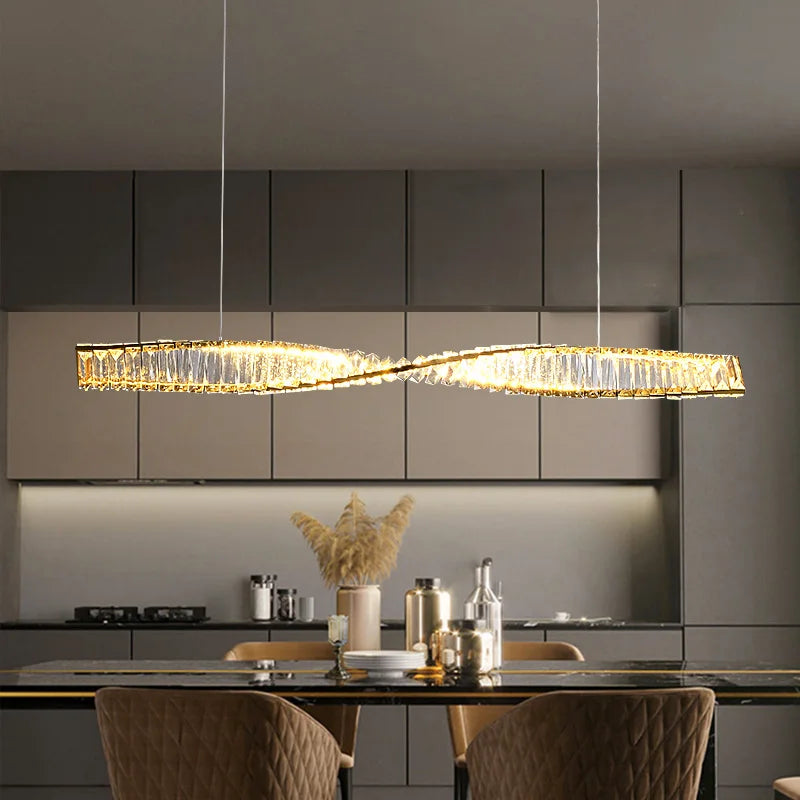
The Moly Linear Crystal Chandelier is the linear crystal for a rectangular dining table or kitchen island, in lengths from about 39 to 59 inches — size it at two-thirds to three-quarters of the table and hang it 30 to 36 inches above.

The Gaia Kitchen Crystal Chandelier is the compact case: a controlled crystal body that scales to normal ceiling heights, for a kitchen table, breakfast nook, or small dining room.
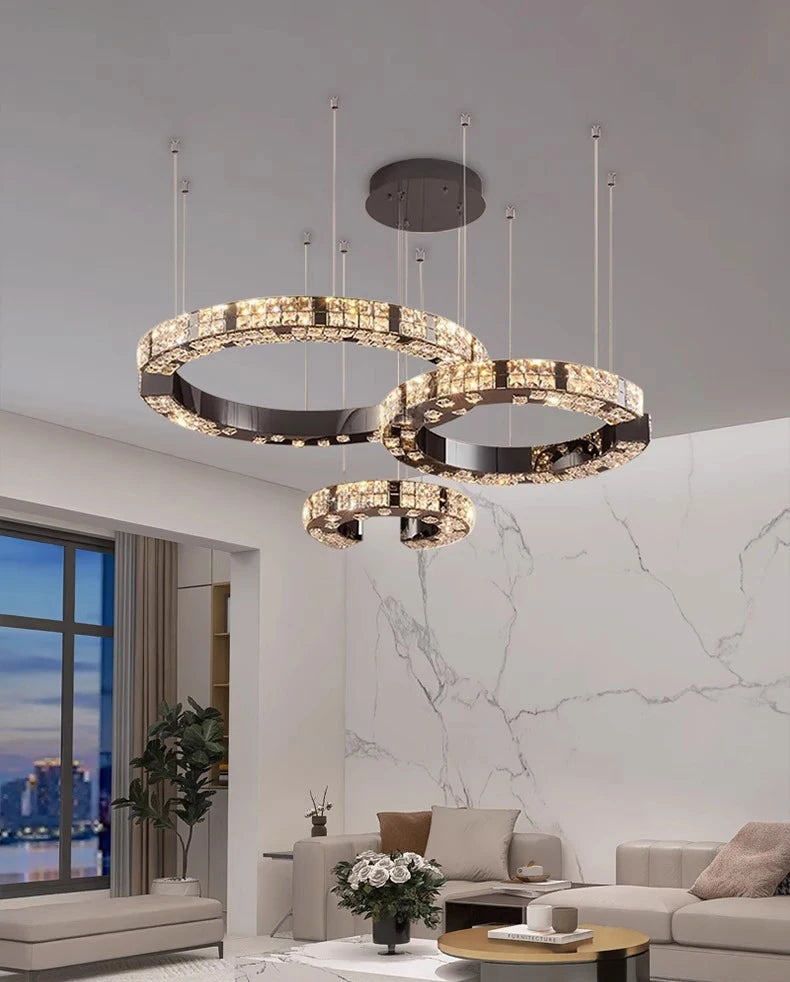
The Cosmo Circle Crystal Chandelier sets crystal on a circular frame — the transitional choice for a dining room or entry where a ring's geometry should carry classic sparkle.
Large rooms, foyers, and staircases
Larger and vertical crystal forms for 12-foot ceilings and up.

The Fyu Modern Large Black and Gold Crystal Chandelier pairs clear crystal with a controlled modern frame at large scale — for a great room or open foyer that wants presence without a fully traditional look. Check the box rating; large crystal is heavy.

The Modern Crystal Light Fixture for Staircase & Foyer is built for tall entries: a vertical crystal composition that fills the height of a two-story foyer or stairwell where a compact fixture would disappear. Keep 7 feet of clearance over the highest tread.

The Yasmin Dimmable Crystal Ring Ceiling Light combines crystal, integrated LED, and dimming in a ring format — a contemporary option for a staircase, landing, or 9-foot-plus living room where bulb changes should be rare.
Rustic and mixed-material crystal
Crystal on iron for farmhouse and modern rustic rooms.
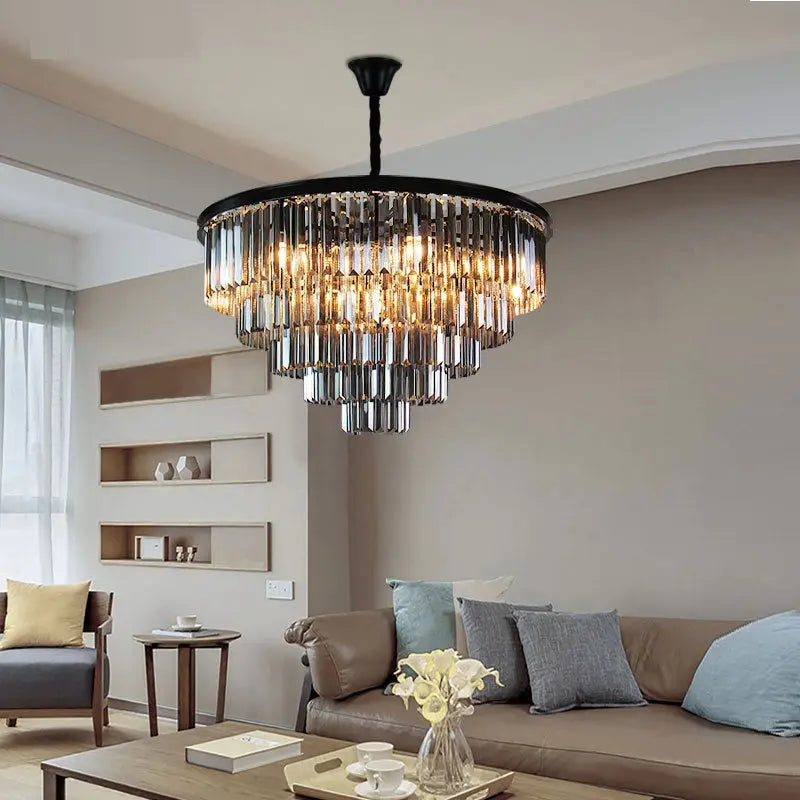
The Emma Rustic Crystal Chandelier sets K9 crystal on an iron frame, in clear, smoke, or golden crystal — the crossover for a dining room or entry that wants sparkle with a warm, country register.
Modern, transitional, linear, vertical, and rustic crystal for every room and ceiling.
Crystal Chandeliers Crystal Foyer Dining Room Staircase
Frequently Asked Questions
How do I choose a chandelier?
Start with the room: measure length, width, and ceiling height, and note what sits below. Size the diameter at the room's length plus width in inches (or half to two-thirds of the table width), choose a form that fits the ceiling (flush at 8 feet, round at 9–10, tiered or vertical at 12+), then pick the style and finish to match the room and light it at 2700–3000K on a dimmer.
What chandelier styles and sizes suit different rooms and ceiling heights?
Dining rooms: round or linear at half to two-thirds of the table width. Living rooms: flush on 8 feet, round or ring on 9–10 feet, tiered on 12 feet and up. Foyers: flush or small drum on 8 feet, round or tiered on 9–10, vertical or staircase forms on 12+. Bedrooms: flush or small round. Staircases: long-drop or cascading forms.
What size crystal chandelier do I need?
Add the room's length and width in feet and use that number in inches — about 26 inches for a 12 by 14 foot room. Over a dining table, use half to two-thirds of its width. In tall spaces, give the body 2.5 to 3 inches of height per foot of ceiling.
What type of crystal is best for a chandelier?
K9 crystal gives clear, crisp sparkle at a sensible weight and suits most modern and transitional fixtures. Lead crystal gives the most dispersion but is heavier. Mid-range crystal and glass give a softer look.
How can you tell crystal from glass?
Crystal is clearer and refracts light into stronger rainbows; lead crystal also feels heavier and rings when tapped. K9 is technically a high-grade optical glass, so the difference is about clarity and cut more than a strict material line.
How high should a crystal chandelier hang?
30 to 36 inches above a dining table and at least 7 feet above the floor in walkways. In a two-story foyer, place the body at or above the second-floor line so it reads from the landing.
What light color is best for a crystal chandelier?
2700K to 3000K warm white for dining rooms, living rooms, and bedrooms; around 3500K for kitchens. Cooler light makes crystal look sharp but cold. Use CRI 90 or higher and a dimmer.
Is a crystal chandelier worth it for a typical home?
Yes, if it fits the room. A correctly sized crystal chandelier adds light and a focal point to a dining room, entry, or bedroom; the value comes from scale and placement more than from crystal grade.
How do I choose an entry-level or budget crystal chandelier?
Choose the right size rather than a bigger one, K9 rather than lead crystal, fewer tiers, and a simple modern frame. These keep cost down without making the fixture look worse in the room.
What should I check before buying a large crystal chandelier?
The weight and ceiling box rating (fan-rated or brace bar above 50 pounds), the ceiling height and drop, how you will reach it for cleaning and bulbs, whether crystals are removable, and whether it uses integrated LED.
Choosing Your Crystal Chandelier
Fit first, finish second: settle the size, the drop, and the form for the ceiling before comparing crystal grades and frame colors. A crystal chandelier chosen in that order looks right on the day it goes up and stays practical for years.
Browse the range in the crystal chandeliers collection and tall-entry designs in crystal foyer chandeliers. For the material comparison, read crystal vs glass chandeliers; for tall vertical crystal, long chandeliers for staircases and high ceilings.


