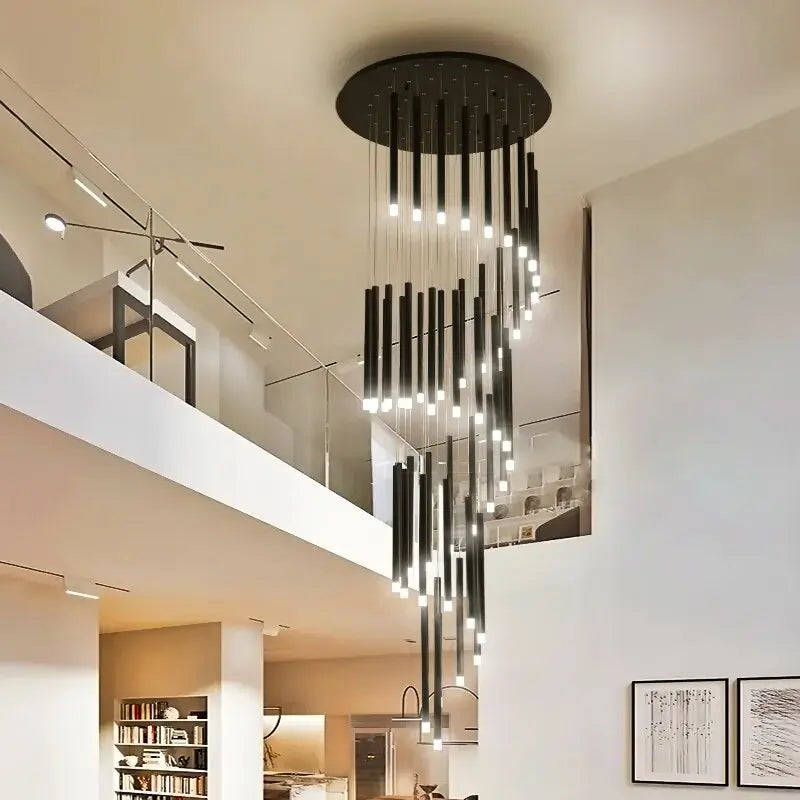

Key Takeaways
| Question | Answer |
|---|---|
| What is a sphere chandelier? | A fixture whose overall shape is a ball, seen the same from every side. |
| Five forms? | Crystal ball, metal orb cage, sputnik sphere, glass-sphere cluster, acrylic or glass orb. |
| How big? | Room L + W in inches; dense crystal balls at the low end, open cages and sputniks at the high end. |
| Best rooms? | Two-story foyers, stairwells, entries, round dining tables, open living rooms. |
| How high? | 30–36 in above a table; 7 ft over walkways; in tall entries, at or above the second-floor line. |
| Ball vs bubble? | A bubble chandelier is many glass globes; a sphere chandelier is one globe-shaped fixture. |
Quick Facts
- Spheres look equally finished from below, the side, and above — ideal where people see them from a stair or landing.
- Dense crystal balls throw sparkle in all directions; keep the light warm (2700–3000K).
- Open orb cages let light and views pass through, so they can be larger without crowding.
- Sputnik spheres need room around the arms — keep 7 ft clearance and clear of walls.
- Two-story foyers: body 2.5–3 in of height per foot of ceiling.
- Crystal balls are heavy — check the ceiling box rating.
Five Kinds of Ball and Sphere Chandelier
| Form | Construction | Density | Best rooms |
|---|---|---|---|
| Crystal ball | Crystal strands or drops shaped into a globe around lights | Dense | Two-story foyers, stairwells, formal dining |
| Metal orb cage | Open iron, brass, or wood rings forming a sphere; lights inside | Open | Farmhouse, modern rustic, great rooms |
| Sputnik sphere | Arms radiating in all directions from a central hub | Open | Mid-century living and dining rooms |
| Glass-sphere cluster | Many glass globes arranged as one ball | Medium | Modern entries, living rooms |
| Acrylic or glass orb | One large diffusing sphere | Solid | Minimal bedrooms, entries, nooks |
How Spheres Read in a Room
A flat or tiered chandelier shows its full width mostly from below; a sphere shows the same round outline from every direction. That has two effects. First, a sphere has as much depth as width, so a dense sphere — a crystal ball or a solid orb — looks larger and heavier than a flat fixture of the same diameter. Second, it looks finished from the side and above, which makes it the natural choice where people see a fixture from a staircase, a landing, or a balcony. Open spheres — orb cages and sputniks — let light and views pass through, so they feel lighter than their size. Bubble clusters built from many separate globes are covered in bubble chandelier ideas; sputnik history in what is a sputnik chandelier.
Sizing a Ball or Sphere Chandelier
| Room / ceiling | Dense sphere (crystal ball, solid orb) | Open sphere (cage, sputnik) | Height |
|---|---|---|---|
| Entry, 8–9 ft | 14–20 in | 18–24 in | 7 ft clearance |
| Living room, 9–10 ft | 20–26 in | 24–32 in | 7 ft clearance |
| Round dining table, 48–60 in | 20–26 in | 24–32 in | 30–36 in above the table |
| Two-story foyer, 16–20 ft | 28–36 in | 32–44 in | Body at or above the second-floor line |
| Stairwell | Well width − 24 in | Well width − 24 in | 7 ft over the highest tread |
Start from the usual rule — the room's length plus width in feet, as inches — then move toward the smaller end for dense spheres and the larger end for open ones. Over a round table, half to two-thirds of the table width works for open spheres; dense crystal balls look right a little smaller. In a two-story foyer, a sphere can also hang in a vertical series (two or three balls at staggered heights) to fill the height. Tall-entry rules are in the foyer lighting size guide.
Where Sphere Chandeliers Work Best
Two-story foyers and stairwells: seen from the door, the stair, and the landing, a crystal ball or large orb looks complete from every viewpoint. Round dining tables: a sphere repeats the table's shape. Open living rooms: an open orb cage or sputnik adds presence without blocking views across the room. Bedrooms and nooks: a single soft orb gives an even, low-glare glow. Farmhouse and modern rustic rooms: iron or wood orb cages are a signature fixture over tables and in great rooms.
Crystal Ball vs Orb Cage vs Glass Orb
| Crystal ball | Metal orb cage | Glass / acrylic orb | |
|---|---|---|---|
| Light | Sparkle scattered in all directions | Open light with cage shadows | Soft, even glow |
| Style | Glam, transitional, formal | Farmhouse, rustic, industrial | Minimal, Scandinavian, modern |
| Weight | Heavy | Moderate | Light |
| Care | Wipe or wash crystals periodically | Dust the frame | Wipe the shell |
Light, Mounting, and Care
Light spheres warm — 2700–3000K — so crystal sparkles without glare and glass glows rather than glares; integrated-LED spheres often switch color, so set warm on first use. Crystal balls are heavy: confirm the ceiling box rating and use a fan-rated box or brace bar above 50 pounds; in tall entries plan lift or winch access for cleaning. Dust crystal and glass regularly with a microfiber cloth and wash removable parts a few times a year; crystal methods are in how to clean a crystal chandelier, and crystal choices in how to choose a crystal chandelier.
Quick decision: which sphere
Two-story foyer or stairwell: crystal ball • Farmhouse or rustic great room: metal orb cage • Mid-century room: sputnik sphere • Modern entry: glass-sphere cluster • Minimal bedroom: acrylic or glass orb • Size: dense spheres smaller, open spheres larger • Always: 2700–3000K, rated box for crystal.
Ball and Sphere Chandeliers
Six sphere fixtures from crystal to glass and open frames.
Crystal and glass spheres
For foyers, stairwells, and modern rooms.

The Gold Crystal Ball Chandelier for High Ceiling & Staircase shapes crystal into a globe for a two-story foyer or stairwell — round and sparkling from every viewpoint.

The 8-Light LED Glass Ball Chandelier in black and gold groups glass balls around integrated LED for a modern entry or dining room.

The Modern Minimalist Bubble Glass Orb Chandelier keeps the orb form quiet — a few glass spheres on a minimal frame for bedrooms and small rooms.
Open spheres and orbs
Sputnik and branch forms with glass orbs.

The Modern Sputnik Glass Sphere Chandelier, in 12 or 15 lights, radiates glass spheres in all directions — a mid-century sphere for living and dining rooms.
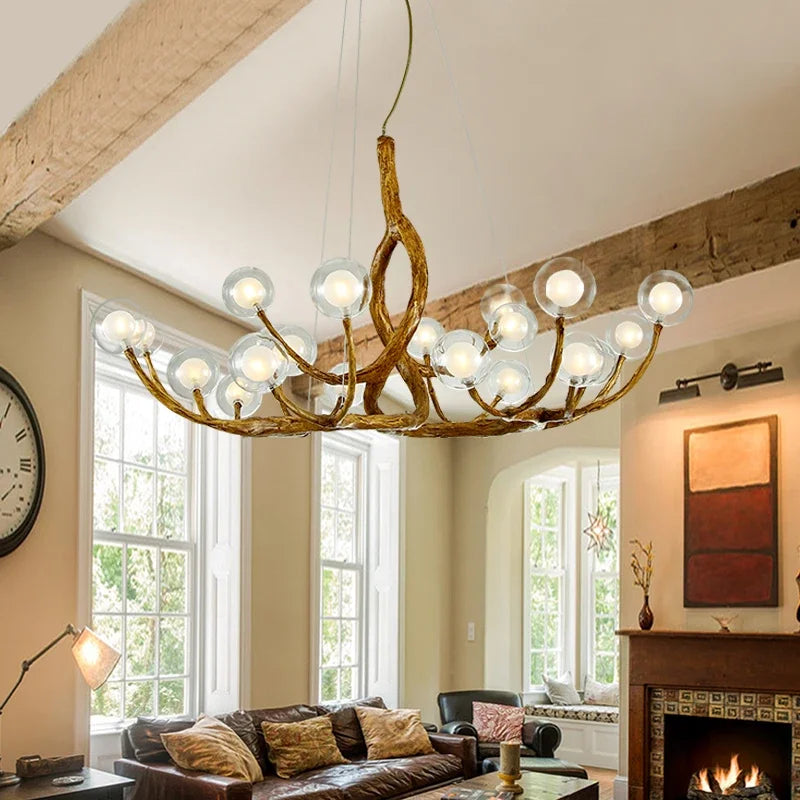
The Rustic Farmhouse Branch Chandelier with Glass Orbs sets glass orbs on rustic branches for farmhouse dining rooms.

The Riley Ball Floor Lamp brings the ball form down to floor level — a soft orb beside a sofa or reading chair.
Crystal balls, glass spheres, sputnik spheres, and orbs.
Crystal Chandeliers Staircase Foyer Chandeliers Sputnik
More spheres: the Ball Design Extra Large Crystal Chandelier for High Ceiling, the Peri Modern Sphere Chandelier, and the Lexi Modern Acrylic Orb Chandelier.
Frequently Asked Questions
What is a ball or sphere chandelier?
A chandelier whose overall shape is a sphere — crystal shaped into a ball, an open metal orb, a sputnik with arms in all directions, a cluster of glass spheres, or a single glass or acrylic orb.
What is a crystal ball chandelier?
A fixture in which crystal strands or drops form a globe around the lights, giving sparkle in all directions; it suits two-story foyers, stairwells, and formal dining rooms.
What is an orb chandelier?
Usually an open sphere of metal or wood rings with lights inside — a farmhouse and modern rustic favorite — or, more broadly, any sphere-shaped fixture.
What is the difference between a ball chandelier and a bubble chandelier?
A ball or sphere chandelier is one globe-shaped fixture; a bubble chandelier is built from many separate glass globes in a cluster, row, or cascade.
What size sphere chandelier do I need?
Use the room's length plus width in feet as inches, then go smaller for dense spheres such as crystal balls and larger for open orb cages and sputniks.
Where should I hang a sphere chandelier?
Where it is seen from several sides — two-story foyers, stairwells, entries, over round tables, and in open living rooms.
How high should a sphere chandelier hang?
30–36 inches above a table, at least 7 feet above walkways, and in tall entries with the body at or above the second-floor line.
Are crystal ball chandeliers heavy?
They can be; check the listed weight and use a ceiling box rated for it, with a brace bar for heavy fixtures.
What light color suits a sphere chandelier?
2700–3000K warm white, so crystal sparkles without glare and glass glows evenly.
Do sphere chandeliers work in small rooms?
Yes — choose a small acrylic or glass orb or a minimal orb fixture rather than a dense crystal ball.
Choosing a Sphere Chandelier
Pick the form for the room — crystal for sparkle, cages for rustic, sputniks for mid-century, orbs for calm — then size it for its density and hang it where it is seen from all sides.
Browse crystal chandeliers, staircase chandeliers, and sputnik chandeliers. For glass globe clusters, read bubble chandelier ideas.