

Hallways are the most under-lit room in most American homes. A single ceiling fixture in the middle of an 8-foot wide corridor leaves the wall plane flat and the passage feeling longer and narrower than it is. Wall lights solve this — but only when the spacing, mounting height, and fixture projection are calculated for the actual hallway, not pulled from generic Pinterest inspiration.
This guide covers the specific math behind hallway wall lighting: how many fixtures you need based on corridor length, what height to mount them, how to handle narrow versus wide hallways, what to do at L-shaped and T-junction layouts, and which fixture types work best in each situation. For broader fixture-type decisions, our complete guide to choosing wall lights covers all rooms; this guide goes deep on hallways alone. To shop the full range, visit our wall lights collection.
Why Hallway Lighting Is Different from Every Other Room
Most rooms have a static use — you sit in a living room, sleep in a bedroom, eat in a dining room. Hallways are different. They are circulation zones, used for seconds at a time as people move between rooms. That changes the lighting requirements in three specific ways:
- Even distribution matters more than total brightness. A hallway with one bright spot and two dim sections feels darker than a hallway with three medium-brightness, evenly-spaced sources. The eye reads contrast as darkness.
- The wall plane carries the lighting load. Ceiling fixtures alone leave the walls — which dominate the visual field as you walk down a corridor — under-lit. Wall lights pull illumination onto the surface you actually see.
- Fixture projection becomes a safety question. A deep wall light in a 36" (91 cm) wide hallway is a head-bumping risk. The same fixture in a 6 ft (183 cm) wide hallway is sculptural. Width determines depth.
Get these three principles right and the rest of the decisions — finish, style, bulb type — fall into place. Get them wrong and even an expensive fixture feels off.
Hallway Wall Light Spacing: The Math
The single most-asked question about hallway lighting is "how many fixtures do I need?" The answer comes from one calculation:
Number of sconces = (Hallway length ÷ 8 ft) rounded to the nearest whole number.
Two examples worked through:
- 16 ft (4.9 m) hallway: 16 ÷ 8 = 2 sconces. Place each one 4 ft (1.2 m) from each end, leaving 8 ft (2.4 m) between them.
- 32 ft (9.8 m) hallway: 32 ÷ 8 = 4 sconces. Place 4 ft (1.2 m) from each end, with 8 ft (2.4 m) between each pair.
For hallways longer than 30 ft (9.1 m) or with high ceilings (over 9 ft / 274 cm), tighten spacing to 6–7 ft (1.8–2.1 m) between fixtures. Long corridors need denser light points to maintain even visual rhythm.
Mounting Height for Hallway Wall Lights
Mount hallway wall lights with the center of the fixture 60–66" (152–168 cm) from the finished floor. This places the light source slightly above adult eye level (which averages 64" / 163 cm for a standing 5'9" / 175 cm adult), so the bulb itself stays out of direct line of sight while still casting useful light onto the floor and walls below.
Mounting height adjustments by ceiling height:
| Ceiling Height | Mounting Height | Why |
|---|---|---|
| 8 ft (244 cm) | 60–63" (152–160 cm) | Standard spec; balances eye-level glare with floor coverage |
| 9 ft (274 cm) | 63–66" (160–168 cm) | Slightly higher to balance vertical visual weight |
| 10 ft (305 cm) + | 66–72" (168–183 cm) | High ceilings need taller fixtures or higher mounting to avoid stranding |
| Vaulted / sloped | Adjust to wall midpoint | Stay proportional to local wall height; don't follow ceiling slope |
For mounting heights in other rooms, our dedicated wall sconce height guide covers bedrooms, bathrooms, staircases, and living rooms. This article focuses only on hallways.
Hallway Width: The Projection Rule
Hallway width determines the maximum fixture projection — how far the light extends out from the wall. Get this wrong and the fixture becomes either visually invisible or a head-bumping liability.
| Hallway Width | Max Projection | Recommended Fixture Type |
|---|---|---|
| Under 36" (91 cm) | 3" (8 cm) max | Flush plate sconces, picture-frame lights |
| 36–48" (91–122 cm) | 4" (10 cm) max | Half-shade sconces, slim LED bars |
| 48–60" (122–152 cm) | 5–6" (13–15 cm) | Standard wall sconces with shade |
| Over 60" (152 cm) | 7–9" (18–23 cm) | Sculptural and statement sconces |
The general rule: fixture projection should never exceed 1/12 of hallway width. A 48" (122 cm) wide hallway can carry a 4" (10 cm) projection sconce. Anything deeper starts to feel like an obstacle to anyone walking close to the wall.
Hallway Layouts: Straight, L-Shaped, T-Junction
Most American homes have one of three hallway layouts. Each one needs slightly different lighting logic.
Straight Corridor
The simplest case. Apply the spacing math directly: one fixture every 8–10 ft (2.4–3 m). For straight corridors longer than 24 ft (7.3 m), consider alternating fixtures on opposite walls rather than running them all on the same wall — this creates more even floor coverage and avoids a dark-bright-dark-bright ladder effect.
L-Shaped Hallway
Place a sconce at the elbow of the L, on the inside wall of the turn. This single fixture serves two purposes: it lights the turn so people don't bump into the corner, and it visually anchors the transition between the two corridor segments. Then apply standard spacing to each leg of the L from the elbow outward.
T-Junction
T-junctions need a fixture at the top of the T (the wall at the end of the perpendicular corridor) — this serves as a visual destination point as someone approaches. Add a second fixture roughly 6 ft (1.8 m) before the junction so the approach itself is well lit. Avoid placing a sconce at the junction corner itself; it creates competing visual weight with the destination fixture.
Long Hallway With High Ceiling (10 ft+)
Standard hallway sconces look stranded under tall ceilings. Two fixes work:
- Mount sconces higher — 66–72" (168–183 cm) instead of standard 60–66" — to balance the visual proportion against the ceiling height.
- Add a low-profile pendant or flush mount overhead at the midpoint of long corridors. This works as a visual stopping point and provides ambient fill that wall lights alone can't deliver in tall corridors.
Hallway Wall Light Brightness: How Many Lumens
Hallways need less brightness than work spaces but more even distribution. Total target lumen output for a hallway:
Total hallway lumens = Hallway length (ft) × 5–10 lumens per square foot × Hallway width (ft).
For a 24 ft × 4 ft (7.3 × 1.2 m) hallway: 24 × 4 × 7 = roughly 670 lumens total. Distributed across 3 sconces (24 ÷ 8 = 3), each fixture should produce around 220 lumens — typical of a 4–5W LED bulb.
| Hallway Use | Target Lumens / Sq Ft | Color Temperature |
|---|---|---|
| Bedroom-to-bathroom path (night use) | 3–5 lm/sqft | 2700K (warm) |
| Standard residential corridor | 5–10 lm/sqft | 3000K (warm white) |
| Gallery / art-display hallway | 10–15 lm/sqft | 3000–3500K |
| Entry hallway / foyer corridor | 8–12 lm/sqft | 3000K |
Avoid 4000K and above in residential hallways. Cool-white reads as commercial corridor lighting and undercuts the residential mood the rest of your home is working for.
LED Hallway Wall Lights: What to Look For
LED wall lights have replaced incandescent and halogen as the default for hallway use. They consume one-fifth the wattage, last 15–25 times longer, and produce less heat in confined corridor spaces. Three specs matter when choosing LED hallway sconces:
- Color Rendering Index (CRI). Look for CRI 90+ for residential hallways. Lower CRI bulbs (under 80) make wall colors and skin tones look greyed out — a common complaint with cheap LED retrofits.
- Dimming compatibility. Hallway lights should be dimmable. Match the LED driver type (TRIAC, ELV, or 0–10V) to the dimmer. Mismatched dimmers cause flicker, especially noticeable in long corridors where the eye scans multiple fixtures at once. If you're already experiencing flicker, our guide on why wall lights flicker and how to fix them covers diagnostic steps.
- Lumen output, not wattage. Wattage was the old measurement when all bulbs were incandescent. With LED, focus on lumens — a 5W LED can produce anywhere from 200 to 600 lumens depending on efficiency.
Recommended Hallway Wall Light Styles
Hallway sconces fall into four main visual categories. The right one depends on the home's broader interior style.
Double-Head Sconces for Wide Corridors
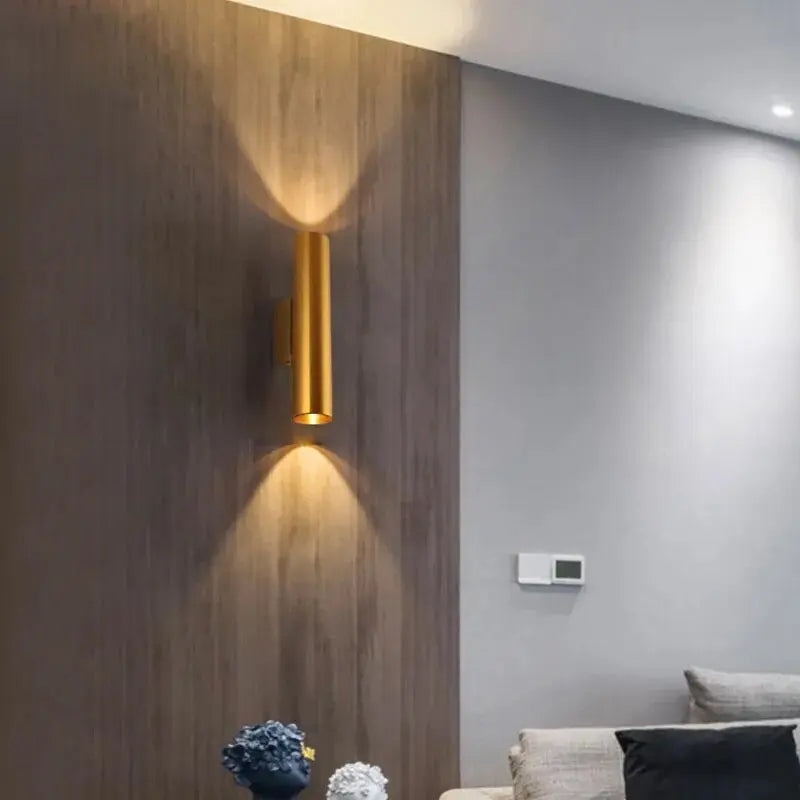
Twin-source sconces produce a wider light pool per mounting point, which means fewer fixtures cover the same corridor length. The Double Head LED Wall Light works well in 5–7 ft (152–213 cm) wide hallways where a single beam would leave the opposite wall under-lit.
Compact Globe Sconces for Narrow Hallways
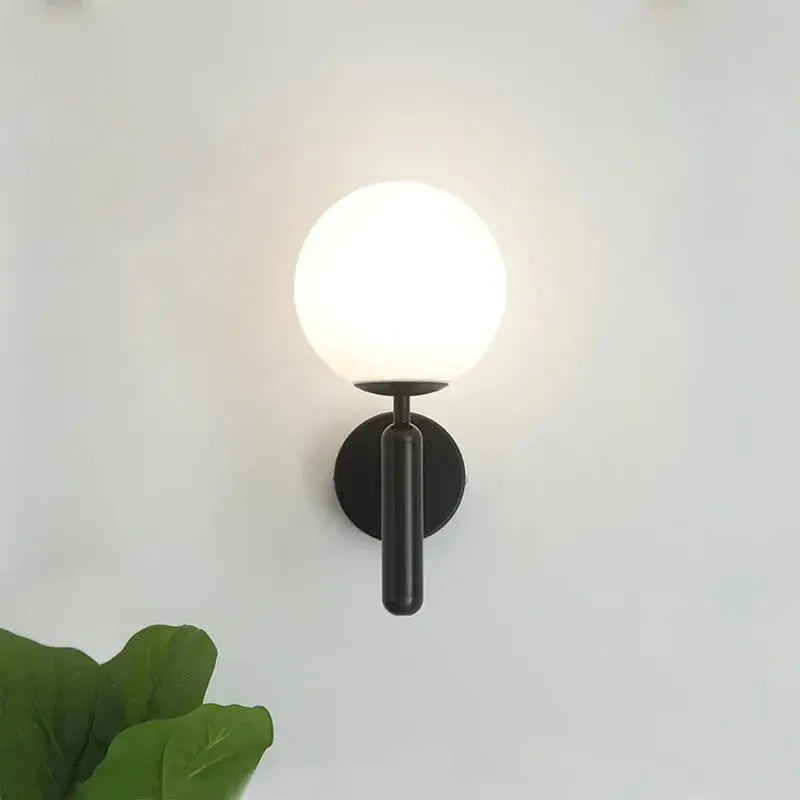
Globe-style sconces with shallow projection diffuse light evenly without protruding into walking space. The Juli Indoor Gloo Wall Light stays under 4" (10 cm) deep, making it safe for narrow corridors where head clearance is a real concern.
Round Modern Sconces for Contemporary Hallways
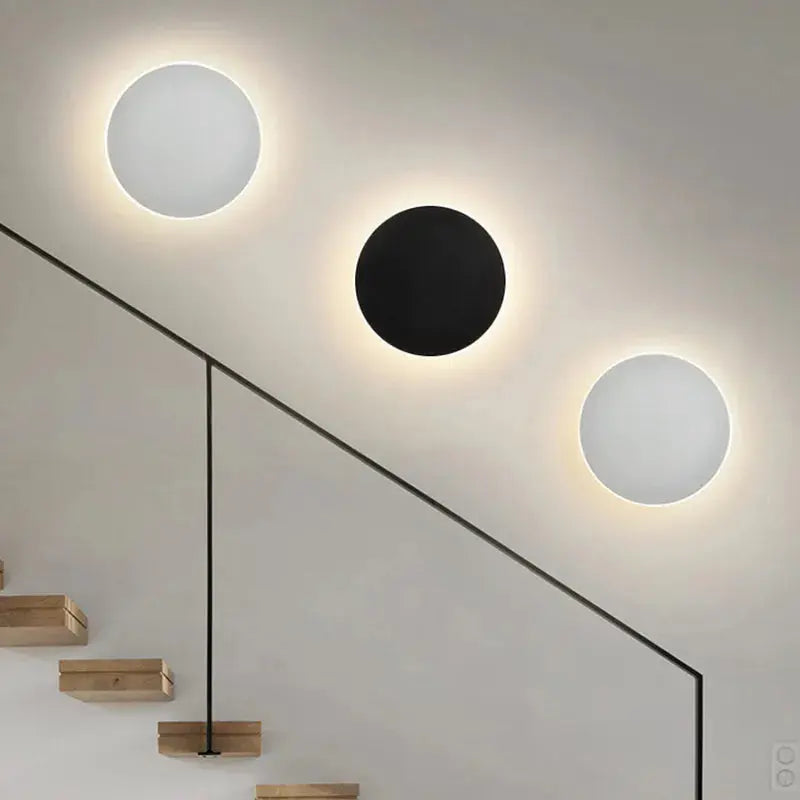
Disc and ring shapes pair cleanly with modern interiors. The Yumi Modern Round Wall Light sits flush enough for medium-width hallways while still reading as a deliberate design choice.
Statement Sconces for Feature Hallways
Wider entry hallways and gallery corridors can support sculptural sconces that act as decorative anchors. The Bambi Bubble Wall Light and the Alessa Gold Branch Wall Light work in this category — visible design pieces that hold the wall plane even when switched off.
Hallway Lighting Style Match
Match the sconce style to the rest of the home's interior, not just to the hallway in isolation. A hallway connects rooms, so its lighting should connect their visual languages.
| Interior Style | Best Hallway Sconce Type | Finish |
|---|---|---|
| Modern / Contemporary | Round disc, slim LED bar, geometric | Matte black, brushed nickel, white |
| Mid-Century Modern | Globe, sputnik-style, curved arm | Polished brass, gold, walnut accent |
| Farmhouse / Rustic | Lantern, barn-style, distressed | Black, oil-rubbed bronze, weathered metal |
| Traditional | Candle-style sconce, fabric shade | Antique brass, bronze, pewter |
| Industrial | Cage sconce, exposed bulb, pipe-style | Black, raw steel, copper |
| Scandinavian / Minimalist | Compact globe, simple disc | White, light wood, brushed steel |
Common Hallway Lighting Mistakes
Mistake 1: Too Few Fixtures Spaced Too Far Apart
The most common mistake is installing two sconces in a 24 ft (7.3 m) hallway because "the budget didn't allow more." The result is a dark-bright-dark-bright pattern that makes the corridor feel longer and less welcoming. Better to use less expensive fixtures and install three at proper spacing than two pricier ones spaced too widely.
Mistake 2: Mounting Too High
Installing sconces at 72" (183 cm) or higher because "the homeowner is tall" puts the bulb above eye level for everyone, which reduces useful floor coverage. Stick to 60–66" (152–168 cm) regardless of household height — the goal is light distribution, not avoiding head bumps.
Mistake 3: Mixing Color Temperatures
Installing 3000K sconces in the hallway when adjacent rooms run 4000K (or vice versa) creates a visible color shift as someone walks from room to corridor. Keep color temperature consistent throughout connected spaces.
Mistake 4: Ignoring the Wiring Reality
Older homes often have no junction boxes at sconce height, which makes hardwired installation expensive. For these cases, plug-in sconces or battery-operated alternatives can deliver the same look without the rewiring cost. Our guide to installing wall lights in old homes with limited wiring covers retrofit options.
Mistake 5: Choosing Style Before Function
A beautiful 7" (18 cm) projection sconce in a 36" (91 cm) hallway is a bad choice no matter how good it looks in the showroom. Width determines depth before style does. Apply the projection rule first, then narrow the style.
Step-by-Step: Designing Hallway Lighting
- Measure the hallway. Length, width, and ceiling height. These three numbers drive every other decision.
- Calculate fixture count. Length ÷ 8 ft, rounded to the nearest whole number.
- Apply the projection rule. Hallway width ÷ 12 = max acceptable projection.
- Choose mounting height. 60–66" (152–168 cm) for 8 ft ceilings; adjust upward for taller ceilings.
- Calculate target lumens. Length × width × 7 lm/sqft ÷ fixture count = lumens per fixture.
- Pick color temperature. 2700K–3000K for residential hallways; match adjacent rooms.
- Match style to interior. Use the style table above; pick a finish that repeats elsewhere in the home.
- Verify wiring or plan a retrofit. Confirm junction box positions before ordering hardwired fixtures.
- Install on a dimmer. Match the dimmer type to the LED driver. Hallways benefit from dimming for late-night use.
For the installation step itself, our walkthrough on how to install a wall light fixture covers the wiring and mounting process step by step.
Frequently Asked Questions
How many wall lights do I need in a hallway?
Divide the hallway length in feet by 8 and round to the nearest whole number. A 16 ft (4.9 m) hallway needs 2 sconces; a 24 ft (7.3 m) hallway needs 3; a 32 ft (9.8 m) hallway needs 4.
How high should hallway wall lights be mounted?
60–66" (152–168 cm) from the floor to the center of the fixture for standard 8 ft (244 cm) ceilings. Raise to 66–72" (168–183 cm) for ceilings over 9 ft (274 cm).
What color temperature is best for hallway wall lights?
2700K–3000K reads warm and residential. Avoid 4000K and above — it reads as commercial corridor lighting and clashes with the rest of a home's lighting palette.
Can I use a hallway wall lamp in a narrow corridor?
Yes, but check the projection. Fixtures should never extend more than 1/12 of the hallway width. For a 36" (91 cm) wide hallway, that means a 3" (8 cm) maximum projection — flush plate or thin-profile sconces only.
Do I need wall lights if my hallway already has a ceiling fixture?
Almost always yes, for hallways over 12 ft (3.7 m) long. Ceiling fixtures alone leave the wall plane flat and create a single bright spot with darkness on either end. Wall lights distribute illumination along the corridor and prevent the long-tunnel effect.
What size sconce works best for a hallway?
Compact sconces (under 8" / 20 cm tall) for narrow corridors under 48" (122 cm) wide. Medium sconces (8–14" / 20–36 cm tall) for standard hallways. Larger statement sconces only in wider entry hallways or gallery corridors.
Are LED hallway wall lights worth the higher price?
Yes. LED hallway sconces consume roughly 80% less energy than equivalent incandescent fixtures and last 15–25 times longer. The payback period in a hallway with daily use is typically 12–18 months.
Should hallway sconces be on a dimmer?
Yes. Hallways benefit from full brightness during the day and dim settings (10–30%) for late-night navigation. Match the dimmer type (TRIAC, ELV, or 0–10V) to the LED driver listed in the product specs.
What hallway sconce works best in modern homes?
Disc-shaped, ring-shaped, or slim LED bar sconces in matte black, brushed nickel, or white finishes. Avoid candle-style or fabric-shade sconces in modern hallways — they read traditional in a contemporary context.
How far apart should hallway sconces be?
8–10 ft (2.4–3 m) apart on the same wall. Light pools should overlap slightly to avoid dark zones between fixtures. For hallways longer than 30 ft (9.1 m), tighten to 6–7 ft (1.8–2.1 m).
Closing
Hallway lighting is mathematical first, decorative second. Get the spacing, projection, mounting height, and lumen output right and the corridor reads as a deliberate design space rather than a leftover. Pick a finish that repeats elsewhere in the home and the hallway pulls the rest of the interior together visually.


