

Most chandeliers are designed for 10-foot ceilings and above, which leaves the majority of American homes — built with 8- or 9-foot ceilings — choosing between a bare ceiling light and a fixture that hits people in the head. A flush mount chandelier is the third option. This guide explains what separates flush from semi-flush, how to size one for each room, and which forms work when the fixture has almost no drop to spend.
Key Takeaways
| Question | Answer |
|---|---|
| Flush or semi-flush? | Flush (0–4 in drop) at 8 ft; semi-flush (4–12 in) at 9 ft; either at 10 ft. |
| How big? | Room length + width in feet → diameter in inches; over a table, ½–⅔ of table width. Go larger, not smaller. |
| Which forms work close to the ceiling? | Ceiling-mounted multi-arm chandeliers, linear frames, bubble or globe clusters, shallow tiers, LED discs with decorative frames. |
| Which rooms? | Bedrooms, dining rooms, hallways and landings, closets, offices, kitchens without an island, standard-height foyers. |
| Glare? | Frosted or opal glass, diffusers, or shades; no exposed clear bulbs; always on a dimmer. |
| Output? | 2,000–5,000 lumens from integrated LED models — enough for a bedroom or dining room up to ~200 sq ft. |
Quick Facts
- Headroom rule: 7 ft of clearance under any fixture in a walking path; on an 8-ft ceiling that leaves 12 in for the fixture.
- Flush mount drop: 0–4 in. Semi-flush drop: 4–12 in. Short hung chandelier: 12 in and more (10-ft ceilings).
- Sizing: 10 × 12 ft room → ~22 in; 12 × 14 ft → ~26 in; 14 × 16 ft → ~30 in.
- Dining: ½–⅔ of table width; bottom of fixture 30–36 in above the tabletop where the ceiling allows.
- Color temperature: 2700–3000K in bedrooms and dining rooms; 3000–3500K in kitchens and hallways.
- Weight: most flush and semi-flush chandeliers are 8–30 lb; a standard box rated to 50 lb covers them.
What Makes a Chandelier "Flush Mount"?
A conventional chandelier is a decorative body hung from a chain, rod, or cable, and its drop — often 3 feet or more — is part of the design. A flush mount chandelier keeps the decorative body and removes the drop: the canopy bolts to the ceiling box and the arms, globes, or frame spread outward instead of downward. The result is a fixture 4 to 12 inches deep that clears 7 feet of headroom under an 8- or 9-foot ceiling.
The category has widened in the last few years. Older flush mount chandeliers were small crystal or glass bowls; current designs include ceiling-mounted chandeliers with 12 to 24 slim arms, linear frames that run along a table or aisle, bubble-glass clusters pressed against the ceiling, and integrated-LED rings and discs with decorative surrounds. Crystal versions remain a large part of the category and are covered separately in the crystal chandeliers collection; this guide covers the metal, glass, and LED forms, and the rules that apply to all of them.
Flush vs Semi-Flush: Which Drop for Which Ceiling
The two designs solve the same headroom problem in different ways. A true flush mount has no stem; its body starts at the canopy, so its total depth is its drop. It is the only option at 8 feet, where 7 feet of headroom leaves 12 inches for the whole fixture and a 4-inch-deep fixture is comfortable. A semi-flush adds a stem of 4 to 8 inches, which lifts the body off the ceiling so light can reach the ceiling plane and reflect back. That reflected light softens shadows and makes a room feel taller — a real advantage in a dining or living room — but the stem costs headroom, so a semi-flush wants a 9-foot ceiling.
At 10 feet the choice opens up: a semi-flush still works, and a short hung chandelier with a 12- to 24-inch drop also keeps 7 feet of clearance over open floor. Over a dining table the rules change again, because a fixture over a table is not in a walking path and can come down to 30 to 36 inches above the tabletop. The chandelier hanging height guide covers hung fixtures; the dining room ceiling lights guide compares flush, semi-flush, and chandelier specifically over a table.
| Flush mount | Semi-flush | Short hung chandelier | |
|---|---|---|---|
| Drop | 0–4 in | 4–12 in | 12–24 in |
| Minimum ceiling (walking path) | 8 ft | 9 ft | 10 ft |
| Light distribution | Downward and outward; ceiling stays dark | Down, out, and up off the ceiling | Mostly down and out; some up-light with open designs |
| Room feel | Ceiling reads at its true height | Room reads slightly taller | Fixture becomes the room's center |
| Glare risk | Highest — fixture nearest eye level | Moderate | Lower over tables, higher over open floor |
| Sloped ceiling | No | With a slope adapter, sometimes | Yes, on a chain or cable |
Sizing a Flush Mount Chandelier
The diameter rule is the same as for any chandelier: add the room's length and width in feet, and that number in inches is the target diameter. A 10 by 12 foot bedroom takes a 22-inch fixture, a 12 by 14 foot dining room a 26-inch one, a 14 by 16 foot living room 30 inches. Over a dining table the table decides instead — half to two-thirds of its width, so a 42-inch-wide table takes a 21- to 28-inch fixture.
Where flush mounts differ is which end of the range to choose. A hung chandelier gains presence from its drop; a flush fixture has only its width, so a fixture at the small end of the range reads as a utility light rather than a chandelier. Go to the larger end, or above it in a room with a long wall of windows, and let the fixture's spread do the work. The exception is a hallway or landing, where a 12- to 16-inch flush chandelier spaced every 8 to 10 feet is the right scale. The full method, with tables by room size, is in the fixture size guide.
Forms That Work Close to the Ceiling
A chandelier form has to be redesigned, not just shortened, to work flush. Four forms do it well.
Ceiling-mounted multi-arm chandeliers
Twelve to twenty-four slim arms radiate from a canopy, each ending in a small LED head or globe, and the whole assembly drops 8 to 16 inches while spreading 24 to 40 inches wide. This is the closest thing to a full chandelier's presence on a 9-foot ceiling, and the many small sources give even light without a hot spot. Because the arms spread rather than hang, a 36-inch version fits a room that could never take a 36-inch hung fixture.
Linear frames
A bar or rectangle of integrated LED, 32 to 48 inches long, mounted flush along a dining table, kitchen aisle, or long hallway. The linear form matches a rectangular table or a corridor better than a round fixture and reads as architecture rather than decoration, which suits modern interiors. Longer versions live in the rectangular chandeliers collection.
Bubble and globe clusters
Eight to fifteen glass spheres in milk-white or clear, pressed up against the ceiling on short stems. The globes diffuse the light so glare stays low even on an 8-foot ceiling, and the cluster reads as a sculpture rather than a fixture. Clear glass shows the LED and looks brighter; opal glass hides it and is the safer choice in a bedroom. The bubble chandeliers collection includes both flush and hung versions.
Shallow tiers and framed LED rings
Two or three concentric rings or tiers, each an integrated LED, with a total depth of 4 to 8 inches. These carry the most light per inch of depth — 3,000 to 5,000 lumens is common — and often include remote dimming and color-temperature switching. They suit a kitchen, office, or dining room where output matters as much as looks. Many are technically ceiling lights rather than chandeliers; the chandelier vs ceiling light guide draws the line.
Flush Mount Chandeliers Room by Room
| Room | Best form | Size | Light |
|---|---|---|---|
| Bedroom | Bubble cluster or shallow tier, opal glass | Room L + W in inches; 22–28 in typical | 2700–3000K, dimmable, 10–20 lumens/sq ft |
| Dining room (8–9 ft) | Semi-flush multi-arm or linear over a rectangular table | ½–⅔ of table width or length | 2700–3000K, dimmable, 20–30 lumens/sq ft |
| Hallway / landing | Small flush chandelier or ring, one every 8–10 ft | 12–16 in | 3000K, 10–20 lumens/sq ft |
| Kitchen, no island | Linear along the aisle or ceiling-mounted multi-arm | Room L + W; two fixtures over 150 sq ft | 3000–3500K, 30–40 lumens/sq ft + task strips |
| Living room (9 ft) | Semi-flush multi-arm, 24–36 in | Room L + W, larger end | 2700–3000K, dimmable, layered with lamps |
| Foyer (standard ceiling) | Semi-flush multi-arm or framed ring | Foyer L + W | 2700–3000K, 10–20 lumens/sq ft |
| Walk-in closet / office | Shallow tier or LED ring | Room L + W | 3500K, higher output, CRI 90+ |
The room table hides one consistent choice: color temperature. Bedrooms, dining rooms, living rooms, and foyers stay at 2700–3000K, where a flush fixture's closeness to eye level reads as warmth rather than glare. Kitchens, closets, and offices go to 3000–3500K for accuracy. Whatever the room, keep every fixture in the line of sight at one temperature; a 3000K flush chandelier in a dining room that opens onto a 4000K kitchen is the most common mismatch in open-plan homes. Small entries have their own guide in small entryway lighting ideas, and low dining rooms in low ceiling dining room light ideas.
Quick decision: flush mount chandelier
8 ft ceiling: true flush, 0–4 in drop, opal glass or diffused LED • 9 ft ceiling: semi-flush, 4–12 in drop, for better spread • Over a rectangular table: linear frame at ½–⅔ of table length • Want chandelier presence: ceiling-mounted multi-arm, 24–40 in spread • Bedroom: bubble or globe cluster in milk-white glass, 2700K, dimmer • Sloped ceiling: skip flush; use a semi-flush with slope adapter or a short hung chandelier on a cable.
Glare, Dimming, and Control on a Low Ceiling
The problem no sizing formula fixes is that on an 8-foot ceiling the fixture is about 2.5 feet above a standing adult's eyes and roughly level with them from across the room. A hung chandelier with exposed bulbs is above the eye line; the same bulbs on a flush mount are in it. So the rules tighten: diffused glass, fabric shades, or LED heads with lenses rather than clear exposed bulbs; a dimmer on every flush chandelier, matched to the fixture's driver type (TRIAC, ELV, or 0–10V — listed on each product page) so it does not flicker; and, where the fixture has selectable color temperature, a check that it is set to 3000K rather than the 6000K many ship on. Fixtures with remote or app control give you all of that without rewiring, which matters in a bedroom or rental where the wall switch is the only control.
Flush Mount Chandeliers by Form
Six fixtures that show the four forms above, from a true flush LED to a ceiling-mounted chandelier with 24 arms.
True flush: LED and bubble glass

The Nelis Modern Smart LED Flush Mount Ceiling Light is the true flush for an 8-foot ceiling: a flat integrated-LED body in white or black with app and remote control of brightness and color temperature. It is the right pick where output and control matter most — a home office, closet, or kitchen — and its diffused face keeps glare down at close range.

The Anya Modern Bubble Glass Flush Mount Light is the bubble cluster: 8, 10, or 15 milk-white globes on black or gold stems, pressed close to the ceiling. The opal glass hides the LED and softens the light, which makes it the bedroom pick on this list, and the 15-globe version has the spread for a 12 by 14 foot room.
Linear and semi-flush
The Flush Mount Linear Chandelier is the linear frame for a rectangular table, kitchen aisle, or long hallway on an 8-foot ceiling. Its slim bar mounts against the ceiling and follows the surface below it, so a dining table in a low room gets a fixture that matches its shape without any drop.

The Amaris Modern Silver Flush Mount Chandelier is the semi-flush with presence: a silver body of layered elements that drops a few inches from the ceiling and spreads wide, sized for a 9-foot dining or living room where the fixture is meant to be the focal point. It carries the formality of a hung chandelier at a fraction of the drop.
Ceiling-mounted multi-arm chandeliers

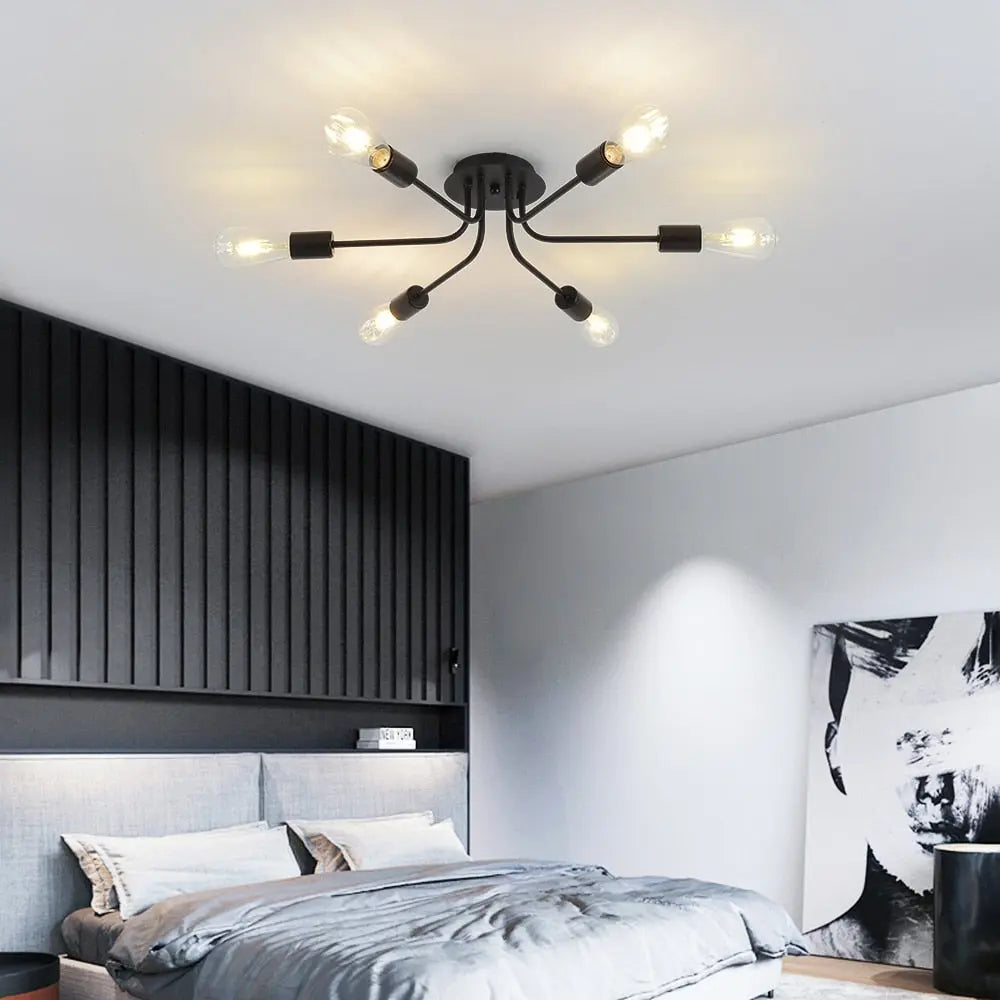
The Belia Modern Ceiling Chandelier, in black, gold, or white, is the compact ceiling-mounted chandelier: slim arms with small heads spreading from a central canopy, sized for a bedroom, hallway landing, or breakfast area on a standard ceiling. It gives a small room a chandelier's outline without a stem to lose.
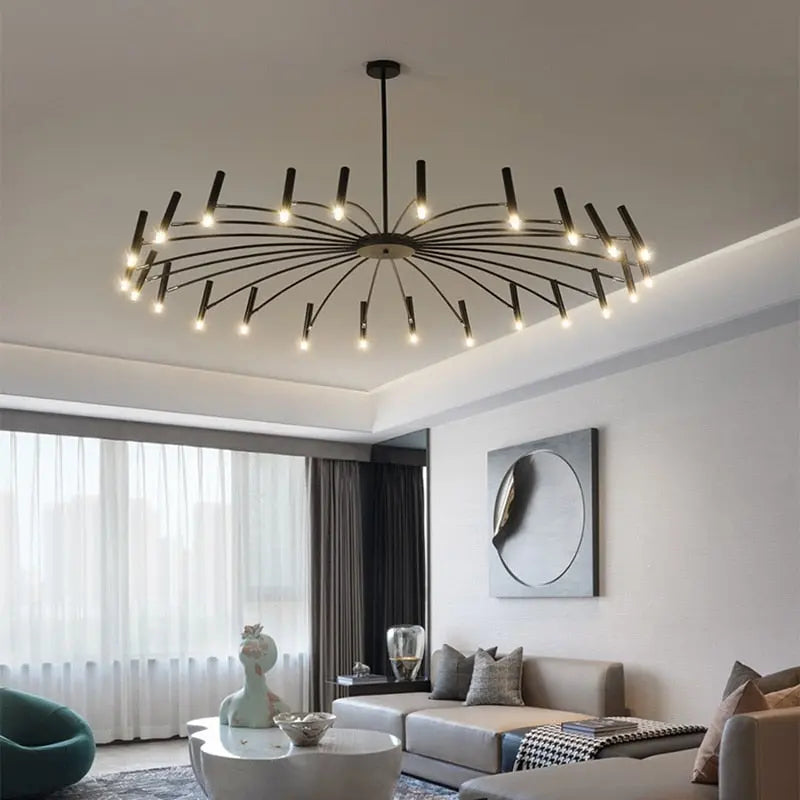
The Berny Ceiling Modern Chandelier, in 12, 18, or 24 lights and black, white, or gold, is the full-scale ceiling-mounted chandelier for a 9-foot dining room, living room, or foyer. The 24-light version spreads wide enough for a 14 by 16 foot room, and the many small heads deliver even light with no single hot spot — the closest a low ceiling gets to a large chandelier.
Flush and semi-flush designs in metal, glass, and integrated LED for 8- and 9-foot ceilings.
Flush Mount Chandeliers Ceiling Lights Bubble Chandeliers Crystal
Installation and Weight
Flush and semi-flush chandeliers are the easiest chandeliers to install: no chain to shorten, no drop to set, and a weight — usually 8 to 30 pounds — that a standard ceiling box carries. A 24-arm ceiling-mounted chandelier can reach 30 to 40 pounds, still within a 50-pound box rating, but confirm the box is fastened to a joist rather than only to drywall. Semi-flush fixtures with a fixed stem cannot hang plumb on a sloped ceiling; check the product page for a slope adapter, or choose a hung fixture on a cable for a vaulted room. The step-by-step, including wiring and canopy alignment, is in the flush mount installation guide.
Frequently Asked Questions
What is a flush mount chandelier?
A flush mount chandelier is a chandelier built to mount directly against the ceiling instead of hanging from a chain or rod. It keeps the decorative elements of a chandelier — multiple arms, glass globes, tiers, or a linear frame — but compresses the drop to roughly 4 to 12 inches so the fixture clears 7 feet of headroom under an 8- or 9-foot ceiling. It is the standard answer for dining rooms, bedrooms, hallways, and kitchens in homes with standard ceiling heights.
What is the difference between flush mount and semi-flush mount?
A flush mount sits tight to the ceiling with no gap; a semi-flush hangs 4 to 12 inches below it on a short stem. The gap on a semi-flush lets light reach the ceiling and reflect down, which spreads light more evenly and makes the room feel taller, but it costs headroom. Use a true flush mount at 8 feet and a semi-flush at 9 feet; either works at 10 feet, where a short hung chandelier also becomes possible.
How big should a flush mount chandelier be?
For a room, add the length and width in feet and use that number as the diameter in inches — a 12 by 14 foot bedroom takes a 26-inch fixture. Over a dining table, size it at half to two-thirds of the table width. Because a flush fixture cannot use height to make its presence felt, err toward the larger end of the range; a 16-inch flush mount in a 12 by 14 foot room reads as a hallway light.
Can you put a flush mount chandelier over a dining table?
Yes. Size it at half to two-thirds of the table width, center it over the table, and choose a semi-flush if the ceiling is 9 feet so the fixture's bottom lands 30 to 36 inches above the tabletop and the light spreads. On an 8-foot ceiling a true flush mount will sit about 48 inches above the table, which is higher than ideal, so pick a wider fixture and a diffused shade to compensate.
Which rooms are best for a flush mount chandelier?
Any room with an 8- or 9-foot ceiling where a chandelier's look is wanted but a drop would block walking or sightlines: bedrooms, dining rooms, hallways and landings, walk-in closets, home offices, and kitchens without an island. In a foyer with a standard ceiling a flush mount chandelier replaces the hung entry chandelier the space cannot fit.
Are flush mount chandeliers bright enough?
Modern flush mount chandeliers with integrated LEDs deliver 2,000 to 5,000 lumens, which covers a bedroom (10–20 lumens per square foot) or dining room (20–30) up to about 200 square feet. Kitchens need 30 to 40 lumens per square foot and usually pair the flush chandelier with under-cabinet or recessed light. Check rated lumens on the product page, not wattage.
Do flush mount chandeliers cause glare on low ceilings?
They can, because on an 8-foot ceiling the fixture is only about 2.5 feet above a standing adult's eye line. Choose frosted or opal glass, fabric shades, or LED heads with diffusers, and avoid exposed clear bulbs pointing down. A dimmer matters more on a low ceiling than a high one for the same reason.
How much does a flush mount chandelier weigh, and does it need a special box?
Most flush and semi-flush chandeliers weigh 8 to 30 pounds, within the rating of a standard ceiling box. Multi-arm ceiling-mounted chandeliers with 18 to 24 heads can reach 30 to 40 pounds; a box rated for 50 pounds handles those. Fixtures over 50 pounds — rare in this category — need a fan-rated or braced box.
Flush mount chandelier or ceiling light: which should I choose?
Choose a flush mount chandelier when the fixture is meant to be looked at — a bedroom, dining room, or entry where it is the focal point. Choose a plain ceiling light (disc, drum, or dome) where you want light without a visible fixture, such as a hallway, laundry, or the second position in a kitchen. The chandelier costs more and needs more cleaning; the ceiling light is cheaper and disappears.
Can a flush mount chandelier be installed on a sloped ceiling?
A true flush mount cannot — it would sit tilted. A semi-flush with a short stem can, if the canopy accepts a slope adapter or the fixture uses a chain or cable that hangs plumb. For sloped or vaulted ceilings a short hung chandelier on a cable is usually the better choice.
Choosing the Right Flush Mount Chandelier
Measure the ceiling first: 8 feet means flush, 9 feet means semi-flush, and the answer is settled before any style question comes up. Then size to the room or the table at the larger end of the range, pick a form that spreads rather than drops, and treat glare control as part of the purchase rather than an afterthought. A flush mount chandelier chosen that way is the fixture the room would have had if the ceiling were 2 feet taller.
Compare flush and semi-flush designs in the flush mount chandeliers collection, or browse ceiling lights for plainer fixtures and crystal chandeliers for flush crystal designs. For the fixture over a dining table specifically, read the dining room ceiling lights guide.


