

Mid-century modern lighting is the rare style that is both seventy years old and one of the leading directions for 2026, because its fixtures were designed as objects first and lights second. This guide covers what defines the style, the six fixture forms that make it up, the materials that keep it from drifting into other decades, and which fixture belongs in each room of a current home.
Key Takeaways
| Question | Answer |
|---|---|
| What defines the style? | Geometric or organic form, visible structure, no ornament; brass, black steel, opal glass, walnut. |
| What are the six fixture forms? | Sputnik, globe/orb, arc lamp, saucer/dome, cone/bullet, linear multi-shade. |
| Which finish? | Aged or living brass first, matte black second, opal glass shades; avoid mirror chrome and bright polished gold. |
| Living room? | Arc floor lamp over the seating + globe cluster or ceiling-mounted sputnik above + a globe table lamp. |
| Dining room? | Sputnik (round over round tables, linear over rectangular) at ½–⅔ of table width, 30–36 in above. |
| Still current? | Yes — a named 2026 direction, now with warmer timber and living brass rather than bright brass. |
Quick Facts
- Period: roughly 1945–1970; the sputnik form dates from the late 1950s, the arc lamp from the early 1960s.
- Materials: brass (aged, satin, living), black-enameled steel, opal and clear glass, walnut and teak, later chrome.
- Ceiling fixture size: room length + width in feet → inches; over a table, ½–⅔ of table width.
- Sputnik light count: 6–8 for small rooms and 8-ft ceilings, 10–12 standard rooms, 15–20 large rooms and foyers.
- Arc lamp: shade centered over the seat, bottom of shade about 6 ft 6 in above the floor for standing clearance.
- Light: 2700–3000K in living spaces, 3000–3500K in kitchens and offices, CRI 90+, dimmer on every ceiling fixture.
What Makes Lighting "Mid-Century Modern"?
The style comes from a specific idea: a light fixture should be honest about its structure. A mid-century fixture shows you the arm that holds the bulb, the stem that carries the wire, and the base that keeps it upright, and it makes those parts the design. There is no crystal draped over the frame, no scrollwork, no fabric skirt. The forms are either geometric — spheres, cones, discs, straight rods — or organic in the way of a plant, with arms that branch and curve. Sculptural pendants and fixtures that read as art when switched off are one of the most-cited 2026 lighting directions, and that is the mid-century approach restated.
Three things separate mid-century from the styles it gets confused with. Against traditional lighting, it has no ornament. Against industrial, it uses brass and glass rather than raw iron and cages, and it is polished rather than rough. Against minimalist contemporary, it has more presence — a sputnik is a sculpture, a bare LED ring is not. The lighting styles guide places it among the others.
The Six Mid-Century Fixture Forms
Sputnik chandelier
Arms radiating from a central hub, each ending in a bulb or globe: the fixture most people picture when they hear "mid-century." The form spreads light in every direction, which is why it works over a dining table or in a foyer where one fixture has to light a whole space. Round versions suit round and square tables and open floor; linear versions suit rectangular tables and islands. Its history and sub-styles are covered in what is a sputnik chandelier and modern sputnik styles; the sputnik chandeliers collection holds the range.
Globe and orb pendants
A single sphere of opal or clear glass on a stem or cord, or a cluster of them at different heights. Opal glass diffuses the bulb and gives soft, even light — the bedroom and hallway choice; clear glass shows the bulb and reads brighter and more decorative. A globe cluster over a stairwell or a living room is the mid-century answer to a crystal chandelier.
Arc floor lamp
A long curved stem rising from a heavy marble or metal base and ending in a shade positioned over a seat or table, so the light comes from above without a ceiling box. It is the fixture that defined the mid-century living room and the one most worth buying well: the base must be heavy enough that the arc cannot tip, and the shade must clear standing head height — about 6 feet 6 inches — where the arc crosses a walking path.
Saucer and dome pendants
A shallow disc or half-sphere of spun metal or glass on a stem, throwing light downward in a wide pool. Saucers are the low-ceiling form of the style: they mount semi-flush or on a short stem, spread wide, and do not need drop for presence. Over a kitchen table, in an entry, or on an 8-foot living room ceiling they carry the style where a hung sputnik would not fit.
Cone and bullet spotlights
Tapered shades on a stem, a bar, or a track, aimed rather than fixed. Three cones on a bar over a kitchen counter, a single bullet on a wall over a reading chair, or a pair aimed at art are the working fixtures of a mid-century home. They are directional by design, so they need a diffused general layer — a saucer or globe — alongside them.
Linear multi-shade fixtures
Several small globes or cones spaced along a single horizontal bar, over a rectangular dining table or an island. The form matches the surface below it and gives even light along its length. Modern versions carry integrated LEDs, which solved the original problem of six small bulbs that each needed changing.
Materials and Finishes That Keep It Mid-Century
| Material | Mid-century use | 2026 note | Avoid |
|---|---|---|---|
| Brass | Arms, stems, hubs; the signature finish | Aged, satin, or "living" brass that darkens with use is the current preference over bright brass | Mirror-polished gold — reads 1980s |
| Black steel | Enameled or matte; often paired with brass on one fixture | Black-and-brass mixed-metal fixtures are a named 2026 trend | Glossy black plastic |
| Opal glass | Globes and shades; diffuses bare bulbs | Pairing opal glass with solid timber is the 2026 mid-century update | Heavily etched or patterned glass |
| Clear and smoked glass | Globes where the bulb is part of the look | Smoked and amber tints are current | Crystal prisms |
| Walnut and teak | Stems, canopies, lamp bases | Warmer timber is the direction; oak reads Scandinavian rather than mid-century | Painted or distressed wood |
| Chrome | Late-period (1960s) fixtures, arc lamps | Polished chrome is taking a back seat to warmer metals | Chrome on a fixture with brass elsewhere in the room |
The single most useful rule: pick brass or black as the room's metal and repeat it in the hardware — door pulls, cabinet handles, the faucet — so the fixture reads as chosen for the room. A brass sputnik over a table with black chairs and brass pulls is a room; a chrome sputnik over the same table is a purchase. Bulb choice is the second rule. Mid-century fixtures often expose the bulb, so use LED bulbs in a warm 2700–3000K with a CRI of 90 or higher, in the globe or candle shape the fixture was designed around, and put every ceiling fixture on a dimmer. Under a 4000K bulb, brass and walnut go gray.
Mid-Century Lighting Room by Room
Living room
Three heights of light define the mid-century living room. The arc floor lamp goes over the sofa or the reading chair, shade centered over the seat, base behind or beside the furniture where no one walks. Overhead, a globe cluster or a ceiling-mounted sputnik on a 9-foot ceiling; on an 8-foot ceiling, a saucer semi-flush. A globe table lamp on a side table finishes it. For a room with a high ceiling, the high ceiling living room guide covers how much drop the sputnik or cluster can take. The living room lighting collection groups the ceiling options.
Dining room
A sputnik is the mid-century dining fixture: round over a round or square table, linear over a rectangular one, sized at half to two-thirds of the table width and hung 30 to 36 inches above the top. A globe cluster or a linear multi-shade is the softer alternative. The full sizing, light count, and pairing rules are in mid-century modern dining room lighting; the dining room lighting collection has the fixtures.
Bedroom
One opal globe pendant or a small ceiling-mounted sputnik overhead, dimmable, at 2700K; at the bedside, globe or cone lamps. The current styling rejects the matched pair — one globe table lamp on one side and a small opal pendant hung low on the other is the 2026 version. Keep the ceiling fixture off the walking path between bed and door, and choose opal over clear glass so the fixture is comfortable to look at from the pillow. The bedroom lighting collection and the table lamps collection cover both heights.
Kitchen
Cones on a bar over the counter or island for task light, a saucer or globe over the kitchen table, and a flush or semi-flush saucer for general light on a standard ceiling. Kitchens run warmer than the mid-century originals did: 3000–3500K rather than the 2700K of the living room, so that food and countertops read true. A linear sputnik over an island follows the same spacing as any island fixture; the island pendant spacing guide has the numbers.
Entry and hallway
A sputnik with 10 to 15 lights fills a foyer with a 9-foot ceiling or higher; a two-story entry takes a 15- to 20-light sputnik or a vertical globe cluster on a long drop. Hallways take small opal globes or saucers every 8 to 10 feet. The foyer lighting collection includes the sputnik and globe options at entry scale.
Home office
A cone or bullet task lamp on the desk, aimed at the work surface, and a saucer or globe overhead at 3500K. Mid-century task lamps — the pivoting cone on a weighted base — are the one category where a vintage piece makes practical sense, because rewiring a lamp is simple and it sits at eye level where the original details show.
Quick decision: mid-century fixture by room
Living room: arc floor lamp over the seating + globe cluster or ceiling-mounted sputnik + globe table lamp • Dining: round sputnik over round tables, linear over rectangular, ½–⅔ of table width • Bedroom: one opal globe or small sputnik, dimmable, 2700K; unmatched bedside lamps • Kitchen: cones for task, saucer for general, 3000–3500K • Foyer: 10–15 light sputnik, 15–20 for two-story • 8-ft ceiling anywhere: saucer semi-flush or ceiling-mounted sputnik, never a hung fixture.
Vintage or New?
Vintage mid-century fixtures have the original proportions and the patina that new brass takes years to acquire, and designers point to their build quality as a reason the style is back. They also come with old wiring, rare bulb bases, sockets that do not accept dimmable LEDs, and no safety listing. New mid-century designs reproduce the six forms with integrated LEDs, dimmer-compatible drivers, UL listing, and adjustable drops, which is what a main ceiling fixture in a family home needs. The sensible split is new for the ceiling and vintage for table and desk lamps, where rewiring is a small job and the piece is close enough to see the details. The vintage lamps guide covers identification and sourcing.
Mid-Century Fixtures by Form
Six fixtures that cover the sputnik, globe, and arc forms across ceiling and floor.
Sputnik chandeliers

The 6-8-10 Lights Mid Century Modern Ceiling Light, in gold or black, is the classic starburst at three sizes: 6 lights for a breakfast nook or bedroom, 8 for a standard dining room, 10 for a living room or entry. The exposed-globe form is the original 1950s silhouette, so pair it with warm 2700K globe bulbs and a dimmer.
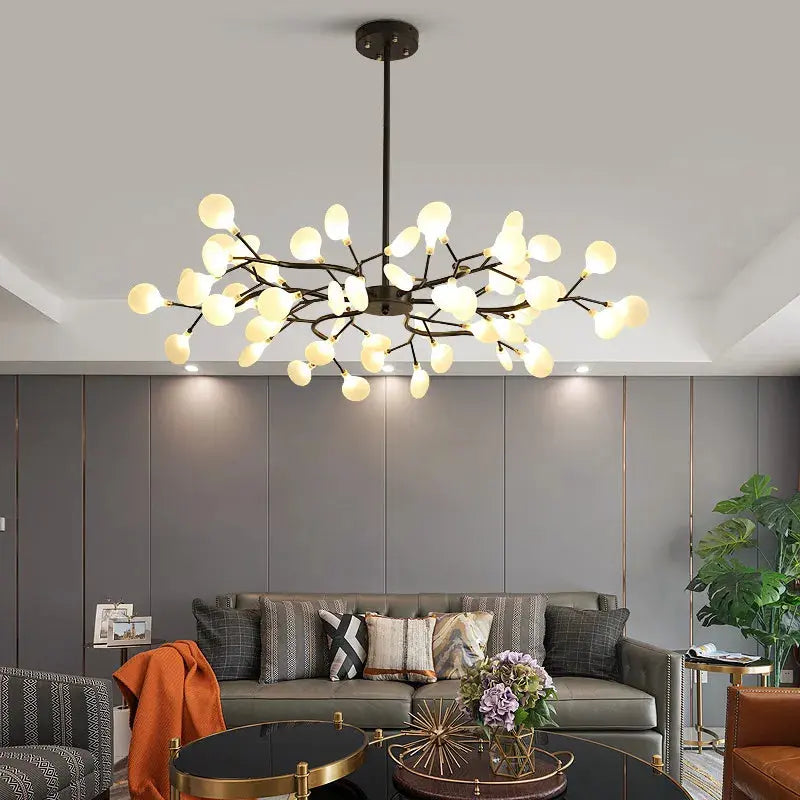
The Sputnik Branch Firefly Chandelier is the organic end of the sputnik family: branching arms tipped with small LED points, in gold or black. It suits a dining room or foyer that leans toward the softer, nature-referenced side of mid-century rather than the atomic-age starburst, and reads well from a living area in an open plan.

The Alissa 20-Light Modern Golden Sputnik Chandelier is the large-room sputnik: twenty arms for a foyer, a two-story entry, or a living room with a ceiling of 10 feet or more. Twenty small sources give even light across a big floor plan, and the gold reads as brass against walnut and black.

The Modern Sputnik Glass Sphere Chandelier, in 12 or 15 lights, combines the sputnik structure with globe shades, so the bulbs are diffused rather than exposed. That makes it the sputnik for a dining room where people sit under it for hours, and the glass spheres bring the fixture into the globe family at the same time.
Arc and globe floor lamps

The Yasa Vintage Arc Floor Lamp is the living room's defining piece: a long arc over the sofa or reading chair from a weighted base, with the shade centered over the seat. Position the base beside the sofa where no one walks and confirm the shade clears standing head height where the arc crosses the room.

The Riley Ball Floor Lamp brings the globe form to the floor: glass spheres on a slim stem, in one-, two-, or three-ball versions, for the corner of a living room or beside a bed. It gives the room a second height of globe light to match a globe or sputnik overhead. More floor options are in the floor lamps collection.
Sputnik and globe chandeliers, arc and globe floor lamps, in brass and black.
Sputnik Chandeliers Floor Lamps Table Lamps Modern Chandeliers
Sizing and Placement for Mid-Century Fixtures
The style changes the look, not the arithmetic. A ceiling fixture over open floor sizes to the room's length plus width in feet, expressed in inches; over a table, to half to two-thirds of the table width; and it keeps 7 feet of clearance over walkways and 30 to 36 inches over a tabletop. Sputniks add a light-count rule — 6 to 8 lights for small rooms and 8-foot ceilings, 10 to 12 for standard rooms, 15 to 20 for large rooms and foyers — and a slope rule: on a vaulted ceiling the hub must hang level or the arms read tilted, so use a chain or cable drop with a slope adapter. Arc lamps size to the seat, not the room: the shade sits over the middle of the sofa or chair, and the arc's reach — usually 5 to 7 feet — sets where the base lands. The general sizing method is in the chandelier sizing guide, and outdoor versions of the style in mid-century modern outdoor lighting.
Frequently Asked Questions
What is mid-century modern lighting?
Mid-century modern lighting is the family of fixtures designed roughly between 1945 and 1970 and the current designs that follow their rules: geometric or organic forms with no applied ornament, a visible structure of thin metal arms or stems, opal or clear glass globes, and materials like brass, black-enameled steel, walnut, and teak. The defining fixtures are the sputnik chandelier, the globe pendant, the arc floor lamp, the saucer or dome pendant, the cone or bullet spotlight, and the linear multi-shade fixture.
What are the most recognizable mid-century modern light fixtures?
Six forms: the sputnik chandelier (arms radiating from a hub, each ending in a bulb or globe), the globe or orb pendant (a single opal or clear sphere), the arc floor lamp (a long curved stem over a seat from a marble base), the saucer or dome pendant (a shallow metal or glass disc), the cone or bullet fixture (tapered shades on a stem or track), and the linear multi-shade fixture (several small shades on one bar). Most mid-century rooms use two or three of these, not all six.
What finishes are used in mid-century modern lighting?
Brass — aged, satin, or living brass that darkens with time — is the signature. Black-enameled or matte black steel is the second, often paired with brass on one fixture. Opal white glass, clear glass, and smoked glass supply the shades; walnut and teak appear in stems and canopies; polished chrome shows up in the later, 1960s end of the style. Bright polished gold and mirror chrome are not mid-century; they read as 1980s.
Is mid-century modern lighting still in style in 2026?
Yes. Designers name mid-century as one of the leading lighting directions for 2026, with a shift toward warmer materials: opal glass paired with solid timber and living brass finishes that patina, rather than the bright brass of a decade ago. Sculptural pendants that read as art when switched off — the mid-century approach to a fixture — are the broader 2026 trend, and sputnik and globe forms sit at its center.
Which mid-century light fixture is best for a living room?
An arc floor lamp over the seating group is the mid-century living room's defining piece, paired with either a globe cluster or a low-profile sputnik on the ceiling. If the ceiling is 8 feet, use a ceiling-mounted sputnik or a saucer flush mount rather than a hung fixture. Add a globe table lamp on a side table so the room has three light heights.
Which mid-century light fixture is best for a bedroom?
A single opal globe pendant or a small ceiling-mounted sputnik on the ceiling, with a pair of globe or cone lamps at the bedside — one on each side, or one lamp and one small pendant if you want the current mismatched look. Keep everything at 2700K to 3000K and put the ceiling fixture on a dimmer.
Can mid-century lighting mix with other styles?
Easily, because mid-century fixtures are geometric and unornamented. A sputnik works in a transitional dining room with a traditional table; an arc lamp works beside a contemporary sofa; a globe pendant works in a farmhouse kitchen. The rule is to repeat one finish — brass or black — from the fixture in the room's hardware so it reads as chosen rather than left over.
What color temperature suits mid-century modern lighting?
2700K to 3000K in living rooms, bedrooms, and dining rooms; 3000K to 3500K in kitchens and offices. Mid-century fixtures often use exposed or lightly diffused bulbs, so a warm color temperature and a dimmer matter more than with a shaded traditional fixture. Choose LED bulbs with a CRI of 90 or higher so brass and walnut show true.
How do I size a sputnik chandelier for a room?
Add the room's length and width in feet and use that number as the diameter in inches for open floor; over a dining table use half to two-thirds of the table width. Match the light count to the room: 6 to 8 lights for a breakfast nook or 8-foot ceiling, 10 to 12 for a standard dining or living room, 15 to 20 for a large room or foyer. Keep 7 feet of clearance over walkways and 30 to 36 inches over a table.
Should I buy vintage or new mid-century lighting?
Vintage pieces carry the original proportions and materials but usually need rewiring, use rare bulb bases, and rarely dim well. New mid-century designs use the same forms with integrated LEDs, dimmer compatibility, and UL listing, and are the practical choice for a main ceiling fixture. Many people buy new for the ceiling and vintage for a table lamp, where rewiring is simple and the piece is at eye level.
Bringing Mid-Century Lighting Into a Current Home
The style works in 2026 for the same reason it worked in 1958: the fixtures are designed as objects, so they hold a room whether the light is on or off. Choose two or three of the six forms rather than all of them, keep one metal running through the fixtures and the hardware, and let the arithmetic of sizing and clearance decide scale. A brass sputnik over the table, an arc lamp over the sofa, and an opal globe in the hall is a complete mid-century scheme that will not date.
Start with the sputnik chandeliers collection for the ceiling, the floor lamps collection for arc and globe lamps, and the modern chandeliers collection for globe clusters and linear fixtures. For the dining room in detail, read mid-century modern dining room lighting.


