

Origins of Mid-Century Modern Outdoor Design
1945–1970
The Mid-Century Modern Era
The design movement that emerged after WWII, pioneered by Eames, Saarinen, Nelson, and Knoll, defined American residential aesthetic for a generation and continues to influence contemporary design today.
The mid-century modern movement emerged from specific historical and technological conditions:
- Post-WWII material innovation. Wartime technology innovations in aluminum, steel, fiberglass, plastic laminates, and bent plywood opened new design possibilities for furniture and architecture. MCM designers were the first to apply these materials residentially.
- Mass-market housing boom. The post-war housing demand created opportunity for new architectural approaches — ranch homes, Eichler tract developments (Northern California), Alexander tract homes (Palm Springs), and Atomic Age suburban communities all originated in this period.
- Iconic designers establishing the movement. Charles and Ray Eames (Eames House, fiberglass chairs, plywood designs), Eero Saarinen (Tulip table, TWA terminal), George Nelson (Bubble lamps, Marshmallow sofa), Florence Knoll (textile and furniture innovation), and Frank Lloyd Wright (Usonian homes) collectively defined the visual language.
- Indoor-outdoor connection philosophy. MCM architecture pioneered the floor-to-ceiling glass, sliding glass doors, and seamless indoor-outdoor flow that influenced outdoor lighting requirements. Outdoor lighting needed to complement the architecture, not compete with it.
- "Form follows function" doctrine. Coined by architect Louis Sullivan and embraced by MCM designers, this principle meant every design element served practical purpose. Decoration for decoration's sake was rejected; sculptural forms had to also illuminate effectively.
- Atomic Age cultural influence. The space race and atomic age cultural moment introduced starburst motifs, sputnik forms, geometric patterns, and futuristic optimism into MCM design. These cultural references became distinctive MCM signatures.
8 Defining Features of MCM Outdoor Lighting
-
Clean Geometric Forms
Cubes, spheres, cones, cylinders, trapezoids, and other geometric primitives define MCM outdoor lighting silhouettes. No Victorian fluting; no Spanish Revival ironwork; no Tudor casting. Pure geometric forms executed in modern materials.
-
Sculptural Shapes Beyond Utility
Globe diffusers, starburst/sputnik patterns, atomic-age silhouettes, and sculptural compositions that function as outdoor art objects beyond just illumination. The fixture itself contributes to architectural character.
-
Premium Era-Appropriate Materials
Brushed aluminum (the era's defining material), brass and antique brass, copper, opaline/milk glass diffusers, walnut and teak wood accents. Materials chosen for both visual impact and weatherability.
-
Form Follows Function
Every design element serves practical illumination purpose. Decorative elements that don't contribute to lighting function are rejected. The starburst pattern diffuses light; the cone shape directs beam; the globe disperses evenly.
-
Warm Color Temperature
2700K-3000K warm white matching the original incandescent warmth of the era. Authentic MCM lighting feels golden and warm — never cool white or daylight. Color-tunable smart bulbs can replicate authentic vintage glow.
-
Edison-Style Filament Bulbs
Visible filament bulbs (Edison-style LED filament reproductions) reference the original incandescent aesthetic of the era. Particularly important in cage-style fixtures, open-frame lanterns, and decorative pendants where the bulb itself becomes design element.
-
Minimalist Restraint
Clean uncluttered designs without ornamental excess. MCM rejected Victorian fussiness, Spanish Revival heaviness, and Tudor traditionalism. Every line serves the composition; nothing decorative for decoration's sake.
-
Architectural Integration
MCM outdoor lighting integrates with the architecture rather than competing with it. The fixture complements ranch home horizontality, atomic ranch geometric facades, Eichler post-and-beam structures, and Usonian organic geometry.
Wall Sconces in Mid-Century Modern Style
Wall sconces are the most common MCM outdoor lighting application — providing focused illumination at entryways, garage doors, patios, and facade architectural details. Six MCM wall sconce principles:
- Geometric box forms. Cube and rectangular box-shaped sconces (frosted glass face) define MCM wall sconce aesthetic. Modern interpretations include brushed aluminum or matte black frames with opaline glass diffusion.
- Globe sconces. Spherical glass globes attached to brass, aluminum, or matte black brackets — quintessential MCM exterior wall sconce form. Single globe or paired globe configurations.
- Cone-shaped designs. Inverted cone or truncated cone wall sconces direct light downward while presenting sculptural silhouette. Often executed in spun aluminum or brass.
- Cylinder forms. Vertical cylinder wall sconces (downlight, uplight, or bi-directional) provide clean geometric form with modern function. Most common in contemporary MCM-inspired exterior applications.
- Symmetric pairing. Wall sconces in MCM exteriors typically work in symmetric pairs flanking entrances, garage doors, or architectural focal points. The symmetry reinforces MCM's geometric clarity.
- Scale matching architecture. Large bold sconces for ranch-scale facades; smaller intimate sconces for Eichler narrow entrances. Match sconce scale to architectural proportion.
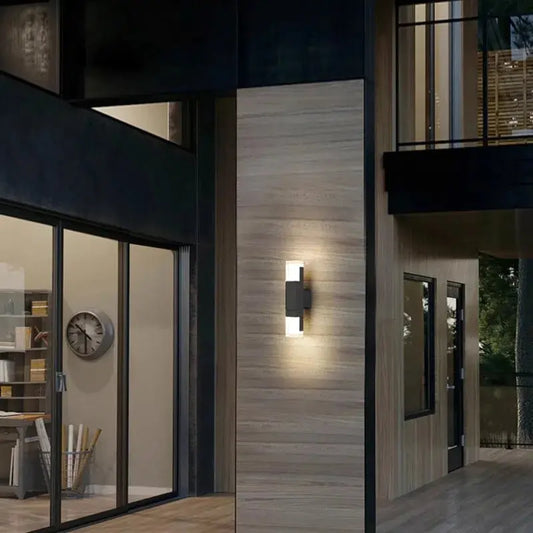
The Aluminum Motion Sensor Outdoor Wall Sconce exemplifies MCM principles — clean geometric form, brushed aluminum finish, modern motion sensor functionality. Browse complete options in our wall lights collection.
Pendant Lights for MCM Covered Patios
Pendant lights for covered patios, porches, and outdoor living rooms add the focal illumination MCM exteriors require. Six MCM pendant principles:
- Globe pendants. Single sphere or cluster of spheres suspended from clean brass, aluminum, or matte black cords. The quintessential MCM pendant form. Works equally in modern contemporary or atomic-ranch contexts.
- Drum shade pendants. Cylindrical drum shades in linen, paper, or modern fabric diffuse warm illumination evenly. Modern interpretations include opaline glass or perforated metal drums.
- Spider and sputnik pendants. Multi-arm sputnik pendants with exposed bulb arrays reference atomic-age aesthetic dramatically. Best for substantial covered patios with high ceilings.
- Cone and trapezoid forms. Inverted cone pendants and truncated trapezoid forms provide directional light plus sculptural silhouette. Particularly effective in dining patio applications.
- Spun metal pendants. Spun aluminum, brass, or copper pendants with smooth flowing forms reference the era's material innovation. Excellent for contemporary MCM revival applications.
- Hang at proper covered-patio height. Minimum 7 feet (84 inches) floor clearance for walking areas; 36-42 inches above outdoor dining tables; 60-72 inches above lounge seating areas.
MCM Post Lanterns
Post lanterns mark transitions, illuminate driveways, anchor landscape design, and provide the vertical lighting element MCM exteriors often need. Five MCM post lantern principles:
- Slim vertical profile. MCM post lanterns reject the colonial bulkiness of traditional post lamps. Slim vertical aluminum or steel posts with geometric or globe heads.
- Geometric head designs. Square, rectangular, hexagonal, or cylindrical lantern heads. Globe heads work especially well in atomic-age and Eichler applications.
- Open-frame cage designs. Some MCM post lanterns feature open-frame cage construction with visible Edison-style bulbs — atomic-age aesthetic with modern LED technology.
- Anchor driveway entrances. Paired post lanterns at driveway entrance create symmetric welcome statement plus practical wayfinding illumination.
- Define garden boundary. Spaced along driveway or property line at 15-25 ft intervals, post lanterns provide both functional illumination and aesthetic punctuation.
MCM Path Lights and Walkway Lighting
Path lights guide visitors along walkways, illuminate landscape features, and add the subtle accent illumination layer that completes MCM exterior lighting design. Five MCM path light principles:
- Low slim profile. MCM path lights sit close to ground (12-24 inches typical), with slim aluminum or brushed metal posts. Avoid Victorian-style bulky path lanterns.
- Geometric head designs. Inverted cone, cylinder, or truncated trapezoid heads direct light downward while presenting clean modern silhouette.
- Solar power for modern function. Modern MCM-inspired path lights often feature solar power with integrated photovoltaic cells. Combines authentic aesthetic with energy efficiency. Browse our solar lights collection.
- Spacing along path. 8-12 feet between path lights typical for walkway illumination. Closer spacing (6-8 feet) for darker walkways or where security matters.
- Match house finish family. Path lights should coordinate with wall sconce and pendant finishes. Mixed-metal mid-century looks work when intentional; accidental mismatches read as unplanned.
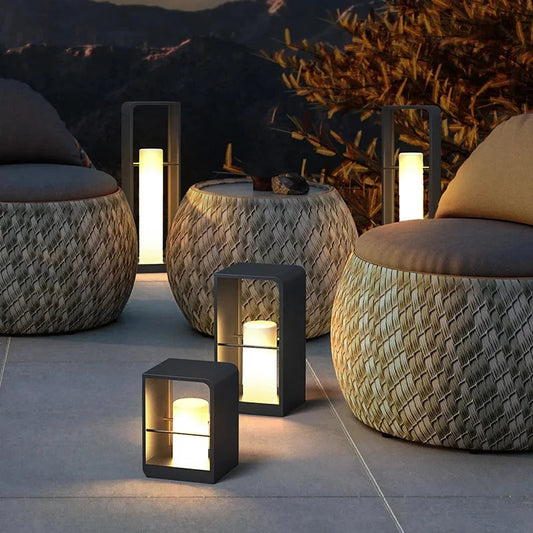
The Alessa Portable Waterproof Lawn Solar LED Lamp combines MCM-influenced clean aesthetics with modern solar technology — flexible placement throughout garden or pathway applications without electrical installation.
MCM Wall Lanterns
Wall lanterns differ from wall sconces — typically larger, more substantial, often featuring open-frame cage construction or distinctive sculptural silhouette. Five MCM wall lantern principles:
- Open-frame cage designs. Geometric metal frames (cubes, rectangles, trapezoids) housing visible bulbs reference Edison-era industrial aesthetic with MCM geometric restraint.
- Substantial scale for substantial entrances. Wall lanterns work best at substantial entrances, garage doors, or facade focal points. Smaller spaces benefit from wall sconces instead.
- Mounted at proper height. Standard height: center of lantern at 60-72 inches from finished floor (typical eye level for arriving guests). Adjust for door header height.
- Paired flanking installations. Symmetric pairs flanking double-door entrances or large garage doors create the formal symmetry MCM design often employs.
- Dark sky compliance considerations. Modern MCM wall lanterns often include dark-sky-compliant designs that direct light downward and inward, reducing light pollution. Particularly important in rural or suburban applications.
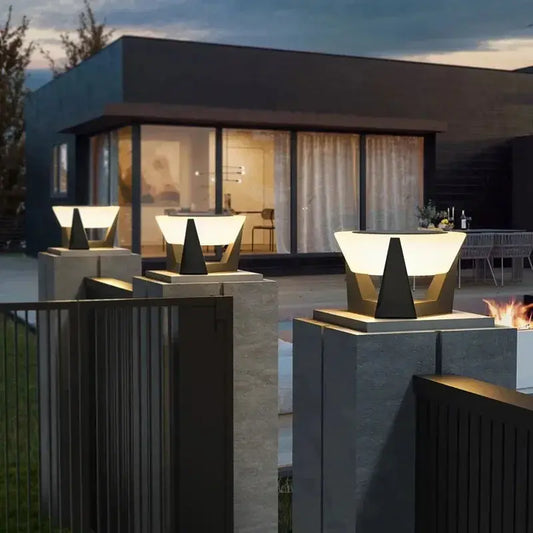
The Modern Outdoor LED Solar Light demonstrates how MCM aesthetic principles combine with 2026 solar LED technology — eco-friendly illumination delivered in clean geometric form. Browse our complete outdoor lights collection.
Architecture That Pairs With MCM Outdoor Lighting
Ranch Homes
Single-story horizontal homes with low-pitched roofs, attached garages, and integrated landscaping. The most common MCM-compatible architecture style across America. Wall sconces and post lanterns work particularly well.
Atomic Ranches
Ranches with explicit atomic-age design motifs — butterfly or flat rooflines, clerestory windows, pops of color, focus on linear features. Sputnik pendants, starburst sconces, and geometric post lanterns reinforce the atomic aesthetic.
Eichler Homes
Joseph Eichler tract homes (primarily Northern California) featuring post-and-beam construction, floor-to-ceiling glass, atrium courtyards. MCM lighting essential to maintaining authentic Eichler aesthetic. Globe pendants and slim wall sconces ideal.
Usonian Homes (Frank Lloyd Wright)
Wright's affordable single-story homes featuring organic integration with site, horizontal emphasis, and minimal ornamentation. Custom-scale MCM lighting required to honor Wright's exacting standards.
Contemporary Modern
Modern homes drawing on MCM principles — clean geometric forms, indoor-outdoor connection, minimalist aesthetic. MCM-inspired lighting reinforces the contemporary modern aesthetic without straight historical reproduction.
Alexander Tract Homes
Palm Springs developments by the Alexander Construction Company defining desert MCM aesthetic. Bold geometric forms, dramatic angles, integration with desert landscape. Dramatic sculptural lighting works particularly well.
Materials and Finishes Defining the Era
The era's defining material. Modern, lightweight, weather-resistant, and aesthetically distinctive. Most authentic MCM outdoor lighting features brushed aluminum bodies.
Warm metallic tone that ages beautifully outdoors. Modern brass finishes range from polished bright to muted antique. Particularly authentic in pendant and sconce applications.
Premium era-authentic material that develops verdigris patina over time. Most common in higher-end MCM lighting. Excellent weatherability and distinctive aesthetic.
2026's dominant finish trend; works particularly well with MCM aesthetic. Provides graphic contrast against light-colored architecture; coordinates with mixed-metal trends.
White opaque diffusion glass softening LED light into warm authentic glow. Globe pendants, drum shades, and sconce diffusers in opaline glass deliver authentic MCM aesthetic.
Warm wood accents on lighting fixtures (mounting plates, decorative elements) reference MCM furniture material vocabulary. Modern MCM lighting integrates wood thoughtfully.
Aged bronze finishes deliver authentic vintage character with modern weatherability. Particularly effective in pendant and post lantern applications.
Frosted glass diffusers (less opaque than opaline) deliver authentic MCM light diffusion while showing slight bulb silhouette through the glass. Common in geometric box sconces.
Color Temperature and Bulbs for MCM Outdoor Lighting
Bulb selection dramatically affects MCM lighting authenticity. The era's incandescent bulbs produced specific warm color temperature impossible to replicate with cool LEDs:
- 2700K warm white standard. The most authentic MCM outdoor color temperature; matches original incandescent warmth. Universal default for MCM outdoor lighting bulbs.
- 2200K extra warm for atmospheric applications. Candlelight-equivalent warmth for pendant lights over outdoor dining areas or intimate patio lounging zones. Genuinely cozy authentic feel.
- 3000K acceptable for task-heavy applications. Slightly cooler than 2700K but still authentically warm. Acceptable for security-focused wall sconces or path lighting where slightly brighter atmosphere matters.
- Avoid 4000K+ cool white entirely. Cool white LEDs are fundamentally inconsistent with MCM aesthetic. Never use in authentic MCM applications regardless of energy efficiency considerations.
- Edison-style filament LED bulbs. LED bulbs designed to replicate visible incandescent filament aesthetic. Particularly important in cage-style fixtures, open-frame lanterns, and exposed-bulb pendants where the bulb itself is design element.
- CRI 90+ for accurate color rendering. High color rendering index ensures landscape colors, architectural finishes, and exterior surfaces appear accurately under MCM lighting.
- Color-tunable smart bulbs for flexibility. 2200K-3000K adjustable smart bulbs (Philips Hue, LIFX, Govee, Wyze) deliver authentic warm range with modern app and voice control flexibility.
Integrating MCM Outdoor Lighting in Your Home
| Location | Recommended MCM Fixture | Quantity | Notes |
|---|---|---|---|
| Main entry door | Pair of geometric wall sconces or wall lanterns | 2 (symmetric flanking) | Center at 60-72 inches from floor |
| Garage door | Wall sconces or wall lanterns | 1-2 depending on door size | Match scale to garage door proportion |
| Covered patio / porch | Pendant light (globe, drum, or sputnik) | 1-3 depending on patio size | 7 ft floor clearance minimum |
| Walkway / path | Path lights every 8-12 feet | Calculate by walkway length | Solar or low-voltage hardwired |
| Driveway entrance | Post lanterns flanking entrance | 2 (symmetric) | 4-6 ft height typical |
| Backyard / patio dining | Pendant over table | 1-3 over table | 36-42 inches above table surface |
| Side yard / utility area | Motion sensor wall sconce | 1-2 as needed | Security focus; modern MCM with motion sensor |
| Landscape accent | Low-profile uplights or accent lights | Varies by landscape | Highlight architecture or featured plants |
Featured MCM-Inspired Outdoor Lighting

Large Modern Outdoor Wall Lights
Clean geometric form perfect for MCM exteriors. Brushed aluminum finish; weather-resistant construction.
View product →
Aluminum Motion Sensor Wall Sconce
MCM aesthetic combined with modern motion sensor functionality. Aluminum body; security plus style.
View product →
Alessa Portable Solar Lawn Lamp
MCM-influenced clean aesthetics with modern solar technology. Flexible placement throughout garden applications.
View product →
Modern Outdoor LED Solar Light
MCM-inspired wall lantern with 2026 solar LED technology. Eco-friendly with authentic geometric form.
View product →2026 Trends in Mid-Century Outdoor Lighting
Matte black replacing traditional brass and chrome as dominant MCM outdoor finish. Coordinates with 2026 mixed-metal trends.
MCM-aesthetic solar-powered fixtures becoming mainstream. Authentic vintage form with modern eco-friendly function.
2200K-3000K adjustable smart LEDs in MCM fixtures. App and voice control for evening atmospheric transitions.
Visible-filament LED bulbs becoming baseline for MCM aesthetic. Energy efficient with authentic vintage appearance.
Dark-sky-compliant designs reducing light pollution. Particularly important in suburban and rural MCM applications.
Bold sputnik and starburst forms returning to MCM exterior applications. Atomic-age aesthetic with modern LED engineering.
Integrated motion sensors in MCM-aesthetic fixtures. Security functionality without aesthetic compromise.
Intentional brass + black + brushed aluminum combinations across exterior. Coordinated mixed metals replacing strict matching.
Common MCM Outdoor Lighting Mistakes
- Using cool 4000K+ color temperature. Cool white LEDs are fundamentally inconsistent with MCM aesthetic. Always specify 2700K-3000K for MCM outdoor lighting. Single most common MCM lighting mistake.
- Choosing Victorian or Spanish Revival fixtures. Traditional ornamental fixtures (Victorian curlicues, Spanish Revival ironwork, Tudor casting) are fundamentally incompatible with MCM clean geometric aesthetic.
- Mismatched scale for architecture. Oversized fixtures dominate small Eichler entrances; undersized fixtures get lost on substantial ranch facades. Match fixture scale to architectural proportion.
- Skipping Edison-filament bulbs in exposed-bulb fixtures. Cage-style and open-frame MCM fixtures look incomplete with frosted modern LED bulbs. Use Edison-filament LEDs to maintain authentic vintage aesthetic.
- Wrong mounting height. Wall sconces mounted at wrong height (typically too high) disrupts the human-scale relationship MCM design requires. Center sconces at 60-72 inches typical residential applications.
- Forgetting symmetric pairing. Single wall sconce on one side of doorway looks unfinished. MCM design typically employs symmetric paired wall lighting flanking entrances.
- Cluttered installation overpowering architecture. Too many MCM fixtures overwhelm even substantial homes. Restraint and intentional placement matter more than fixture quantity.
- Skipping dimmer compatibility. Non-dimmable MCM outdoor lighting locks aesthetic at single brightness. Always specify LED-rated dimmer compatibility for evening atmospheric flexibility.
- Inadequate weather rating for application. Verify wet-location rated for full exposure; damp-location rated for covered locations only. Wrong weather rating leads to premature fixture failure.
- Ignoring dark-sky considerations. Bright unshielded outdoor lighting contributes to light pollution. Modern MCM design embraces dark-sky-compliant fixtures directing light downward.
Browse Seus Lighting's outdoor-focused collections — outdoor lights including authentic MCM-inspired wall sconces and post lanterns, wall lights for symmetric flanking installations at entries and garages, solar lights combining MCM aesthetic with modern eco-friendly function, ceiling lights for covered patio and porch applications, and our custom service for fixtures requiring specific MCM dimensions or authentic vintage finishes.
Outdoor Lights Wall Lights Solar Lights Ceiling Lights Custom Service
Frequently Asked Questions
What is mid-century modern outdoor lighting?
Mid-century modern (MCM) outdoor lighting is exterior lighting designed in the visual language defined by American residential architecture from 1945 through 1970. Key characteristics include: (1) Clean geometric forms — cubes, spheres, cones, cylinders, trapezoids; never Victorian ornamentation or Spanish Revival ironwork. (2) Sculptural shapes — globe diffusers, starburst/sputnik motifs, atomic-age silhouettes. (3) Premium materials — brushed aluminum, brass, copper, opaline glass, walnut accents. (4) Form follows function — every element serves practical purpose without decorative excess. (5) Warm color temperature — 2700K-3000K matching original incandescent warmth. (6) Minimalist restraint — clean uncluttered designs reflecting MCM rejection of Victorian fussiness. (7) Architectural integration — fixtures complement rather than compete with MCM architecture. (8) Heritage references — inspired by designers like Charles and Ray Eames, Eero Saarinen, George Nelson, Florence Knoll. MCM outdoor lighting pairs best with ranch homes, atomic ranches, Eichler tracts, Usonian homes, and contemporary modern architecture.
What are the best mid-century modern outdoor lighting fixtures?
The best MCM outdoor lighting fixtures fall into five categories: (1) Wall sconces — geometric box forms, globe sconces, cone-shaped designs, cylinder forms; typically in symmetric pairs flanking entrances. (2) Pendant lights — globe pendants, drum shade pendants, spider/sputnik pendants, spun metal pendants for covered patios and porches. (3) Post lanterns — slim vertical profile with geometric or globe heads; anchoring driveway entrances or defining property boundaries. (4) Path lights — low slim profile (12-24 inches), geometric heads, often solar-powered for modern function. (5) Wall lanterns — substantial open-frame cage designs or distinctive sculptural silhouettes; flanking substantial entrances or garage doors. Choose fixtures based on application location, architectural scale of your home, and intended function. Best results combine 2-3 categories rather than single fixture type — wall sconces at doors + post lanterns at driveway + path lights along walkway creates complete MCM exterior lighting plan.
What architecture styles work with mid-century modern outdoor lighting?
Six architecture styles pair particularly well with mid-century modern outdoor lighting: (1) Ranch homes (1945-1970) — single-story horizontal homes, the most common MCM-compatible architecture across America. (2) Atomic ranches — ranches with explicit atomic-age design motifs including butterfly or flat rooflines, clerestory windows, and pops of color. (3) Eichler homes (1949-1974) — Joseph Eichler tract homes in Northern California featuring post-and-beam construction and floor-to-ceiling glass. (4) Usonian homes (1936-1960) — Frank Lloyd Wright's affordable single-story homes featuring organic integration with site. (5) Alexander tract homes (1945-1970) — Palm Springs developments defining desert MCM aesthetic with bold geometric forms. (6) Contemporary modern (1990-present) — modern homes drawing on MCM principles with clean geometric forms and indoor-outdoor connection. Architecture styles that don't pair well: Victorian, Tudor, Colonial Revival, Spanish Revival, Mediterranean — these traditional styles have fundamentally different visual languages incompatible with MCM clean geometric aesthetic.
What materials define mid-century modern outdoor lighting?
Eight key materials define authentic MCM outdoor lighting: (1) Brushed aluminum — the era's defining material; modern, lightweight, weather-resistant. (2) Brass and antique brass — warm metallic tone that ages beautifully outdoors; ranges from polished bright to muted antique. (3) Copper — premium era-authentic material that develops verdigris patina over time. (4) Matte black — 2026's dominant finish trend, works particularly well with MCM aesthetic. (5) Opaline/milk glass — white opaque diffusion glass softening LED light into warm authentic glow. (6) Walnut and teak wood accents — warm wood references MCM furniture material vocabulary. (7) Bronze patina — aged bronze finishes deliver authentic vintage character with modern weatherability. (8) Frosted glass — less opaque than opaline, common in geometric box sconces with visible bulb silhouette. Materials to avoid in MCM applications: cast iron (too Victorian), ornate brass with curlicues (too traditional), heavy black wrought iron (too Spanish Revival), Tiffany-style stained glass (incompatible aesthetic).
What color temperature works best for MCM outdoor lighting?
The best color temperature for mid-century modern outdoor lighting is 2700K-3000K warm white. Specific recommendations: (1) 2700K (warm white) — the most authentic MCM outdoor color temperature; matches original incandescent warmth. Universal default for all MCM outdoor lighting bulbs. (2) 2200K (extra warm) — candlelight-equivalent warmth for pendant lights over outdoor dining areas or intimate patio lounging zones. (3) 3000K (soft white) — slightly cooler but still authentically warm; acceptable for security-focused wall sconces or path lighting where slightly brighter atmosphere matters. Never use 4000K+ cool white — cool LEDs are fundamentally inconsistent with MCM aesthetic regardless of energy efficiency benefits. Always specify CRI 90+ for accurate color rendering of landscape and architecture. Consider Edison-style filament LED bulbs for cage-style fixtures, open-frame lanterns, and exposed-bulb pendants where the bulb itself is design element. Color-tunable smart bulbs (2200K-3000K adjustable) deliver maximum atmospheric flexibility for evening transitions while maintaining authentic MCM warm range.
How do you choose mid-century modern wall sconces?
Choose MCM outdoor wall sconces following six principles: (1) Match form to MCM aesthetic — geometric box forms, globe sconces, cone shapes, or cylinder forms. Avoid Victorian ornamentation or traditional ironwork. (2) Choose era-appropriate materials — brushed aluminum, brass, copper, opaline glass, or matte black; never cast iron with curlicues or Tudor-style heavy brackets. (3) Specify symmetric pairs — MCM design typically employs paired wall sconces flanking entrances, garage doors, or architectural focal points. (4) Match scale to architecture — large bold sconces for substantial ranch facades; smaller intimate sconces for narrow Eichler entrances. Verify with painter's tape template before purchase. (5) Mount at correct height — center of sconce at 60-72 inches from finished floor (eye level for arriving guests). Adjust for unusual door header heights. (6) Verify weather rating — wet-location rated for full exposure; damp-location rated for protected locations only. Use 2700K-3000K warm white LED bulbs with dimmer compatibility for evening atmospheric flexibility.
Are sputnik fixtures considered mid-century modern?
Yes — sputnik fixtures are quintessentially mid-century modern, representing one of the most recognizable MCM design motifs. Sputnik design originated from the era's atomic-age cultural moment and the 1957 Soviet satellite launch that defined space race aesthetics. Sputnik fixtures feature multiple radiating arms terminating in light bulbs, creating starburst silhouette. Key sputnik characteristics: (1) Multiple radiating arms — typically 6-12 arms in classic configurations; can extend to 20+ arms in elaborate designs. (2) Exposed bulbs — visible bulb at each arm terminus; Edison-style filament bulbs maintain authentic vintage aesthetic. (3) Brass, gold, or brushed aluminum finish — classic 1950s-60s materials. (4) Multi-directional illumination — light radiates in multiple directions from single fixture center. (5) Statement scale — sputnik fixtures work best as substantial focal pieces, not as small accent fixtures. Best applications: covered outdoor entertaining areas (pendant), substantial covered patios, atomic ranch architecture, retro-revival contemporary modern homes. Modern sputnik alternatives: 2026 designs include LED-engineered sputniks with integrated lighting, weather-resistant materials, and dimmer compatibility — authentic atomic-age aesthetic with modern function.
What bulbs should you use in MCM outdoor lighting?
Five bulb specifications for authentic MCM outdoor lighting: (1) Color temperature 2700K-3000K — warm white matching original incandescent era. Single most important MCM bulb specification. (2) Edison-style filament LED — LED bulbs with visible filament references original incandescent aesthetic. Particularly important in cage-style fixtures, open-frame lanterns, sputnik fixtures, and exposed-bulb pendants where the bulb itself is design element. (3) CRI 90+ color rendering — ensures landscape colors, architectural finishes, and exterior surfaces appear accurately. Cheap LEDs with CRI 80 or below produce dull muddied colors that compromise MCM aesthetic. (4) Dimmer-compatible LED — verify "LED dimmable" rating; pair with LED-rated dimmer switches (Lutron Caséta, Leviton DSL06). Allows evening atmospheric transitions. (5) Wet or damp location rating — verify bulb rating matches fixture weather exposure. Outdoor wet-location bulbs more robust than standard indoor LEDs. Specific brand recommendations 2026: Philips Hue color-tunable smart bulbs (premium); LIFX (best color quality); Cree Lighting standard 2700K LEDs (budget); Edison-filament specialty manufacturers like Bulbrite, Feit Electric, GE Reveal for vintage filament aesthetic.
How do you light an Eichler home exterior?
Light an Eichler home exterior following five Eichler-specific principles: (1) Preserve the post-and-beam aesthetic — Eichlers are defined by exposed structural beams and floor-to-ceiling glass; lighting must complement rather than compete with this signature aesthetic. (2) Use slim minimalist fixtures — substantial Victorian-style fixtures overwhelm Eichler's clean modernist proportion. Slim wall sconces, simple globe pendants, and minimalist post lights work best. (3) Maintain indoor-outdoor flow — Eichlers are designed with seamless indoor-outdoor connection. Outdoor lighting should match indoor color temperature (2700K throughout) for visual continuity. (4) Light the atrium courtyard — many Eichlers feature central atrium courtyards. Light these intimately with pendants, wall sconces, or hidden cove lighting. (5) Avoid period-inappropriate styles — Spanish Revival, Tudor, or Colonial fixtures fundamentally clash with Eichler aesthetic. Stick to authentic MCM language. Recommended Eichler exterior lighting plan: paired modernist wall sconces flanking entry; single globe pendant at front entry; subtle path lights along walkway (low solar); accent uplighting on architectural features (mature trees, signature post-and-beam elements). Avoid: bright security floodlights, oversized lanterns, ornamental traditional fixtures.
What's the difference between mid-century modern and contemporary outdoor lighting?
Mid-century modern and contemporary outdoor lighting differ in heritage references, design specificity, and aesthetic philosophy: Mid-Century Modern (MCM): (1) Specific historical reference period (1945-1970); (2) Heritage design vocabulary including starburst, sputnik, globe, atomic-age motifs; (3) Era-appropriate materials (brushed aluminum, brass, opaline glass); (4) Authentic warm color temperature (2700K-3000K); (5) Form follows function philosophy with sculptural restraint. Contemporary Modern: (1) Reflects current 2020s-2026 design without specific era reference; (2) Mixed influences from various design movements (Bauhaus, Industrial, Japandi); (3) Wider material palette including modern composites; (4) More flexible color temperature choices including cool whites; (5) More experimental forms beyond MCM clean geometry. Key similarities: Both reject Victorian ornamentation; both embrace clean lines; both value minimalist restraint. Key differences: MCM has specific historical reference defining acceptable forms; contemporary modern allows wider experimentation. Application guidance: Choose MCM if you have MCM architecture (ranch, atomic ranch, Eichler, Usonian) or want specific heritage reference. Choose contemporary modern if you have current modern architecture or want maximum design flexibility without era constraint.
Are mid-century modern outdoor lights expensive?
MCM outdoor lighting price varies dramatically by quality tier: (1) Budget tier ($30-100 per fixture): Basic MCM-inspired wall sconces and path lights from mass-market retailers. Acceptable for budget-conscious projects but quality typically reflects price. (2) Mid-range tier ($100-400 per fixture): Quality MCM outdoor fixtures with proper materials (brushed aluminum, real brass, opaline glass), LED integration, and weather-rated construction. The 2026 sweet spot for most residential MCM projects. (3) Premium tier ($400-1,500 per fixture): High-end MCM outdoor lighting from specialty designers and authentic vintage reproductions. Premium materials, exceptional craftsmanship, design specificity. (4) Authentic vintage ($500-5,000+ per fixture): Original 1950s-1970s outdoor lighting fixtures restored for modern use. Often requires rewiring and bulb adaptation. Cost of complete MCM exterior: Typical ranch home MCM lighting upgrade (2 entry wall sconces + 1 garage sconce + 1 covered patio pendant + 4 path lights + 2 post lanterns): $800-2,500 mid-range; $2,500-6,000 premium tier; $200-1,200 budget tier. Investment justification: MCM outdoor lighting becomes part of home's architectural identity. Quality fixtures from mid-range or premium tier maintain aesthetic for decades; budget fixtures typically need replacement within 5-10 years.
What are the 2026 trends in MCM outdoor lighting?
Eight dominant 2026 trends in mid-century modern outdoor lighting: (1) Matte black dominant finish — replacing traditional brass and chrome as dominant MCM outdoor finish; coordinates with mixed-metal trends. (2) Solar LED integration — MCM-aesthetic solar-powered fixtures becoming mainstream; authentic vintage form with modern eco-friendly function. (3) Color-tunable smart bulbs — 2200K-3000K adjustable smart LEDs in MCM fixtures with app and voice control. (4) Edison-filament LED standard — visible-filament LED bulbs becoming baseline for MCM aesthetic; energy efficient with authentic vintage appearance. (5) Dark-sky compliance — dark-sky-compliant designs reducing light pollution; particularly important in suburban and rural MCM applications. (6) Sculptural sputnik revival — bold sputnik and starburst forms returning to MCM exterior applications. (7) Motion sensor MCM — integrated motion sensors in MCM-aesthetic fixtures; security functionality without aesthetic compromise. (8) Mixed-metal coordination — intentional brass + black + brushed aluminum combinations replacing strict matching throughout exteriors.
Closing Notes on Mid-Century Modern Outdoor Lighting
Mid-century modern outdoor lighting rewards a deliberate intentional approach combining specific era heritage, geometric form vocabulary, and authentic warm color temperature. Apply the universal framework: understand the era heritage (1945-1970 design movement defined by Eames, Saarinen, Nelson, Knoll, Eichler); apply the eight defining MCM features (geometric forms, sculptural shapes, premium materials, form follows function, warm color temperature, Edison filaments, minimalist restraint, architectural integration); choose appropriate fixture types (geometric wall sconces, globe and drum pendants, slim post lanterns, low-profile path lights, substantial wall lanterns); match architecture (ranch, atomic ranch, Eichler, Usonian, Alexander, contemporary modern); select era-appropriate materials (brushed aluminum, brass, copper, opaline glass, walnut accents, matte black, bronze patina); specify 2700K-3000K warm white with CRI 90+ and Edison-filament LED bulbs; install with LED-rated dimmer compatibility; verify proper weather ratings (wet vs damp location); avoid common mistakes (cool color temperature, Victorian or Spanish Revival fixtures, mismatched scale, mismatched bulbs, wrong mounting height, missing symmetric pairs). Apply 2026 trends: matte black dominant finish, solar LED integration, color-tunable smart bulbs, Edison-filament LED standard, dark-sky compliance, sculptural sputnik revival, motion sensor MCM integration, mixed-metal coordination. Done right, mid-century modern outdoor lighting transforms a home's exterior into the timeless aesthetic that has experienced remarkable revival since the early 2000s — paying homage to mid-20th century design while delivering modern conveniences, energy efficiency, and weatherability that original era fixtures could never achieve.
For complementary lighting decisions, see our related resources: complete solar lighting guide, fixture selection guide, color temperature guide, complete light bulb types, how much light does my room need, ambient lighting foundation guide, layered lighting guide, lighting without rewiring (wireless options), lighting design mistakes, and energy-efficient fixtures guide.


