

Key Takeaways
| Question | Answer |
|---|---|
| What is a modern pendant? | One light source on a cord, rod, or cable with a simple shade — no arms or tiers. |
| Pendant or chandelier? | Pendant for focused light and simple lines; chandelier for spread and presence; pendant chandelier (cluster) for both from one box. |
| How high? | 30–36 in above islands and tables; 7 ft clearance in walkways; bedside 20–30 in above the nightstand. |
| What size? | Island: ~⅓ of width each; round table: ½–⅔ of width (single); room light: L + W in inches. |
| How many? | Island length ÷ 3; one large pendant over a small table; a cluster where one box must cover a wide surface. |
| Which glass? | Opal or frosted near eye level; clear above eye level; metal shades for downward task light. |
Quick Facts
- Pendant spacing over islands: 24–30 in center to center, at least 6 in from the island ends to the pendant edge.
- A single pendant over a table should be at least 12 in narrower than the table on each side.
- Stairwell and foyer pendants: lowest point 7 ft above the floor or highest tread.
- Plug-in pendants with a swag hook avoid hardwiring where no box exists.
- Multi-port canopies hang 3–12 pendants from one box.
- Integrated-LED pendants often dim by remote; bulb pendants need dimmable LED and a matched dimmer.
What Makes a Pendant Modern
Every pendant hangs a light from the ceiling; a modern one does it with as little as possible — a clean shade, a single material or two, no scrolls or arms, and usually a straightforward suspension. Within that definition the range is wide: a matte black dome over an island, a smoked glass globe beside a bed, a slim LED bar over a table, a cluster of opal spheres in an entry, a crystal cylinder in a stairwell. "Contemporary" pendants overlap with "modern" in search and in practice; contemporary usually means current materials and shapes such as LED, sculpted glass, and organic forms, while modern leans on mid-century geometry. Both share the same placement rules.
Pendant, Chandelier, or Pendant Chandelier?
| Pendant | Pendant chandelier (cluster) | Chandelier | |
|---|---|---|---|
| Light sources | One | Several pendants on one canopy | Several on a rigid frame |
| Light | Focused, downward | Spread over a wider surface | Spread in all directions |
| Look | Simple, repeatable in rows | Sculptural, adjustable heights | Defined outline, focal point |
| Boxes | One per pendant | One | One |
| Best for | Islands (in rows), bedside, small tables, halls | Wide islands, tables, entries, stairwells | Dining rooms, living rooms, foyers |
"Pendant chandelier" and "chandelier pendant light" describe the middle column — a cluster of pendants hung from one canopy, which gives a chandelier's presence with a pendant's clean lines. The full decision is in chandelier vs pendant light, and clusters in multi-light pendant chandeliers.
Eight Modern Pendant Styles
Dome and bell
Metal or glass domes throw light down in a defined pool — the classic island and desk pendant. Metal reads industrial or modern; glass bells read softer and suit farmhouse kitchens.
Globe
Opal, frosted, clear, or smoked spheres give soft light in all directions — bedside, over small round tables, in entries and hallways. The most versatile modern shape.
Cylinder
Slim tubes of glass, metal, or crystal with focused light, good in rows, narrow halls, and stairwells where width is limited.
Linear
A bar of LED or glass along a table or island — technically a pendant on two cables, it lights the whole length evenly from one box.
Cluster
Several pendants on one canopy at staggered heights — the pendant chandelier. It covers a wide table or entry from a single box.
Crystal
Crystal cylinders, drops, or rods on a pendant suspension add sparkle in foyers, bedrooms, and over dining tables; see crystal pendant lights.
Organic
Wood, rattan, rice paper, and ceramic shades give warm, diffused light for Japandi, Scandinavian, and modern-rustic rooms.
Sculptural
Waves, folded glass, and asymmetric forms make the pendant the room's focal object — usually a single large piece over a table or in a living room.
Sizes and Heights by Room
| Room / location | Height | Size | Count and spacing |
|---|---|---|---|
| Kitchen island | 30–36 in above the counter | ≈ ⅓ of island width each | Length (ft) ÷ 3; 24–30 in apart |
| Dining table | 30–36 in above the table | Single: ½–⅔ of table width; row: as island | 1 large, a row of 2–3, or a linear |
| Bedside | Bottom 20–30 in above the nightstand | 6–12 in | One per side, centered on the nightstand |
| Entry / foyer | 7 ft clearance; above door height | Room L + W in inches | One pendant or a cluster |
| Stairwell | 7 ft over the highest tread | Well width minus 24 in | Single long pendant or cascade |
| Hallway | 7 ft clearance (9 ft+ ceilings) | ≤ ⅓ of hallway width | Every 8–10 ft |
| Over a sink | 30–36 in above the counter | 8–12 in | One, centered on the bowl |
| Living room corner / reading chair | Bottom ~5 ft above the floor, beside the chair | 10–16 in | One, swag or hardwired |
Each row has a deeper guide: kitchen island pendant rules, pendant lights in the dining room, foyer pendant lights, stairwell pendant sizing, large pendant lights, and contemporary pendants for high ceilings.
One Pendant, Several, or a Cluster?
Use one large pendant over a small round table, a breakfast nook, a sink, or a reading chair — at least 12 inches narrower than the table on each side. Use a row of pendants over an island or a long table, counted by length in feet divided by 3 and spaced 24 to 30 inches apart, all identical and at one height. Use a cluster when one box has to light a wide surface or an entry — the pendants hang at staggered heights from a single canopy. Use a linear pendant when you want a row's coverage from one box with a calmer look. Mixing different pendants over one surface usually looks accidental; repeat one design.
Glass, Finish, and Light
| Shade | Light | Use it |
|---|---|---|
| Opal / frosted glass | Soft, even, no visible bulb | At eye level: bedside, dining, seated islands |
| Clear glass | Bright, sparkly, bulb visible | Above eye level: entries, stairwells; with a filament bulb |
| Smoked / tinted glass | Dimmer, warm, moody | Dining, bars, bedrooms; add other light |
| Metal (dome, cone) | Downward task pool | Islands, desks, workbenches |
| Crystal | Sparkle, scattered light | Foyers, bedrooms, formal dining |
| Wood, rattan, paper, ceramic | Warm, diffused | Japandi, Scandinavian, organic rooms |
Finish follows the room's hardware — matte black for modern and industrial rooms, brass or gold for warm and mid-century rooms, white to disappear, wood for organic rooms — with one metal per room. Keep pendants at 2700–3000K in living spaces and 3000–3500K over kitchen work surfaces, CRI 90 or higher, and on a dimmer matched to the driver or bulbs. Tinted glass is covered in colored glass chandeliers.
Installing Pendants
Each hardwired pendant needs its own ceiling box on the planned center point; a multi-port canopy hangs several from one box; a linear pendant needs one box. Set cord or rod length before trimming so every pendant in a row sits at the same height, use a sloped-ceiling adapter on angled ceilings, and check the box rating for heavy glass or crystal. Where there is no box, a plug-in pendant on a swag hook works, though the cord stays visible. Step-by-step instructions are in how to install pendant lights safely and easily.
Quick decision: which modern pendant
Island: row of domes, globes, or bells (length ÷ 3), or a linear • Round table or nook: one large globe or sculptural pendant • Wide table or entry with one box: cluster • Bedside: small opal globe, 20–30 in above the nightstand • Stairwell: long crystal or cascade, 7 ft over treads • Japandi room: wood, rattan, or paper • Always: 30–36 in above surfaces, 7 ft over walkways, 2700–3000K, dimmer.
Modern Pendant Lights by Style
Seven pendants across glass, metal, crystal, wood, and cluster styles.
Single pendants for rows, tables, and bedsides
Repeatable single pendants in glass and metal.

The Modern Glass Flower Pendant Lights are compact glass shades that work in rows over narrower islands or as a pair of bedside pendants — light in look, easy to repeat.
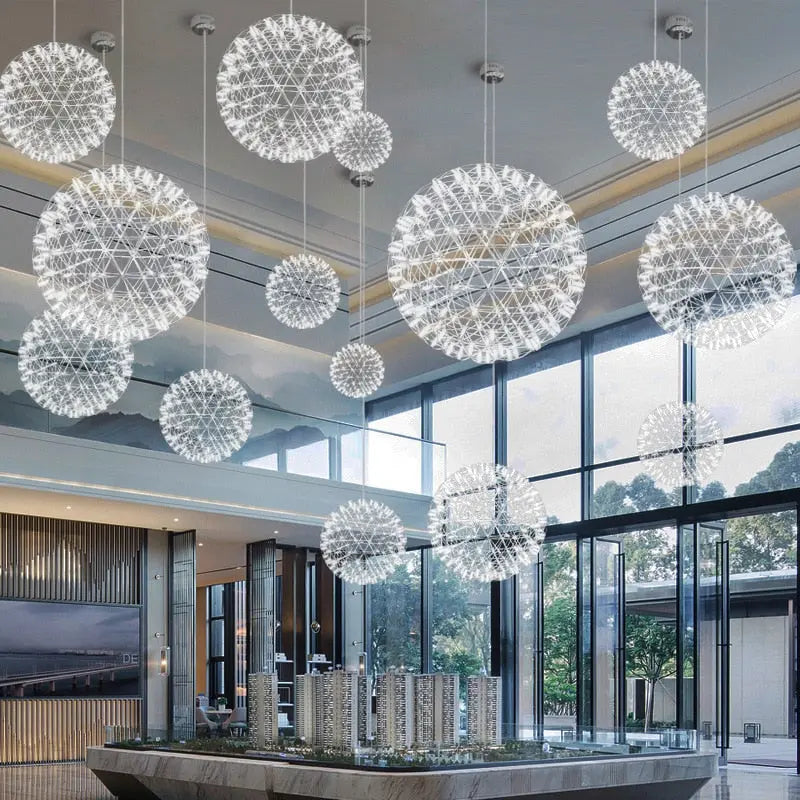
The Spark Ball Stainless Steel Pendant Light is a reflective metal sphere — a sculptural single pendant over a small table or a bold row over an island at 28–30 inches apart.

The Rustic Bell Jar Pendant Light is a glass bell with downward light — the modern-farmhouse island pendant; give it 8–12 inches of end clearance.
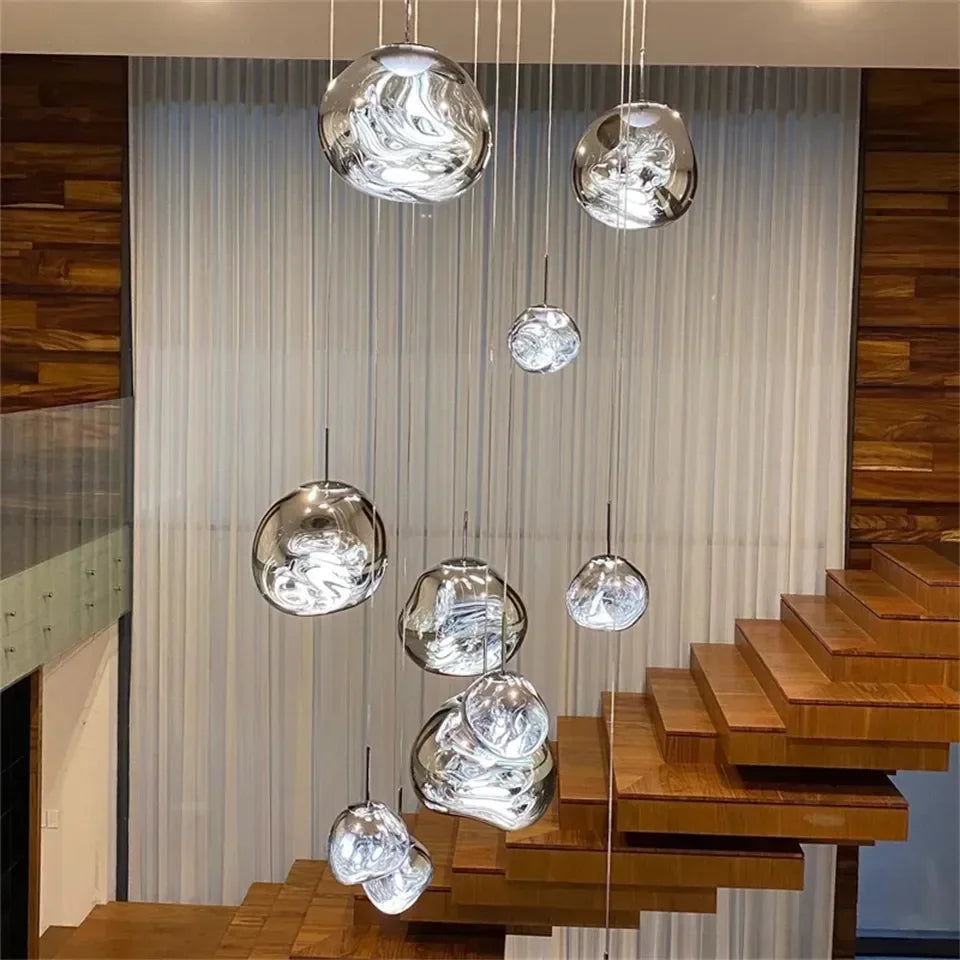
The Ruby Contemporary Bubble Glass Pendant Chandelier is a bubble-glass pendant in many tints — a colored accent over a dining table, entry, or bedroom.
Clusters and multi-light pendants
Pendant chandeliers that cover a wide surface from one box.
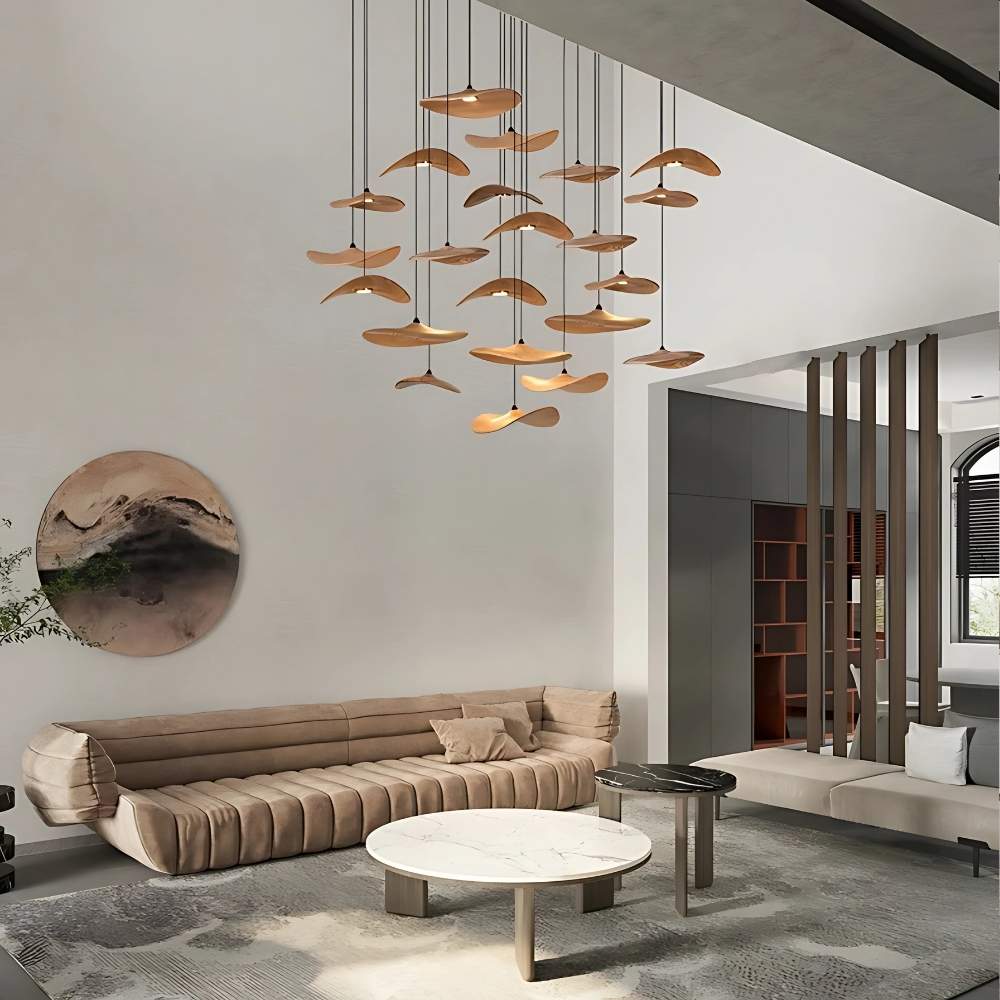
The Bidi Multi Light Pendant Chandelier hangs glass pendants at staggered heights from one canopy — the pendant chandelier for an island with a single box, a wide table, or an entry.

The Elor Contemporary Wood Multi Light Pendant runs wood shades along a linear canopy — warm, downward task light for an island or table in a Scandinavian or modern-rustic kitchen.
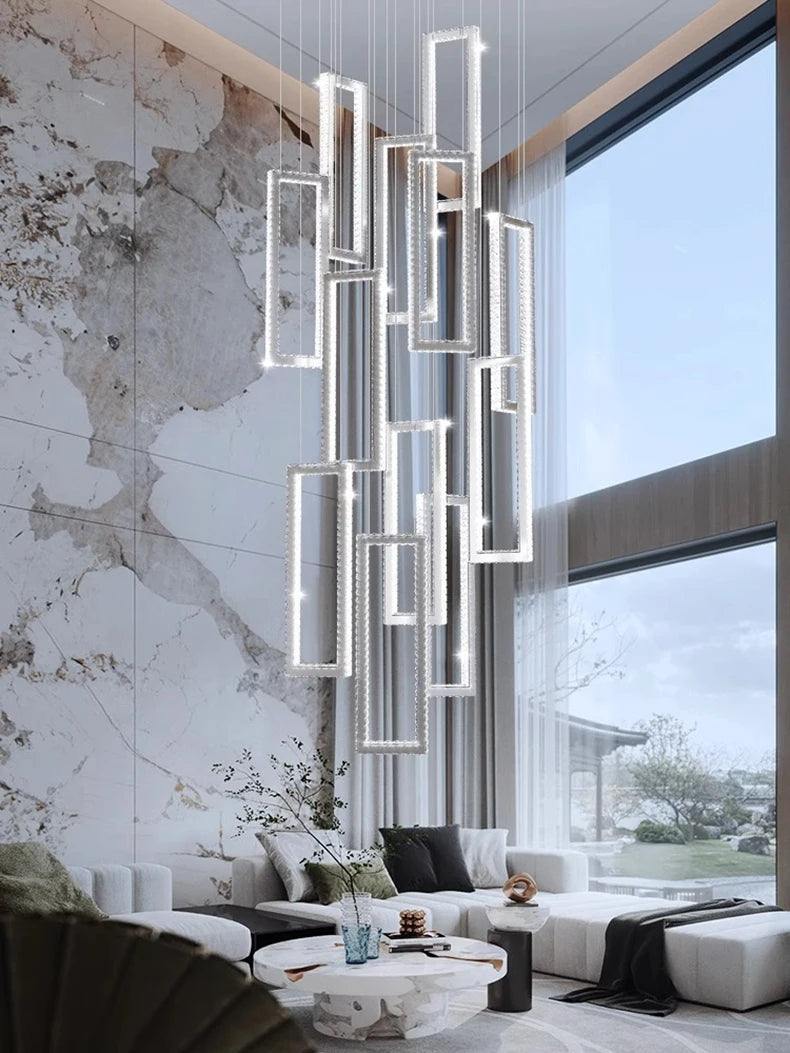
The Acai Crystal Multi Pendant Chandelier groups crystal pendants for sparkle without a traditional frame — over a dining table, in an entry, or in a primary bedroom.
Glass, metal, crystal, wood, cluster, and linear pendants for every room.
Pendant Lighting Kitchen Dining Room Bubble Glass
Frequently Asked Questions
What is modern pendant lighting?
A pendant is a single light source hung from the ceiling on a cord, rod, or cable. Modern pendants use clean shades — domes, globes, cylinders, linear bars, clusters, crystal, organic materials, or sculptural forms — without arms or tiers.
What is the difference between a pendant and a chandelier?
A pendant has one light source with focused light; a chandelier has several on a rigid frame with light spread in all directions. A pendant chandelier is a cluster of pendants on one canopy, combining both.
How high should a pendant light hang?
30 to 36 inches above a kitchen island or dining table, at least 7 feet above the floor anywhere people walk, and about 20 to 30 inches above a nightstand for bedside pendants.
What size pendant light do I need?
Over an island, about one-third of the island width per pendant; a single pendant over a round table, half to two-thirds of its width; a pendant used as a room's main light, the room's length plus width in feet as inches.
How many pendant lights over a kitchen island?
Island length in feet divided by 3, rounded — 2 on a 6-foot island, 3 on 8 to 9 feet — spaced 24 to 30 inches apart, or one linear fixture at about two-thirds of the length.
Can I use a pendant light in a living room?
Yes — a large sculptural pendant as the main light, a cluster over a seating group, or a single pendant beside a reading chair with its bottom about 5 feet above the floor.
Are pendant lights good for bedrooms?
Yes. Bedside pendants free the nightstand and give soft reading light; choose small opal or frosted globes, hang them 20 to 30 inches above the nightstand, and put them on a dimmer.
What is the difference between modern and contemporary pendants?
The terms overlap. Modern usually draws on mid-century geometry; contemporary means current materials and shapes such as LED, sculpted glass, and organic forms. Placement rules are the same.
Which pendant glass is best?
Opal or frosted near eye level for glare-free light, clear above eye level for sparkle, metal shades for downward task light, and tinted glass for mood with other light in the room.
Can I install a pendant without a ceiling box?
Use a plug-in pendant with a swag hook and a visible cord, or have an electrician add a box. Hardwired pendants each need a box or a multi-port canopy.
Choosing Modern Pendant Lighting
Start with the surface or spot the pendant serves, set the height for it, size the shade to it, and then pick the style. Pendants chosen in that order look simple for the right reason — because everything about them fits.
Browse the full range in the pendant lighting collection, island options in kitchen lighting, and ten island picks in modern pendant lights for kitchen islands.


