

Chandelier or ceiling light is one of those decisions that looks stylistic but is really structural — ceiling height, room function, and maintenance appetite settle most of it before taste enters the picture. This guide compares the two honestly across looks, light output, installation, upkeep, and cost factors, then widens out to pendants, flush mounts, and the low-ceiling question, so you leave with an actual answer rather than "it depends."
What Counts as a Chandelier?
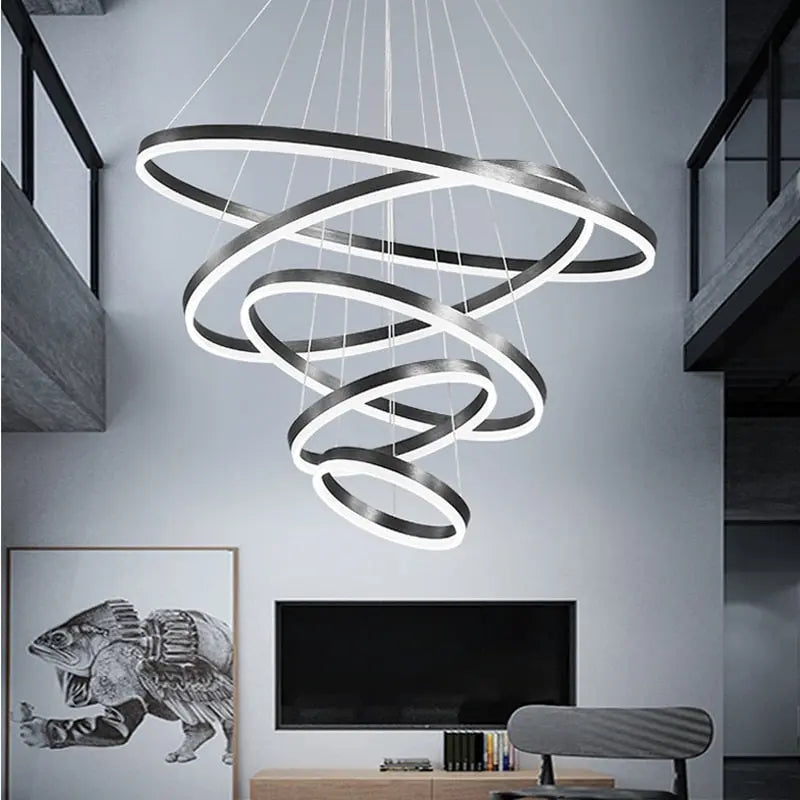
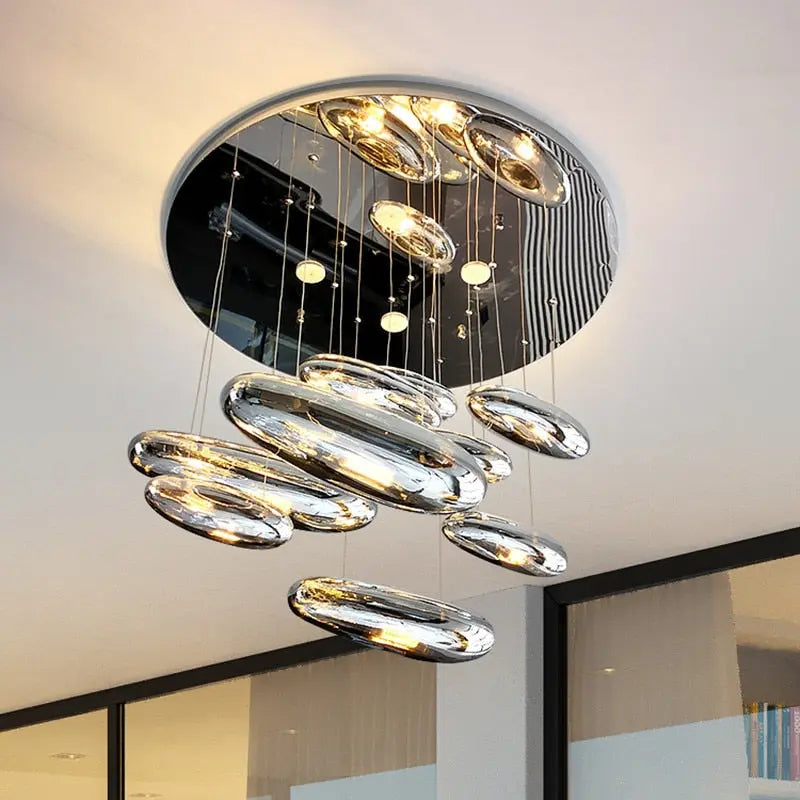
A chandelier is a suspended, branched fixture — it hangs from a chain, rod, or cord and spreads its light across multiple arms or elements. The form goes back to medieval candle frames, which is why the classic version still echoes candle holders, but the modern definition is broad: crystal tiers, metal rings, sputnik arms, and branch-and-orb designs all qualify. What unites them is that the fixture occupies vertical space and is meant to be looked at, not just lit.
That decorative intent is the practical difference. A chandelier's job is one part illumination, one part architecture — it anchors a room the way a fireplace or a great window does. The trade-offs (weight, height requirements, cleaning) all follow from that. Browse the chandelier collection to see how wide the modern definition runs.
What Counts as a Ceiling Light?
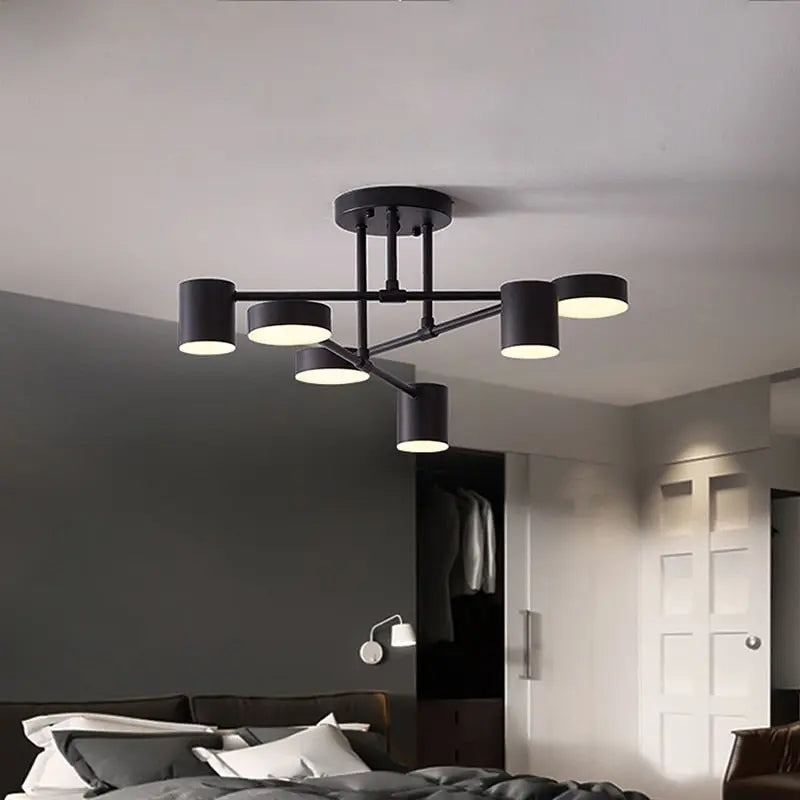
A ceiling light mounts directly to the ceiling with little or no suspension. The family includes flush mounts (tight to the ceiling), semi-flush mounts (a short visible drop, usually 4–10 inches), and recessed lighting (built into the ceiling plane itself). The design goal is the inverse of a chandelier's: distribute even, efficient light while staying visually quiet.
That quietness is a feature, not a limitation. Ceiling lights let the room's furniture, art, and architecture do the talking, and they fit spaces a chandelier physically can't — low-ceilinged bedrooms, hallways, closets, and kitchens where headroom over a work zone is non-negotiable. The ceiling lights collection covers the range from minimal discs to multi-head designs that borrow a little chandelier drama.
The Head-to-Head Comparison
| Chandelier | Ceiling Light | |
|---|---|---|
| Visual role | Focal point; defines the room's character | Supporting player; blends with the decor |
| Light quality | Atmospheric — shadows, sparkle, warmth; often supplemented for tasks | Even, consistent coverage; task-friendly |
| Ceiling height needed | 8 ft minimum, 9+ ft comfortable (7 ft floor clearance rule) | Works at any height, including 7-ft basements |
| Installation | Heavier; often needs a rated junction box and a second pair of hands; professional install common | Light; standard box almost always sufficient; common DIY swap |
| Cleaning | Regular dusting plus periodic detail cleaning of arms, crystals, or glass elements | Occasional wipe-down; few parts |
| Cost pattern | Higher purchase and install cost, driven by size, materials, and complexity | Generally lower purchase cost and near-zero install cost |
| Best rooms | Dining rooms, entries and foyers, living rooms, stairwells | Kitchens, bedrooms, hallways, bathrooms, low-ceiling rooms |
Look and Presence
A chandelier is furniture for the ceiling. It draws the eye upward, gives the room a center, and often becomes the thing guests comment on. That works brilliantly above a dining table or in an entry, and it can overwhelm a small utilitarian room. A ceiling light does the opposite — it disappears into the design, which is exactly right for spaces where the lighting should serve rather than perform.
Light Output and Quality
Here the honest answer favors ceiling lights for pure function. A flush mount or multi-head ceiling fixture throws even light across the whole room, which is what kitchens, offices, and bathrooms need. Chandeliers produce a more atmospheric light — points of brightness, soft shadows, sparkle if there's crystal involved — which flatters a dinner party and frustrates anyone trying to read. The mature solution in living spaces is layering: a chandelier for ambience, supplemented by lamps or recessed lights for tasks.
Height and Clearance
The rule that decides most cases: keep at least 7 feet between the floor and the lowest point of a hanging fixture in any walking area. At an 8-foot ceiling that leaves 12 inches for the entire fixture and its mount — possible with a compact design, comfortable with nothing. At 9 feet the options open up; at 10 feet and beyond, chandeliers are fully at home. Over a dining table the math relaxes, since nobody walks under the fixture: hang it 30–36 inches above the tabletop regardless of ceiling.
Installation and Upkeep
Ceiling lights are the easiest fixtures in the house to install — light, close to the box, and typically a one-person job for anyone comfortable with basic wiring. Chandeliers add weight (a standard junction box is rated to 50 pounds; larger fixtures need a rated box and sometimes blocking above), height (ladder work), and awkwardness (a second person is realistic above 25 pounds). Cleaning follows the same pattern: a ceiling light takes a wipe; a chandelier with arms and glass elements takes a session.
What Drives the Cost
Rather than quote prices that shift with materials and market, it's more useful to know what moves them. For chandeliers: size, number of lights, material (crystal and hand-worked iron at the top, simple metal frames at the base), and control features like dimming and app connectivity. Add professional installation for heavy pieces. For ceiling lights: mostly size and whether LED technology is integrated. Operating cost now favors both roughly equally — LED options exist across the board and cut energy use dramatically against old incandescent assumptions.
Where Pendants Fit In
A pendant light sits between the two categories: suspended like a chandelier, but typically a single light source in a single shade or globe rather than a branched, multi-arm structure. That makes pendants the right tool for focused light over a specific spot — a kitchen island (in twos and threes), a reading corner, a console table — where a chandelier would be too much structure and a ceiling light too diffuse.
The practical rule of thumb: choose a pendant when you're lighting a place, a chandelier when you're lighting a room. Rooms with very tall ceilings blur the line — oversized and multi-tier pendants can take on a chandelier's role — and that decision has its own logic covered in the high-ceiling pendant guide. For the fixtures themselves, the pendant lighting collection spans both minimal and statement designs.
The Full Fixture Family, Compared
Since the choice is rarely just two-way, here's how all five common ceiling-mounted types compare:
| Fixture Type | How It Mounts | Light Character | Best Use |
|---|---|---|---|
| Chandelier | Suspended, multi-arm | Atmospheric, decorative, room-defining | Dining rooms, foyers, living rooms with 9+ ft ceilings |
| Pendant | Suspended, single-source | Focused pool of light | Islands, tables, reading spots; multiples for coverage |
| Semi-flush mount | Short fixed drop (4–10 in) | Even, with a little decorative presence | 8–9 ft ceilings wanting more than a disc |
| Flush mount | Tight to ceiling | Even, unobtrusive | Low ceilings, hallways, bedrooms, closets |
| Recessed | Inside the ceiling plane | Directional, invisible source | Kitchens, task zones, layered schemes |
Low Ceilings: Can You Still Have a Chandelier?
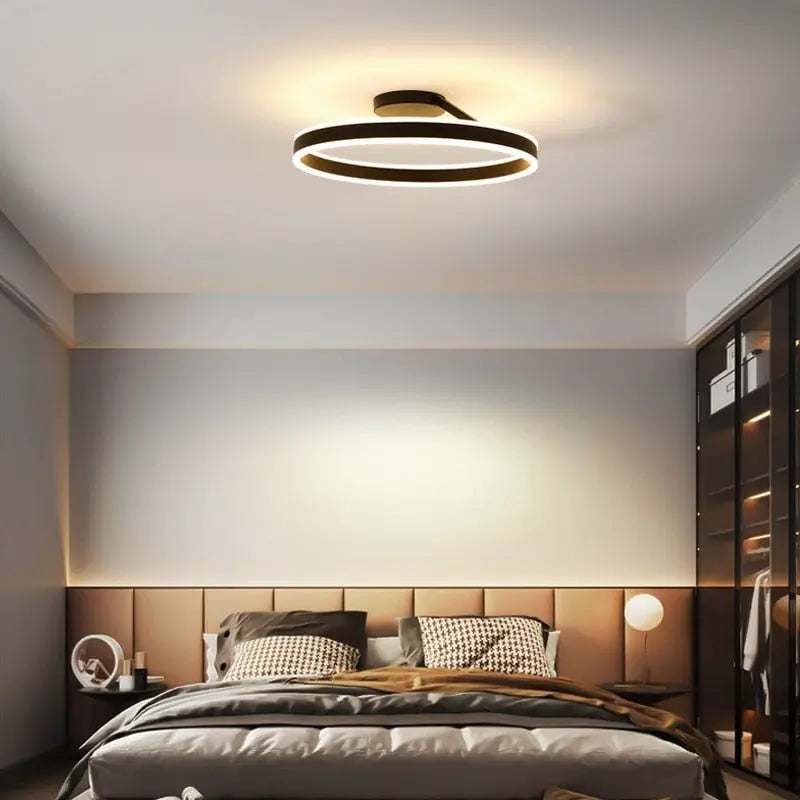
Yes — this is what flush-mount chandeliers exist for. They keep the branched, decorative character of a chandelier while mounting tight to the ceiling like a flush fixture, so an 8-foot room gets the ornament without the head hazard. Semi-flush designs split the difference with a short fixed drop, appropriate from about 8 feet up.
Two tips for low-ceiling rooms that want chandelier presence: choose designs with horizontal spread rather than vertical drop (a wide, shallow fixture reads grander than a tall narrow one at these heights), and keep the finish light or open-structured so the fixture doesn't visually press the ceiling down. The flush mount chandelier collection is built for exactly this situation.
Room-by-Room Recommendations
| Room | First Choice | Why |
|---|---|---|
| Dining room | Chandelier | Fixed focal point over the table; clearance rules relax to 30–36 in above the surface |
| Entry / foyer | Chandelier (height permitting) | First impression; flush mount if under 8 ft |
| Living room | Either — often both | Chandelier for character plus lamps or recessed for tasks; see the living room chandelier guide |
| Kitchen | Ceiling light + pendants | Even light for work zones; pendants over the island |
| Bedroom | Ceiling light (or flush-mount chandelier) | Low-key, even light; a dimmer earns its keep here |
| Hallway | Flush mount | Clearance and coverage; repeat fixtures every 8–10 ft |
| Bathroom | Ceiling light + sconces | Even light plus eye-level light at the mirror |
| Stairwell | Chandelier / long pendant | Vertical space suits vertical fixtures |
Using Both: The Layered Approach
The chandelier-versus-ceiling-light question dissolves in most whole-home plans, because the sensible answer is both, deployed by room. A common pattern: chandelier in the dining room and entry, flush or semi-flush fixtures in bedrooms and halls, recessed plus pendants in the kitchen, and a chandelier-plus-lamps combination in the living room. Within a single room, pairing an atmospheric fixture with functional supplements — and putting the main fixture on a dimmer — gives you both moods without compromise.
One consistency rule makes mixed fixtures feel intentional: keep bulb color temperature the same throughout connected spaces (2700K–3000K warm white for living areas), and let finishes share at least one common note across rooms that see each other.
Sizing, Whichever You Choose
The same formula serves both categories: add the room's length and width in feet, and use that sum in inches as the fixture's diameter — a 12 × 14 ft room points to roughly 26 inches, whether that's a chandelier or a large flush mount. Dining fixtures size to the table instead: one-half to two-thirds of its width. For full reference tables by room and ceiling height, use the chandelier size calculator.
Every category in this comparison, in one place.
Chandeliers Ceiling Lights Flush Mount Chandeliers Pendant Lighting Dining Room Size Calculator
Frequently Asked Questions
What's the difference between a chandelier and a ceiling light?
A chandelier hangs from the ceiling on a chain, rod, or cord and spreads light across multiple decorative arms or elements — it's built to be a focal point. A ceiling light mounts directly to the ceiling with little or no drop (flush, semi-flush, or recessed) and is built to deliver even, unobtrusive illumination. In practice the differences cascade from there: chandeliers need more ceiling height, weigh more, cost more to buy and install, and take more cleaning; ceiling lights fit anywhere, install easily, and light rooms more evenly.
Which is better, a chandelier or a ceiling light?
Neither is better — they solve different problems. A chandelier is the right call when the room has 9+ feet of ceiling, a natural focal point (dining table, entry, seating area), and the fixture is meant to define the space. A ceiling light wins when ceilings are low, when the room needs even task light (kitchens, bedrooms, hallways), or when simple installation and maintenance matter. Most well-lit homes use chandeliers in two or three key rooms and ceiling lights everywhere else.
What is a chandelier, exactly?
A chandelier is a suspended light fixture with multiple arms, branches, or light-carrying elements arranged around a central body. The form descends from medieval candle frames, but the modern category is broad: crystal tiers, metal ring designs, sputnik arms, branch-and-orb structures, and cascading multi-tier fixtures all qualify. The defining traits are suspension (it hangs rather than mounts flat) and multiplicity (light comes from several points, not one) — plus the intent to be decorative, not just functional.
Can a room with low ceilings have a chandelier?
Yes, through flush-mount and semi-flush chandeliers — fixtures that keep the branched, decorative form while mounting tight to the ceiling. A flush-mount chandelier works at any ceiling height, including 8-foot rooms; semi-flush designs with a 4–10 inch drop suit ceilings from about 8 feet. The design trick at low heights is horizontal spread: a wide, shallow fixture delivers presence without eating headroom, whereas anything with vertical drop runs into the 7-foot walking clearance rule.
What's the difference between a pendant light and a chandelier?
A pendant is a suspended fixture with a single light source in one shade, globe, or diffuser; a chandelier is a suspended fixture with multiple arms or light points around a central structure. Functionally, pendants light a spot — an island, a table, a corner — while chandeliers light and define a whole room. The line blurs at large sizes: oversized multi-light pendants in tall rooms effectively play a chandelier's role, and which one belongs in a high-ceiling space is its own decision with its own sizing rules.
Do chandeliers give enough light for a whole room?
Often not on their own, and that's by design — chandelier light is atmospheric, with points of brightness and soft shadows rather than flat even coverage. For rooms where tasks happen (reading, cooking, working), the standard approach is layering: the chandelier provides ambience and character, while recessed lights, lamps, or sconces supply the functional brightness. A dimmer on the chandelier lets it run bright for gatherings and low for quiet evenings.
Are chandeliers hard to install?
Harder than ceiling lights, mainly because of weight and height. A standard junction box supports up to 50 pounds; heavier chandeliers need a rated box and sometimes structural blocking above the ceiling. Fixtures over about 25 pounds realistically need two people, and anything involving tall ladders, new wiring, or a heavy fixture is a sound reason to hire an electrician. Ceiling lights, by contrast, are the easiest swap in home lighting — light, close to the box, and typically a one-person job.
What makes chandeliers cost more than ceiling lights?
Four drivers: size, materials, complexity, and installation. Crystal elements, hand-worked iron, and multi-tier structures push chandelier prices up; simple metal frames keep them accessible. Heavier fixtures add professional installation to the bill. Ceiling lights are cheaper on all four counts — smaller, simpler, lighter, and usually self-installed. Operating costs have converged, though: LED options exist across both categories and cut energy use to a fraction of old incandescent levels.
Should the ceiling light height change where I hang a fixture over a dining table?
Over a dining table the walking-clearance rule doesn't apply, since nobody passes under the fixture. Hang a chandelier or pendant so its bottom sits 30–36 inches above the tabletop at an 8-foot ceiling, adding about 3 inches per additional foot of ceiling height. This keeps the fixture below eye-line-blocking height while concentrating light on the table — one of the few places a hanging fixture works even in a lower-ceilinged room.
Can I mix chandeliers and ceiling lights in the same house?
Not only can you — you probably should. The standard whole-home pattern puts chandeliers where character matters (dining room, entry, living room) and ceiling lights where function leads (kitchen, bedrooms, halls, baths). Two rules keep the mix coherent: use one bulb color temperature throughout connected spaces (2700K–3000K warm white in living areas), and let fixture finishes share at least one common element — a metal tone, a shade material — across rooms that are visible from each other.
Wrapping Up
The chandelier-versus-ceiling-light decision comes down to two questions: is there enough ceiling (9 feet makes chandeliers comfortable; under 8 rules out most hanging fixtures), and is the room for gathering or for tasks? Character rooms earn chandeliers, working rooms earn ceiling lights, and most homes rightly use both. Flush-mount chandeliers cover the low-ceiling middle ground, and pendants handle the spots in between.
Size whichever you choose with the length-plus-width formula — or let the size calculator do it per room — and browse the chandelier and ceiling light collections side by side to see the comparison in real fixtures.


