

Picking the right size light fixture comes down to two universal formulas — room dimensions for diameter, ceiling height for fixture height — applied differently for each room and fixture type. This complete 2026 guide covers room-by-room sizing in both inches and centimeters, with specific recommendations for living rooms, bedrooms, dining rooms, kitchens, bathrooms, and foyers.
Universal Light Fixture Sizing Formulas
The Two Universal Formulas
Diameter (inches) = Length (ft) + Width (ft)
Height (inches) = Ceiling Height (ft) × 2.5 to 3
Apply both formulas together for properly proportioned light fixtures.
These formulas apply to chandeliers, pendant lights, flush mounts, and semi-flush mounts in general room applications. Dining room and kitchen island fixtures use different proportional rules based on the surface below them (table or island width).
- Diameter formula example. 12 ft × 14 ft room: 12 + 14 = 26 inches diameter (66 cm). A 26-inch diameter chandelier or pendant works in this room.
- Height formula example. 9 ft ceiling: 9 × 2.5 to 3 = 22 to 27 inches maximum fixture height (56-69 cm). Chandelier stays within this range to maintain proportion.
- Sizing adjustment for visual weight. Minimal airy designs (sphere pendants, linear bars) can be sized 10% larger than formula. Ornate heavy designs (crystal chandeliers with substantial visual weight) should be sized 10-15% smaller.
- Ceiling height adjustment for tall ceilings. For ceilings above 8 ft, add 2.5-3 inches to base diameter per additional foot. A 10×12 ft room with 12 ft ceiling: base 22" + 10-12" adjustment = 32-34" diameter.
- Quick metric conversion. Multiply inches × 2.54 for centimeters. Common conversions: 16" = 41 cm; 20" = 51 cm; 24" = 61 cm; 26" = 66 cm; 30" = 76 cm; 36" = 91 cm; 40" = 102 cm.
- The visual proportion test. Take photo from room floor — if fixture looks lost, size up 10-20%; if it dominates uncomfortably, size down 10-20%.
Sizing by Room Dimensions (8×8 to 20×20)
| Room Size (L × W) | Fixture Diameter (Inches) | Fixture Diameter (CM) | For 8 ft Ceiling | For 9 ft Ceiling | For 10+ ft Ceiling |
|---|---|---|---|---|---|
| 8 × 8 ft | 16" | 41 cm | 12-16" tall (30-41 cm) | 18-22" tall (46-56 cm) | 22-27" tall (56-69 cm) |
| 10 × 10 ft | 20" | 51 cm | 12-16" tall | 18-24" tall | 24-30" tall |
| 10 × 12 ft (most common) | 22" | 56 cm | 12-16" tall | 18-24" tall | 24-30" tall |
| 12 × 12 ft | 24" | 61 cm | 14-18" tall | 20-26" tall | 26-32" tall |
| 12 × 14 ft | 26" | 66 cm | 14-18" tall | 22-28" tall | 28-34" tall |
| 14 × 14 ft | 28" | 71 cm | 16-20" tall | 22-28" tall | 28-34" tall |
| 14 × 16 ft | 30" | 76 cm | 16-20" tall | 24-30" tall | 30-36" tall |
| 16 × 18 ft | 34" | 86 cm | 18-22" tall | 24-30" tall | 32-40" tall |
| 18 × 20 ft | 38" | 97 cm | 18-22" tall | 26-32" tall | 34-42" tall |
| 20 × 20 ft (large) | 40" | 102 cm | 20-24" tall | 28-34" tall | 36-48" tall |
Living Room Light Fixture Sizing
Living Room Sizing
Living rooms typically benefit from substantial focal fixture sized to room dimensions using L+W formula. The fixture anchors the seating area visually while providing ambient illumination supplemented by lamps and sconces. Common living room sizes: 12×16 ft (28" fixture / 71 cm); 14×18 ft (32" / 81 cm); 16×20 ft (36" / 91 cm); 18×24 ft (42" / 107 cm large). Substantial open-concept rooms: divide into zones and apply formula per conversation zone. Multiple fixtures alternative: rather than single oversized chandelier, use 2-3 medium fixtures across substantial spaces. Layering essential: chandelier + wall sconces flanking sofa + floor lamps in corners + table lamps on end tables creates dimensional atmosphere impossible with single fixture. Light output: 1,500-3,000 lumens total for typical living room from all combined fixtures. Browse our chandeliers collection, table lamps, and floor lamps.
Bedroom Light Fixture Sizing
Bedroom Sizing
Bedrooms prioritize comfort, safety, and softness over dramatic statement. Standard ceiling height (8-9 ft) bedrooms work best with flush mount or semi-flush fixtures avoiding the head-clearance concerns of substantial chandeliers. Common bedroom sizes: 10×12 ft (22" fixture / 56 cm); 12×14 ft (26" / 66 cm); 14×16 ft primary bedroom (30" / 76 cm). Bedroom-specific rules: scale fixture conservatively (10-15% smaller than living room formula); avoid fixtures directly over bed; specify dimmer compatibility throughout; layer bedside table lamps + wall sconces for reading without disturbing partner. Light output: 800-1,500 lumens total ambient; supplemented by 400-600 lumen bedside reading. Color temperature critical: 2200K-2700K warm only — cool color temperature disrupts sleep architecture and circadian rhythm. Browse our ceiling lights collection for flush and semi-flush options.
Kitchen Light Fixture Sizing
Kitchen Sizing
Kitchens combine pendant clusters over islands with distributed recessed downlights for whole-room ambient. Pendant cluster sizing: 1 pendant for 4 ft island; 2 pendants for 5-6 ft island; 3 pendants for 7-8 ft island; 4-5 pendants for 9+ ft island. Pendant spacing: 24-30 inches between pendant centers; minimum 6 inches from island edge to first/last pendant. Pendant diameter: 10-14" for single pendant clusters; 16-22" for substantial standalone pendants over large islands. Pendant hanging height: 30-36" above kitchen island work surface. Recessed downlight spacing: divide ceiling height by 2 for distance between lights (8 ft ceiling = 4 ft spacing). Under-cabinet LED: continuous strip below all upper cabinets for task lighting on counters. Browse our pendant lighting collection.
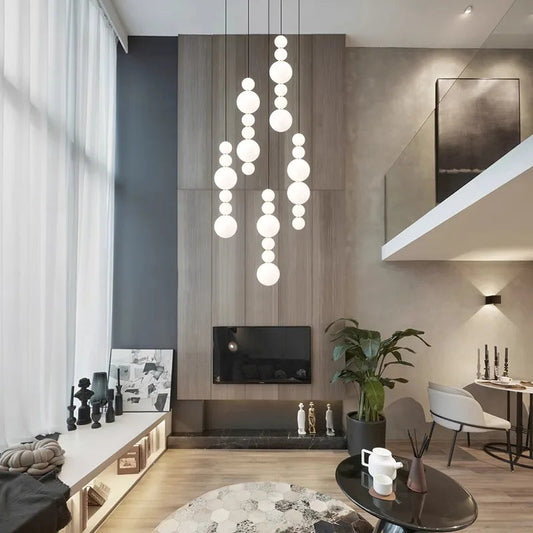
The White Multi Globe Pendant Light features 3-8 string configurations enabling flexible scaling for kitchens with high ceilings or substantial island applications.
Dining Room Light Fixture Sizing
Dining Room Sizing
Dining room fixtures size to table proportion rather than room dimensions. The chandelier should be approximately 1/2 to 2/3 the width of the dining table, or roughly 12 inches narrower than the table (6 inches on each side). Common dining table sizing: 48" round table → 24-32" chandelier (61-81 cm); 60" rectangular table → 30-40" chandelier (76-102 cm); 72" rectangular table → 36-48" chandelier (91-122 cm); 84" rectangular table → 42-56" linear chandelier (107-142 cm). Linear vs cluster decision: linear fixtures (single horizontal bar) work best for 6+ ft rectangular tables; cluster (3-pendant arrangement) works best for traditional dining; round tables suit single statement pendant or compact round chandelier. Hanging height standard: 30-36" above tabletop for 8 ft ceiling; add 3" per additional foot of ceiling height. Browse our dining room lighting collection.
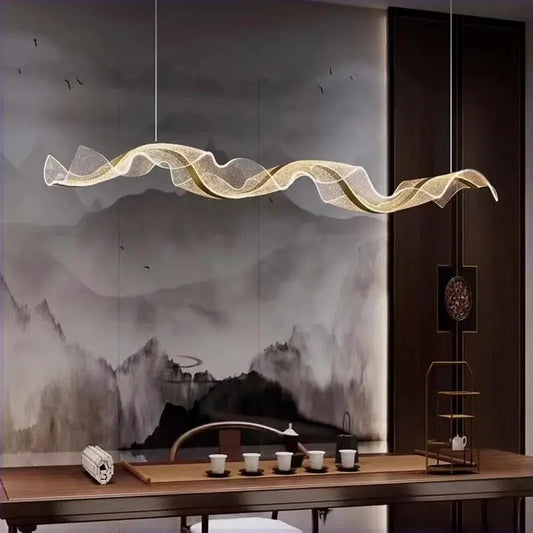
The Modern Ocean Wave Pendant Chandelier and the Modern Moravian Star Chandelier exemplify dining room chandelier scale appropriate for substantial dining table applications.
Bathroom Light Fixture Sizing
Bathroom Sizing
Bathrooms use vanity-specific sizing different from general room formula. Vanity light above mirror: width approximately 3/4 the mirror width. For 36-inch mirror: 27-inch vanity light. Flanking sconces: paired sconces flanking mirror at 36-40" apart; mounted at 60-65" from floor to center of sconce; best skin tone rendering. Ceiling fixture for bathroom: apply L+W formula. For 8×10 ft bathroom: 18" diameter flush mount. Shower-rated recessed: minimum 4-inch wet-location rated recessed light in shower area; 6 ft above shower floor minimum. Bulb specifications: CRI 90+ minimum for accurate skin tone rendering during grooming; 3000K-3500K color temperature; dimmer compatibility for evening atmosphere. Light output: 1,000-1,500 lumens at vanity (highest light requirement); 800-1,200 lumens whole bathroom ambient. Browse our bathroom lighting collection.
Foyer Light Fixture Sizing
Foyer Sizing
Foyers establish the home's first impression through dramatic substantial fixtures sized to foyer dimensions and ceiling height. Standard ceiling foyer (8-9 ft): apply L+W formula; 10×10 ft foyer = 20" diameter (51 cm); 12×12 ft foyer = 24" diameter (61 cm). High ceiling foyer (10-12+ ft): apply L+W formula plus 2.5-3" per foot above 8 ft. 10×12 ft foyer with 12 ft ceiling: 22" + 10-12" adjustment = 32-34" diameter. Two-story foyer (18-20+ ft): substantial 30-40" diameter chandelier (76-102 cm); 45-60" tall (114-152 cm); positioned at second-floor floor line. Hanging height standard: minimum 7 ft floor clearance walkthrough; for two-story foyers position bottom at second-floor floor line. Browse our foyer lighting collection.
Ceiling Height Adjustment Formula
| Ceiling Height | Diameter Adjustment | Maximum Fixture Height | Bottom From Floor |
|---|---|---|---|
| 8 ft | No adjustment (base formula) | 12-16" (30-41 cm) | 7 ft (84") |
| 9 ft | Add 2.5-3" to base diameter | 18-27" (46-69 cm) | 7.5 ft (90") |
| 10 ft | Add 5-6" to base diameter | 25-30" (64-76 cm) | 7.5-8 ft (90-96") |
| 11 ft | Add 7.5-9" to base diameter | 27-33" (69-84 cm) | 8 ft (96") |
| 12 ft | Add 10-12" to base diameter | 30-36" (76-91 cm) | 8 ft (96") |
| 14 ft | Add 15-18" to base diameter | 35-42" (89-107 cm) | 8.5 ft (102") |
| 16 ft | Add 20-24" to base diameter | 40-48" (102-122 cm) | 9 ft (108") |
| 18-20 ft (two-story) | Add 25-30" to base diameter | 45-60" (114-152 cm) | 9-10 ft (second-floor line) |
Chandelier Sizing — DEDICATED Guide
Chandelier sizing applies room dimensions formula (L+W) for general applications plus table proportion formula (1/2 to 2/3 table width) for dining applications:
- General room chandelier: L+W formula (inches diameter). 12×14 ft room = 26" diameter (66 cm).
- Dining table chandelier: 1/2 to 2/3 table width OR 12" narrower than table. 60" table = 30-40" chandelier.
- Multiple chandelier rooms: long rectangular dining or great rooms support 2-3 medium chandeliers spaced 6-8 ft apart instead of single large.
- Visual weight adjustment: crystal chandeliers and ornate designs size 10-15% smaller; minimalist sphere and modern chandeliers size 10% larger; both within formula tolerance.
- Hanging height standard: 7 ft minimum floor clearance walkthrough; 30-36" above dining table; 30-36" above kitchen island. Browse our modern chandeliers and crystal chandeliers.
Pendant Light Sizing — DEDICATED Guide
| Pendant Diameter | Recommended Distance Between Pendants | Height Above Surface | Best Application |
|---|---|---|---|
| 10" (25 cm) | 20-24" (50-60 cm) | 30-36" above table/counter | Small island, compact bar |
| 12" (30 cm) | 24-28" (60-71 cm) | 30-36" above table/counter | Standard kitchen island |
| 14" (36 cm) | 26-30" (66-76 cm) | 30-36" above table/counter | Medium kitchen island |
| 16" (40 cm) | 28-32" (71-81 cm) | 30-36" above table/counter | Substantial kitchen island |
| 20" (50 cm) | 32-36" (81-91 cm) | 30-36" above table/counter | Large island, dining table |
| 24" (61 cm) | 36-42" (91-107 cm) | 30-36" above table/counter | Statement single pendant |
Recessed Lighting Sizing — DEDICATED Guide
| Ceiling Height | Recommended Distance Between Lights | Best Recessed Size | Best Application |
|---|---|---|---|
| 8 ft (2.4 m) | 4 ft (1.2 m) | 4-5 inch recessed | General ambient, accent |
| 9 ft (2.7 m) | 4.5 ft (1.4 m) | 4-6 inch recessed | Standard residential |
| 10 ft (3 m) | 5 ft (1.5 m) | 5-6 inch recessed | Upscale residential |
| 12 ft (3.6 m) | 6 ft (1.8 m) | 6 inch recessed | High ceiling, substantial spaces |
| 14+ ft | 7+ ft (2.1+ m) | 6 inch recessed | Cathedral, grand spaces |
Flush Mount & Semi-Flush Sizing
| Room Size | Flush Mount Diameter | Semi-Flush Diameter | Best Application |
|---|---|---|---|
| Under 100 sq ft | 12-14" (30-36 cm) | 14-16" (36-41 cm) | Small bedrooms, bathrooms, closets |
| 100-150 sq ft | 14-16" (36-41 cm) | 16-18" (41-46 cm) | Medium bedrooms, dining nooks |
| 150-225 sq ft | 16-20" (41-51 cm) | 18-22" (46-56 cm) | Standard bedrooms, foyers |
| 225-350 sq ft | 20-24" (51-61 cm) | 22-26" (56-66 cm) | Living rooms, large bedrooms |
| 350+ sq ft | 24-30" (61-76 cm) | 26-32" (66-81 cm) | Substantial living rooms, great rooms |
Hanging Height Reference Tablo
| Application | Height Specification | Notes |
|---|---|---|
| Walkthrough areas (foyer, hallway) | 7 ft (84") minimum floor to bottom | Safety clearance walkthrough |
| Dining table chandelier | 30-36" above tabletop | 8 ft ceiling base; add 3" per extra foot |
| Kitchen island pendant | 30-36" above island surface | Standard task lighting height |
| Bedside pendant alternative | 24-30" above bedside table surface | Reading position; eye level when sitting in bed |
| Wall sconce (general) | 60-72" from floor to center | Eye level for arriving adult |
| Vanity sconce flanking mirror | 60-65" from floor to center | Optimal grooming flattering height |
| Two-story foyer chandelier bottom | 9-10 ft (second-floor line) | Readable from both floors |
| Vaulted ceiling chandelier | Adjustable based on peak height | Use adjustable chain for positioning |
| Outdoor wall lantern | 60-72" from finished surface | Eye level entry illumination |
| Shower-rated recessed | 6+ ft above shower floor | Wet-location rated mandatory |
Common Light Fixture Sizing Mistakes
- Choosing undersized fixtures for room. Most common sizing mistake. Apply L+W formula; verify with painter's tape template before purchase. Undersized fixtures look insignificant; the visual statement matters as much as the illumination function.
- Skipping ceiling height adjustment. L+W formula produces correct diameter for 8 ft ceilings only. Higher ceilings require adding 2.5-3 inches per foot above 8 ft. A 22" chandelier appropriate for 8 ft ceiling becomes 32-34" for 12 ft ceiling.
- Hanging fixtures too low. Minimum 7 ft floor clearance required for walkthrough safety. Lower clearance creates safety hazards and visual disconnection from human scale.
- Using room formula for dining chandelier. Dining chandeliers size to table (1/2 to 2/3 table width), not room dimensions. Applying room formula leaves dining chandelier looking lost relative to table.
- Wrong pendant count over island. 5 pendants over 4 ft island looks crowded; 1 pendant over 8 ft island looks lost. Match pendant count to island length (1 per 4 ft).
- Insufficient pendant spacing. Pendants closer than 24 inches apart appear cluttered. Maintain 24-30" minimum between pendant centers.
- Wrong recessed light spacing. Lights spaced too close create overlit zones; too far apart leave dim zones between. Divide ceiling height by 2 for approximate spacing.
- Skipping visual weight adjustment. Ornate crystal chandeliers should be sized 10-15% smaller than formula; minimalist sphere pendants can be sized 10% larger. Visual weight affects perceived size.
- Forgetting dimmer compatibility. Fixtures locked at single brightness fail to support mood flexibility residential applications require. Always specify LED-rated dimmer compatibility.
- Wrong vanity light proportion. Vanity lights wider than mirror look unprofessional; narrower than 3/4 mirror width looks insufficient. Match vanity light width to 3/4 mirror width approximately.
Browse Seus Lighting's complete collections — chandeliers and modern chandeliers for substantial room and dining applications, crystal chandeliers for luxury aesthetic, pendant lighting for kitchen islands and dining tables, ceiling lights for flush mount and semi-flush sizing, dining room lighting for table-proportional chandeliers, foyer lighting for entryway sizing, bathroom lighting for vanity-specific applications, table lamps and floor lamps for supplementary illumination, and our custom service for unique sizing requirements.
Chandeliers Modern Chandeliers Crystal Chandeliers Pendant Lighting Ceiling Lights Dining Room Foyer Lighting Bathroom Lighting Table Lamps Floor Lamps Custom Service
Frequently Asked Questions
What size light fixture for room?
Two universal formulas determine correct light fixture size: (1) Diameter formula: room length (ft) + width (ft) = fixture diameter (inches). For 12×14 ft room: 12+14 = 26" diameter (66 cm). (2) Height formula: ceiling height (ft) × 2.5-3 = maximum fixture height (inches). For 9 ft ceiling: 22-27" tall. Common room sizes: 8×8 ft → 16" (41 cm); 10×10 ft → 20" (51 cm); 10×12 ft → 22" (56 cm); 12×12 ft → 24" (61 cm); 12×14 ft → 26" (66 cm); 14×16 ft → 30" (76 cm); 16×18 ft → 34" (86 cm); 20×20 ft → 40" (102 cm). Visual weight adjustment: minimalist airy designs can be sized 10% larger; ornate heavy crystal designs should be sized 10-15% smaller. Ceiling height adjustment: for ceilings above 8 ft, add 2.5-3 inches to base diameter per additional foot. Room-specific exceptions: dining rooms size to table (1/2 to 2/3 table width); kitchen islands use 3-pendant clusters; bedrooms favor flush/semi-flush for safety.
What size ceiling light for 12x12 room?
For a 12×12 room, use a ceiling light fixture 24 inches in diameter (61 cm) following the universal formula: room length (12 ft) + width (12 ft) = 24 inches diameter. Specific recommendations for 12×12 room by ceiling height: (1) 8 ft ceiling: 24" diameter × 14-18" tall maximum (semi-flush or compact chandelier). (2) 9 ft ceiling: 26-27" diameter × 20-26" tall (substantial single-tier chandelier). (3) 10 ft ceiling: 29-30" diameter × 26-32" tall (multi-tier chandelier viable). (4) 12 ft ceiling: 32-34" diameter × 30-36" tall (multi-tier statement). Visual weight adjustment: airy minimalist designs (sphere pendant, simple drum) can size up to 27"; ornate crystal designs should stay at 22-24". Multiple fixture alternative: 12×12 rooms also work with 2 medium 16-18" pendants spaced 5-6 ft apart instead of single 24" chandelier. Color temperature: 2700K-3000K warm white for residential applications.
What size light fixture for living room?
Living room light fixture size follows the universal formula based on room dimensions: room length (ft) + width (ft) = fixture diameter (inches). Common living room sizes: (1) 10×12 ft small living room: 22" diameter (56 cm) chandelier or pendant. (2) 12×14 ft medium living room: 26" diameter (66 cm). (3) 14×16 ft standard living room: 30" diameter (76 cm). (4) 16×20 ft large living room: 36" diameter (91 cm). (5) 18×24 ft great room: 42" diameter (107 cm) or multiple fixtures across zones. For living rooms with high ceilings: add 2.5-3 inches per foot above 8 ft. A 14×16 ft room with 12 ft ceiling: 30" + 10-12" adjustment = 40-42" diameter substantial chandelier. Multiple fixtures alternative: substantial living rooms benefit from 2-3 medium chandeliers spaced 6-8 ft apart rather than single oversized fixture. Layered lighting essential: chandelier + wall sconces + floor lamps + table lamps creates dimensional atmosphere. Color temperature: 2700K-3000K warm white. Light output: 1,500-3,000 lumens total combined fixtures.
What size light fixture for bedroom?
Bedroom light fixture size follows universal formula but typically 10-15% smaller than living room equivalent for restrained atmosphere matching the room's sleep-focused function. Common bedroom sizes: (1) 10×12 ft standard bedroom: 18-22" diameter flush mount or semi-flush; small chandelier acceptable for 9+ ft ceilings. (2) 12×14 ft medium bedroom: 22-26" diameter; semi-flush mount or modest chandelier. (3) 14×16 ft primary bedroom: 26-30" diameter; substantial flush/semi-flush or chandelier with 9+ ft ceiling. (4) 16×20 ft luxury primary suite: 32-36" diameter chandelier; substantial scale for grand bedroom. Bedroom-specific rules: avoid fixtures directly over bed (safety); scale conservatively (smaller side of formula range); favor flush/semi-flush in 8 ft ceiling bedrooms; specify dimmer compatibility throughout; layer bedside table lamps + wall sconces for reading. Color temperature critical: 2200K-2700K warm only — cool color temperature disrupts sleep architecture. Light output: 800-1,500 lumens total ambient; supplemented by 400-600 lumen bedside reading.
How to measure for a ceiling light?
Measuring for a ceiling light requires four measurements applied through universal formulas: (1) Room length: measure longest dimension wall-to-wall in feet. (2) Room width: measure perpendicular dimension wall-to-wall in feet. (3) Ceiling height: measure from finished floor to ceiling in feet. (4) Special application surfaces: measure dining table width, kitchen island length, or vanity mirror width for application-specific sizing. Apply formulas: (1) General ambient fixture diameter: length + width = diameter inches. (2) Maximum fixture height: ceiling height × 2.5-3 = max height inches. (3) Hanging height: minimum 7 ft floor clearance walkthrough; 30-36" above dining table or kitchen island; second-floor floor line for two-story foyers. Convert to centimeters if needed: inches × 2.54 = cm. 24" = 61 cm; 30" = 76 cm. Verify with painter's tape template: tape off proposed fixture diameter on floor or ceiling using painter's tape. If template looks insignificant, size up 10-20%; if dominates uncomfortably, size down 10-20%.
What's the ceiling light dimensions in cm?
Standard ceiling light dimensions in centimeters by room size: (1) Small room 3×3 m (10×10 ft): 51 cm diameter (20 inches). (2) Standard room 3×4 m (10×12 ft): 56 cm diameter (22 inches). (3) Medium room 3.5×3.5 m (12×12 ft): 61 cm diameter (24 inches). (4) Medium-large room 3.5×4 m (12×14 ft): 66 cm diameter (26 inches). (5) Large room 4×5 m (14×16 ft): 76 cm diameter (30 inches). (6) Very large room 5×6 m (16×20 ft): 91 cm diameter (36 inches). Conversion formula: inches × 2.54 = centimeters. Apply this to any room size: room length (m) × 3.28 + width (m) × 3.28 = total feet sum × 2.54 = diameter in cm. Ceiling height in cm: 240 cm (8 ft); 270 cm (9 ft); 300 cm (10 ft); 360 cm (12 ft). Maximum fixture height: ceiling height in cm × 0.25-0.30 for standard residential proportions. Hanging height in cm: 213 cm minimum floor to fixture bottom (7 ft); 76-91 cm above tabletop or counter (30-36").
How big should a chandelier be?
Chandelier size depends on whether sizing for general room or dining application: For general room (foyer, living room, bedroom): apply L+W formula. Room length (ft) + width (ft) = chandelier diameter (inches). A 12×14 ft room: 26" diameter chandelier (66 cm). For dining room: chandelier should be approximately 1/2 to 2/3 the width of the dining table, or roughly 12 inches narrower than the table. A 60-inch round dining table: 30-40" chandelier (76-102 cm). A 72-inch rectangular table: 36-48" chandelier (91-122 cm). Ceiling height adjustment: for ceilings above 8 ft, add 2.5-3 inches to base diameter per additional foot. A 10×12 ft room with 12 ft ceiling: 22" + 10-12" adjustment = 32-34" diameter. Maximum chandelier height: 2.5-3 inches of fixture height per foot of ceiling height. For 10 ft ceiling: 25-30" tall maximum. Visual weight adjustment: ornate crystal chandeliers size 10-15% smaller; minimalist sphere chandeliers can size 10% larger. Hanging height: 7 ft minimum floor clearance walkthrough; 30-36" above dining table.
What size pendant light for living room?
Living room pendant lights size to room dimensions using L+W formula: room length (ft) + width (ft) = pendant diameter (inches). Common living room pendant sizes: (1) 10×12 ft living room: 22" diameter single statement pendant (56 cm). (2) 12×14 ft living room: 26" diameter pendant (66 cm). (3) 14×16 ft living room: 30" diameter substantial pendant (76 cm). Multiple pendants alternative: substantial living rooms support 2-3 medium pendants (18-24") spaced 5-8 ft apart instead of single oversized statement. Living room pendant position: centered over conversation seating area; not necessarily room center. Hanging height: minimum 7 ft floor clearance walkthrough; can hang lower over coffee tables (60-72" above table) for intimate atmosphere. Style coordination: pendant style should match living room aesthetic — modern minimalist sphere for contemporary; drum shade for transitional; crystal for traditional luxury. Color temperature: 2700K warm white standard for living room atmosphere. Dimmer compatibility essential for mood flexibility.
How many pendant lights over kitchen island?
Pendant count over kitchen island scales with island length: (1) 4 ft island: 1 substantial pendant centered. (2) 5-6 ft island: 2 pendants spaced 24-30" apart. (3) 7-8 ft island: 3 pendants spaced 24-30" apart (most common American kitchen). (4) 9-10 ft island: 4 pendants spaced 24-30" apart, OR 1 large linear fixture spanning length. (5) 12+ ft island: 5+ pendants OR linear fixture. Spacing rule: 24-30 inches between pendant centers; minimum 6 inches from island edge to first/last pendant. Pendant diameter for islands: 10-14" for 3-pendant clusters; 16-22" for substantial standalone pendants over large islands. Pendant hanging height: 30-36" above island work surface. Linear vs cluster decision: 8+ ft islands work well with single linear fixtures (modern minimalist); traditional/transitional applications favor cluster (3 pendants) over linear; 5-6 ft islands often best with single statement pendant rather than cluster. Color temperature: 3000K-3500K for kitchen task accuracy.
How high should you hang a light fixture?
Light fixture hanging height depends on application: (1) Walkthrough areas (foyer, hallway): 7 ft minimum floor to fixture bottom (84 inches / 213 cm). (2) Dining table chandelier: 30-36" above tabletop (76-91 cm). Add 3" per additional foot of ceiling height above 8 ft. (3) Kitchen island pendant: 30-36" above island work surface (76-91 cm). (4) Two-story foyer chandelier: bottom positioned at second-floor floor line (typically 9-10 ft from first floor / 274-305 cm). (5) Wall sconce general: center at 60-72" from floor (152-183 cm) — eye level for arriving adult. (6) Bathroom vanity sconces: 60-65" from floor to center (152-165 cm). (7) Bedside pendant alternative to table lamp: 24-30" above bedside table surface (61-76 cm). (8) Vaulted ceiling: adjustable based on peak height; use adjustable chain for positioning. (9) Outdoor wall lantern: 60-72" from finished surface (152-183 cm). The 7-foot rule absolute minimum: never less than 7 ft floor clearance for walkthrough safety regardless of ceiling height.
What's the difference between flush mount and semi-flush mount sizing?
Flush mount and semi-flush mount fixtures size similarly but differ in profile: Flush mount: (1) Direct ceiling contact with zero drop; (2) Total fixture height 4-6 inches typical; (3) Best for ceilings 8 ft or lower; (4) Apply room formula for diameter: 12-14" for small rooms, 16-20" for medium, 20-26" for large. Semi-flush mount: (1) 4-12 inch drop from ceiling (chain, rod, or stem); (2) Total fixture height 8-18 inches typical; (3) Best for 8-9 ft ceilings wanting more visual interest than flush; (4) Apply room formula for diameter: 14-16" for small rooms, 18-22" for medium, 22-28" for large. Sizing rule for both: apply L+W formula for diameter; flush mount stays compact in vertical profile; semi-flush mount adds 4-12 inches vertical drop. When to choose flush: very low ceilings (under 8 ft); hallways with headspace concerns; modern minimalist preference. When to choose semi-flush: 8-9 ft ceilings wanting decorative presence; foyers needing chandelier-like aesthetic; transitional traditional applications.
What size light fixture for hallway?
Hallway light fixture sizing depends on hallway width and length: (1) Narrow hallway (3-4 ft wide): 10-14" flush mount or compact semi-flush diameter every 8-10 ft along hallway length. (2) Standard hallway (4-5 ft wide): 12-16" flush mount or semi-flush every 8-10 ft. (3) Wide hallway (5-6 ft wide): 14-18" flush mount or modest pendant every 8-10 ft. (4) Grand entry hallway (6+ ft wide): 16-22" pendant or substantial flush mount every 8-10 ft. Number of fixtures: divide hallway length by 8-10 ft for fixture count. A 24 ft hallway needs 2-3 fixtures. Hanging height: minimum 7 ft floor clearance throughout walkthrough; flush mounts ideal for 8 ft ceilings. Hallway lighting style: maintain consistent style and color temperature throughout hallway for visual continuity. Color temperature: 2700K-3000K warm white matching adjacent room standards. Wall sconces alternative: substantial hallways benefit from wall sconces at decision points (room entrances) supplementing overhead flush mounts.
Closing Notes on Light Fixture Sizing
The L+W diameter formula plus 2.5-3" per foot ceiling height adjustment delivers properly proportioned fixtures for most room applications. Dining rooms size to table (1/2 to 2/3 table width); kitchen islands use 3-pendant clusters with 24-30" spacing. Verify proportions with painter's tape template before purchase, specify dimmer compatibility on every fixture, and apply room-specific color temperature (2700K bedrooms, 3000K kitchens, 3000K-3500K bathrooms).
For complementary lighting decisions, see our related resources: fixture selection guide, types of light fixtures, color temperature guide, how much light does my room need, ambient lighting, layered lighting, high ceiling foyer, foyer lighting, bedroom lighting, kitchen island lighting, dining room lighting, and lighting mistakes.


