

Crystal chandeliers divide cleanly into two design languages: the traditional fixture, built from tiered arms, candle-style lights, and cascades of cut crystal, and the modern fixture, which strips the form down to a ring, a wave, or a linear drop and lets clean geometry carry the crystal. Both sparkle; they do it in very different rooms. This guide compares the two on form, crystal, finish, light quality, and upkeep, then helps you choose — including the transitional middle ground that suits homes mixing old and new.
Key Takeaways
| Question | Answer |
|---|---|
| What is the difference between modern and traditional crystal chandeliers? | Traditional puts crystal first — tiered candelabra arms with hanging strands and prisms; modern puts form first — rings, waves, and linear drops with crystal applied as texture. |
| What finishes do each use? | Modern: matte black, brushed gold, chrome. Traditional: polished brass, antique bronze, gold leaf, silver. |
| Which light source? | Modern fixtures use integrated dimmable LED; traditional fixtures use candle-base (E12) bulbs, now usually filament-look LED. |
| Which style suits my home? | Modern for open-plan and contemporary rooms; traditional for formal rooms with crown moulding; transitional for homes that mix both. |
| What is a transitional crystal chandelier? | Crystal in a clean, restrained silhouette — often a branch or Art Deco form in brushed gold — that bridges modern and traditional. |
| Which is easier to clean? | Modern, because it has fewer loose strands; traditional cascades carry dozens or hundreds of individual drops. |
Quick Facts
- Traditional crystal chandeliers are built on a central stem with tiered candle-style arms; modern ones are built on a ring, wave, or linear frame.
- Modern crystal chandeliers typically use integrated LED rated 15–25 years with no bulbs to change.
- Both styles size the same way: ½–⅔ of table width over a table; room length + width in feet as inches in a foyer.
- Traditional cascades weigh more at the same diameter and may exceed a standard 50-lb ceiling box rating.
- Warm white 2700–3000K at CRI 90+ flatters crystal in both styles.
- Transitional crystal chandeliers bridge the two styles for homes with mixed architecture.
What Separates a Modern Crystal Chandelier from a Traditional One
The difference isn't how much crystal a fixture carries — it's how the crystal is organised. A traditional chandelier is built around a central column with radiating arms, each holding a candle-style light, and the crystal hangs from those arms in strands, drops, and prisms. The crystal is the point; the frame exists to display it.
A modern crystal chandelier inverts that relationship. The form comes first — a ring, a stacked set of rings, a wave, a straight linear bar, a cluster of pendants at staggered heights — and the crystal is applied to that form as texture and refraction. The frame is the point; the crystal makes it catch light. That single distinction explains almost every other difference in the comparison below.
Side-by-Side: Form, Crystal, Finish, Light, and Upkeep
| Modern crystal | Traditional crystal | |
|---|---|---|
| Silhouette | Ring, stacked rings, wave, linear, staggered cluster | Tiered candelabra, empire, basket, cascade |
| How crystal is used | Panels, drops, or K9 accents applied to a geometric frame | Strands, prisms, and pendalogues hung from arms |
| Typical finishes | Matte black, brushed gold, chrome, satin nickel | Polished brass, antique bronze, gold leaf, silver |
| Light source | Integrated LED strips or modules, often dimmable with remote or app | Candle-base (E12) bulbs, usually filament-look LED today |
| Light quality | Even, adjustable; can shift warm to cool | Warm, sparkling, point-source glow through prisms |
| Visual weight | Lighter, architectural, recedes when off | Heavier, ornamental, a presence even when off |
| Cleaning | Fewer loose elements; wipe panels and rings | Many strands and drops; more time per clean |
| Fixture weight | Generally lighter (LED, fewer strands) | Often heavier (glass mass, metal arms) |
| Best rooms | Open-plan living, modern dining, contemporary foyers, stairwells | Formal dining, classic foyers, period living rooms |
Modern Crystal Chandeliers: Geometry That Catches Light
The modern crystal category has grown quickly because integrated LED freed designers from the candle-arm layout. When light can come from a ring or a bar rather than a bulb on an arm, the crystal can be arranged in ways that were structurally impossible before — a continuous wave of crystal over a dining table, a set of illuminated rings stacked in a stairwell, a long vertical drop of crystal rods in a two-story foyer.
Rings and Stacked Rings
The most common modern form. A single illuminated ring dressed in crystal reads clean and architectural over a round table or in a foyer; stacked and tilted rings add sculptural presence in tall spaces. Because the light comes from the whole ring, the crystal glows evenly rather than sparkling from points.
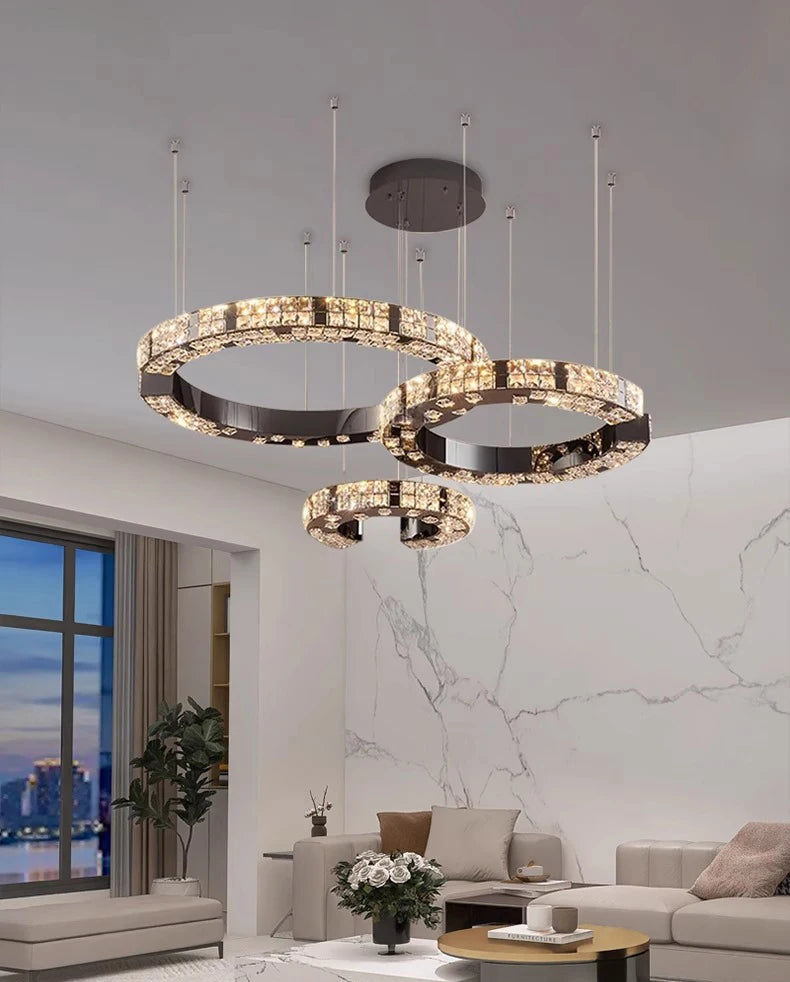
The Cosmo Circle Crystal Chandelier shows the ring form at its clearest — crystal set into a circular frame with integrated LED, so the whole ring glows rather than lighting from individual bulbs. It suits round dining tables, modern foyers, and living rooms where you want crystal presence without ornament.
Waves and Linear Forms
Over a rectangular dining table or a kitchen island, a linear or wave-shaped crystal fixture matches the furniture's proportions in a way a round traditional chandelier can't. The crystal follows the curve or the line, so the fixture reads as a single sculptural object rather than a collection of drops.
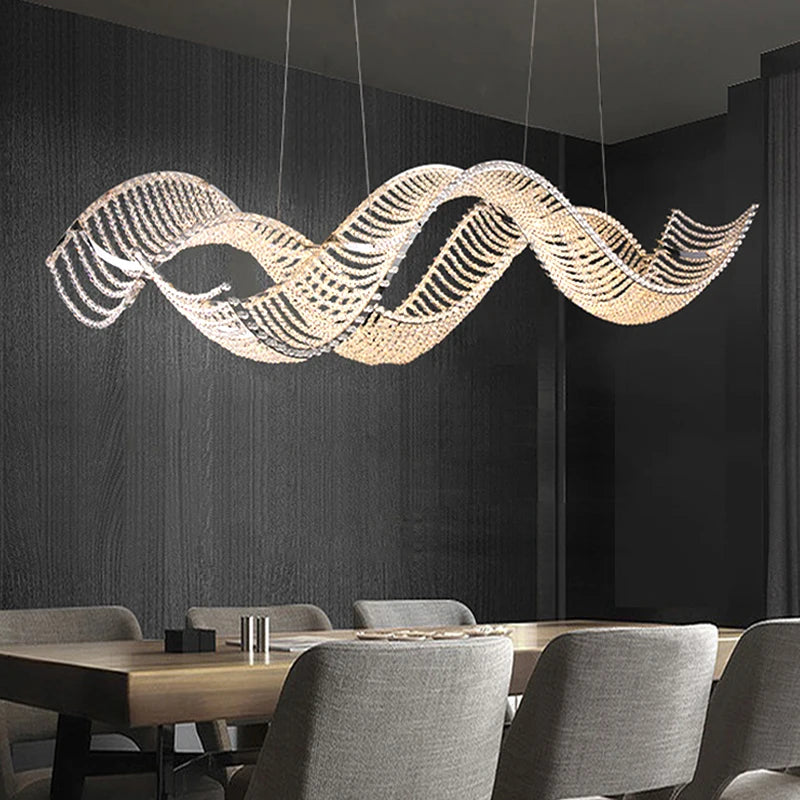
The Modern Wave Crystal Chandelier is built specifically for long tables — a continuous wave of crystal in chrome or gold that spans the table's length and distributes light evenly along it, the modern answer to a traditional fixture's single central point.
Sculptural Statement Forms
At the top of the modern range are fixtures that function as sculpture — interlocking rings, twisted forms, and large-scale geometric compositions built for double-height spaces. Crystal here is a surface treatment on a form that would hold the room even without it.
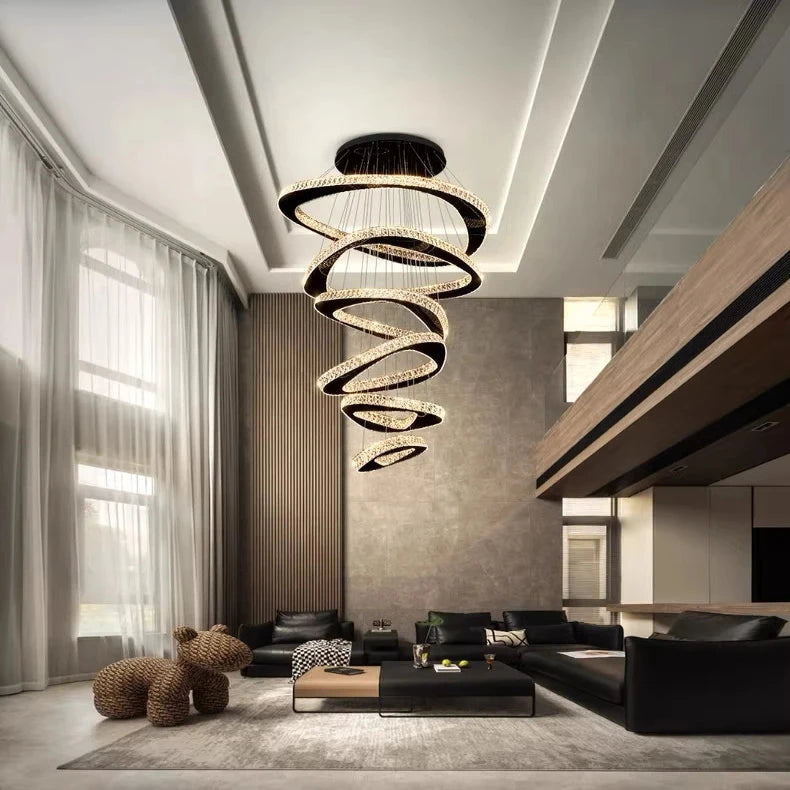
The Twisted Ring LED Chandelier is the sculptural end of the modern spectrum — interlocking illuminated rings in black, gold, or silver, sized for grand foyers and two-story stairwells where the fixture is the architecture.
Traditional Crystal Chandeliers: The Classic Cascade
The traditional crystal chandelier is the form most people picture when they hear the word: a central stem, tiers of curved arms, candle-style lights, and crystal hung in strands, drops, and prisms that scatter light in every direction. It descends from the candle chandeliers of the 17th and 18th centuries, and its proportions have stayed remarkably consistent because they work — the tiered form spreads light outward and downward, and the hanging crystal multiplies each point of light into dozens.
Tiered and Empire Forms
The tiered chandelier stacks rings of arms at increasing widths, giving the classic wedding-cake silhouette. The empire form drapes crystal strands from a top crown to a bottom ring, creating a dense, tent-like cascade. Both suit formal dining rooms and classic foyers where the fixture is meant to be an heirloom-scale centerpiece.
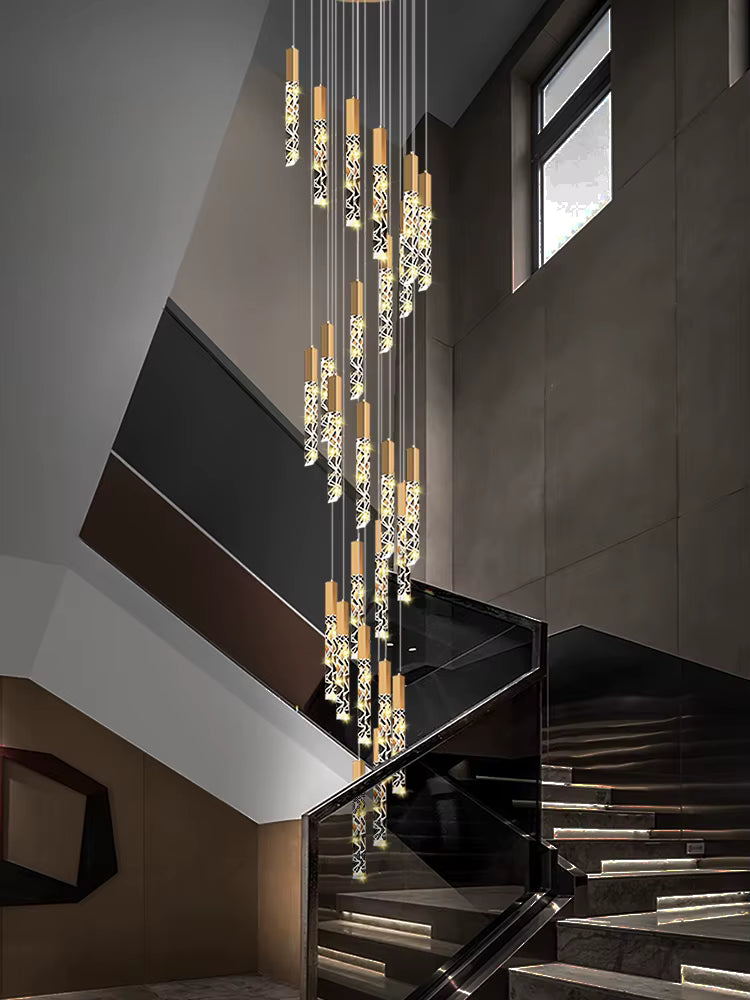
The Large Crystal Chandelier for High Ceilings carries the classic cascade into tall spaces — a dense fall of crystal in silver, gold, or black, sized so the traditional form fills a two-story foyer rather than floating near the ceiling.
Antique Brass and Period Detail
Traditional fixtures lean on warm metals. Polished and antique brass, bronze, and gold leaf complement the warm sparkle of crystal and suit rooms with wood floors, crown moulding, and classic furniture. The finish is part of the design language — a traditional crystal chandelier in matte black would read as transitional, not classic.

The Auric Antique Vintage Brass Crystal Chandelier is a textbook traditional piece — crystal tiers wrapped in warm brass, built for formal dining rooms, classic foyers, and hospitality spaces where the fixture should feel established rather than new.
Transitional: When Your Home Is Neither
Most homes aren't purely modern or purely traditional. A renovated older house with original millwork and contemporary furniture, or a new build with classic proportions, needs a fixture that speaks both languages. That's the transitional crystal chandelier: recognisable crystal sparkle in a silhouette that's cleaner and more restrained than a full cascade, in a finish — often brushed gold or aged brass — that reads warm without reading antique.

The Emily Branch Art Deco Crystal Chandelier sits squarely in this middle ground — Art Deco-inspired branching with crystal accents, in gold or silver, ornamental enough for a classic dining room and structured enough for a contemporary one. It's the kind of piece that resolves the "which style" question for a home that has both.
Which Style Suits Your Home?
Architecture decides more than taste does. Match the fixture to the bones of the room, then refine by finish and scale.
| If your space is... | Lean toward | Why |
|---|---|---|
| Open-plan living/dining, clean drywall, large windows | Modern | Geometric forms match the architecture; cascades look out of place against minimal surfaces |
| Formal dining room with crown moulding and wainscoting | Traditional | The room's detail supports a detailed fixture; a bare ring looks underdressed |
| Renovated older home, mixed furniture | Transitional | Bridges original millwork and contemporary pieces without committing to either |
| Two-story foyer or stairwell, any style | Whichever has vertical drop | Height matters more than style here; choose the form that fills the volume |
| Kitchen island or long rectangular table | Modern (linear/wave) | Linear forms match the furniture's proportions; round traditional fixtures don't |
| Small dining nook or low ceiling | Modern (compact ring) or small transitional | Fewer strands and lighter forms suit tight spaces; full cascades crowd them |
Sizing Rules That Apply to Both Styles
Style changes the look, not the math. Over a dining table, either style should measure about one-half to two-thirds of the table's width, hung so the bottom sits 30 to 36 inches above the tabletop. In an open room or foyer, add the room's length and width in feet and read the total as the fixture's diameter in inches — a 12 by 14-foot room suits roughly a 26-inch chandelier. Keep at least 7 feet of floor clearance anywhere people walk beneath it.
One style-specific note: traditional cascades carry more visual weight at the same diameter, so a traditional fixture at the small end of the range often looks fuller than a modern ring at the large end. If you're between two sizes, a modern fixture can go up a size more safely than a traditional one. For the full method, see the crystal chandelier selection guide and the chandelier sizing guide.
Light Quality: Sparkle vs Glow
The two styles light a room differently, and that matters as much as how they look switched off. A traditional chandelier is a collection of point sources — each candle bulb throws light through cut crystal, which splits it into moving flashes and rainbow refractions across the walls. The effect is sparkle: lively, warm, and best appreciated at lower light levels on a dimmer.
A modern fixture with integrated LED is closer to a single continuous source. The crystal glows rather than flashes, the light is more even, and many models let you shift color temperature from warm to cool for different times of day. The effect is glow: calmer, more uniform, and better for rooms that need genuine task light as well as atmosphere. Neither is better — but if you want the classic rainbow-on-the-walls effect, that comes from cut prisms and point-source bulbs, which is the traditional side of the line.
Color temperature for crystal
Warm white — 2700K to 3000K — flatters crystal in both styles, bringing out the warmth in gold and brass finishes and keeping a dining room welcoming. Cool white (4000K and above) can make crystal look clinical against warm metals; reserve it for chrome or silver fixtures in deliberately cool, modern palettes, or for adjustable LED fixtures where you can shift to warm in the evening. Aim for CRI 90 or higher so the crystal's refractions show true color.
Cleaning and Weight: The Practical Trade-Offs
Traditional chandeliers have more loose elements — dozens or hundreds of strands and drops, each of which collects dust and each of which needs wiping. A modern fixture with crystal panels or a ring of fixed crystal cleans in a fraction of the time. If the fixture is going in a high or two-story space where cleaning is a project, that difference is worth weighing; the crystal chandelier cleaning guide covers both types.
Weight matters for mounting. Traditional fixtures carry more glass mass and metal, and a large one can exceed the 50-pound rating of a standard ceiling box, requiring a reinforced brace. Modern LED fixtures are typically lighter at the same visual size. Either way, confirm the fixture's stated weight against your ceiling box before installation, and use a licensed electrician for anything heavy or high.
Modern rings and waves, classic cascades, and transitional pieces that bridge both.
All Crystal Chandeliers Modern Chandeliers Crystal Foyer Dining Room
Frequently Asked Questions
What is the difference between a modern and a traditional crystal chandelier?
A traditional crystal chandelier is built around a central stem with tiered candle-style arms, and the crystal hangs from those arms in strands, drops, and prisms — the crystal is the point, and the frame displays it. A modern crystal chandelier starts with a geometric form — a ring, a wave, a linear bar, a cluster — and applies crystal to that form as texture; the form is the point, and the crystal makes it catch light. Modern fixtures typically use integrated dimmable LED and finishes like matte black, brushed gold, or chrome; traditional fixtures use candle-base bulbs and warm metals like polished brass and antique bronze.
Are modern crystal chandeliers in style?
Yes — modern crystal is currently the faster-growing side of the category, because integrated LED made forms like illuminated rings, waves, and long vertical drops possible. Crystal in a clean geometric silhouette suits the open-plan and minimalist interiors that dominate new homes and renovations, while still delivering the sparkle people want from crystal. Traditional cascades remain in style too, in the classic and formal rooms they were designed for. The fixture that dates fastest is the one that clashes with its room, not one style or the other.
Can a crystal chandelier be both modern and traditional?
That's what a transitional crystal chandelier is: recognisable crystal sparkle in a silhouette cleaner than a full cascade, usually in a warm finish like brushed gold or aged brass. Branch-form crystal fixtures and Art Deco-inspired designs are good examples — ornamental enough for a classic dining room, structured enough for a contemporary one. Transitional pieces are the right choice for renovated older homes with mixed furniture, or new builds with classic proportions, where a purely modern ring would look underdressed and a full empire cascade would look overdone.
Which is better for a dining room, modern or traditional crystal?
It depends on the table and the room. Over a long rectangular table, a modern linear or wave-shaped crystal fixture matches the furniture's proportions and spreads light along its length, which a round traditional fixture can't do. Over a round or square table in a formal room with moulding, a traditional tiered chandelier suits the setting and gives the classic sparkle. In either case, size the fixture at one-half to two-thirds of the table's width, hang it 30 to 36 inches above the tabletop, use warm white bulbs, and add a dimmer — the sizing and light rules are the same for both styles.
Do traditional crystal chandeliers use more electricity?
Not necessarily any more. Traditional fixtures use candle-base bulbs, and filament-look LED candle bulbs are now standard, so a twelve-arm traditional chandelier can run on a fraction of the energy its incandescent ancestor used. Modern fixtures with integrated LED are similarly efficient. The practical difference is bulb changes: a traditional fixture has individual bulbs you replace occasionally, while an integrated-LED modern fixture has no bulbs at all and typically runs 15 to 25 years before the module needs attention. For a hard-to-reach high-ceiling fixture, that can be a meaningful advantage for modern.
Is a traditional crystal chandelier harder to clean?
Generally yes, because it has more loose elements. A traditional cascade may carry dozens or hundreds of individual strands, drops, and prisms, each collecting dust and each needing a wipe; a modern fixture with crystal panels or a fixed ring of crystal cleans in far less time. The cleaning method is the same for both — a lint-free cloth dampened with one part isopropyl alcohol to four parts distilled water, applied to the cloth rather than the fixture, with each piece buffed dry immediately. In high or two-story spaces where cleaning means ladders or a lift, the lower upkeep of a modern form is worth weighing.
What finish should a modern crystal chandelier have?
Matte black, brushed gold, and chrome are the finishes that read most clearly as modern, and each pairs differently with crystal. Matte black gives crisp contrast and suits industrial and minimalist rooms; brushed gold adds warmth without looking antique and suits most contemporary palettes; chrome and satin nickel give a cooler, sleeker result that suits glass, white, and grey interiors. Coordinate the fixture's finish with the other metals in the room — door hardware, cabinet pulls, mirror frames — so the chandelier looks intentional rather than mismatched.
Choosing Between Modern and Traditional Crystal
The decision comes down to the room's architecture more than personal taste. Clean, open, contemporary spaces call for a modern crystal chandelier — a ring, a wave, a linear drop — where the geometry matches the surroundings and the crystal adds refraction without ornament. Formal, classic, and period rooms call for the traditional cascade that their detailing was designed to hold. Homes that mix both find their answer in transitional pieces that carry crystal in a restrained silhouette. Whichever way you lean, size to the table or room, hang with proper clearance, use warm dimmable light, and confirm the weight against your ceiling box.
Browse the full crystal chandelier collection to compare forms side by side, or narrow to the modern chandelier collection for geometric designs. If the difference between real crystal and glass matters to your choice, crystal vs. glass chandeliers explains what changes in sparkle, weight, and care.


