

The right light fixture for a dining room table is decided by the table, not the room. Its shape tells you which fixture type to use, its width tells you how big, and the ceiling tells you how the fixture should hang. Get those three matched and almost any style works; get them wrong and no style saves it. This guide walks through fixture type, shape, size, and height as one decision, with a fixture-by-table reference you can use directly.
Key Takeaways
| Question | Answer |
|---|---|
| Which fixture type suits a round or square table? | One centered fixture with circular symmetry: a single pendant, drum, ring, cluster, or round chandelier. |
| Which fixture type suits a rectangular or oval table? | A linear chandelier, a bar, or a row of two or three matched pendants that follow the table's length. |
| How big should a dining table light fixture be? | One-half to two-thirds of the table's width for a round fixture; one-half to two-thirds of the table's length for a linear one. |
| How high should it hang above the table? | The bottom of the fixture should sit 30 to 36 inches above the tabletop. |
| What fits an 8-foot ceiling? | A semi-flush or short-drop fixture of about 6 to 8 inches total depth; full chandeliers need 9 feet or more. |
| Should the fixture be centered on the table or the room? | On the table — center it on the tabletop even if the table sits off the room's center. |
Quick Facts
- A 60-inch round table takes a 30-to-40-inch fixture; an 84-inch rectangular table takes a 42-to-56-inch linear fixture.
- Two pendants suit tables up to 72 inches long; three suit 84 to 96 inches.
- Fixture bottom sits 30 to 36 inches above the dining tabletop.
- On an 8-foot ceiling, about 6 to 8 inches of fixture depth is available above the table clearance line.
- Size a round fixture to the table's width (shorter side), never its length.
- A dining table fixture should deliver roughly 2,000 to 3,000 lumens at 2700–3000K on a dimmer.
The Decision in One Diagram
Step 1: Table Shape Chooses the Fixture Type
Shape is the first filter because it eliminates half the options immediately. A round or square table wants a fixture with a single center of gravity — one pendant, a drum, a ring, a cluster, or a round chandelier — so the fixture and the table share a center point. A rectangular or oval table wants a fixture that follows its length: a linear chandelier, a bar, or a row of matched pendants spaced along it. Hang a single round fixture over a long table and the ends sit in shadow; hang a linear fixture over a round table and the shape reads wrong from every seat.
| Table shape | Fixture types that suit it | Avoid |
|---|---|---|
| Round | Single pendant, drum, ring, stacked rings, cluster, round chandelier | Linear fixtures; anything asymmetrical |
| Square | Single pendant, ring, square or round chandelier, 4-pendant cluster | Linear fixtures |
| Rectangular | Linear chandelier, bar, rectangular chandelier, row of 2–3 pendants | Small single round fixtures (leave the ends dark) |
| Oval | Linear or oval chandelier, row of pendants | Sharp rectangular fixtures (fight the curve) |
| Extension / expandable | Linear sized to the extended length, or pendants on a track | Fixed round fixtures sized to the closed table |
The rectangular table chandelier shape guide and round dining table lighting guide go deeper on each shape.
Step 2: Table Width or Length Sets the Size
Once the type is chosen, size is a proportion of the table. For a round or square fixture over any table, measure the table's width — its shorter dimension — and choose a fixture one-half to two-thirds of it. For a linear fixture over a rectangular table, measure the table's length and choose a fixture one-half to two-thirds of that. The two most common sizing errors are measuring the length of a rectangular table for a round fixture (which produces something far too large) and sizing to the room instead of the table (which is a rule for foyers, not dining rooms).
| Table | Measure | Fixture size (½–⅔) | Suggested form |
|---|---|---|---|
| 42" round | 42" diameter | 21–28" | Single pendant or small drum |
| 48" round | 48" diameter | 24–32" | Drum, ring, or small cluster |
| 54" round | 54" diameter | 27–36" | Ring or cluster |
| 60" round | 60" diameter | 30–40" | Ring, cluster, or round chandelier |
| 72" round | 72" diameter | 36–48" | Large ring or chandelier |
| 36 × 60" rectangular | 60" length | 30–40" linear | Linear or 2 pendants |
| 40 × 72" rectangular | 72" length | 36–48" linear | Linear or 3 pendants |
| 42 × 84" rectangular | 84" length | 42–56" linear | Linear chandelier |
| 44 × 96" rectangular | 96" length | 48–64" linear | Linear chandelier or 3 pendants |
| 48 × 48" square | 48" width | 24–32" | Single pendant, ring, or 4-pendant cluster |
Between two sizes, choose the larger — an undersized fixture over a dining table is the most common mistake in the room. The dining room chandelier size guide and 60-inch round table sizing guide work through specific cases.
Step 3: Ceiling Height Sets the Drop
The fixture's bottom should sit 30 to 36 inches above the tabletop: 30 inches on a standard 8-foot ceiling, rising toward 36 inches on 9 feet and above. That height lights the table without blocking the view across it. What changes with ceiling height is how much fixture fits in the space above that line. On an 8-foot ceiling with a 30-inch table, there's about 36 inches between the table and the ceiling, and 30 of it is clearance — leaving a 6-inch envelope, which means a semi-flush or a fixture with a very short drop. On a 9-foot ceiling the envelope grows to 12 to 18 inches and full chandeliers become possible. Sloped ceilings need an adjustable or sloped-ceiling canopy. The hanging height guide covers the details, and low ceiling dining room light ideas covers the 8-foot case.
Drop envelope by ceiling
8 ft ceiling: ~6–8 inches of fixture depth (semi-flush or short-drop) • 9 ft: ~12–18 inches (most chandeliers) • 10 ft: ~18–24 inches (add 3 inches of drop per extra foot) • Vaulted: measure from the table straight up to the ceiling point above it, then apply the same math.
Fixture Types for the Dining Table, With Examples
Linear Chandeliers for Rectangular Tables
The linear chandelier is the workhorse over a rectangular table: one long fixture that spreads light evenly along the table's length and matches its proportions. Clean geometric bars suit modern rooms; farmhouse linears with exposed frames suit casual and transitional ones; crystal waves suit formal and glam settings.
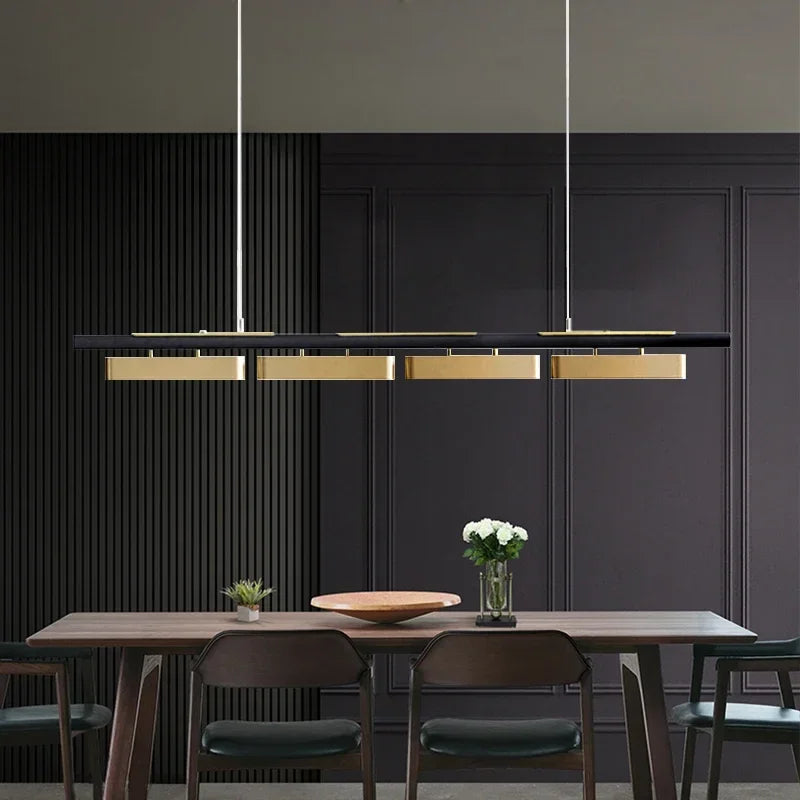
The Torin Contemporary Rectangular Chandelier is a clean rectangular frame for a modern rectangular table — sized to follow the table's length and light every seat evenly.

The Aris Farmhouse Linear Chandelier is the casual version — a linear frame with farmhouse character that suits a long wood table in a transitional or rustic dining room.
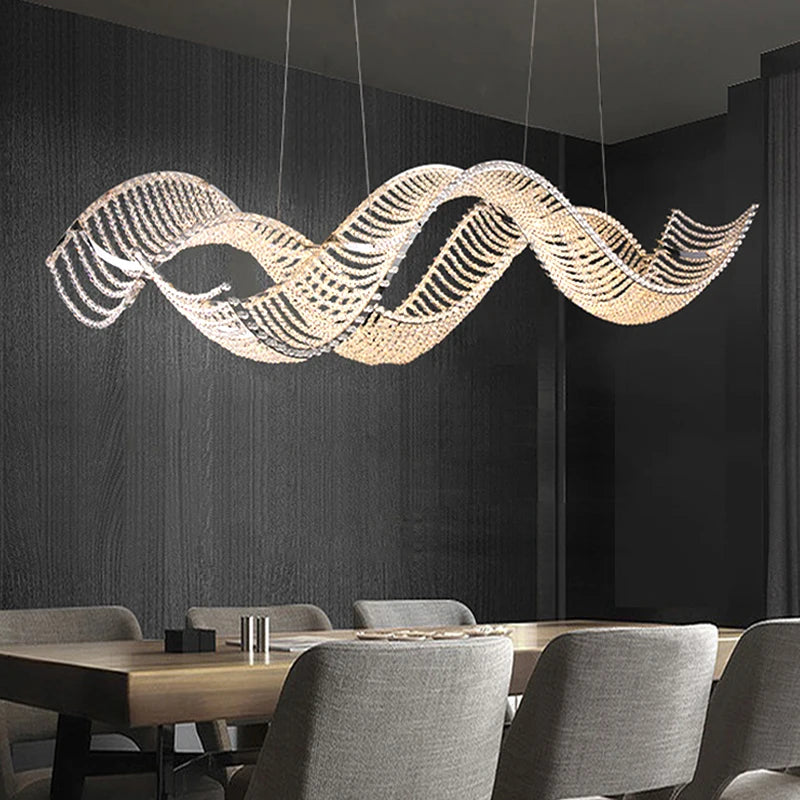
The Modern Wave Crystal Chandelier Over Dining Table, in chrome or gold, is a linear crystal wave made specifically for long tables — the formal end of the linear category. Long chandeliers for the dining room covers linear fixtures in depth.
Rows of Pendants for Rectangular Tables
Two or three matched pendants spaced along a rectangular table do the same job as a linear chandelier with a lighter look. Space them evenly, keep the row's total length within one-half to two-thirds of the table, and hang all pendants at the same height. Globe pendants on a shared frame are a middle path — linear in footprint, pendant-like in character.
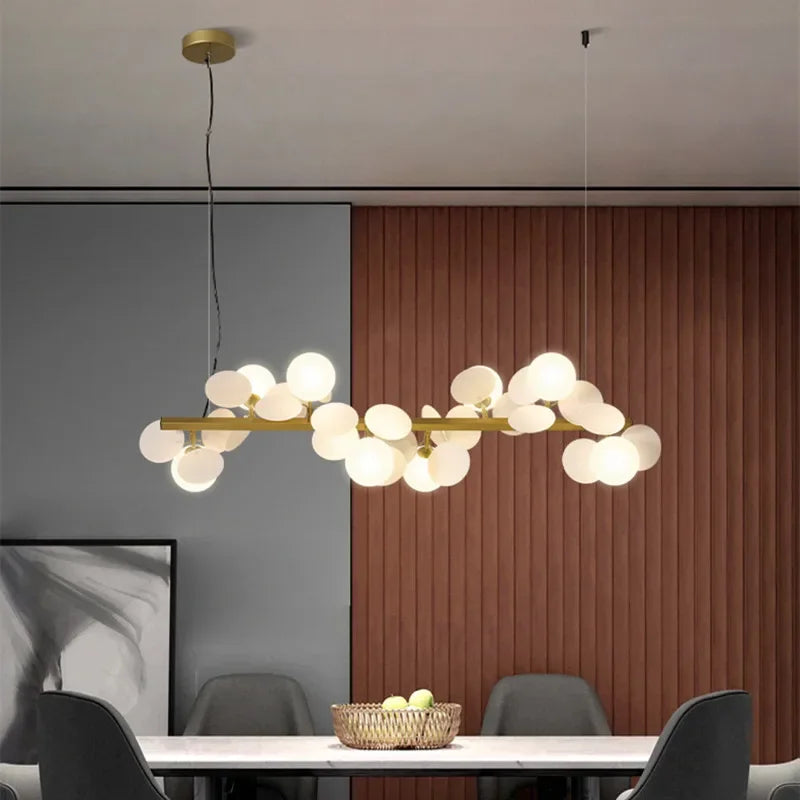
The Eli Glass Globes Linear Chandelier for Dining Room puts glass globes in a linear row on one frame — the look of a pendant row with the simplicity of a single fixture, suited to mid-century and contemporary rectangular tables. The dining room pendant lighting guide covers spacing rows of separate pendants.
Centered Fixtures for Round and Square Tables
A round or square table takes one fixture centered over it. The choice is scale and character: a single pendant or drum for a small table; a ring, cluster, or round chandelier for a larger one. Branch and organic forms suit rustic and transitional rooms; rings and clusters suit modern ones.

The Madelyn Rustic Branch Chandelier, with frosted or clear glass balls, is a round branching form that centers naturally over a round or square table in a rustic, transitional, or organic-modern room.
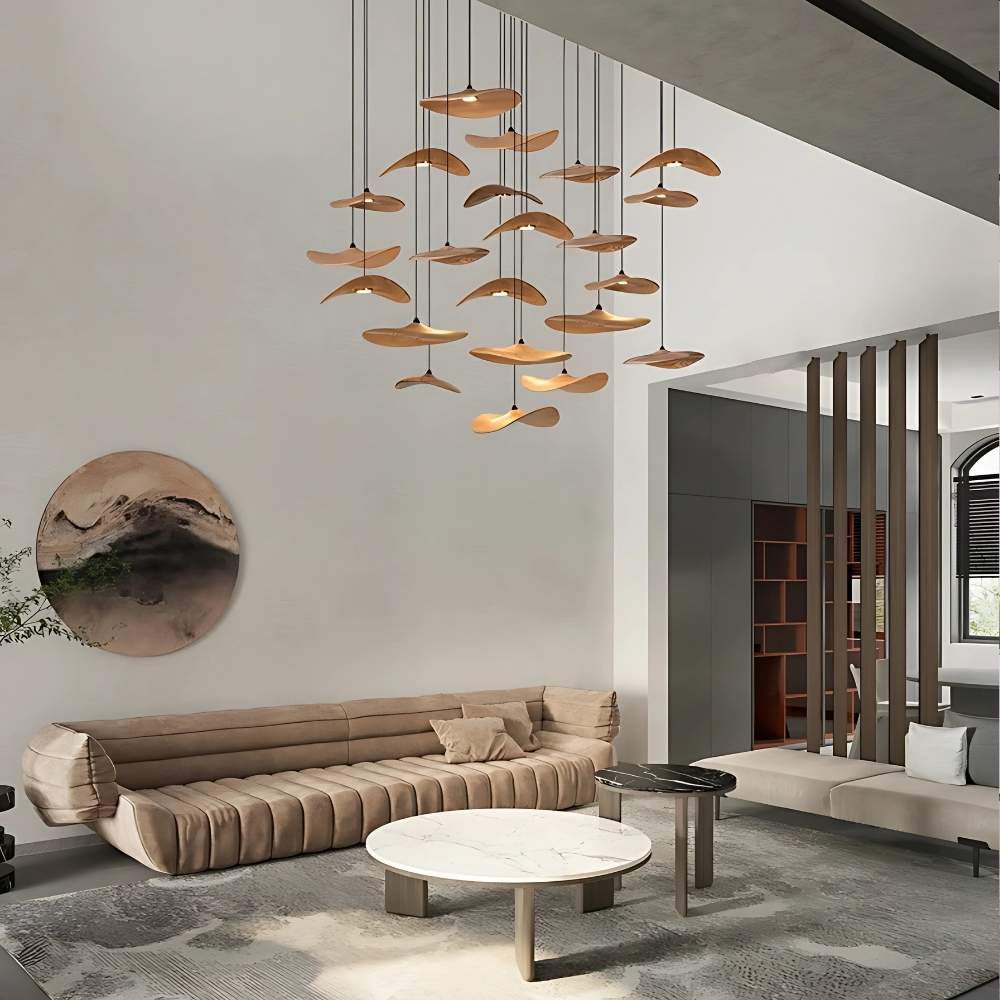
The Bidi Multi Light Pendant Chandelier gathers multiple pendants into one cluster — the contemporary centered fixture for a round table, with more light and presence than a single pendant.
Step 4: Style, Last
Style is the last decision because it's the only one that doesn't affect whether the fixture works. Once type, size, and drop are fixed, choose a style that matches the room: modern rooms take geometric bars, rings, and clusters in matte black, brushed gold, or chrome; farmhouse and rustic rooms take wood, wrought iron, and branch forms; formal rooms take crystal and classic tiered chandeliers; transitional rooms take restrained versions of any of these. Match the fixture's finish to the room's other metals — chair legs, hardware, mirror frames — so it looks intentional. The modern dining room table lighting ideas guide covers the contemporary end, and best farmhouse chandeliers the rustic end.
Light Quality Over the Table
A dining table wants warm, dimmable light. Choose bulbs or integrated LED at 2700 to 3000K, which flatters food and faces; cooler light makes a dining table look like a workspace. Put the fixture on a dimmer — full brightness for setting up and clearing, 30 to 40 percent for the meal. For a table fixture with multiple lights, look for CRI 90 or higher so colors render true. Aim for roughly 2,000 to 3,000 lumens from the table fixture in a standard dining room, with buffet or wall lamps adding the rest. If the fixture uses exposed bulbs, choose frosted or filament-look LED so no one at the table looks into a bare source.
Common Mistakes Over the Dining Table
- Round fixture over a long table. The ends go dark; use a linear or a row of pendants.
- Sizing to the length for a round fixture. Measure the width; the length gives a fixture that's far too big.
- Sizing to the room. That's the foyer rule; over a table, size to the table.
- Undersized fixture. The most common error — go larger when between sizes.
- Hung too high. 30–36 inches above the table; higher loses the intimacy.
- Full-drop chandelier on an 8-foot ceiling. There's no room — use a semi-flush or short drop.
- Off-center. Center the fixture on the table, not the room, if the table sits off the room's center.
- No dimmer. A table fixture needs two settings; a plain switch gives one.
Linear, pendant, ring, and cluster fixtures sized to every table shape.
Dining Room Lighting Pendants Chandeliers Size Calculator
Frequently Asked Questions
What light fixture is best over a dining room table?
It depends on the table's shape. Over a round or square table, use one fixture centered on it — a single pendant or drum for a small table, a ring, cluster, or round chandelier for a larger one. Over a rectangular or oval table, use a linear chandelier, a bar, or a row of two or three matched pendants that follow the table's length. Size a round fixture at one-half to two-thirds of the table's width and a linear one at one-half to two-thirds of its length, hang the bottom 30 to 36 inches above the tabletop, and put it on a dimmer with warm white light.
How do I choose the size of a light fixture for a dining table?
Measure the table, not the room. For a round or square fixture, take the table's width — the shorter side of a rectangular table — and choose a fixture one-half to two-thirds of it: a 48-inch table takes a 24-to-32-inch fixture. For a linear fixture over a rectangular table, take the table's length and choose a fixture one-half to two-thirds of that: an 84-inch table takes a 42-to-56-inch linear. When between two sizes, choose the larger, since an undersized fixture is the most common mistake over a dining table.
Should the light fixture be centered over the table or the room?
Over the table. A dining fixture is sized and placed to the table it lights, so center it on the tabletop even if the table sits off the room's center — a fixture centered on the room but off-center on the table looks like a mistake from every chair. If the existing ceiling box is off-center, a fixture with a swag-style cord or an adjustable canopy can shift the drop point, or an electrician can relocate the box. For rectangular tables, center the linear fixture on both the table's length and width.
Can I put a round light fixture over a rectangular table?
Only if it's large — at least one-half to two-thirds of the table's width — and the table is short enough that the ends aren't left dark, which usually means 72 inches or less. Over longer rectangular tables, a single round fixture leaves the end seats in shadow no matter how large it is; a linear chandelier or a row of two or three pendants lights the whole length evenly and matches the table's proportions. A large round fixture works best over a rectangular table when it's paired with buffet or wall lamps that fill the ends.
How many pendants should hang over a dining table?
Two over a table up to about 72 inches long, three over 84 to 96 inches, and rarely more than three. Keep the row's total span within one-half to two-thirds of the table's length, space the pendants evenly with equal gaps at each end, and hang them all at the same height — 30 to 36 inches above the tabletop. Use matched pendants in a single finish so the row reads as one fixture, and confirm the ceiling box positions or use a multi-pendant canopy that hangs them all from one point.
What light fixture works over a dining table with an 8-foot ceiling?
A semi-flush or a fixture with a very short drop. On an 8-foot ceiling with a 30-inch-high table, there's about 36 inches between table and ceiling, and 30 of it is the required clearance — leaving roughly 6 to 8 inches for the entire fixture. Compact semi-flush designs, shallow drums, low-profile rings, and short-drop linear fixtures all fit that envelope. Choose one with crystal, glass, or an open form so it still reads as a proper dining fixture rather than a ceiling light, and use a dimmer so it can run low for dinner.
What is the difference between a dining table chandelier and a pendant?
A pendant is a single-shade fixture on one cord or rod; a chandelier is a multi-light fixture on one frame. Over a dining table, both follow the same sizing and height rules. A single pendant suits a small round or square table; a row of two or three pendants suits a rectangular one; a chandelier — round for round tables, linear for rectangular — gives more light and presence from one fixture. Multi-pendant clusters on a single canopy blur the line, offering pendant character with chandelier-level light. Choose by the table's size and how much light and presence you want.
Choosing the Fixture for Your Table
The fixture over a dining table is a three-measurement decision: shape chooses the type, width or length sets the size, and ceiling height sets the drop. Match those — centered fixture over round and square tables, linear or a pendant row over rectangular ones, sized at one-half to two-thirds of the table, hung 30 to 36 inches above it, fitted to the ceiling's envelope — and style becomes a free choice. Add warm dimmable light and the table is lit for every meal.
Browse the dining room lighting collection by fixture type, or run your table's dimensions through the chandelier size calculator for a number to shop with. For the room's other lamps, dining room lamps covers the buffet and floor layer that finishes the space.


