

"Dining room lamps" means two different things, and a well-lit dining room needs both. The first is the hanging ceiling lamp over the table — the pendant or chandelier that does most of the work. The second is the supporting lamps around the room: a pair on the buffet or sideboard, a floor lamp in a dark corner. This guide covers how to choose the ceiling lamp by table and ceiling height, which buffet and floor lamps complete the room, and how to set the whole scheme so it works for dinner as well as it does for cleanup.
Key Takeaways
| Question | Answer |
|---|---|
| What are dining room lamps? | Dining room lamps are the three light layers of a dining room: a hanging ceiling lamp (pendant or chandelier) over the table, a pair of buffet lamps on the sideboard, and a floor lamp for corners. |
| What size should the ceiling lamp be? | One-half to two-thirds of the table's width for a round lamp, or one-half to two-thirds of the table's length for a linear lamp. |
| How high should a dining room lamp hang? | The bottom of the ceiling lamp should sit 30 to 36 inches above the tabletop — 30 inches on an 8-foot ceiling, up to 36 on 9 feet and above. |
| How tall should buffet lamps be? | Buffet lamps should be 28 to 36 inches tall with a slim profile, used in a matched pair, with the shade bottom at seated eye level. |
| How much light does a dining room need? | 20 to 30 lumens per square foot across all lamps — about 3,000 to 4,500 lumens for a 150-square-foot room, 60 to 70 percent of it from the ceiling lamp. |
| What bulb temperature is best? | Warm white at 2700 to 3000K for every lamp in the room, with the ceiling lamp on a dimmer. |
Quick Facts
- A dining room is lit in three layers: ceiling lamp (60–70% of light), buffet lamp pair (15–25%), floor lamp (10–15%).
- Buffet lamps are 28–36 inches tall and always used in matched pairs.
- A dining room floor lamp should be 58–66 inches tall and used for fill, not reading.
- Target 20–30 lumens per square foot across all dining room lamps combined.
- Ceiling lamp bottom: 30 inches above the table on an 8 ft ceiling, up to 36 inches on 9 ft and above.
- All dining lamps should share one finish family and one warm bulb temperature (2700–3000K).
Which Kind of Lamp Do You Mean?
Most people searching for dining room lamps want the ceiling lamp — the hanging fixture over the table that in American usage is called a pendant or chandelier. In much of the world, and increasingly in the US, "lamp" covers any light fixture, so a "ceiling lamp for the dining room" is the same thing as a dining room pendant or chandelier. This guide uses both terms.
The other meaning — table lamps, buffet lamps, and floor lamps — is where dining rooms are most often under-lit. A single overhead fixture, however good, leaves the room's edges dark and the light coming from one direction. Buffet and floor lamps fix that, and they're the difference between a room that's lit and a room that feels finished. The two kinds of lamp are covered in turn below.
The Ceiling Lamp: Sizing and Hanging Over the Table
The hanging lamp over the table is sized to the table, not the room. Measure the table's width — the shorter dimension on a rectangular table — and choose a lamp whose diameter or length is one-half to two-thirds of it. A 42-inch-wide table takes a 21-to-28-inch lamp; a 60-inch round table takes 30 to 40 inches. For long rectangular tables, a linear lamp that runs one-half to two-thirds of the table's length matches the furniture far better than a single round fixture.
Hang the bottom of the lamp 30 to 36 inches above the tabletop — 30 inches on an 8-foot ceiling, up to 36 on 9 feet and above. That range lights the table without blocking sightlines across it. The dining room chandelier size guide and how high to hang a chandelier above a dining table cover the math in full.
| Table | Ceiling lamp size | Lamp type that suits it |
|---|---|---|
| Round, 42–48" | 21–32" diameter | Single pendant, drum, or small ring |
| Round, 54–72" | 27–48" diameter | Ring, cluster, or multi-light pendant |
| Rectangular, 60–72" long | 30–48" long | Linear lamp or two matched pendants |
| Rectangular, 84–96" long | 42–64" long | Linear lamp or three pendants |
| Square, 48–54" | 24–36" diameter | Single centered pendant or ring |
Ceiling Lamp Styles for the Dining Room
Single-Shade Pendant Lamps
The simplest ceiling lamp: one shade — glass, metal, or fabric — hung from a cord or rod. A single pendant suits small round and square tables and casual dining areas, and it's the form most people picture when they say "lamp." Glass shades spread light; metal shades direct it down onto the table; fabric shades soften it.

The Rustic Bell Jar Pendant Light is the single-shade lamp at its most classic — a clear glass bell that suits a small dining table on its own or, hung in a row of two or three, a longer table in a farmhouse or transitional room.
Multi-Pendant Cluster Lamps
Several pendants gathered on one canopy at staggered heights read as a single sculptural lamp over a round or square table, and give more light than one shade can. Clusters suit contemporary and transitional rooms and work well where you want a ceiling lamp with presence but not a full chandelier.
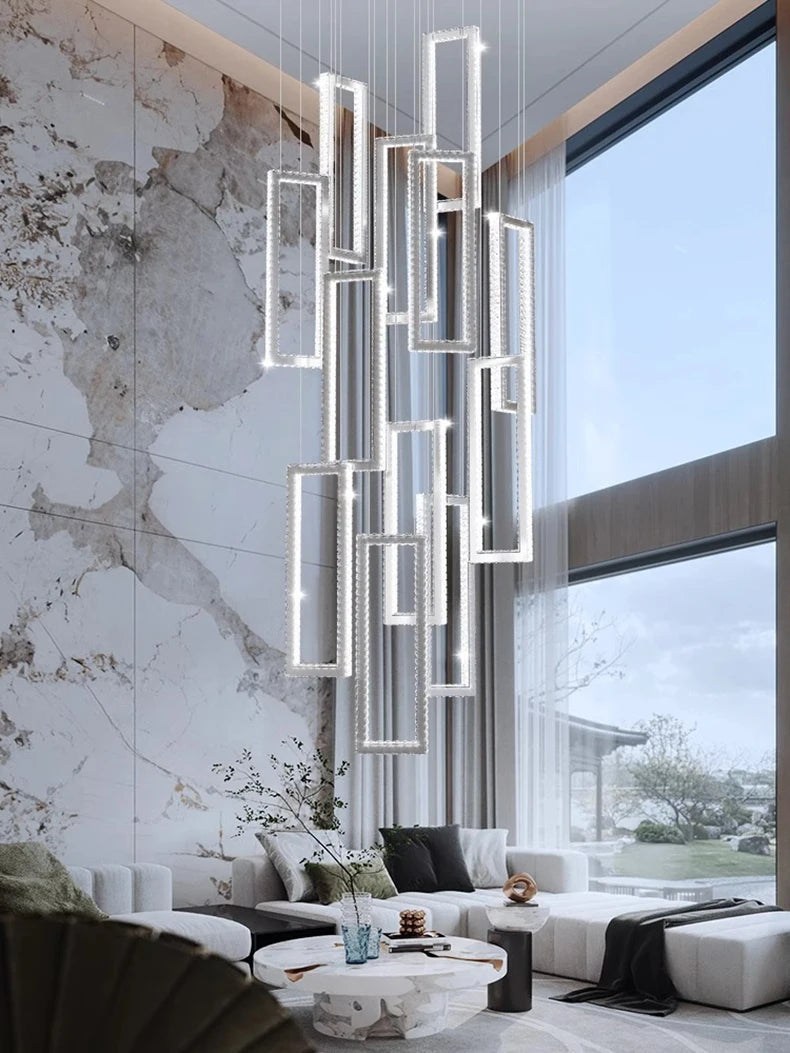
The Acai Crystal Multi Pendant Chandelier, in silver or gold, clusters crystal pendants at varied heights — a ceiling lamp that fills the space above a round table with a soft, layered glow.
Linear Ceiling Lamps for Long Tables
Over a rectangular table, a linear lamp — a bar, a wave, a row of shades on one frame — follows the table's length and lights every seat evenly. It's the form that most reliably makes a long table look intentional.
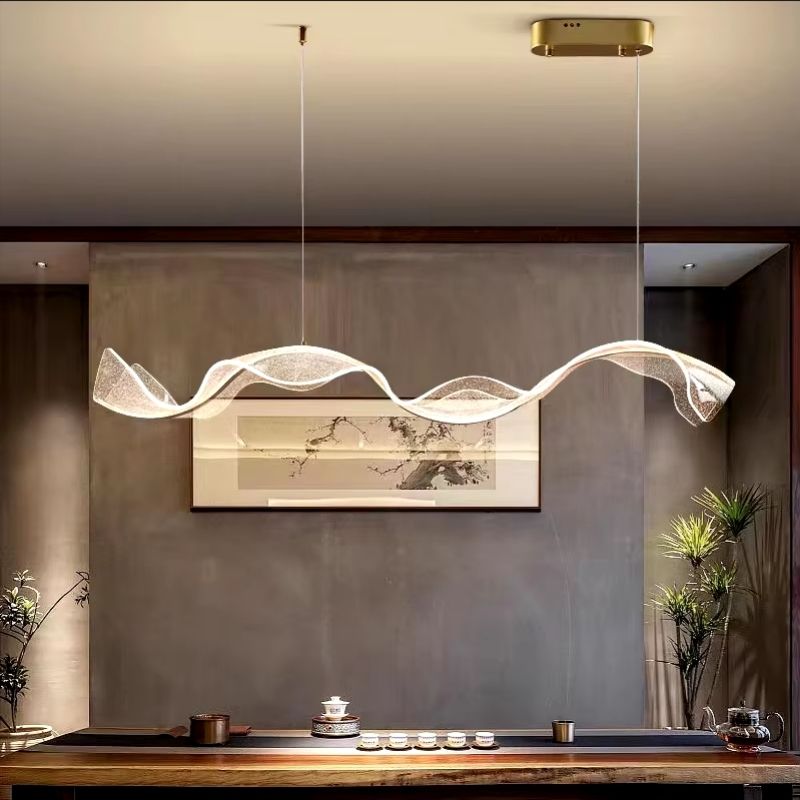
The Modern Ocean Wave Pendant Chandelier, in gold or black, is a linear wave lamp built for long tables and islands — it spans the length and reads as one flowing form rather than a row of separate lamps.
Modern Sculptural Ceiling Lamps
Beyond shades and bars are ceiling lamps that read as sculpture — strung glass, beaded forms, geometric compositions — where the lamp is the room's focal point. These suit contemporary dining rooms and open-plan spaces where the table sits in the living area's sightline.
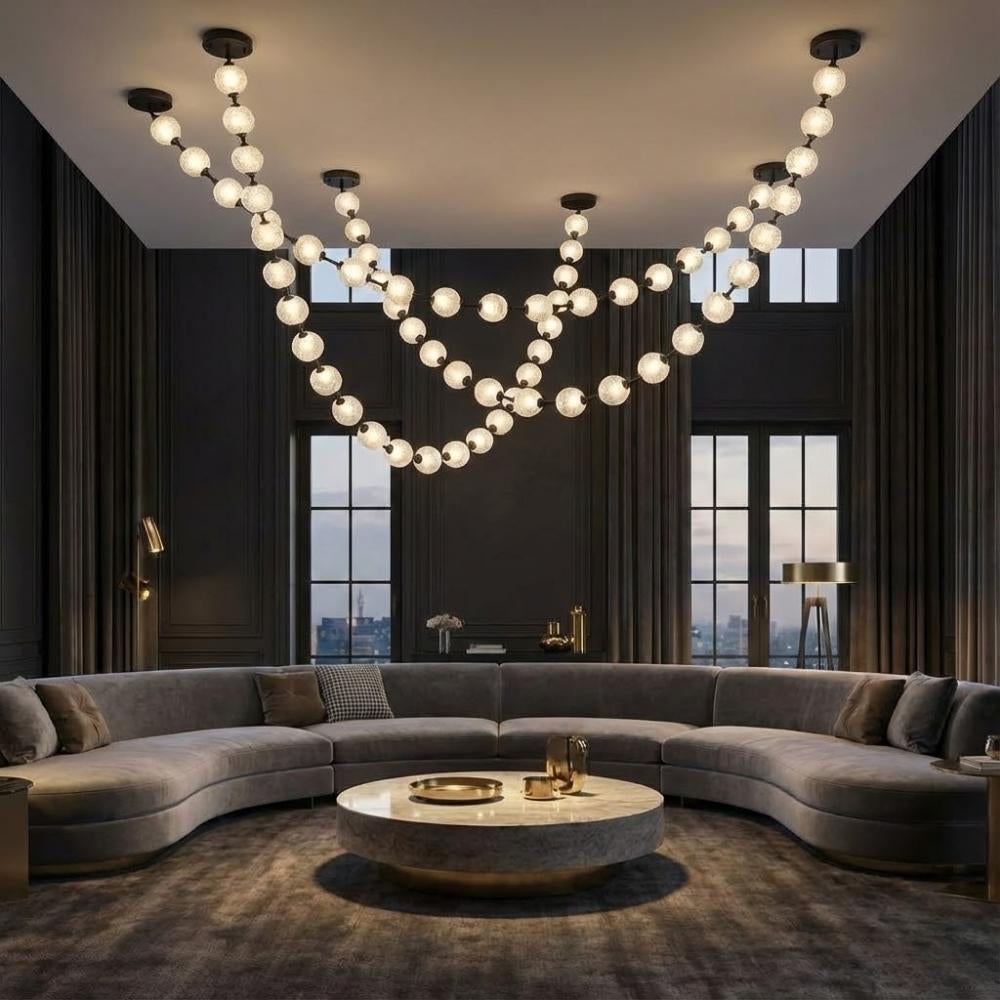
The Esle Modern Pearl Necklace Chandelier strings glass spheres like a necklace — a sculptural ceiling lamp that gives a modern dining room a soft, distinctive focal point.
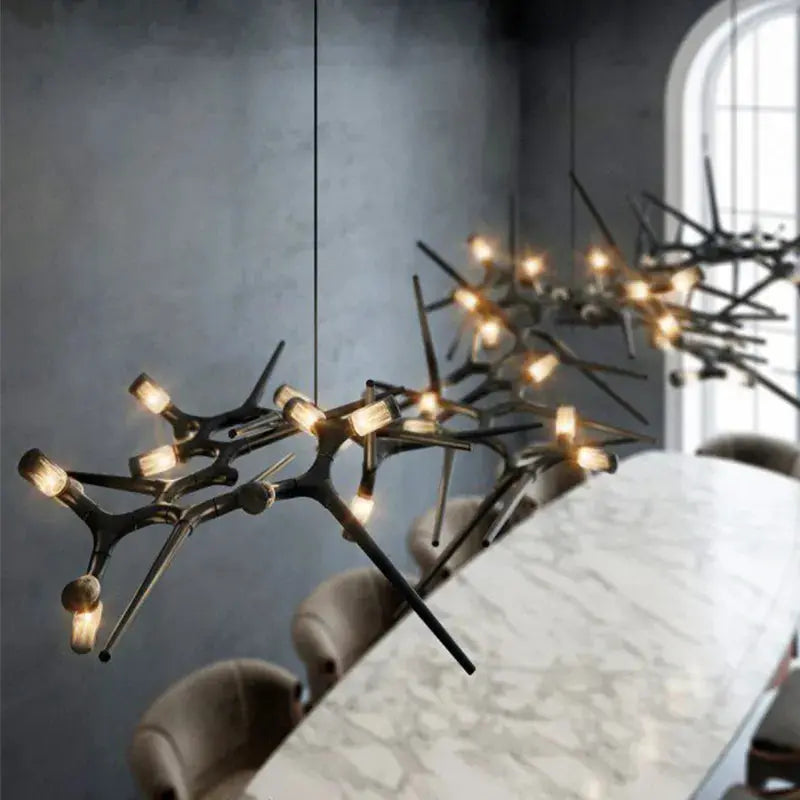
The Modern Trendy Dining Room Lighting fixture is a clean contemporary ceiling lamp designed specifically for the dining table — a good reference for the minimalist end of the category.
Mid-Century and Globe Lamps
Glass globes on a branching frame are the mid-century ceiling lamp, and they've stayed current because the form is simple and the light is soft. They suit Scandinavian, mid-century, and transitional dining rooms, and most come with remote or dimmer control.

The Sesi Mid Century Modern Glass Chandelier puts glass globes on a mid-century frame with remote control — a diffused, dimmable ceiling lamp for a dining room that wants warmth without ornament.
Buffet and Console Lamps: The Second Layer
A pair of lamps on the buffet, sideboard, or console is the single most effective addition to a dining room lit only from above. They put warm light at seated eye level, which flatters faces and food in a way overhead light can't, and they let the ceiling lamp run lower on the dimmer without the room going dim.
Choose buffet lamps 28 to 36 inches tall with a slim profile — the classic buffet lamp is taller and narrower than a living-room table lamp so it doesn't crowd the serving surface. The bottom of the shade should sit at roughly the eye level of someone seated at the table, so the bulb is hidden from every chair. Use them in a matched pair, one at each end of the sideboard, with the same finish family as the ceiling lamp. Browse the table lamp collection for buffet-scale options, and the wider lamps collection for the full range.
Buffet lamp rules
Pairs, not singles. One lamp on a sideboard looks unfinished; two frame it. Tall and slim: 28–36 inches, narrow base. Shade bottom at seated eye level so no diner sees the bulb. Same warm white as the ceiling lamp — mixing 2700K and 4000K across a room is the most common lamp mistake. Finish that echoes the ceiling lamp — brass with brass, black with black.
Floor Lamps: Filling the Corners
Dining rooms don't usually need task light from a floor lamp — nobody reads at the table — so the floor lamp's job is fill: lifting a dark corner, lighting a plant or artwork, and adding a third direction of light. Choose a floor lamp 58 to 66 inches tall with an uplight or a shaded head rather than a directional reading arm, and place it in a corner the ceiling lamp doesn't reach or behind a chair at the end of the table. A dining room floor lamp should be seen and not noticed; a slim stem and a shade that matches the buffet lamps keep it in the background. The floor lamp collection covers the options, and where to put a floor lamp applies its placement logic to any room.
How the Three Lamps Divide the Light
A dining room wants 20 to 30 lumens per square foot in total — roughly 3,000 to 4,500 lumens for a 150-square-foot room — but that total is shared across the lamps, not delivered by one. The ceiling lamp should supply about 60 to 70 percent, the buffet pair 15 to 25 percent, and a floor lamp the remaining 10 to 15. That split is what lets the ceiling lamp dim for dinner while the room stays comfortably lit.
| Lamp | Share of room light | Lumens for a 150 sq ft room | Bulb temperature |
|---|---|---|---|
| Ceiling lamp (over table) | 60–70% | ~2,000–3,000 | 2700–3000K, dimmable |
| Buffet lamp pair | 15–25% | ~450–1,100 (both) | 2700K |
| Floor lamp | 10–15% | ~300–650 | 2700K |
Two settings cover most evenings: everything at full for setting up and clearing, then the ceiling lamp at 30 to 40 percent with the buffet lamps on for the meal itself. The room lumens guide sets the target for other room sizes.
Matching Lamps Across the Room
Three lamps from three sources can look like a collection of leftovers unless something ties them together. The tie is finish and light: keep all lamps in one finish family (brass with brass, black with black, mixed only when the mix is clearly deliberate), and keep all bulbs at the same warm temperature. Shade materials can vary — a glass ceiling lamp with linen buffet lamps is fine — as long as the metal and the light color agree. If the ceiling lamp is the statement, keep the buffet and floor lamps quiet; if the ceiling lamp is simple, the buffet lamps can carry more character. The layered lighting guide covers the ambient-task-accent logic behind this.
Common Dining Room Lamp Mistakes
- One lamp only. A single overhead fixture leaves the room's edges dark and the light one-directional; add the buffet pair.
- Ceiling lamp too small. The most common error — size to ½–⅔ of the table width and lean larger.
- Ceiling lamp hung too high. 30–36 inches above the table; higher loses the intimacy the room is for.
- No dimmer. A dining ceiling lamp on a plain switch is either too bright for dinner or too dim for cleanup.
- Mixed bulb temperatures. A 4000K ceiling lamp with 2700K buffet lamps looks wrong immediately; match them.
- Single buffet lamp. Sideboards want pairs.
- Floor lamp as a reading lamp. Dining rooms want fill, not a directional arm.
Ceiling lamps over the table, plus buffet and floor lamps to finish the room.
Dining Room Lighting Pendant Lamps Table Lamps Floor Lamps
Frequently Asked Questions
What is the best lamp for a dining room?
The main lamp should be a hanging ceiling lamp — a pendant or chandelier — over the table, sized at one-half to two-thirds of the table's width and hung 30 to 36 inches above the tabletop, on a dimmer with warm white bulbs. Which form is best depends on the table: a single pendant or ring for a small round table, a cluster or larger ring for a big round one, and a linear lamp for a rectangular table. Then add a pair of buffet lamps on the sideboard so the room has light at eye level as well as from above; that combination is what makes a dining room feel properly lit.
What size ceiling lamp for a dining room table?
Size it to the table, not the room. Measure the table's width — the shorter side of a rectangular table — and choose a lamp whose diameter is one-half to two-thirds of that: a 42-inch table takes a 21-to-28-inch lamp, a 60-inch round table 30 to 40 inches. For a long rectangular table, use a linear lamp one-half to two-thirds of the table's length instead of a round one. When in doubt between two sizes, the larger usually looks more intentional over a dining table than one that's slightly too small.
How high should a lamp hang over a dining table?
Hang the bottom of the lamp 30 to 36 inches above the tabletop — 30 inches on a standard 8-foot ceiling, and up to 36 inches on 9-foot ceilings and taller. That range lights the table well while keeping sightlines open so people can see each other across it. If the lamp hangs over a walkway rather than the table, the rule changes to at least 7 feet above the floor. Most hanging lamps ship with adjustable cord or chain, so you can fine-tune the drop after installation.
Should a dining room have lamps on the buffet?
Yes — a matched pair of buffet lamps is the most effective second layer a dining room can have. They put warm light at seated eye level, which flatters faces and food better than overhead light alone, and they let the ceiling lamp run low on the dimmer during dinner without the room going dim. Choose lamps 28 to 36 inches tall with a slim profile so they don't crowd the serving surface, set the shade bottom at seated eye level to hide the bulb, use them in pairs at each end of the sideboard, and match their finish and bulb temperature to the ceiling lamp.
Can you use a floor lamp in a dining room?
Yes, as a fill light rather than a reading light. A dining room floor lamp's job is to lift a dark corner, light a plant or artwork, and add a third direction of light — so choose a 58-to-66-inch lamp with an uplight or shaded head, not a directional reading arm, and place it in a corner the ceiling lamp doesn't reach or behind a chair at the end of the table. Keep it slim and in the same finish family as the other lamps so it stays in the background. It typically supplies 10 to 15 percent of the room's total light.
How many lumens does a dining room need?
Aim for 20 to 30 lumens per square foot across all lamps combined — about 3,000 to 4,500 lumens for a 150-square-foot dining room. Divide it so the ceiling lamp over the table supplies 60 to 70 percent, a pair of buffet lamps 15 to 25 percent, and a floor lamp the remainder. That split means the ceiling lamp can dim to 30 or 40 percent for dinner while the buffet lamps keep the room comfortable, and everything can run at full for setting up and clearing. Use warm white bulbs at 2700 to 3000K throughout.
What is the difference between a dining room lamp and a chandelier?
In everyday use, a dining room ceiling lamp and a dining room chandelier are the same category — a hanging fixture over the table. "Lamp" is the broader word, used for any light fixture in much of the world; "chandelier" usually means a multi-arm or multi-light hanging fixture, and "pendant" a single-shade one. All three hang from the ceiling, size to the table, and follow the same 30-to-36-inch height rule. The lamps that are genuinely different are the buffet and floor lamps around the room, which sit on surfaces or the floor and supply the second and third layers of light.
Lighting the Dining Room with Lamps
A dining room lit with lamps works in three layers: a ceiling lamp over the table sized to the table and hung at the right height, a pair of buffet lamps for warmth at eye level, and a floor lamp for the corners. Keep them in one finish family and one warm bulb temperature, put the ceiling lamp on a dimmer, and divide the room's light between them rather than asking one fixture to do everything. The result is a room that's bright when it needs to be and intimate when it matters.
Start with the ceiling lamp in the dining room lighting collection, then complete the room from the lamps collection. For the ceiling lamp's sizing in full, the dining room chandelier size guide works through every table shape.


