

The best dining room lighting combines a properly sized chandelier or pendant fixture (table width × 0.5-0.7 diameter) positioned 30-36 inches above the table surface, 2700K-3000K warm white LED bulbs at CRI 90+ for accurate food color rendering, and layered lighting (ambient + task + accent) for atmospheric flexibility from family dinners through formal entertaining. This complete 2026 guide covers fixture selection by table shape, sizing formulas, color temperature, top dining room lighting styles (modern, traditional, farmhouse, industrial, coastal), 2026 trends, and the common mistakes that disrupt dining lighting design.
Why Dining Room Lighting Matters
- Atmosphere creation. Dining room lighting sets the tone for meals and gatherings. The right fixture transforms a basic table into a welcoming gathering place.
- Functional task illumination. Dining areas need adequate brightness for safe food preparation and confident serving.
- Visual hierarchy and focal point. A statement chandelier above the dining table creates the primary visual anchor.
- Color rendering for food presentation. Quality LED bulbs (CRI 90+) at 2700K-3000K render food colors accurately.
- Atmosphere modulation. Dimmable lighting transitions from bright family dinners to soft formal entertaining to dim ambient evening conversation.
- First impression for guests. Open-concept American homes often place dining room within sight of entry — the dining fixture creates significant guest first impression.
- Reinforces dining room style. The fixture style anchors the room's aesthetic — modern, traditional, farmhouse, industrial, or transitional.
- Connection with adjacent spaces. Coordinated dining lighting with kitchen pendants and foyer chandeliers creates cohesive open-concept design.
Assess Your Dining Room — Pre-Selection Checklist
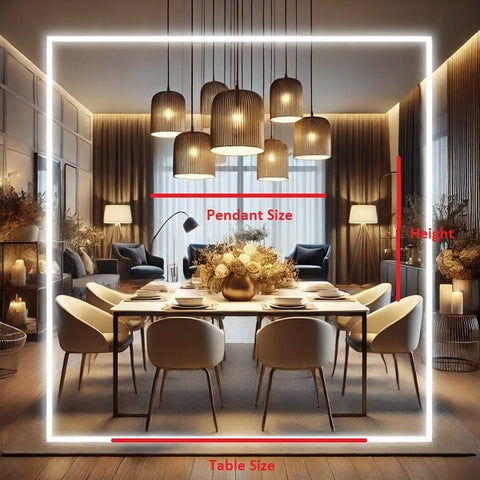
- Measure room dimensions. Length × width in feet. Apply L+W diameter formula: chandelier diameter inches = room length ft + room width ft.
- Measure ceiling height. Standard 8-9 ft; substantial homes may have 10-12 ft. Ceiling height determines fixture height and drop length.
- Measure dining table dimensions. Width × length × shape. Chandelier diameter approximately 0.5-0.7× table width.
- Identify natural light sources. Window placement affects daytime lighting needs.
- Note dark corners or shadowed areas. These need supplementary lighting beyond primary fixture.
- Document current electrical setup. Existing junction box position relative to table center; dimmer switch availability.
- Identify decor coordination needs. Cabinet hardware finishes, curtain rod colors, furniture style.
- Consider primary use cases. Daily family dining, formal entertaining, holiday gatherings.
- Document seating capacity. 4-person vs 8-person table needs different fixture scales.
- Visualize sight lines. Open concept homes need dining lighting that coordinates with visible kitchen and living spaces.
How to Choose Dining Room Lighting
-
Determine your dining room style direction.
Identify your overall aesthetic — modern minimalist, traditional, farmhouse, industrial, transitional, coastal, or eclectic. Modern homes pair with sphere or linear fixtures; traditional homes with crystal chandeliers; farmhouse with lantern style; industrial with cage forms.
-
Apply the L+W sizing formula.
Chandelier diameter (inches) = room length (ft) + room width (ft). Example: 12×15 ft dining room = 27" diameter chandelier. Also verify table width × 0.5-0.7 rule. Larger of the two calculations typically appropriate.
-
Choose fixture type appropriate to table shape.
Round table = round chandelier; rectangular/long table = linear suspension OR 2-3 pendant cluster; oval table = linear or oval chandelier; square table = square or compact round chandelier.
-
Verify hanging height calculations.
Bottom of fixture 30-36 inches above table surface (8 ft ceiling baseline). Add 3 inches per foot of ceiling height above 8 ft. Example: 10 ft ceiling = 36-42" above table.
-
Specify 2700K-3000K warm white LED bulbs.
Warm white welcoming dining atmosphere. Specify CRI 90+ for accurate food color rendering. Dimmable LED + compatible dimmer switch for atmospheric flexibility.
-
Calculate total lumens needed.
Small dining (under 100 sq ft) = 1,500-3,000 lumens. Medium dining (100-150 sq ft) = 3,000-5,000 lumens. Large dining (150+ sq ft) = 5,000-8,000+ lumens.
-
Plan supplementary lighting.
Primary fixture provides ambient illumination; supplementary buffet pendants, wall sconces flanking artwork, and accent lighting create layered dining atmosphere.
-
Coordinate finish with adjacent fixtures.
Open-concept homes need dining fixture coordination with kitchen pendants and foyer chandeliers. Match finish family for cohesive design story.
For specific chandelier selection, read our how to choose the right chandelier for your dining room guide.
Dining Room Lighting Sizing Formula
| Dining Table Size | Chandelier Diameter | Fixture Height (10 ft ceiling) | Total Lumens |
|---|---|---|---|
| 36" round (4-person) | 18-24" | 20-25" | 1,500-2,000 |
| 48" round (6-person) | 24-32" | 22-27" | 2,000-3,000 |
| 60" round (6-8 person) | 30-42" | 25-30" | 3,000-4,500 |
| 60" rectangular | 30-42" OR linear 30-45" | 25-30" | 2,500-4,000 |
| 72" rectangular | 36-50" OR linear 36-54" | 25-30" | 3,000-5,000 |
| 84" rectangular | 42-60" OR linear 42-60" | 30-36" | 4,500-7,000 |
| 96"+ rectangular | 48-72"+ OR multiple chandeliers | 36-42" | 6,000-10,000+ |
- Universal L+W formula: chandelier diameter = room length (ft) + room width (ft).
- Table-relative formula: chandelier diameter = table width × 0.5-0.7.
- Use the larger calculation: when L+W and table-relative formulas differ, choose the larger result.
- Ceiling height adjustment: add 2.5-3 inches to diameter per foot of ceiling height above 8 ft.
- Fixture height formula: 2.5-3 inches per foot of ceiling height.
- Multiple chandelier strategy: rectangular tables over 96" benefit from two coordinated chandeliers spaced over table length.
Dining Room Light Fixture Types
1. Chandeliers
Chandeliers are the most popular dining room lighting choice, creating substantial visual statement at primary focal point.
- Crystal chandeliers: luxury traditional aesthetic; multi-faceted crystals; dimensional sparkle. Browse our crystal chandeliers collection.
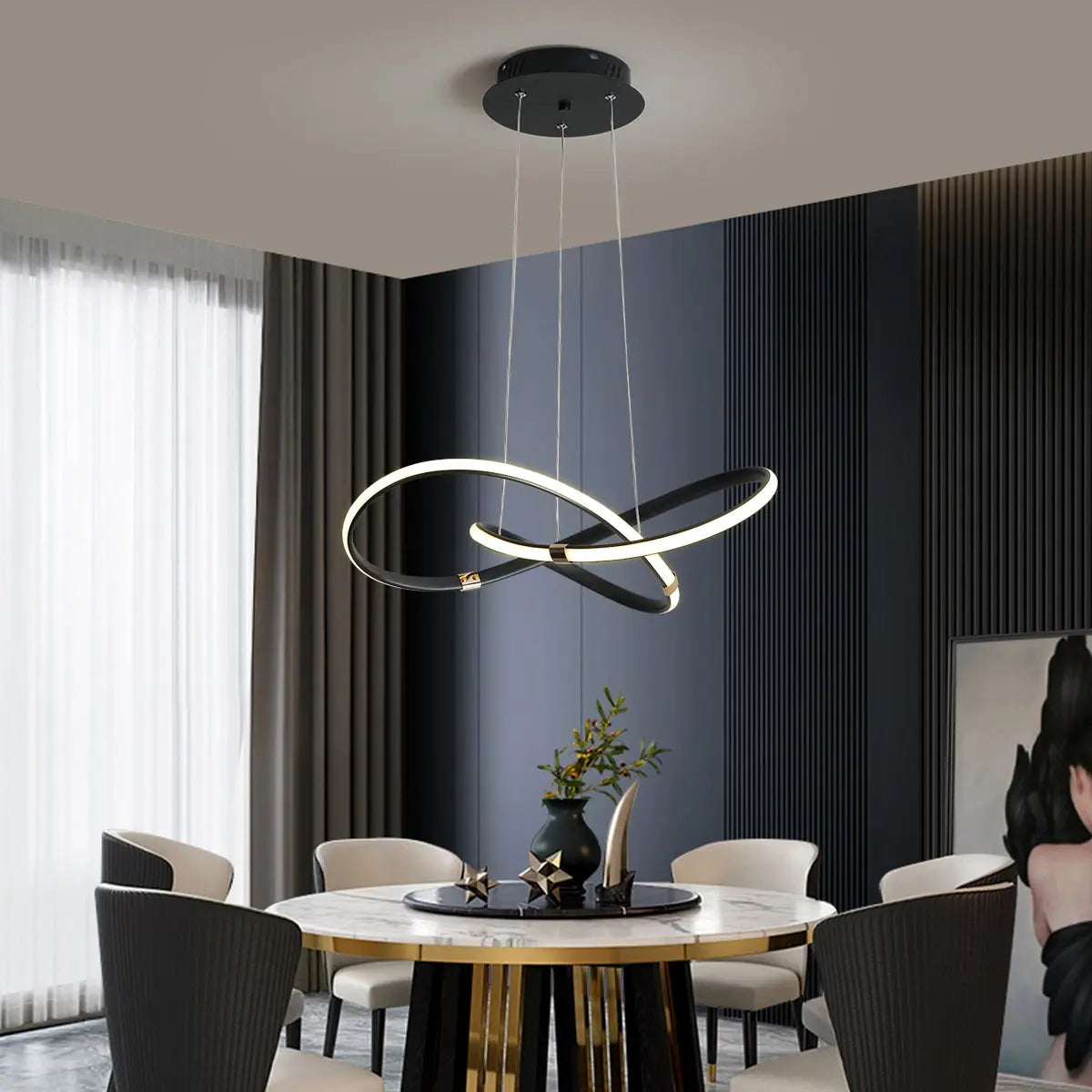
- Modern chandeliers: clean lines, geometric forms. Browse our modern chandeliers collection.
- Black chandeliers: bold contemporary statement. Explore our black chandeliers collection.
- Bubble chandeliers: modern playful aesthetic with multi-globe glass clusters. See our bubble chandeliers collection.
- Drum shade chandeliers: transitional aesthetic with fabric or metal drum diffusing light softly.
- Linear chandeliers: horizontal bar fixtures perfect for rectangular and elongated dining tables.
Browse our black chandeliers for dining rooms.
2. Pendant Lights
- Single substantial pendant: 16-24" diameter centered over dining table; modern minimalist statement.
- 3-pendant cluster: rectangular dining table coordinates with 2-3 pendants spaced over table length.
- Glass globe pendants: timeless versatile aesthetic.
- Drum shade pendants: substantial fabric or metal drum shades.
- Crystal mini-pendants: luxury detail at pendant scale.
- Edison cage pendants: industrial farmhouse aesthetic.
- Read our using pendant lights in your dining room guide.
3. Linear Suspension Lights
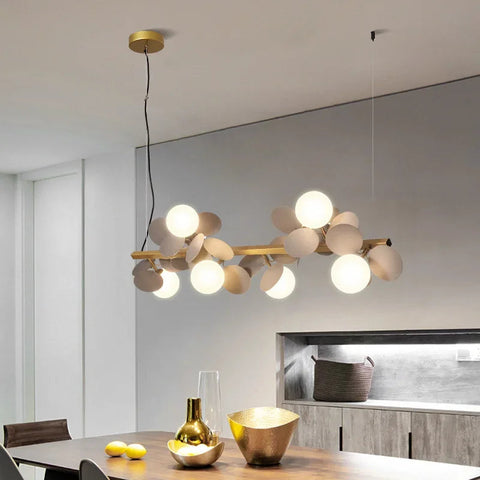
Linear suspension lights work brilliantly for rectangular and long dining tables, delivering balanced illumination across substantial table length.
4. Other Light Types
- Flush and semi-flush mounts: lights mounted close to ceiling for low ceiling applications.
- Wall sconces: supplementary architectural lighting flanking dining buffet or artwork. Browse our wall lights collection.
- Track lighting: adjustable directional lighting for accent illumination.
- Recessed lighting: built-in ceiling lights for clean minimal aesthetic.
- Buffet lamps: table lamps on dining buffet for task lighting and ambient accent.
Dining Room Lighting by Table Shape
| Table Shape | Best Fixture Type | Sizing |
|---|---|---|
| Round table | Round chandelier; circular pendant | Diameter = table width × 0.5-0.7 |
| Square table | Square or compact round chandelier | Diameter = table width × 0.5-0.7 |
| Rectangular (short) | Linear suspension OR oval chandelier | Linear length = 0.5-0.7× table length |
| Rectangular (long, 84"+) | Linear OR 2-3 pendant cluster | Multiple fixtures for substantial tables |
| Oval table | Linear or oval chandelier | Length matches oval major axis |
| Extension/dual-purpose | Sized for extended position | Apply formula to maximum extended size |
Best Lighting for Rectangular Dining Table
Rectangular dining tables present specific lighting considerations — single round chandelier often looks visually incorrect against elongated proportions.
- Linear suspension lights: most common best choice; echoes table elongated proportions.
- 2-3 pendant cluster: 2 substantial pendants for 60-72" tables; 3 pendants for 72-96" tables; spaced evenly along table center.
- Substantial oval chandelier: works beautifully on rectangular tables when room style is more traditional.
- Two coordinated chandeliers: 84"+ rectangular tables benefit from 2 spaced chandeliers.
- Linear chandelier sizing: length = 0.5-0.7× table length.
- Pendant cluster spacing: 24-30" apart center-to-center; one pendant per 2-3 ft of table length.
- What to avoid: single round chandelier on long rectangular tables looks visually incorrect.
- Hanging height: same 30-36" above table surface rule applies.
Dining Room Lighting Styles
Modern & Contemporary
Modern and contemporary dining lighting features clean lines, geometric shapes, and restrained ornamentation. Look for fixtures with sphere, linear, or angular forms; mixed materials (metal + glass); innovative LED designs. Browse our modern chandeliers collection and explore our contemporary black chandeliers.
Traditional & Classic
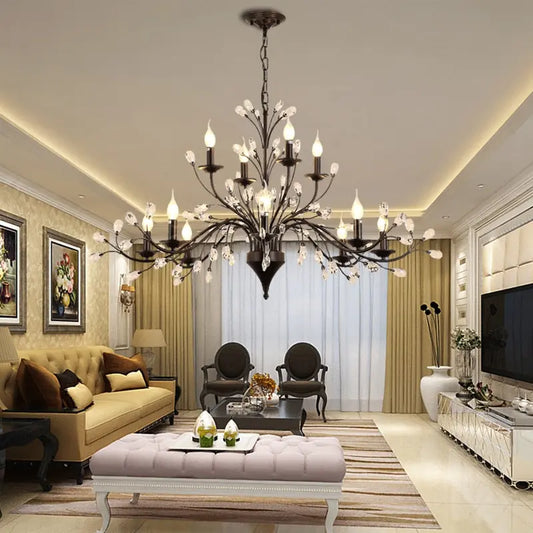
Traditional dining lighting features crystal chandeliers, ornate metalwork, and classical proportions. Look for substantial crystal cascades, ornate brass arms, classic candelabra silhouettes. Browse our crystal chandeliers collection.
Rustic & Modern Farmhouse
Rustic and modern farmhouse dining lighting features lantern forms, blackened metal finishes, natural wood elements, and Edison-style bulbs. Look for fixtures with distressed finishes, wrought iron details, mason jar accents. Browse our rustic wood chandeliers.
Industrial
Industrial dining lighting features exposed bulb cage designs, raw metal finishes, blackened steel structures, and Edison aesthetic. Look for substantial cage chandeliers, pipe-mounted pendants, factory-inspired forms. Works particularly well in loft conversions, urban modern homes.
Coastal & Boho
Coastal and boho dining lighting features natural materials (rattan, jute, light woods), organic forms, and breezy aesthetic. Look for woven rattan pendants, natural fiber shades, light wood accents.
Unique Statement Pieces
Sometimes a truly unusual fixture becomes the star of your dining room — substantial sculptural pieces, artistic designs, or unexpected material combinations. Browse our branching bubble chandelier for substantial sculptural statement.
2026 Dining Room Lighting Trends
- Warm metal finish dominance. Aged brass, warm gold, copper finishes mainstream. Polished chrome retreated significantly.
- Statement linear chandeliers. Horizontal bar fixtures gaining popularity for rectangular tables.
- Bubble chandeliers. Multi-globe glass clusters dominating modern dining.
- Mixed metal finishes intentionally. Brass + matte black designer-level contrast — most popular 2026 strategy.
- Tunable white smart bulbs. Circadian-aware color temperature shifts.
- Biophilic dining direction. Branch chandeliers, organic compositions, natural material hybrids.
- LED-integrated longevity. 50,000+ hour ratings eliminate frequent bulb replacement.
- Sculptural statement pieces. Bold sculptural dining chandeliers as primary focal points.
- Sustainable materials. FSC-certified wood, recycled glass, organic textiles.
- Smart dining scenes. "Dinner Party" + "Family Dinner" + "Late Night" via smart lighting.
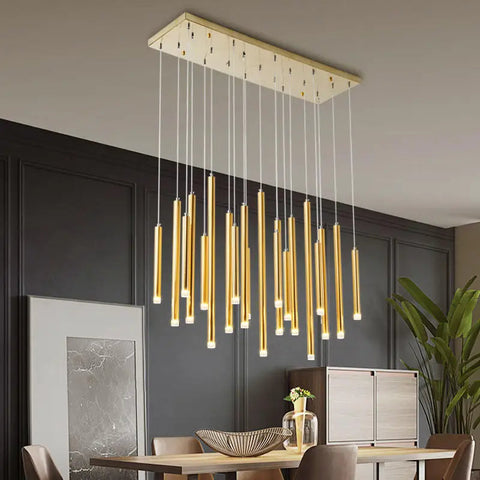
Layered Dining Room Lighting
- Primary ambient lighting (chandelier). Substantial statement fixture provides overall room illumination and primary visual anchor.
- Task lighting (buffet/sideboard). Buffet lamps, adjustable wall sconces, or pendants above sideboard deliver task-focused illumination.
- Accent lighting (walls/artwork). Wall sconces flanking dining artwork, picture lights, recessed track lighting create dimensional accent.
- Natural light integration. Daytime natural light through windows complements artificial lighting.
- Candle integration. Tabletop candles add intimate atmosphere at dinner gatherings.
- Dimmer-required across all layers. Each lighting layer dimmable for atmospheric flexibility.
- Smart scene presets. "Bright Family Dinner" + "Formal Dinner" + "Conversation Evening" via smart lighting.
- Layered system investment: primary chandelier $300-1,500 + 2-4 wall sconces $100-400 each + buffet lamp $80-200 = $700-2,500 typical.
Best Color Temperature for Dining Room
| Color Temperature | Appearance | Dining Application | Recommendation |
|---|---|---|---|
| 2200K-2400K | Very warm amber | Intimate romantic dinners | Accent only |
| 2700K | Warm yellow-white | Welcoming residential dining | ★ Best for dining |
| 3000K | Slightly cooler warm white | Modern residential dining | ★ Excellent |
| 3500K | Neutral white | Kitchen + dining combo | Acceptable |
| 4000K | Cool white | Office, garage | ❌ Avoid |
| 5000K+ | Cool blue-white | Commercial | ❌ Never |
- 2700K-3000K warm white is the dining standard. Welcoming residential atmosphere; matches incandescent traditional warmth.
- 2700K classic warm white. Most traditional dining color temperature.
- 3000K modern warm white. Slightly cooler; works well with modern dining rooms.
- CRI 90+ for food color rendering. Specify CRI 90+ ($4-8 per bulb).
- Avoid cool 4000K+ in residential dining. Creates institutional clinical feel.
- Tunable white smart bulbs. Adjust color temperature — warmer evening, cooler morning.
- Mixed color temperature warning. Maintain consistent Kelvin across all fixtures.
Best Light Bulb for Dining Room
- LED bulbs preferred. 75-85% less electricity than incandescent; 15,000-25,000+ hour longevity.
- 2700K-3000K warm white. Welcoming dining atmosphere standard.
- CRI 90+ specification. Accurate color rendering for food and skin tones.
- Dimmable LED with compatible dimmer. Atmospheric flexibility critical.
- Bulb base type matching chandelier. Most US chandeliers use E26 medium base; some decorative use E12 candelabra base.
- Wattage equivalent matching. 10W LED = 60W incandescent equivalent.
- Total lumens calculation. Match to dining room size requirements.
- Vintage/Edison aesthetic. Edison-style LED filament bulbs for farmhouse and industrial styles.
- Smart bulb integration. Enable scene presets, voice control, tunable white.
- Explore our modern LED chandeliers for dining rooms.
Dining Room Lighting Hanging Height
| Ceiling Height | Above Table Surface | Above Floor |
|---|---|---|
| 8 ft ceiling | 30-32" | 5.5-6 ft from floor |
| 9 ft ceiling | 33-35" | 6-6.5 ft from floor |
| 10 ft ceiling | 36-38" | 6.5-7 ft from floor |
| 11-12 ft ceiling | 39-42" | 7-7.5 ft from floor |
| Vaulted/cathedral | 36-42" | Use chain/cable to lower into range |
- 30-36 inches above table surface (baseline). Standard for 8 ft ceiling dining rooms.
- Add 3 inches per foot of ceiling above 8 ft.
- Center over table. Fixture center aligns with table center.
- Verify guest height clearance. Standing guests should have clearance below fixture.
- Read our detailed how to hang a chandelier above a dining table guide.
Installation Tips
- Hang chandeliers 30-36 inches above your dining table.
- Center fixture over table. If junction box isn't centered, use swag kit or relocate.
- Two-person installation mandatory.
- Verify junction box weight rating. Standard 50 lbs; heavier chandeliers need brace box.
- Consult electrician for complex installations.
- Plan dimmer installation. LED-compatible dimmer switch.
- Verify weight before purchase. Heavy chandeliers may need additional ceiling support.
- For detailed installation: see our how to install a chandelier guide.
- For high ceiling dining: see our high ceiling chandelier installation guide.
Dining Room Lighting Maintenance & Care
- Regular monthly dusting. Soft cloth or long-handled duster.
- Crystal chandelier cleaning solution. One part isopropyl alcohol to three parts distilled water.
- Deeper cleaning every 6-12 months. Turn off power before cleaning.
- Replace bulbs promptly. Keep spare LED bulbs on hand.
- Annual inspection. Verify mounting hardware tightness.
- Update fixtures every 5-10 years. Sometimes simple changes (new shades, dimmer addition) refresh appearance.
- Professional cleaning for large chandeliers. 9-21 bulb crystal chandeliers benefit from professional service annually.
- Tighten loose parts periodically.
Common Dining Room Lighting Mistakes
- Wrong fixture size for table or room. Apply L+W formula AND table-relative formula; use larger result.
- Hanging fixture too high. 48"+ above table looks visually disconnected. Use 30-36".
- Hanging fixture too low. Under 30" obstructs views and creates head strike risk.
- Cool color temperature in dining. 4000K+ creates institutional feel. Use 2700K-3000K warm white.
- Round chandelier on rectangular table. Use linear suspension or 2-3 pendant cluster instead.
- Single overhead fixture without layering. Creates harsh shadows. Use ambient + task + accent.
- Non-dimmable fixtures. Specify dimmable LED + compatible LED-rated dimmer switches.
- Low CRI bulbs. Specify CRI 90+ for accurate food presentation.
- Insufficient lumens. Verify total lumens meets room size requirements.
- Mismatched finish with kitchen. Open-concept homes need finish family coordination.
Browse Seus Lighting's dining-focused collections — dining room lighting for all styles, chandeliers across modern through traditional aesthetics, pendant lighting for substantial style flexibility, crystal chandeliers for luxury traditional dining, modern chandeliers for contemporary statements, black chandeliers for bold contemporary dining, bubble chandeliers for modern playful luxury, wall lights for layered architectural illumination, and our custom service for unique requirements.
Dining Room Lighting All Chandeliers Pendant Lighting Crystal Chandeliers Modern Chandeliers Black Chandeliers Bubble Chandeliers Wall Lights Custom Service
Frequently Asked Questions
What are the best dining room lighting ideas?
The best dining room lighting ideas combine substantial visual statement chandelier with layered supplementary lighting: (1) Statement chandelier above table: primary focal point creates welcoming first impression. Modern minimalist sphere chandelier; crystal chandelier for traditional luxury; linear suspension for rectangular tables; bubble cluster for modern playful luxury; lantern style for farmhouse traditional. (2) Coordinated buffet/sideboard pendants: paired pendants above buffet create supplementary task lighting. (3) Wall sconces flanking artwork: paired sconces create symmetric architectural lighting. (4) Layered ambient + task + accent: creates dimensional welcoming dining atmosphere. (5) Dimmable LED across all fixtures: atmospheric flexibility from bright family dinner to soft entertaining. Critical specifications: 2700K-3000K warm white; CRI 90+; 30-36" above table; total lumens 1,500-8,000+ depending on room size. 2026 trends: warm metal finishes (aged brass, copper); statement linear chandeliers; bubble chandeliers; biophilic natural materials; tunable white smart bulbs; mixed brass + matte black combinations. Browse our dining room lighting collection.
How do you choose dining room lighting?
Choose dining room lighting through systematic 8-step process: (1) Determine style direction: modern, traditional, farmhouse, industrial, transitional, coastal. (2) Apply L+W sizing formula: chandelier diameter = room length + room width (in feet, converted to inches). Also verify table width × 0.5-0.7. (3) Choose fixture type by table shape: round = round chandelier; rectangular = linear or pendant cluster; oval = linear; square = square/round. (4) Verify hanging height: 30-36" above table (8 ft ceiling); add 3" per foot of ceiling above 8 ft. (5) Specify 2700K-3000K warm white LED at CRI 90+. (6) Calculate total lumens: small 1,500-3,000; medium 3,000-5,000; large 5,000-8,000+. (7) Plan supplementary lighting: chandelier + buffet pendants + wall sconces. (8) Coordinate finish with adjacent fixtures. For chandelier-specific selection, see our how to choose the right chandelier for dining room guide.
How do you light a dining room?
Light a dining room through layered illumination combining ambient, task, and accent lighting: Primary ambient lighting (chandelier): statement fixture above dining table. Apply L+W sizing formula plus ceiling adjustment. Task lighting (buffet/sideboard): buffet lamps, wall sconces, or pendants above sideboard. Accent lighting (walls/artwork): wall sconces flanking artwork, picture lights, recessed track lighting. Hanging height critical: 30-36 inches above dining table surface. Color temperature critical: 2700K-3000K warm white across all fixtures. Lumens calculation: 20-30 lumens per square foot. Small dining 1,500-2,000; medium 2,500-3,500; large 4,000-7,000. Dimmable LED essential: atmospheric flexibility. Smart scene integration: "Bright Family Dinner" + "Formal Dinner" + "Conversation Evening". What to avoid: single overhead fixture without layering; non-dimmable fixtures; cool 4000K+ color temperature; insufficient lumens. For atmosphere creation, see our creating dining room atmosphere guide.
How do you pick a chandelier for a dining room?
Pick a dining room chandelier through systematic selection: (1) Measure dining table: chandelier diameter approximately 0.5-0.7× table width. (2) Measure room dimensions: apply L+W formula. Use larger of two results. (3) Measure ceiling height: determines fixture height (2.5-3" per foot of ceiling). (4) Match fixture shape to table: round = round chandelier; rectangular = linear; oval = linear/oval; square = square/round. (5) Choose style direction: modern, traditional, farmhouse, industrial, transitional, coastal. (6) Specify 2700K-3000K LED at CRI 90+. (7) Verify hanging height: 30-36" above table (8 ft baseline). (8) Total lumens calculation: 1,500-8,000+ depending on room. (9) Coordinate finish with adjacent fixtures. (10) Verify weight against junction box rating: standard 50 lbs. Browse dining room lighting collection and read our how to choose the right dining room chandelier guide.
What size chandelier for dining room?
Dining chandelier sizing follows table-width and room-dimensions formulas: Table-relative formula: chandelier diameter = table width × 0.5-0.7. Examples: (1) 36" round table: 18-24". (2) 48" round: 24-32". (3) 60" round: 30-42". (4) 60" rectangular: 30-42" OR linear 30-45". (5) 72" rectangular: 36-50" OR linear 36-54". (6) 84" rectangular: 42-60" OR linear 42-60". (7) 96"+ rectangular: 48-72"+ OR multiple chandeliers. Universal L+W formula: chandelier diameter = room length (ft) + room width (ft). Example: 12×15 ft room = 27". Use larger calculation. Ceiling height adjustment: add 2.5-3" per foot above 8 ft. Fixture height: 8 ft ceiling = 20-26"; 9 ft = 22-28"; 10 ft = 25-30"; 12 ft = 30-36". Multiple chandelier strategy: 96"+ rectangular tables benefit from 2 coordinated chandeliers OR single linear matching length. Bulb count for lumens: 4-bulb (1,600-2,000 lumens); 6-bulb (2,400-3,000); 9-bulb (3,600-4,500); 15+ bulb (6,000-9,000+).
What color light is best for dining room?
Best color temperature for dining room is 2700K-3000K warm white. Why 2700K-3000K is the dining standard: (1) Welcoming residential atmosphere. (2) Skin tone flattery. (3) Food color rendering. (4) Compatible with most dining styles. Specific recommendations: (1) 2700K classic warm white: most traditional. (2) 3000K modern warm: slightly cooler; works in modern dining. (3) 3500K neutral warm: acceptable for kitchen-adjacent dining. What to avoid: (1) Cool 4000K+ creates institutional feel. (2) Very warm 2200K too warm for primary lighting. (3) Mixed color temperature creates atmospheric disconnection. CRI 90+ critical: even correct Kelvin LEDs at low CRI (75-80) render food colors poorly. Specify CRI 90+ ($4-8 per bulb). Tunable white smart bulbs: adjust temperature throughout day — warmer evening (2700K), cooler morning (3000K-3500K).
What's the best lighting for rectangular dining table?
Best lighting for rectangular dining table is linear suspension light OR 2-3 pendant cluster. Top fixture options: (1) Linear suspension light: length = 0.5-0.7× table length. Example: 72" table = 36-50" linear. (2) 2-3 pendant cluster: 2 pendants for 60-72" tables; 3 pendants for 72-96"; 24-30" apart center-to-center. (3) Substantial oval chandelier: traditional style. (4) Two coordinated chandeliers: 84"+ rectangular benefit from 2 spaced chandeliers. Pendant cluster spacing: (1) 60" table = 2 pendants 30" apart. (2) 72" table = 2-3 pendants 24-30" apart. (3) 84" table = 3 pendants 24-28" apart. Linear suspension sizing: (1) 60" table = 30-42" linear. (2) 72" table = 36-50". (3) 84" table = 42-60". (4) 96"+ = 48-70"+ OR multiple fixtures. What to avoid: single round chandelier on substantial rectangular table looks visually incorrect. Hanging height: 30-36" above table surface. Specifications: 2700K-3000K LED; CRI 90+; dimmable; total lumens 2,500-7,000+. Browse dining room lighting collection.
What are the dining room lighting trends 2026?
2026 dining room lighting trends: (1) Warm metal finish dominance: aged brass, warm gold, copper mainstream. Polished chrome retreated. (2) Statement linear chandeliers: gaining popularity for rectangular tables. (3) Bubble chandeliers: dominating modern dining. (4) Mixed metal finishes intentionally: brass + matte black designer combinations. (5) Tunable white smart bulbs: circadian-aware shifts. (6) Biophilic direction: branch chandeliers, organic compositions, natural material hybrids. (7) LED-integrated longevity: 50,000+ hour ratings. (8) Sculptural statement pieces: bold sculptural chandeliers as primary focal points. (9) Sustainable materials: FSC-certified wood, recycled glass, organic textiles. (10) Smart dining scenes: "Dinner Party" + "Family Dinner" + "Late Night". Trends to avoid 2026: polished chrome (dated); single fixture without layering; cool 4000K+; non-dimmable; oversized chandelier in small dining. Browse our 2026 collections: modern chandeliers, bubble chandeliers, black chandeliers.
How many lumens should a dining room have?
Dining lumens requirements scale to room size: (1) Small dining (under 50 sq ft): 1,500-2,000 lumens. (2) Medium dining (50-100 sq ft): 2,000-3,500 lumens. (3) Large dining (100-150 sq ft): 3,500-5,000 lumens. (4) Substantial dining (150-200 sq ft): 5,000-7,000 lumens. (5) Entertaining dining (200+ sq ft): 7,000-10,000+ lumens. Lumens formula: 20-30 lumens per square foot. Multiply dining sq footage by 25 for total lumens target. Layered distribution: chandelier (60-70%) + wall sconces (20-30%) + buffet lamp (10%). Dimmable critical: bright family dinner full lumens; soft entertaining 50-70%; ambient evening 20-40%. Smart bulbs: preset scenes adjust all layers simultaneously. Lumens by bulb type: 60W incandescent = 800 lumens; 100W incandescent = 1,600 lumens; 10W LED = 800-1,000 lumens. Verify lumens output, not wattage equivalent.
What are the best dining room light fixtures?
Best dining room light fixtures: (1) Crystal chandeliers: luxury traditional. Browse our crystal chandeliers. (2) Modern chandeliers: clean lines, geometric. Browse our modern chandeliers. (3) Black chandeliers: bold contemporary. Browse our black chandeliers. (4) Bubble chandeliers: modern playful. Browse our bubble chandeliers. (5) Linear suspension: rectangular tables. (6) Drum shade chandeliers: transitional. (7) Lantern chandeliers: farmhouse traditional. (8) Sculptural statement pieces: bold dining statements. Critical specifications: (1) Proper diameter (L+W + table-relative). (2) 2700K-3000K LED. (3) CRI 90+. (4) Dimmable. (5) Junction box weight rating. (6) Adjustable chain/cable length. Investment: entry $150-400; mid-range $400-1,200; luxury $1,200-3,000+. Browse our dining room lighting collection.
How high should a dining room chandelier hang?
Dining chandelier hanging height: Standard rule: bottom of chandelier 30-36 inches above table surface (8 ft ceiling baseline). Ceiling adjustment: add 3" per foot of ceiling above 8 ft. By ceiling: (1) 8 ft: 30-32" above table. (2) 9 ft: 33-35". (3) 10 ft: 36-38". (4) 11-12 ft: 39-42". (5) Vaulted: 36-42"; use chain/cable to lower. Critical considerations: (1) Center fixture over table. (2) Verify guest height clearance. (3) Don't hang too high (48"+ looks disconnected). (4) Don't hang too low (under 30" obstructs views). For rectangular tables: linear suspension or pendant cluster same 30-36" rule. For tall ceilings: vaulted dining benefits from drop chandeliers with adjustable cable. Read our how to hang a chandelier above a dining table guide.
What kind of pendant lights are best for dining room?
Best pendant lights for dining: (1) Single substantial pendant: 16-24" diameter centered over round/square table. (2) 3-pendant cluster: rectangular tables; 2-3 pendants spaced evenly. (3) Glass globe pendants: timeless versatile. (4) Drum shade pendants: substantial fabric or metal drum shades. (5) Crystal mini-pendants: luxury detail. (6) Edison cage pendants: industrial farmhouse. (7) Natural material pendants: coastal boho. (8) Lantern pendants: farmhouse traditional. Sizing: pendant diameter 1/2 to 1/3 of table width. Example: 60" table = 20-30" pendants. 3-pendant cluster sizing: 12-18" diameter each; spaced 24-30" apart. Hanging height: 30-36" above table. Color temperature: 2700K-3000K warm white. CRI 90+: accurate food rendering. Dimmable LED: atmospheric flexibility. Read our using pendant lights in your dining room guide. Browse our pendant lighting collection.
Wrapping Up
Picking the right dining room lighting combines proper fixture sizing (L+W diameter formula plus table-relative formula), correct hanging height (30-36 inches above table surface with ceiling adjustment), 2700K-3000K warm white LED bulbs at CRI 90+ for accurate food color rendering, layered ambient + task + accent lighting for atmospheric flexibility, and dimmable specification across all fixtures. Choose fixture type appropriate to table shape (round table = round chandelier; rectangular = linear suspension or pendant cluster), match style to dining room aesthetic, and coordinate finish family across visible adjacent zones in open-concept homes. With careful application of these principles, your dining room becomes a welcoming gathering space ready for everyday family meals and substantial formal entertaining alike.
For complementary dining lighting decisions, see our related resources: choosing the right dining room chandelier, creating dining room atmosphere with chandeliers, hanging a chandelier above a dining table, using pendant lights in your dining room, matching chandeliers and pendant lights, light fixture sizing guide, color temperature guide, how much light does my room need, and light fixture cost calculator.


