

Indoor lighting fixtures combine three lighting types (ambient, task, accent) with 10 main fixture categories (chandeliers, pendants, flush mounts, recessed, track, sconces, floor lamps, table lamps, LED strips, smart lighting) selected room-by-room based on space size, ceiling height, color temperature (2700K-3000K warm white for residential), and lumens requirements (20-40 per square foot). This complete 2026 guide covers all major fixture types, the 8-step indoor lighting selection process, room-by-room recommendations for living room through bathroom, color temperature and lumens guidelines, energy-efficient LED technology, smart lighting integration, and the common mistakes that disrupt residential lighting design.
The 3 Types of Indoor Lighting
| Lighting Type | Purpose | Common Fixtures | Brightness Level |
|---|---|---|---|
| Ambient (general) | Overall room illumination | Chandeliers, flush mounts, recessed lights, ceiling-mounted fixtures | Primary brightness — full room coverage |
| Task | Specific work areas | Pendants over islands, under-cabinet, desk lamps, vanity lights, reading lamps | Focused brightness — 2-3× ambient at work surface |
| Accent | Highlighting features | Wall sconces, track lighting, picture lights, LED strips, decorative lamps | Targeted brightness — 3× the surrounding ambient on focal point |
- Ambient lighting establishes baseline. Every room needs adequate ambient illumination for safe transit and general activities.
- Task lighting supports specific activities. Cooking, reading, working, grooming all benefit from focused task lighting beyond ambient.
- Accent lighting creates visual interest. Highlights artwork, architectural features, decorative elements, or focal points.
- Most rooms need at least 2 of 3 layers. Living room: ambient + accent; kitchen: ambient + task; dining: ambient + accent.
- Substantial layered rooms benefit from all 3 layers. Substantial kitchens, master bedrooms, formal dining rooms typically use ambient + task + accent combination.
Indoor Lighting Layering Principles
- Start with ambient layer. Establish overall illumination first; supplement with task and accent layers.
- Identify task areas needing focused light. Kitchen counters, dining tables, reading chairs, vanity mirrors, desks all benefit from task lighting.
- Identify focal points needing accent light. Artwork, architectural features, plants, fireplaces, decorative shelving benefit from accent lighting.
- Use dimmable layers across all fixtures. Atmospheric flexibility transforms rooms across day and evening uses.
- Match color temperature across layers. 2700K-3000K warm white across all layers creates cohesive atmosphere.
- Calculate total lumens: ambient layer 60-70% of total; task layer 20-30%; accent layer 10-20%.
- Smart scene presets simplify layered control. "Bright Activity" activates all layers; "Evening Relax" dims ambient + maintains accent; "Movie Mode" minimal ambient + warm accent only.
All Indoor Lighting Fixture Types
| Fixture Type | Primary Function | Best Rooms | Investment Range |
|---|---|---|---|
| Chandeliers | Statement ambient illumination | Dining, foyer, two-story stairwells | $150-3,000+ |
| Pendant lights | Targeted task or accent | Kitchen islands, breakfast bars, reading areas | $80-800 each |
| Flush/semi-flush mounts | Low ceiling ambient | Bedrooms, hallways, closets, low-ceiling rooms | $80-400 |
| Recessed lighting | Clean minimal ambient | Kitchens, living rooms, bathrooms, hallways | $50-150 per fixture |
| Track lighting | Adjustable directional accent | Kitchens, home offices, art display areas | $100-400 per track system |
| Wall sconces | Architectural accent + supplementary | Hallways, bathrooms, dining rooms, foyers | $60-400 each |
| Floor lamps | Layered ambient + accent | Living rooms, bedrooms, reading corners | $80-600 |
| Table lamps | Accent + task on surfaces | Bedside, console tables, side tables | $50-400 each |
| LED strip lights | Under-cabinet + cove + accent | Kitchens (under-cabinet), bedrooms (cove), bathrooms | $30-150 per strip |
| Smart lighting | App + voice + scene control | All rooms — particularly tech-integrated homes | $15-80 per smart bulb |
Ceiling-Mounted Fixtures: Making a Statement
Ceiling-mounted fixtures are often the primary light in a room. Chandeliers in particular make foyers, dining rooms, and substantial living areas look elevated. When choosing a chandelier, consider the room size — apply the L+W formula: chandelier diameter (inches) = room length (ft) + room width (ft).
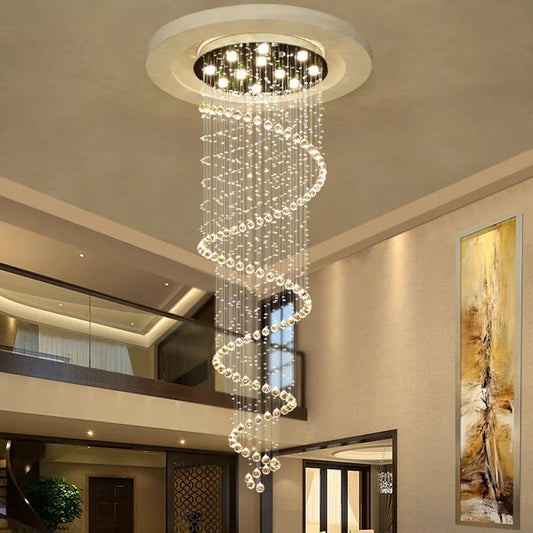
Our Large Foyer Lighting for High Ceilings, made of stainless steel with K9 crystal pendants, creates substantial entryway statement. At 31.5 inches wide and 47.2 inches tall, it works well for rooms with ceilings 9 feet or higher.
For rooms with lower ceilings or sleeker aesthetic, try flush mounts or semi-flush mounts. Flush mount chandeliers work for rooms with ceilings under 8 feet, while semi-flush mounts suit rooms with 8-10 ft ceilings, balancing style and practicality.
For detailed types of light fixtures, read our complete types of light fixtures guide.
Pendant Lighting: Versatile and Stylish
Pendant lights work across many applications — kitchen islands, breakfast bars, bedside accents, reading corners, dining tables. They come in single or cluster configurations and substantial style range. When hanging pendant lights over a kitchen island or dining table, position them 28-34 inches above the surface for optimal light coverage and visual proportion.
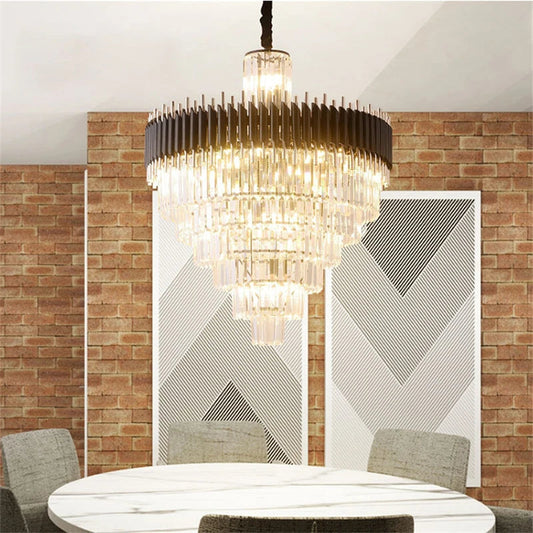
The Cody Modern Black Leather Strap Chandelier delivers contemporary aesthetic with black leather straps and 7 or 13 LED lights. Adjustable from 15.7 to 70.9 inches tall, it accommodates various ceiling heights.
Browse our pendant lighting collection for substantial pendant options.
Wall-Mounted Fixtures: Adding Depth and Function
Wall-mounted lights like sconces add dimensional depth while serving substantial functional purposes. They work well in bathrooms, hallways, and as reading lights next to beds. When installing wall sconces, position them at eye level (about 5.5 to 6 feet from the floor) for optimal light and visual balance.


When choosing wall lights for your kitchen or bathroom, consider both aesthetic and functional performance. Proper positioning balances task and ambient lighting effectively. In kitchens, supplementary under-cabinet lighting substantially improves visibility for food preparation. Browse our wall lights collection.
How to Choose Indoor Lighting Fixtures
-
Identify each room's primary functions.
Living room (relaxation + entertaining), kitchen (food preparation + dining), bedroom (sleep + reading), bathroom (grooming), home office (work). Each function drives lighting decisions significantly.
-
Measure room dimensions and ceiling height.
Length × width × height. Apply L+W diameter formula for ceiling fixture sizing. Determine appropriate fixture proportions for each space.
-
Plan the 3 lighting layers per room.
Ambient (primary fixture), task (specific work areas), accent (focal points). Identify where each layer belongs in each room.
-
Choose fixture types matching room functions.
Chandeliers/pendants for dining and foyer; recessed + pendants for kitchen; ceiling fans + bedside lamps for bedroom; vanity lights for bathroom; track + recessed for office.
-
Specify 2700K-3000K warm white LED bulbs.
Welcoming residential atmosphere across all rooms. CRI 90+ for accurate color rendering. Dimmable specification for atmospheric flexibility.
-
Calculate total lumens needed per room.
20-40 lumens per square foot total ambient illumination. Living room 20-30; kitchen 30-40; bathroom 50-70; bedroom 15-25.
-
Coordinate finish family across visible zones.
Open-concept homes need finish coordination between kitchen, dining, and living spaces. Warm metals together OR cool metals together OR intentional brass + matte black designer combination.
-
Plan dimmer compatibility across all fixtures.
Dimmable LED + LED-rated dimmer switches enable atmospheric modulation across day and evening uses.
Indoor Lighting by Room — Living Room
Living Room Lighting
Living rooms benefit substantially from layered lighting combining floor lamps, table lamps, and overhead fixtures. Substantial multi-purpose space requires atmospheric flexibility — bright family activities, soft entertaining evenings, dim movie nights. Use overhead chandelier or flush mount as primary ambient layer; supplementary floor lamps in seating corners deliver task lighting for reading; table lamps on side tables add accent illumination. Browse our floor lamps collection.
- Primary ambient fixture: chandelier or flush mount centered in room; sized using L+W formula.
- Floor lamps in seating corners: deliver task lighting for reading + accent illumination.
- Table lamps on side tables: accent + ambient supplement; coordinate with floor lamp finish.
- Wall sconces flanking artwork or fireplace: architectural accent + dimensional lighting.
- Dimmable specification critical: atmospheric flexibility from bright activities to dim movie evenings.
- Color temperature 2700K-3000K warm white: welcoming residential atmosphere.
- CRI 90+ for accurate color rendering: artwork, furniture, decor all look better with high CRI.
Indoor Lighting by Room — Dining Room
Dining Room Lighting
Dining rooms feature substantial statement chandelier as primary fixture creating welcoming gathering atmosphere. Chandelier diameter approximately 0.5-0.7× dining table width; positioned 30-36 inches above table surface (8 ft ceiling baseline). Supplementary wall sconces flanking buffet or artwork create symmetric architectural accent. Buffet lamps add task lighting for serving. CRI 90+ critical for accurate food color rendering.
For detailed dining lighting guidance, read our dining room lighting ideas guide and browse our dining room lighting collection.
Indoor Lighting by Room — Kitchen
Kitchen Lighting
Kitchens require substantial task-focused lighting for safe food preparation combined with ambient illumination for gathering. Recessed lighting delivers primary ambient layer; pendant cluster over island delivers task lighting for cooking prep; under-cabinet LED strips deliver task lighting for countertop work. Kitchen color temperature may run slightly cooler (3000K-3500K) than dining for task focus, but maintain warm under 4000K for residential feel. Browse our kitchen lighting collection.
- Recessed ceiling lights: primary ambient; spaced 4-6 ft apart; 50-100 lumens per square foot.
- Pendant cluster over island: 2-3 pendants spaced 24-30" apart; 800-1,200 lumens per pendant.
- Under-cabinet LED strip lighting: substantial task illumination for countertops; 250-450 lumens per linear foot.
- Pantry recessed lighting: supplementary task lighting; motion-activated optional.
- Color temperature 2700K-3500K: warm white for residential feel; slightly cooler acceptable for task focus.
- CRI 90+ critical for food preparation: accurate food color rendering for cooking decisions.
- Coordinate finish with dining chandelier: open-concept homes need finish family coordination.
Indoor Lighting by Room — Bedroom
Bedroom Lighting
Bedrooms benefit substantially from soft dimmable lighting promoting relaxation. Primary ceiling fixture (flush mount, semi-flush mount, or modest chandelier) delivers ambient layer; bedside table lamps or wall sconces deliver focused reading task lighting; accent lighting (LED cove, decorative lamps) adds atmospheric depth. 2700K warm white throughout — cooler temperatures interfere with sleep preparation. Browse our bedroom lighting collection.
- Primary ceiling fixture: flush mount or semi-flush mount for typical bedroom ceiling heights; modest chandelier for substantial master bedrooms.
- Bedside table lamps: focused reading task lighting; 800-1,200 lumens; dimmable preferred.
- Bedside wall sconces: alternative to table lamps; saves bedside surface space; install at 50-60" from floor.
- 2700K warm white only: cooler color temperatures interfere with sleep preparation; avoid 3000K+ in bedrooms.
- Dimmable specification mandatory: bright morning + dim bedtime transitions essential for bedroom.
- Smart lighting valuable in bedroom: voice-activated "Bedtime" scene dims all bedroom lighting simultaneously.
- Accent LED cove lighting optional: substantial atmospheric depth without harsh overhead light.
Indoor Lighting by Room — Bathroom
Bathroom Lighting
Bathrooms require substantial brightness for grooming combined with damp-rated fixtures appropriate to humid environments. Vanity lighting flanks both sides of mirror (eliminates shadows) or above mirror as bar fixture. Recessed lighting delivers ambient layer. Damp/wet-rated recessed fixtures over shower deliver shower task lighting. Color temperature 3000K-3500K balances accurate grooming visibility with welcoming atmosphere. Browse our bathroom lighting collection.
- Vanity lights on both sides of mirror: substantial preferred — eliminates face shadows for grooming.
- Above-mirror bar fixtures: alternative when sides not possible; full-width bar above mirror.
- Recessed ambient lighting: substantial primary illumination; 4-6 ft spacing.
- Damp-rated shower recessed light: substantial waterproof rated; required by code in most US jurisdictions.
- Color temperature 3000K-3500K: substantial brighter task focus while maintaining residential warmth.
- CRI 90+ critical: substantial accurate skin tone rendering for grooming.
- Code compliance: bathroom fixtures must meet US NEC code requirements; damp/wet ratings for water-exposed areas.
Indoor Lighting by Room — Foyer/Entryway
Foyer/Entryway Lighting
Foyers create substantial first impression through statement primary fixture. Substantial chandelier or pendant centered in foyer space; sized using L+W formula plus ceiling height adjustment. Substantial two-story foyers benefit from substantial multi-tier chandelier filling vertical space. Coordinate wall sconces flanking entry mirror or console table. Smart "Welcome Home" scenes activate foyer lighting automatically when arrival detected. Browse our foyer lighting collection.
For detailed foyer guidance, read our best foyer lighting guide and high ceiling foyer lighting ideas.
Indoor Lighting by Room — Home Office
Home Office Lighting
Home offices benefit substantially from focused task lighting combined with substantial ambient illumination to reduce eye strain. Adjustable desk lamps deliver substantial focused task lighting; overhead fixture (flush mount, pendant, or recessed) delivers ambient layer; accent lighting adds atmospheric depth. Home office may use slightly cooler color temperature (3500K-4000K) for substantial work focus, but maintain warm under 5000K for residential feel during non-work hours. Use tunable white smart bulbs for time-of-day adjustment.
- Adjustable desk lamp: substantial focused task lighting; 1,000-1,500 lumens; dimmable preferred.
- Overhead ambient fixture: substantial primary illumination reducing eye strain; flush mount or pendant.
- Accent lighting: substantial atmospheric depth; reduces harsh shadows.
- Color temperature 3500K-4000K: substantial work focus; cooler than residential 2700K-3000K standard.
- Tunable white smart bulbs ideal: shift cooler during work hours; warmer during evening relaxation.
- Anti-glare positioning: avoid direct light on screens; position task lamps to side of work area.
- CRI 90+ for accurate color work: substantial accurate color rendering for design, photo editing, video calls.
Indoor Lighting by Room — Hallway/Stairwell
Hallway/Stairwell Lighting
Hallways and stairwells need substantial safe transit illumination with welcoming atmospheric quality. Flush mount fixtures or substantial pendant cluster spaced evenly along hallway length deliver ambient illumination. Wall sconces along walls add architectural accent + dimensional depth. Substantial stairwell chandeliers fill vertical space in two-story stairwells. Motion-activated smart bulbs reduce energy consumption while maintaining safety. Browse our ceiling lights collection.
- Hallway flush mounts: spaced 8-10 ft apart; 800-1,200 lumens per fixture.
- Hallway pendant cluster: alternative for substantial hallways; clusters 6-10 ft apart.
- Wall sconces flanking artwork: substantial architectural accent + dimensional depth.
- Stairwell chandelier: substantial two-story stairwells benefit from multi-tier chandelier filling vertical space.
- Motion-activated smart bulbs: substantial energy savings while maintaining safe transit illumination.
- Color temperature 2700K-3000K: substantial residential consistency with adjacent rooms.
- Code compliance: stairwell lighting required by US code; verify adequate illumination for safe transit.

Color Temperature for Indoor Lighting
| Color Temperature | Appearance | Best Rooms | Notes |
|---|---|---|---|
| 2200K-2400K (candlelight) | Very warm amber | Accent only | Substantial atmospheric accent; too warm for primary |
| 2700K (warm white) | Warm yellow-white | Living, dining, bedroom, foyer | ★ Best residential standard |
| 3000K (soft warm) | Slightly cooler warm | Modern living/dining, kitchen-adjacent | ★ Excellent for modern homes |
| 3500K (neutral warm) | Neutral white | Kitchen, bathroom | Task-focused; substantial brighter feel |
| 4000K (cool white) | Cool white | Home office, garage, workshop | Work focus only; avoid in living spaces |
| 5000K+ (daylight) | Cool blue-white | Commercial, industrial only | ❌ Never in residential |
Lumens by Room
| Room | Lumens/sq ft | Total Lumens Range | Color Temperature |
|---|---|---|---|
| Living room | 20-30 | 2,000-4,000 | 2700K-3000K |
| Dining room | 25-35 | 2,500-5,000 | 2700K-3000K |
| Kitchen | 30-40 | 4,000-8,000 | 2700K-3500K |
| Bedroom | 15-25 | 1,500-3,000 | 2700K only |
| Bathroom | 50-70 | 4,000-8,000 | 3000K-3500K |
| Foyer (small) | 30-40 | 800-2,000 | 2700K-3000K |
| Foyer (two-story) | 30-40 | 5,000-10,000+ | 2700K-3000K |
| Home office | 40-60 | 3,000-5,000 | 3500K-4000K |
| Hallway | 20-30 | 800-2,000 | 2700K-3000K |
| Closet | 40-60 | 800-1,500 | 3000K-3500K |
For detailed lumens calculation, read our how much light does my room need guide.
Energy Efficiency & LED Technology
When choosing indoor lighting fixtures, energy efficiency matters substantially. LED lights deliver substantial long-lasting energy-saving options across all fixture types. LED lighting fixtures use less energy, provide better light quality, and last substantially longer than traditional incandescent alternatives.
LED bulbs come in different color temperatures, allowing atmospheric customization across rooms. When selecting LED bulbs, look at the Color Rendering Index (CRI) — higher CRI delivers more accurate color appearance. Specify CRI 90+ for substantial accurate color rendering across home applications.
Energy Efficiency
75-85% less energy than incandescent
Longevity
15,000-25,000+ hour lifespan
Versatility
2200K-6500K color range
Cost-Effectiveness
Pays back within 1-2 years
- LED bulbs save substantial electricity. 75-85% less energy than incandescent equivalents.
- 15,000-25,000+ hour lifespan. Substantially reduces bulb replacement frequency.
- Minimal heat generation. Safer in enclosed fixtures; reduces fire risk.
- Wide color temperature range. 2200K-6500K covers all residential applications.
- CRI 90+ for accurate rendering. Substantial accurate color appearance.
- Dimmable specifications available. "Dimmable LED" + LED-rated dimmer switch.
- Energy Star certification. Verified efficiency claims.
- Smart LED options. App control, voice integration, scene presets.
- Tunable white smart LEDs. Adjustable color temperature throughout day.
- For detailed cost analysis: read our light fixture cost calculator guide.
Smart Indoor Lighting
- Smart bulb categories: WiFi-direct (no hub needed); hub-required (more reliability); Bluetooth-only (limited range).
- Voice control integration: Amazon Alexa, Google Assistant, Apple HomeKit. Verify smart bulb compatibility.
- Scene presets transform indoor lighting: "Bright Activity", "Family Time", "Evening Relax", "Movie Mode", "Bedtime", "Welcome Home", "Vacation".
- Geofencing automation: smart bulbs detect smartphone proximity; activate welcome lighting automatically.
- Tunable white smart bulbs: adjustable 2200K-6500K throughout day; circadian-friendly transitions.
- RGB color-changing smart bulbs: holiday accents, party lighting, special occasion ambiance.
- Dimmable without separate dimmer: smart bulbs include internal dimming; eliminates compatible dimmer requirement.
- Smart switches alternative: smart switches control standard bulbs; lower per-bulb cost for multi-bulb fixtures.
- Investment: smart bulbs $15-40 each vs $3-12 standard LED; smart switches $20-50 each.
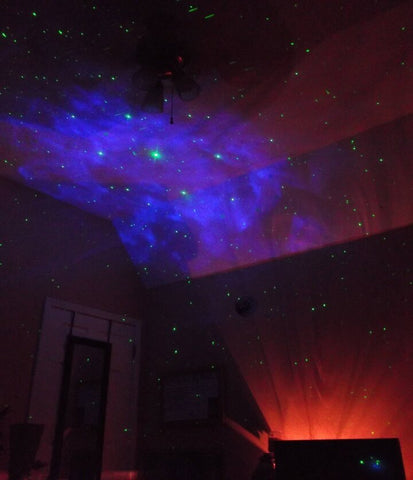

For home theaters and reading spaces, dimmable lights enable substantial atmospheric flexibility across activities and moods. Read our right lighting fixtures for movie nights guide.
Installation Considerations
- Verify electrical requirements. Check wattage limits, dimmer compatibility, junction box weight ratings.
- Professional installation for complex setups. Substantial chandeliers, new circuits, aluminum wiring, two-wire ungrounded systems warrant licensed electrician.
- Junction box weight ratings. Standard 50 lbs; brace box 50-75 lbs; heavy-duty 75-100 lbs; structural mounting 100+ lbs.
- Code compliance. US NEC code requirements for all installations; bathroom damp/wet ratings; stairwell illumination requirements.
- Two-person installation. Substantial chandeliers, pendant clusters, substantial fixtures require two-person team.
- Dimmer compatibility verification. LED-rated dimmer switches required for dimmable LED bulbs.
- Smart wiring considerations. Smart switches require neutral wire (most modern homes); some pre-1985 homes lack neutral.
- For detailed installation: read our how to install a chandelier guide and how to safely hang a chandelier guide.
Maintenance Tips
- Regular dusting. Soft cloth or long-handled duster; monthly across all fixtures.
- Material-specific deep cleaning. Crystal (isopropyl alcohol + distilled water 1:3); brass (mild soap + water); chrome (mild soap + water); brushed nickel (vinegar + water in grain direction).
- Replace bulbs promptly. Maintains consistent illumination; LED bulbs last 15,000-25,000+ hours.
- Annual mounting hardware inspection. Substantial chandeliers benefit from substantial annual inspection.
- Professional cleaning for substantial chandeliers. Substantial 9-21+ bulb crystal chandeliers; $150-500+ per service.
- Glass shade cleaning. Ammonia-free glass cleaner; spray on cloth not directly on fixture.
- LED fixture vent cleaning. Compressed air for vent cleaning; maintains heat dissipation.
Common Indoor Lighting Mistakes
- Single overhead fixture without layering. Creates harsh shadows. Use ambient + task + accent layered approach.
- Cool color temperature in residential spaces. 4000K+ creates institutional feel. Use 2700K-3000K warm white.
- Wrong fixture size for room dimensions. Apply L+W formula (chandelier diameter inches = room length + room width feet).
- Insufficient lumens for room functions. Calculate 20-40 lumens per square foot ambient.
- Non-dimmable fixtures. Specify dimmable LED + LED-rated dimmer switches across all fixtures.
- Mismatched finish across visible zones. Open-concept homes need finish family coordination.
- Skipping task lighting. Kitchen counters, dining tables, reading chairs, vanity mirrors all benefit from focused task lighting.
- Low CRI bulbs. Specify CRI 90+ for accurate color rendering.
- Wrong bulb base type purchases. Verify E26 vs E12 before purchase.
- Skipping smart lighting in tech-integrated homes. Smart bulbs deliver substantial convenience + scene preset value.
Browse Seus Lighting's full collection — chandeliers across all styles, pendant lighting for substantial style flexibility, ceiling lights for ambient illumination, wall lights for architectural accent, floor lamps for layered seating illumination, table lamps for accent + bedside, dining room lighting for substantial dining statements, kitchen lighting for substantial culinary tasks, bedroom lighting for relaxing atmosphere, bathroom lighting for grooming, foyer lighting for welcoming entries, LED strip lights for under-cabinet and cove, and our custom service for unique requirements.
All Chandeliers Pendant Lighting Ceiling Lights Wall Lights Floor Lamps Table Lamps Dining Lighting Kitchen Lighting Bedroom Lighting Bathroom Lighting Foyer Lighting LED Strip Lights Custom Service
Frequently Asked Questions
What are the best indoor lighting fixtures?
The best indoor lighting fixtures combine 3 lighting layers (ambient, task, accent) with 10 main fixture categories selected room-by-room: (1) Chandeliers: statement ambient for dining, foyer, two-story stairwells. Investment $150-3,000+. (2) Pendant lights: targeted task/accent for kitchen islands, breakfast bars, reading areas. $80-800 each. (3) Flush/semi-flush mounts: low ceiling ambient for bedrooms, hallways, closets. $80-400. (4) Recessed lighting: clean minimal ambient for kitchens, living rooms, bathrooms. $50-150 per fixture. (5) Track lighting: adjustable directional accent for kitchens, offices, art display. $100-400 per system. (6) Wall sconces: architectural accent for hallways, bathrooms, dining rooms, foyers. $60-400 each. (7) Floor lamps: layered ambient + accent for living rooms, bedrooms. $80-600. (8) Table lamps: accent + bedside for nightstands, console tables. $50-400 each. (9) LED strip lights: under-cabinet + cove for kitchens, bedrooms. $30-150 per strip. (10) Smart lighting: app + voice + scene control for tech-integrated homes. $15-80 per smart bulb. Critical specifications across all fixtures: 2700K-3000K warm white LED; CRI 90+; dimmable; appropriate lumens per room. Browse our complete collection.
How do you choose indoor lighting?
Choose indoor lighting through systematic 8-step process: (1) Identify each room's primary functions: living room (relaxation + entertaining), kitchen (food prep + dining), bedroom (sleep + reading), bathroom (grooming), home office (work). (2) Measure room dimensions and ceiling height: apply L+W diameter formula for ceiling fixture sizing. (3) Plan the 3 lighting layers per room: ambient (primary fixture), task (specific work areas), accent (focal points). Most rooms benefit from at least 2 of 3 layers. (4) Choose fixture types matching room functions: chandeliers/pendants for dining and foyer; recessed + pendants for kitchen; ceiling fans + bedside lamps for bedroom; vanity lights for bathroom; track + recessed for office. (5) Specify 2700K-3000K warm white LED bulbs: welcoming residential atmosphere; CRI 90+ for accurate color rendering. (6) Calculate total lumens needed per room: 20-40 lumens per square foot. Living room 2,000-4,000; kitchen 4,000-8,000; dining 2,500-5,000; bedroom 1,500-3,000; bathroom 4,000-8,000. (7) Coordinate finish family across visible zones: warm metals together OR cool metals together OR intentional brass + matte black combination. (8) Plan dimmer compatibility: dimmable LED + LED-rated dimmer switches across all fixtures.
What are the 3 types of indoor lighting?
The 3 types of indoor lighting are ambient, task, and accent: (1) Ambient lighting (general): provides overall room illumination. Common fixtures: chandeliers, flush mounts, recessed lights, ceiling-mounted fixtures. Establishes baseline brightness for safe transit and general activities. Brightness level: primary, full room coverage. (2) Task lighting: provides specific work areas illumination. Common fixtures: pendants over islands, under-cabinet, desk lamps, vanity lights, reading lamps. Supports cooking, reading, working, grooming with focused brightness — typically 2-3× ambient at work surface. (3) Accent lighting: highlights specific features and decorative elements. Common fixtures: wall sconces, track lighting, picture lights, LED strips, decorative lamps. Creates visual interest by highlighting artwork, architectural features, focal points. Brightness: targeted, typically 3× the surrounding ambient on focal point. Most rooms benefit from at least 2 of 3 layers: living room ambient + accent; kitchen ambient + task; dining ambient + accent. Substantial layered rooms use all 3: substantial kitchens, master bedrooms, formal dining rooms. Layering principles: start with ambient; identify task areas needing focused light; identify focal points needing accent; use dimmable across all layers; match color temperature 2700K-3000K throughout.
What lighting is best for each room?
Indoor lighting recommendations by room: (1) Living room: chandelier or flush mount (ambient) + floor lamps in seating corners (task reading) + table lamps on side tables (accent) + wall sconces (architectural accent). 2,000-4,000 total lumens at 2700K-3000K. (2) Dining room: statement chandelier above table (ambient + focal point) + wall sconces flanking buffet (accent) + buffet lamps (task). 2,500-5,000 lumens at 2700K-3000K. (3) Kitchen: recessed lighting (primary ambient) + pendant cluster over island (task) + under-cabinet LED strips (task) + pantry recessed (task). 4,000-8,000 lumens at 2700K-3500K. (4) Bedroom: flush mount or modest chandelier (ambient) + bedside table lamps or sconces (task reading) + LED cove (optional accent). 1,500-3,000 lumens at 2700K only. (5) Bathroom: vanity lights flanking mirror (task) + recessed lighting (ambient) + damp-rated shower light (task). 4,000-8,000 lumens at 3000K-3500K. (6) Foyer/entryway: statement chandelier (ambient + focal) + wall sconces flanking entry (accent). 800-10,000+ lumens at 2700K-3000K. (7) Home office: adjustable desk lamp (task) + overhead fixture (ambient) + accent. 3,000-5,000 lumens at 3500K-4000K. (8) Hallway/stairwell: flush mounts spaced evenly (ambient) + wall sconces (accent). 800-2,000 lumens at 2700K-3000K.
What are the most common indoor lighting fixtures?
The most common indoor lighting fixtures across American homes: (1) Chandeliers: substantial statement fixtures with multi-bulb configurations. Most popular for dining rooms, foyers, two-story stairwells. (2) Pendant lights: single or cluster hanging fixtures. Most popular over kitchen islands, breakfast bars. (3) Flush mount fixtures: mounted directly to ceiling. Most popular in bedrooms, hallways, closets, low ceiling rooms. (4) Recessed lighting (can lights): built into ceiling for clean minimal aesthetic. Most popular in kitchens, living rooms, bathrooms, hallways. (5) Wall sconces: wall-mounted decorative + architectural lighting. Most popular in hallways, bathrooms (vanity), dining rooms, foyers. (6) Track lighting: adjustable directional lighting on track system. Most popular in kitchens, art display areas, home offices. (7) Floor lamps: free-standing tall lamps. Most popular in living rooms, reading corners, bedrooms. (8) Table lamps: lamps on tables, nightstands, consoles. Most popular bedside, side tables, entry consoles. (9) Under-cabinet LED strips: substantial task lighting under kitchen cabinets. (10) Smart lighting: WiFi/Bluetooth connected bulbs with app + voice control. Growing popularity in tech-integrated homes. Investment ranges: chandeliers $150-3,000+; pendants $80-800 each; flush mounts $80-400; recessed $50-150 per fixture; sconces $60-400 each; floor lamps $80-600; table lamps $50-400 each.
What's the difference between ambient, task, and accent lighting?
Ambient, task, and accent lighting serve distinct purposes in residential lighting design: Ambient lighting: Purpose — overall room illumination establishing baseline brightness. Function — safe transit, general activities, room atmosphere. Common fixtures — chandeliers, flush mounts, recessed lighting, semi-flush mounts. Brightness level — primary, full room coverage (60-70% of total room lumens). Example: chandelier centered in dining room or recessed lighting throughout kitchen. Task lighting: Purpose — specific work area illumination supporting focused activities. Function — cooking, reading, working, grooming. Common fixtures — pendants over kitchen islands, under-cabinet lighting, desk lamps, vanity lights, reading lamps, bedside lamps. Brightness level — focused, typically 2-3× ambient at work surface (20-30% of total room lumens). Example: pendant cluster over kitchen island or bedside reading lamp. Accent lighting: Purpose — highlighting specific features or decorative elements creating visual interest. Function — architectural emphasis, artwork illumination, decorative atmosphere. Common fixtures — wall sconces, track lighting, picture lights, LED strips, decorative lamps. Brightness level — targeted, typically 3× the surrounding ambient on focal point (10-20% of total room lumens). Example: wall sconces flanking artwork or LED cove lighting in living room. Layered lighting approach: most rooms benefit from at least 2 of 3 layers; substantial multi-purpose rooms use all 3 for atmospheric depth and functional versatility.
How many lumens do I need per room?
Indoor lighting lumens requirements scale to room size and function: (1) Living room: 20-30 lumens per sq ft total. 100 sq ft = 2,000-3,000 lumens; 200 sq ft = 4,000-6,000 lumens. Relaxation and entertaining focus. (2) Dining room: 25-35 lumens per sq ft. 100 sq ft = 2,500-3,500 lumens; 150 sq ft = 3,500-5,000 lumens. (3) Kitchen: 30-40 lumens per sq ft for substantial task focus. 100 sq ft = 3,000-4,000 lumens; 200 sq ft = 6,000-8,000 lumens. (4) Bedroom: 15-25 lumens per sq ft. 100 sq ft = 1,500-2,500 lumens; 150 sq ft = 2,250-3,750 lumens. Sleep promotion focus. (5) Bathroom: 50-70 lumens per sq ft for substantial grooming brightness. 50 sq ft = 2,500-3,500 lumens; 100 sq ft = 5,000-7,000 lumens. (6) Foyer (small under 30 sq ft): 30-40 lumens per sq ft = 800-1,500 lumens. (7) Foyer (substantial two-story): 30-40 lumens per sq ft + vertical space accommodation = 5,000-10,000+ lumens. (8) Home office: 40-60 lumens per sq ft. 100 sq ft = 4,000-6,000 lumens. Work focus higher than residential standard. (9) Hallway: 20-30 lumens per sq ft. Typical 80 sq ft = 1,600-2,400 lumens. (10) Closet: 40-60 lumens per sq ft. Substantial closet illumination for clothing color accuracy. Layered distribution: ambient layer 60-70%, task 20-30%, accent 10-20% of total lumens. Dimmable specification critical: full lumens for activities; 50-70% for relaxation; 20-40% for ambient evening.
What color temperature is best for indoor lighting?
The best color temperature for indoor lighting is 2700K-3000K warm white for residential living spaces with room-specific variations: (1) 2700K (warm white): most welcoming residential standard. Best for living room, dining room, bedroom, foyer. Matches incandescent traditional warmth. (2) 3000K (soft warm): slightly cooler. Best for modern living/dining rooms, kitchen-adjacent dining. Works with modern minimalist homes featuring white walls. (3) 3500K (neutral warm): task-focused warmer neutral. Best for kitchen task lighting, bathroom grooming. Balances task brightness with residential warmth. (4) 4000K (cool white): work-focused cool. Best for home office, garage, workshop. AVOID in living spaces — creates institutional clinical feel. (5) 5000K+ (daylight): NEVER use in residential. Commercial and industrial only. By room recommendations: Living/dining/bedroom/foyer = 2700K-3000K; Kitchen = 2700K-3500K; Bathroom = 3000K-3500K; Home office = 3500K-4000K; Hallway = 2700K-3000K. Critical specifications: (1) CRI 90+ for accurate color rendering. (2) Dimmable LED + LED-rated dimmer switch. (3) Consistent color temperature across visible adjacent zones — mixed Kelvin creates atmospheric disconnection. (4) Tunable white smart bulbs adjust temperature throughout day for circadian-friendly transitions. Read our detailed color temperature guide.
Are LED bulbs better for indoor lighting?
Yes — LED bulbs are substantially better for indoor lighting than incandescent, halogen, or CFL alternatives across virtually every meaningful metric: LED advantages over incandescent: (1) 75-85% less electricity consumption. (2) 10-25× longer lifespan (15,000-25,000+ hours vs 750-2,000). (3) Minimal heat generation (safer in enclosed fixtures). (4) Available across full color temperature range 2200K-6500K. (5) Dimmable specifications available. (6) CRI 90+ options for accurate color rendering. (7) Edison-style filament LEDs deliver vintage aesthetic with LED efficiency. LED advantages over halogen: (1) 60-75% less electricity. (2) 5-10× longer lifespan. (3) Substantially lower heat. (4) Wider color temperature range. (5) No skin oil sensitivity (halogen reduced lifespan if touched). LED advantages over CFL: (1) Instant full brightness (no warm-up time). (2) Better color quality at 2700K. (3) No mercury content (CFL contains mercury requiring proper disposal). (4) Longer lifespan with frequent on/off cycling. (5) Truly dimmable across full range. (6) Smaller form factors fitting more fixtures. LED economic comparison (60W equivalent): incandescent uses 60W ($80-100 over 10 years); halogen uses 43W ($60-80); CFL uses 13-15W ($25-40); LED uses 6-9W ($15-25). LED 9-bulb chandelier saves $150-250/year vs incandescent. LED critical specifications: 2700K-3000K warm white; CRI 90+; dimmable; Energy Star certified when available; correct base type (E26 medium most common; E12 candelabra for decorative chandeliers).
Should indoor lighting be dimmable?
Yes — indoor lighting should be dimmable across most rooms for substantial atmospheric flexibility throughout day and evening uses: Why dimmable matters: (1) Atmospheric flexibility: bright activity → soft entertaining → dim relaxation transitions across day. (2) Energy savings: dimmed lights consume proportionally less electricity. (3) Bulb longevity: dimmed LEDs may last longer than full-brightness operation. (4) Mood adjustment: family dinner vs formal entertaining vs late-night relaxation each need different brightness. (5) Sleep promotion: dim evening lighting supports circadian rhythm and sleep preparation. Rooms most benefiting from dimming: living room (movie nights, entertaining, reading); dining room (formal meals, family meals, late-night); bedroom (bright morning, dim bedtime); foyer (bright welcome, soft evening); home office (task work, evening relaxation). Dimmer compatibility specifications: (1) Dimmable LED bulbs: specifically labeled "dimmable" on packaging. (2) LED-rated dimmer switches: standard incandescent dimmers may not work properly with LED bulbs; replace with LED-compatible dimmers ($20-50 each). (3) Wattage capacity verification: dimmer rated for total connected LED wattage (most LED dimmers handle 150W minimum). (4) Match dimmable across all bulbs in circuit: mixed dimmable + non-dimmable creates uneven dimming. Smart bulb alternative: smart bulbs include internal dimming via app/voice — eliminates compatible dimmer switch requirement. Smart switch alternative: smart switches dim standard bulbs; lower per-bulb cost for multi-bulb fixtures. When dimmable may be unnecessary: hallway transit lighting; closet illumination; pantry; utility spaces.
How do I choose lighting for a small room?
Choose lighting for small rooms through space-appropriate fixture selection and layered illumination strategy: (1) Avoid oversized fixtures: substantial chandeliers overwhelm small rooms visually. Apply L+W formula: chandelier diameter (inches) = room length (ft) + room width (ft). 10×12 ft room = 22" diameter maximum. (2) Choose flush or semi-flush mount fixtures: low ceiling small rooms benefit from ceiling-hugging fixtures preserving visual space. Browse our flush mount chandeliers. (3) Multiple smaller fixtures over single large fixture: 2-3 small pendants OR recessed lighting cluster more visually appropriate than single oversized chandelier. (4) Wall sconces save floor space: small bedroom or living room wall sconces eliminate need for floor lamp footprint. (5) Mirror-reflected lighting: positioning fixtures near mirrors amplifies perceived brightness without additional fixtures. (6) Layered approach still applies: small room benefits from ambient + accent layering through smaller scale fixtures. (7) LED bulbs preferred: cooler operation safer in enclosed small space fixtures; substantial energy efficiency. (8) 2700K-3000K warm white: small rooms feel warmer and more welcoming at warmer color temperatures. (9) Dimmable specification: small rooms benefit substantially from atmospheric flexibility. (10) Maximize lumens per square foot: small rooms benefit from upper end of lumens range (30-40 per sq ft) for adequate brightness despite smaller fixture sizes. What to avoid: single overhead bare bulb (creates shadows); oversized chandelier (visually overwhelming); cool color temperature (makes small space feel sterile); insufficient lumens (creates dim cramped feeling).
What's the best lighting for a home office?
The best lighting for a home office combines substantial task focus with substantial ambient illumination reducing eye strain across long work sessions: (1) Adjustable desk lamp (primary task): substantial focused work surface illumination. 1,000-1,500 lumens; dimmable specification; adjustable arm for positioning; matte shade reduces glare. (2) Overhead ambient fixture: substantial primary illumination reducing harsh shadows. Flush mount, pendant, or recessed lighting. 2,000-3,500 lumens depending on office size. (3) Accent lighting: substantial atmospheric depth + reduces stark single-source environment. Wall sconces, decorative lamps, or LED accent. (4) Color temperature 3500K-4000K (work focus): substantial alertness + work focus. Cooler than residential standard 2700K-3000K. (5) Tunable white smart bulbs ideal: shift cooler (4000K-5000K) during work hours; warmer (2700K-3000K) during evening relaxation. Circadian-friendly transitions. (6) Anti-glare positioning: position task lamps to side of work area; avoid direct light on screens; matte finish reduces reflective glare. (7) CRI 90+ critical for color work: substantial accurate color rendering for design, photo editing, video calls, presentation review. (8) Dimmable specification: substantial atmospheric flexibility across work day. (9) Smart lighting integration: scene presets — "Deep Work" full bright cool; "Video Call" balanced 3500K; "Evening Wrap-up" warmer dim 2700K. (10) Avoid harsh single source: layered ambient + task + accent prevents eye strain across long work sessions. Total lumens for home office: 40-60 lumens per sq ft. 100 sq ft office = 4,000-6,000 total lumens.
Find Your Ideal Indoor Lighting Fixtures Today
Picking the right indoor lighting fixtures combines functional performance, aesthetic coordination, and energy efficiency. Apply the 8-step selection process across each room, layer the 3 lighting types (ambient + task + accent) for substantial atmospheric depth and functional versatility, specify 2700K-3000K warm white LED bulbs at CRI 90+ for welcoming residential atmosphere with accurate color rendering, calculate appropriate lumens by room size (20-40 lumens per square foot), and coordinate finish family across visible adjacent zones. With careful planning across all rooms, your home delivers substantial welcoming atmosphere through thoughtful indoor lighting design. Explore a variety of indoor lighting fixtures at Seus Lighting to elevate every room.
For complementary indoor lighting decisions, see our related authority guides: complete types of light fixtures guide, dining room lighting ideas, best foyer lighting, how much light does my room need, color temperature guide, light fixture sizing guide, light fixture cost calculator, how to install a chandelier, and matching chandeliers and pendant lights.


