

A rustic chandelier for a dining room has to do two things at once: carry the warmth of iron, wood, and glass over the table, and light the table well enough for everyday meals and long dinners. This guide works through the decisions in order — shape by table, size, hanging height, brightness and bulbs, finish pairing with the table, and which rustic sub-style suits the room — and ends with six branch, iron, and wood fixtures for dining rooms.
Key Takeaways
| Question | Answer |
|---|---|
| Which shape? | Linear over rectangular tables; round, radial, or wheel over round and square tables. |
| What size? | ½–⅔ of table width (round) or length (linear); cross-check with room L + W in inches. |
| How high? | 30–36 in above the tabletop at 8 ft; +3 in per extra foot of ceiling. |
| How bright? | 30–40 lm/sq ft over the dining zone; dimmer essential. |
| Which bulbs? | 2700K dimmable LED, CRI 90+; filament candelabra in open iron, frosted in glass globes. |
| How to pair with the table? | Wood in the same tone family; black iron over dark wood; brass over light wood; two metals max. |
Quick Facts
- Shape by table: rectangular → linear; round/square → round or radial; oval → round if ≤ 72 in, linear if longer.
- Size: 42 in round → 21–28 in; 60 in round → 30–40 in; 72 in rectangular → 36–48 in linear; 96 in → 48–64 in.
- Height: 30–36 in above the table at 8 ft; 36–42 at 10 ft; 7 ft clearance outside the table footprint.
- Light: 30–40 lm/sq ft; 300–450 lm per candelabra socket; dim to 30–50% for dinner.
- Bulbs: 2700K, CRI 90+, dimmable; filament E12 in open iron, frosted G9 or integrated LED in globes.
- Rustic fixtures read heavy: stay mid-range in size, open forms over dark tables.
1. Shape: Let the Table Decide
In a rustic dining room the table is the strongest element, and the chandelier should read as belonging to it. A rectangular table takes a linear rustic chandelier: a branch run along a bar, a single timber beam with a row of bulbs, an elongated black-iron frame, a linear lantern. A round or square table takes a round or radial form: a branch spread, an open iron ring, a wood-and-iron drum, a wagon wheel. An oval table follows its length — round if it is 72 inches or shorter, a soft linear if longer. The one gray zone is a round fixture over a shorter rectangular table in a near-square room, which works when the fixture has presence; the farmhouse round vs rectangular guide covers that decision and a full size-by-table chart.
2. Size: Half to Two-Thirds of the Table
A round or radial fixture should measure one-half to two-thirds of the table's width; a linear fixture one-half to two-thirds of the table's length and one-quarter to one-half of its width. In practice: a 42-inch round table takes a 21- to 28-inch fixture, a 60-inch round table 30 to 40 inches, a 72-inch rectangular table a 36- to 48-inch linear, an 84-inch table 42 to 56 inches, a 96-inch table 48 to 64 inches, and tables of 108 inches and up either one long linear or two matched fixtures, each centered over its half. Cross-check against the room — length plus width in feet as inches of diameter — so a big table in a small room doesn't get a fixture that crowds the walls. The rustic adjustment: iron, timber, and antler read heavier than glass or brass, so stay in the middle of the range, and over a dark table favor open forms — a branch with glass tips, a slim iron ring — over a solid drum or beam.
3. Hanging Height Over the Table
Hang the bottom of the fixture 30 to 36 inches above the tabletop on an 8-foot ceiling and add about 3 inches for each extra foot of ceiling: 33 to 39 inches at 9 feet, 36 to 42 at 10. Round and radial forms can sit at the low end because their footprint is centralized; long linears want the upper end so they don't cut across sightlines down a narrow room. Anything that extends beyond the table's footprint — a wide branch spread, a long linear over a short table — must keep 7 feet of clearance from the floor, which is the limit on how wide a fixture can go before it becomes a walkway hazard. On a vaulted or two-story dining ceiling, use a tiered or stepped form so the light still ends 6.5 to 7 feet above the table, or two or three pendants at the same height to bring the ceiling down over the table visually. The dining chandelier height guide covers the exceptions.
4. Brightness, Bulbs, and Dimming
Rustic dining chandeliers fail on brightness more than on looks. Shades, seeded glass, and many small candle bulbs diffuse light, so a fixture that looks lit can leave the table dim. Plan 30 to 40 lumens per square foot over the dining zone — roughly 3,600 to 4,800 lumens for a 10 by 12 foot area — from the chandelier plus any sconces, with the chandelier carrying about half. For a candle-arm iron fixture, that means 300 to 450 lumens per candelabra socket; a 9-light fixture at 400 lumens per bulb gives about 3,600. Then dim: full for homework and cleanup, 30 to 50 percent for dinner.
| Fixture type | Bulb | Why |
|---|---|---|
| Open candle-arm iron, wagon wheel | Filament-style candelabra (E12), 2700K, dimmable | Candle look without eye-level glare; exposed socket is the design |
| Branch with glass globes | Frosted G9 or integrated LED, 2700K | Soft glow inside the globe; no hot spot |
| Timber beam with exposed bulbs | Large filament globe (G25/G30), 2200–2700K | The bulb is the decoration; warm filament matches wood |
| Drum or shaded | A-shape LED, 2700K, higher lumens | Shade absorbs light; size up output |
| Integrated LED rustic | Built-in; check dimmer compatibility | Driver must match the wall dimmer to avoid flicker |
Every option at 2700K and CRI 90 or higher: warm light makes iron, wood, and brass read as intended, and high CRI keeps food and the table's grain true. The lumens calculator guide works the numbers for any dining area.
5. Pairing the Chandelier With the Table
The fixture should relate to the table, not match it. Wood on the chandelier sits in the same tone family as the table — warm with warm, gray-washed with gray-washed — never the same stain, which looks like a set. Black iron is the safe pick over a dark walnut or espresso table because it reads as an outline rather than a competing mass; brass warms a light oak, ash, or whitewashed table; a glass-tipped branch keeps a dark table from feeling heavy. Repeat the fixture's metal once more in the room — a drawer pull, a picture frame, a sconce — and hold to two metals at most. Chairs do the balancing: upholstered or light-toned chairs under a dark table and a dark fixture keep the room from going somber. The wood vs wrought iron guide compares the two materials in depth.
| Table | Fixture that works | Why |
|---|---|---|
| Dark walnut / espresso | Black iron linear or branch with glass tips | Outline, not mass; glass lightens |
| Light oak / ash / whitewash | Brass or warm-metal branch; wood-and-iron with matching tone | Warms a pale table |
| Reclaimed / gray-washed | Black iron or gray-washed wood frame | Stays in the cool-rustic family |
| Live-edge slab | Sculpted branch or slim iron; nothing with its own wood | The slab is the wood story |
| Painted farmhouse table | Wagon wheel, lantern, or candle-arm iron in black | Classic farmhouse pairing |
6. Rustic Sub-Styles Over the Dining Table
"Rustic" over a dining table covers several looks, and the chairs and architecture usually decide which. Farmhouse: black iron, X-frames, simple lanterns, candle arms over a trestle or painted table — see the farmhouse chandeliers guide. Modern rustic: a sculpted linear or radial branch with glass tips, a slim iron ring, a single beam, over slab tables and clean-lined chairs — see modern rustic chandeliers. Lodge and cabin: heavier iron, antler, wagon wheel at scale, over long plank tables in vaulted rooms. Vintage rustic: candle-arm iron, wheel, or lantern with controlled patina over a traditional table — see vintage rustic chandeliers. Copper and warm-metal rustic for a dining room with a copper range hood or sink is covered in the copper chandelier dining guide.
Six Rustic Chandeliers for Dining Rooms
For rectangular tables
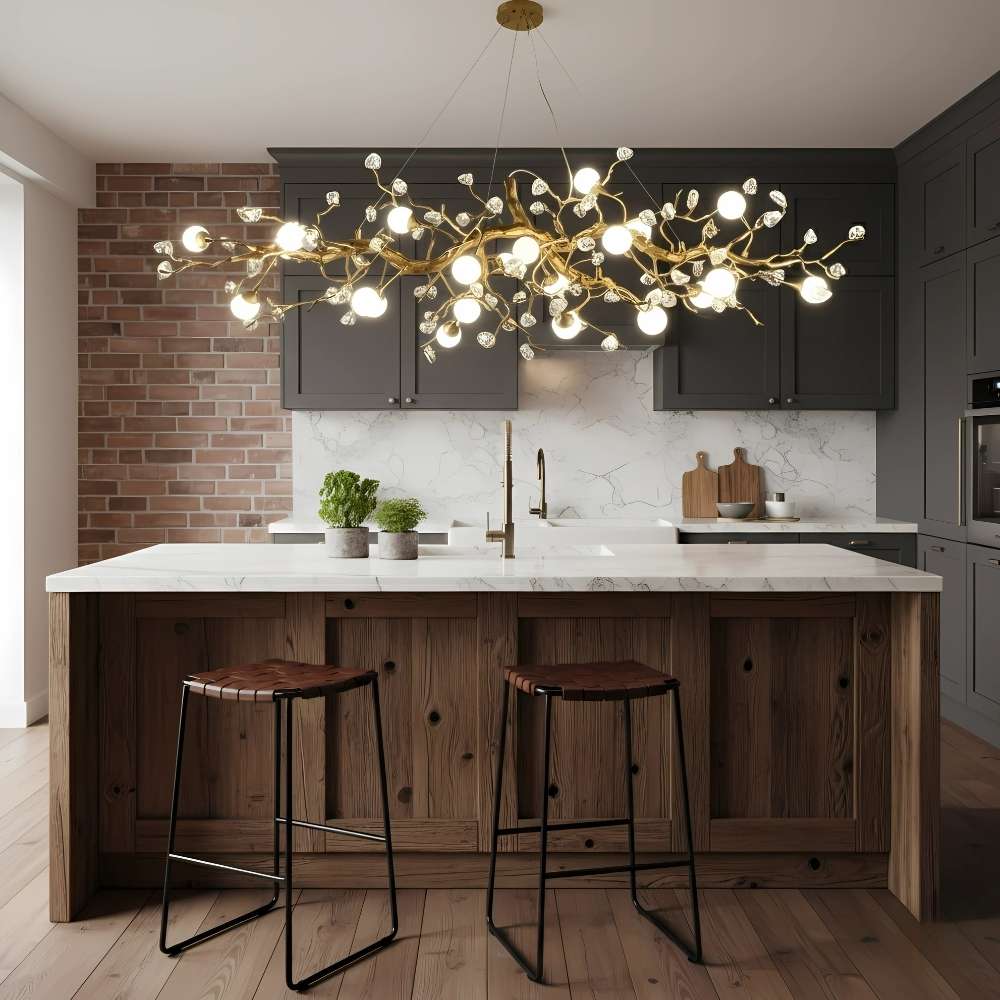
The Orgi Statement Linear Branch Chandelier runs branch arms along a line, so a 72- to 96-inch table is lit end to end with an organic form that suits modern rustic and farmhouse rooms alike. The Alba Tree Branch Chandelier, oriented along the table, is the wider-spreading alternative for a 60- to 72-inch table in a room that wants a softer, more sculptural line.
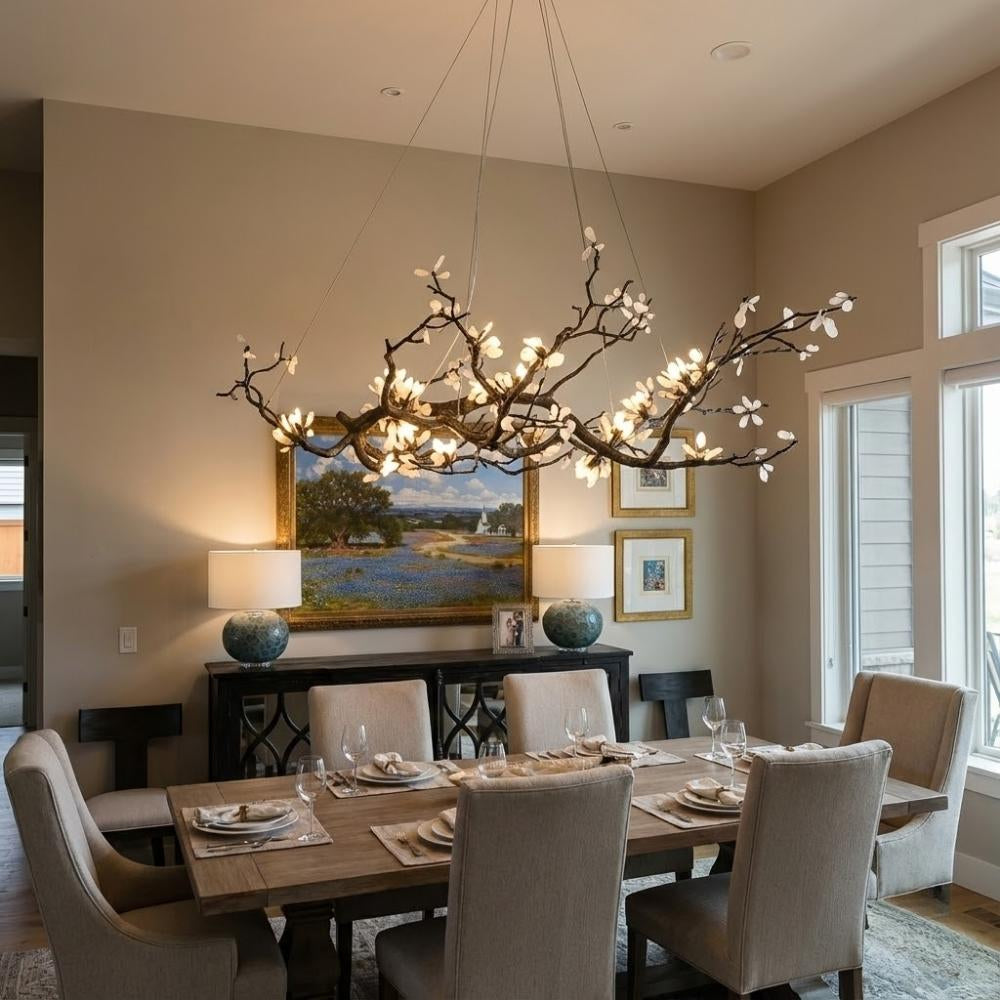
For round and square tables
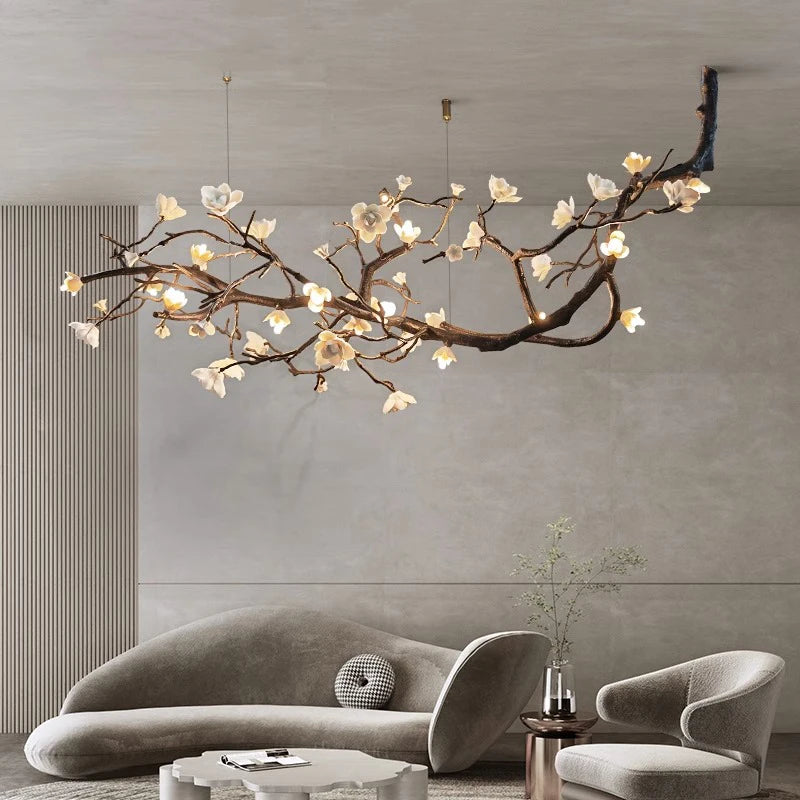
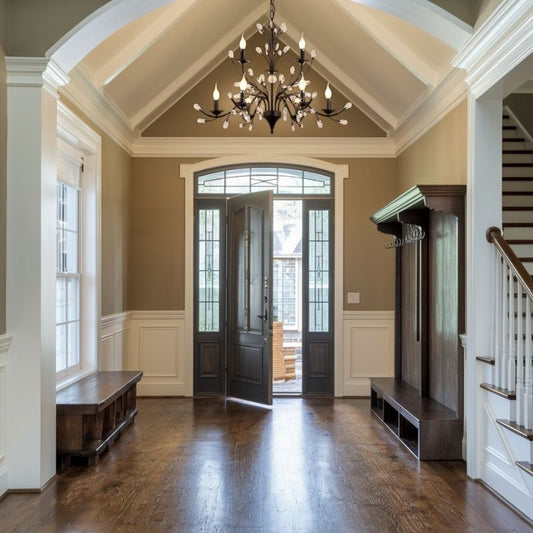
The Minas Dimmable Rustic Tree Branch Chandelier spreads a bark-textured canopy with glass globes over a 48- to 60-inch round table — the rustic branch at its most literal, dimmable for dinner. The Wrought Iron Chandelier, 6–9 Lights is the candle-arm classic: the 6-light over a 42- to 48-inch table, the 9-light over 54 to 60 inches, in black over dark wood or gold over light. For a large round table in a big or vaulted room, the Rose Wooden Large Rustic Chandelier brings a timber ring at scale — the heavy-weight option that needs a 60- to 72-inch table and a beam-clamp mount.

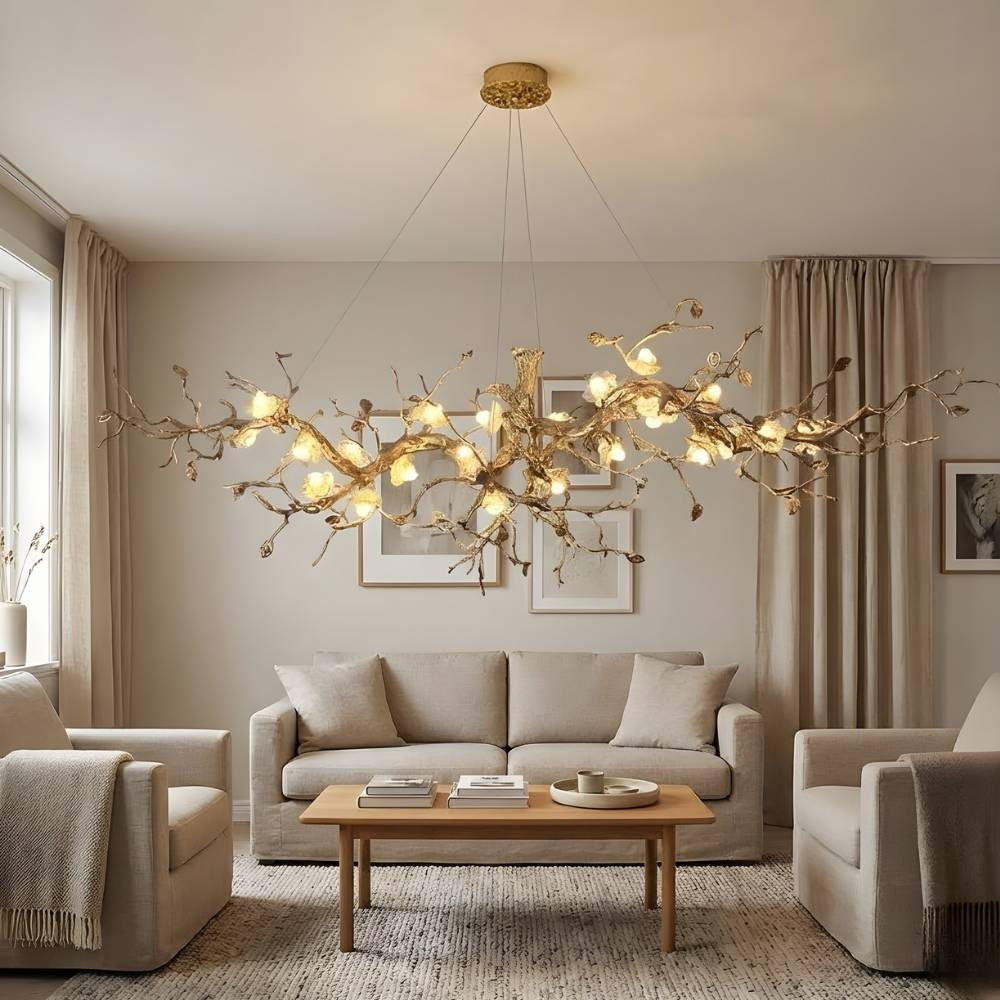
The Noa Flower Branch Chandelier softens the branch with petal-shaped shades, which also diffuse the light — the pick for a dining room that wants the rustic form with a gentler, more decorative glow over a round or square table.
| Fixture | Table | Form | Finish |
|---|---|---|---|
| Orgi Statement Linear Branch | Rectangular 72–96 in | Linear branch | Black |
| Alba Tree Branch | Rectangular 60–72 in or round | Wide branch spread | Warm metal |
| Minas Dimmable Rustic Tree Branch | Round 48–60 in | Radial branch, glass globes | Bark-texture metal |
| Wrought Iron 6–9 Lights | Round 42–60 in | Candle-arm iron | Black or gold |
| Rose Wooden Large Rustic | Round 60–72 in, tall room | Timber ring | Natural wood |
| Noa Flower Branch | Round or square 42–54 in | Branch with petal shades | Warm metal |
Supporting Lights in a Rustic Dining Room
The chandelier should carry about half the room's light. A pair of iron or brass sconces on the main wall, a buffet lamp with a linen shade, or a picture light over art fill the corners, light faces from more than one direction, and let the chandelier dim for dinner without losing the sideboard. Put the chandelier and the supporting lights on separate dimmers. The dining room lamps guide covers buffet and floor lamps for the second layer.
Quick decision: rustic chandelier for your dining table
Rectangular 72–96 in: Orgi linear branch, 36–64 in long • Rectangular 60–72 in, square room: Alba along the table or a round form with presence • Round 42–48 in: Wrought Iron 6-light or Noa • Round 48–60 in: Minas or Wrought Iron 9-light • Round 60–72 in, tall room: Rose Wooden • All: 30–36 in above the table, 2700K dimmable, sconces or a buffet lamp alongside.
Linear branch, radial branch, candle-arm iron, and timber forms sized for dining tables.
Rustic Chandeliers Dining Room Branch Rectangular
Frequently Asked Questions
What shape rustic chandelier should go over a dining table?
Follow the table. A rectangular table takes a linear rustic chandelier — a linear branch, a wood beam with a row of bulbs, an elongated iron frame — sized to one-half to two-thirds of the table's length. A round or square table takes a round or radial form — a branch spread, an open iron ring, a wood-and-iron drum, a wagon wheel — at one-half to two-thirds of the table's width. A round fixture can sit over a rectangular table only when the table is 72 inches or shorter and the room is near-square.
What size rustic chandelier for a dining room?
One-half to two-thirds of the table's width for a round or radial fixture, or of its length for a linear: a 42-inch round table takes 21 to 28 inches, a 72-inch rectangular table a 36- to 48-inch linear, an 84-inch table 42 to 56 inches. Cross-check against the room — length plus width in feet as inches — so a big table in a small room doesn't get an oversized fixture, and keep iron and wood forms toward the middle of the range because they read heavier than glass.
How high should a rustic chandelier hang above a dining table?
Bottom of the fixture 30 to 36 inches above the tabletop on an 8-foot ceiling, about 3 inches higher per extra foot of ceiling, so 36 to 42 inches at 10 feet. Round and radial forms can sit at the lower end; long linears want the upper end so they don't read as a bar across sightlines. Any part of the fixture outside the table's footprint needs 7 feet of clearance from the floor.
How bright should a rustic dining room chandelier be?
Plan 30 to 40 lumens per square foot over the dining zone — about 3,600 to 4,800 lumens for a 10 by 12 foot area — from the chandelier plus any sconces, and put the chandelier on a dimmer. Rustic forms often use shades, seeded glass, or many small candle bulbs that diffuse light, so size the bulbs for the bright setting (300 to 450 lumens per candelabra socket) and dim to 30 to 50 percent for dinner.
What bulbs work best in a rustic dining chandelier?
Dimmable LED at 2700K, CRI 90 or higher. For open candle-arm iron and wagon-wheel forms, filament-style candelabra (E12) bulbs give the candle look without glare at eye level; for branch forms with glass globes, frosted G9 or integrated LED keep the glow soft; for beams with exposed bulbs, large filament globes at 2200 to 2700K read as intended. Match the bulb to the dimmer to avoid flicker.
How do I match a rustic chandelier to the dining table?
Relate, don't match. Wood on the fixture should sit in the same tone family as the table — warm with warm, gray-washed with gray-washed — not the same stain. Black iron suits almost any table and is the safe pick over dark wood; brass warms a light oak or ash table; a glass-tipped branch keeps a dark table from feeling heavy. Repeat the fixture's metal once more in the room — a pull, a frame, a sconce — and keep to two metals at most.
Can a rustic chandelier work in a modern dining room?
Yes — choose the modern rustic version: a sculpted linear or radial branch with glass tips, a slim candle-arm iron, or a single timber beam, in matte black or brushed brass, over clean-lined chairs and a slab or trestle table. One organic fixture with plain supporting lights reads as intentional; a wagon wheel over carved chairs reads as a theme.
What rustic chandelier works over a long farmhouse table?
A linear: a linear branch, a timber beam, or an elongated iron frame at one-half to two-thirds of the table's length — 48 to 64 inches over a 96-inch table. Over tables of 108 inches and up, use one long linear or two matched fixtures, each centered over its half, so both ends of the table are lit and no seat sits in shadow.
What rustic chandelier suits a low dining room ceiling?
A wide, shallow form — a linear branch with a short drop, a flat open iron ring, a semi-flush wood-and-iron drum — that hangs 30 to 36 inches above the table while anything outside the table's footprint keeps 7 feet of clearance. Skip tall drums, multi-tier wheels, and deep branch forms. The table lets the fixture hang lower than a walkway would, which is why dining is the easiest room for a rustic chandelier on an 8-foot ceiling.
Do I need other lights in a rustic dining room besides the chandelier?
Yes. The chandelier carries about half the room's light; a pair of iron or brass sconces on the main wall, a buffet lamp with a linen shade, or a picture light over art fill the corners and keep faces lit from more than one direction. Put the chandelier and the supporting lights on separate dimmers so the room shifts from bright to dinner without losing the sideboard.
A Rustic Chandelier That Lights the Table
The rustic dining chandelier that works is the one chosen in order: shape from the table, size from the table and the room, height from the ceiling, brightness from the floor area, and finish from the table and the room's other metal. Done that way, the fixture carries the material warmth the style is for and still lights every seat for dinner.
Browse the rustic chandeliers collection and dining room lighting for the forms above. For the shape decision in more detail, see the round vs rectangular guide; for the whole-home style, rustic lighting ideas.


