

Key Takeaways
| Question | Answer |
|---|---|
| What is it? | One or more LED-lit hoops on cables; even light from the whole circumference, no visible bulb. |
| Five forms? | Single ring, concentric, stacked, offset multi-ring, twisted ring. |
| How to size? | Largest ring = ½–⅔ of table width, or room L + W in inches; lowest ring 30–36 in above a table. |
| How many rings? | 1 at 8–9 ft; 2–3 at 10–12 ft; 4–7 in a foyer or stairwell. Each stacked ring adds 6–12 in of drop. |
| Output and control? | 2,000–4,000 lumens per ring; remote or app dimming, 3000K/4000K/6000K switching — set to 3000K. |
| Finish? | Black or white for modern; gold or brass for transitional; match the room's most visible hardware. |
Quick Facts
- Ring depth: 1–3 in; ring width: 16–48 in single, up to 60 in on statement pieces.
- Output: 24-in ring ≈ 2,000–3,000 lm; 32-in ≈ 3,000–4,000 lm; three rings ≈ 6,000+ lm.
- Drop per stacked ring: 6–12 in; a 9-ft ceiling takes one hung ring, a 12-ft ceiling three, a 20-ft foyer five to seven.
- Weight: single ring 8–20 lb; 5–7 rings 30–60 lb — rated box on structure above 50 lb.
- Color temperature: switchable on most; ships on 6000K — set to 2700–3000K in living spaces, 3500K in kitchens.
- Life: 25,000–50,000 hours; driver replaceable, LED strip usually not.
What a Ring Chandelier Is
The ring chandelier is a product of integrated LED. A strip of LEDs runs inside an aluminum hoop behind an acrylic or polycarbonate diffuser, so the whole circumference glows evenly with no bulb, socket, or hot spot; the hoop hangs on two to four cables from a canopy that houses the driver. Earlier ring fixtures — a metal hoop with candle sockets, or a ring carrying crystal — still exist and fall in the same family, but the LED ring is what most people mean by the term now, and it is the version that dims and switches color temperature from a remote.
Two things follow from the construction. The ring is thin — 1 to 3 inches deep — so it can be wide without being heavy or blocking a view, which makes it the modern fixture best suited to low ceilings and to open plans where the fixture is seen edge-on. And the light is diffuse: even, glare-free, and without the sparkle of crystal or the points of a sputnik, which suits a dining table or a bedroom and is why a dimmer is standard. The larger modern forms the ring belongs among are covered in large modern chandeliers; the LED technology in tall rooms in LED chandeliers for high ceilings.
The Five Ring Chandelier Forms
Single ring
One hoop, 16 to 48 inches across, on two to four cables or flush to the ceiling. It is the form for a standard-ceiling dining room, a bedroom, or a living room, and one of the few modern fixtures that gives an 8-foot ceiling real presence: the width does the work, the 1- to 3-inch depth keeps headroom, and a flush-mounted ring is effectively a designed ceiling light. Over a round table it sizes to half to two-thirds of the diameter.
Concentric rings
Two to four hoops of decreasing size nested in one plane, like a target seen from below. It spreads light across a wider area than a single ring without adding drop, which makes it the choice for a large round table, a wide living room, or a low-ceilinged great room where stacked rings would not fit. The outer ring sizes to the table or room; the inner rings fill the center.
Stacked rings
Two to seven hoops on one vertical axis at increasing heights, usually decreasing in size downward so the fixture reads as a cone or a column of circles. Each ring adds 6 to 12 inches of drop, so the count is set by the ceiling: two or three at 10 to 12 feet, four or five at 14 to 18, five to seven in a two-story foyer or stairwell. It is the ring family's vertical form and shares the sizing and clearance rules of any tall fixture, covered in long chandeliers for staircases and high ceilings.
Offset multi-ring
Three to eight rings of different sizes hung at different heights and often at slight angles from one canopy, so the composition is loose rather than axial. It is the form for a great room or open-plan living area with a 12-foot ceiling or higher, where a symmetrical stack would read formal, and for a wide stairwell where rings at several heights read from the landing and the floor. Cables are set on site, which makes it the ring form with the most adjustment and the most planning.
Twisted ring
One large hoop — 36 to 60 inches — bent into a curve, a figure-eight, or a partial spiral, usually as an LED ribbon. It is a statement piece for a tall living room, a grand entry, or a stairwell of 20 feet and up, and it belongs to the current preference for curved light that stops short of a full circle. Its size and output put it in the remote-dimmer, rated-mount category from the start.
| Form | Rings | Diameter | Ceiling | Best rooms |
|---|---|---|---|---|
| Single | 1 | 16–48 in | 8 ft and up | Dining, bedroom, living, hallway |
| Concentric | 2–4, one plane | 24–48 in outer | 8 ft and up | Large round tables, wide rooms, low great rooms |
| Stacked | 2–7 | 16–40 in top ring | 10 ft and up; 5–7 rings need 18 ft+ | Tall dining rooms, foyers, stairwells |
| Offset multi-ring | 3–8 | Mixed, 12–36 in | 12 ft and up | Great rooms, open plans, wide stairwells |
| Twisted | 1 | 36–60 in | 14 ft and up | Statement living rooms, grand entries |
Sizing Rings and Drop
The diameter rule is the usual one, applied to the largest ring: half to two-thirds of a round table's diameter or a rectangular table's width, or the room's length plus width in feet expressed in inches over open floor. A 48-inch round table takes a 24- to 32-inch ring; a 12 by 14 foot living room takes a 26-inch ring or a concentric set with a 26-inch outer hoop. Rings read slightly smaller than a chandelier of the same diameter because they are open in the center, so the top of the range is safe.
Drop is where rings differ from other forms. A single ring hangs 30 to 36 inches above a dining table like any chandelier, or flush on a low ceiling. A stacked fixture's total height is the sum of its ring spacings — 6 to 12 inches each — plus the top ring's cable, and the lowest ring is what has to clear the table or the 7-foot walkway line, so count rings from the ceiling height down: a 9-foot ceiling over a dining table has about 36 inches to spend between the 30-inch table clearance and the ceiling, which is one hung ring or two flush; a 12-foot ceiling has 72 inches, which is three stacked rings with room for cable. In a foyer or stairwell the vertical-fixture rule of 2.5 to 3 inches of body per foot of ceiling applies to the stack. The chandelier hanging height guide covers the clearance rules by room.
Output, Color, and Control
Because the LED runs the full circumference, a ring delivers more lumens per inch of diameter than a bulb fixture: a 24-inch ring produces 2,000 to 3,000 lumens, a 32-inch ring 3,000 to 4,000, and a three-ring stack 6,000 or more, which is why a single ring can be a dining room's only fixture at 20 to 30 lumens per square foot. The light is diffuse and glare-free — good over a table and in a bedroom, less useful as task light, and without the sparkle of crystal — so the dimmer is not optional. Most ring fixtures ship with a remote or app that dims steplessly and switches between 3000K, 4000K, and 6000K, and most arrive set to 6000K; set them to 3000K on first use, or 2700K in a bedroom and 3500K in a kitchen or office. Where the fixture uses a wall dimmer instead, its driver type — TRIAC, ELV, or 0–10V — is on the product page and must match. The chandelier mood lighting guide covers dimming and driver matching in detail.
Quick decision: which ring chandelier
8–9 ft ceiling, any room: single ring, flush or short cables, sized to the table or room • Large round table or wide low room: concentric rings in one plane • 10–12 ft dining or living room: two or three stacked rings • Two-story foyer or stairwell: five to seven stacked, or an offset multi-ring • Great room, open plan: offset multi-ring, cables set on site • Statement space, 14 ft+: twisted ring • Every ring: set to 3000K, level after hanging, match finish to hardware.
Finish and Room Pairing
A ring is a single continuous surface, so its finish shows more than on a multi-arm chandelier where the frame is thin and broken up. Black and white rings read as a drawn line and suit modern, minimalist, and Scandinavian rooms; gold and brass read warmer and pair with brass hardware in transitional rooms; chrome and silver suit cooler contemporary palettes; wood-finish rings suit Japandi and organic rooms. Match the ring to the most visible hardware in the room — door handles, cabinet pulls, the faucet — and keep the diffuser white or opal, because a tinted diffuser changes the light's color. By room: a single black or brass ring over a dining table; a single white ring in a bedroom at 2700K; concentric rings in a wide living room; a stacked set in a foyer that repeats the stair rail's finish; a wood-finish single ring in a kitchen at 3500K. For how the ring compares with the other modern forms — sputnik, globe cluster, linear — the contemporary chandeliers guide shows them side by side.
Ring Chandeliers by Form
Six fixtures across single, stacked, offset, twisted, and crystal-ring forms.
Single and stacked rings
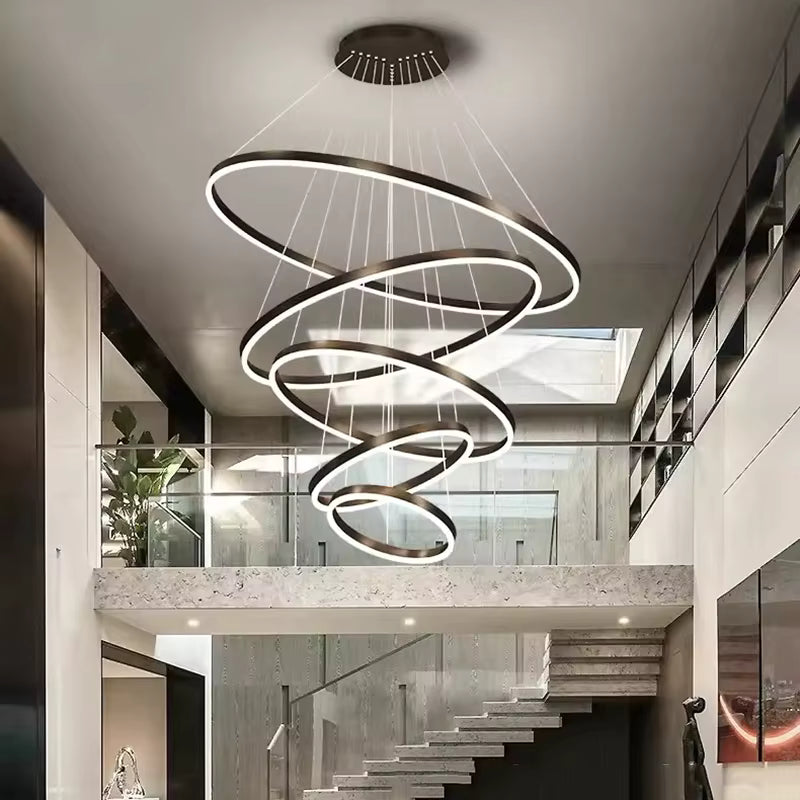
The Aysan Modern Ring Chandeliers, in black, gold, brown, and white and in two- to seven-ring versions, covers the single-to-stacked range in one design: two rings for a dining room, three for a 12-foot living room, seven for a two-story foyer. Its finish options let it match black, brass, or wood hardware.

The Verda Modern Circular Chandelier, in gold or black, is the circular form with a sculptural body rather than a bare hoop, for a dining table or a living room that wants the ring's even light with more presence when switched off. Size its diameter to the table like any single ring.

The Qyra Contemporary Circular LED Chandelier is the integrated-LED ring in its cleanest form — a circle of diffused light for a modern dining room, bedroom, or hallway on a standard ceiling. It is the pick for an 8- or 9-foot room that wants a designed fixture rather than a plain ceiling light.
Offset, twisted, and crystal rings
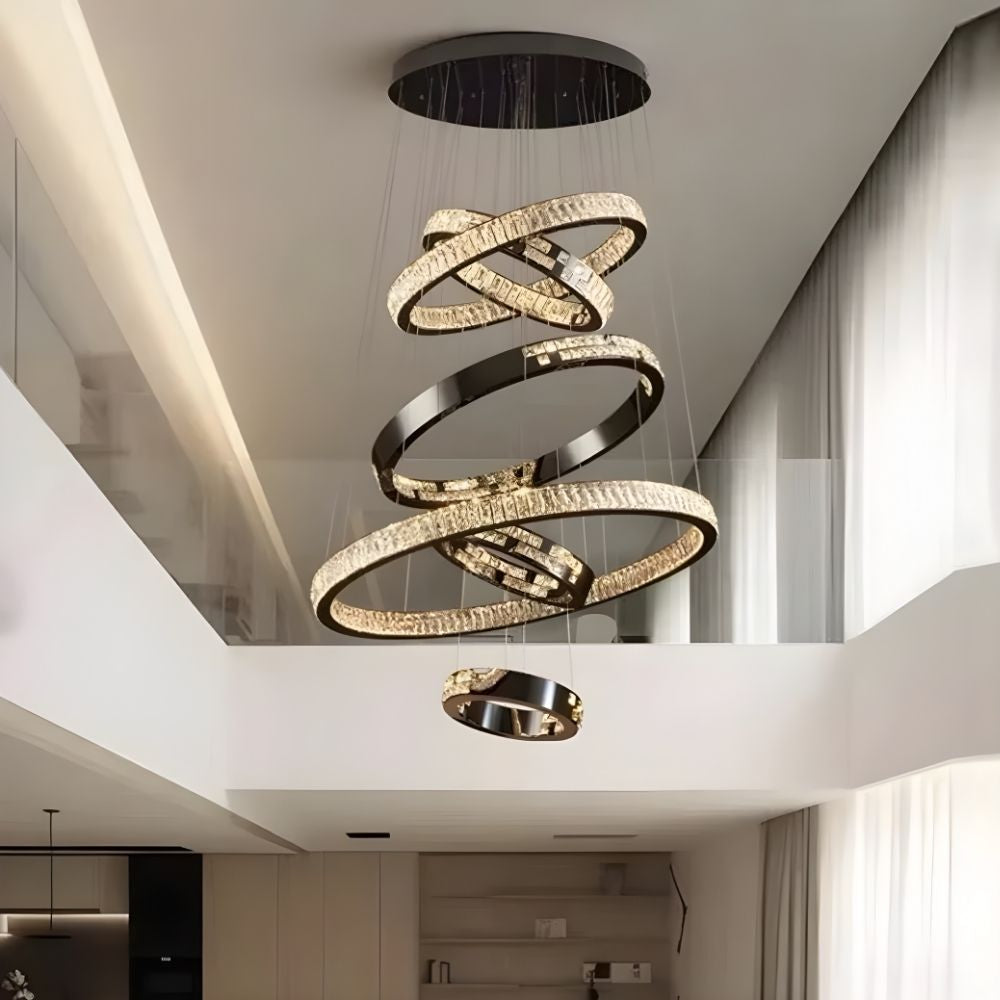
The Malen Multi Ring Pendant Light, in six- or eight-ring versions with remote dimming, is the offset multi-ring: rings of different sizes at staggered heights from one canopy, for a great room, a tall living room, or a wide stairwell where a loose composition reads better than a symmetrical stack.
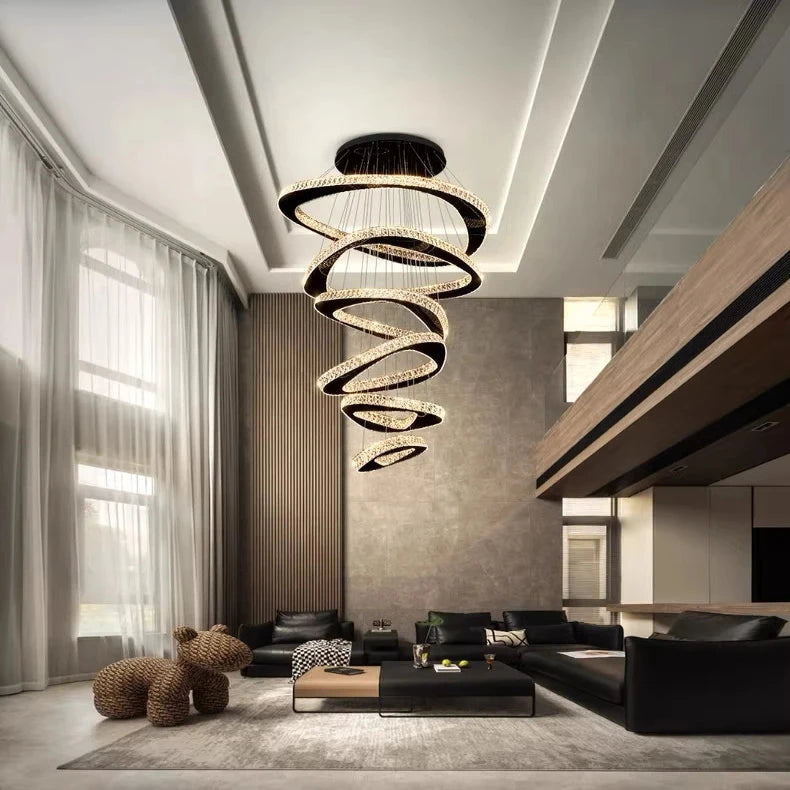
The Twisted Ring LED Light Chandelier for High Ceiling, in black, gold, or silver, is the twisted form: one large LED ribbon bent into a curve for a statement living room, grand entry, or stairwell of 20 feet and up. Its continuous LED makes it the brightest fixture on this list and one to run on its remote dimmer.
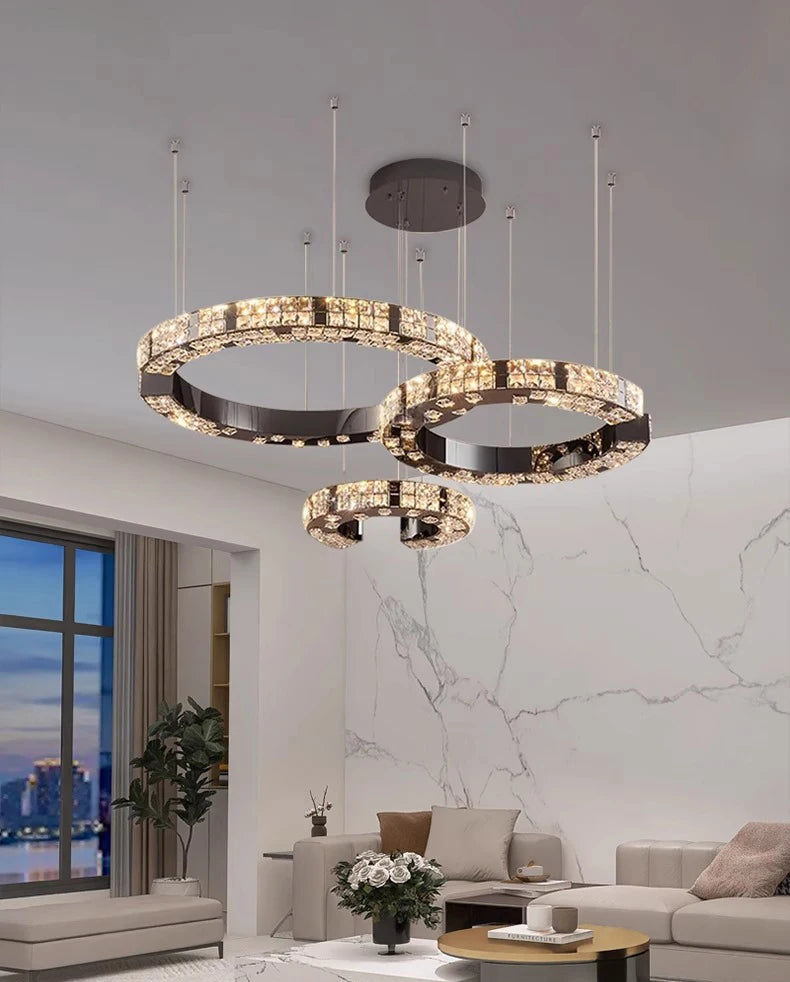
The Cosmo Circle Crystal Chandelier is the ring family's crystal member: a circular frame carrying crystal, for a transitional dining room or foyer that wants the ring's geometry with sparkle instead of a diffuser. It weighs more than an LED ring of the same diameter, so check the box rating.
Single, stacked, offset, and twisted LED rings in black, gold, white, and silver.
Modern Chandeliers Black Chandeliers Dining Room Staircase
Installation, Leveling, and Longevity
A ring chandelier wires like any chandelier from one ceiling box, with the driver in the canopy. A single ring at 8 to 20 pounds mounts to a standard box; a five- to seven-ring stack or a large twisted ring at 30 to 60 pounds needs a box rated for the load on a joist or brace bar. The step that matters more than on other fixtures is leveling: a ring hangs on two to four cables and a tilt of even a few degrees reads immediately, so level each ring with a spirit level after hanging, adjusting the cables at the canopy, and level stacked rings from the top down. On a sloped ceiling the canopy needs a slope adapter so the cables hang plumb.
Longevity is the question people ask about integrated LED. Rings are rated for 25,000 to 50,000 hours, which is 15 to 25 years at three to four hours a day, and the part that fails first is the driver in the canopy, which is replaceable; the LED strip usually is not. Buy from a seller with a stated warranty and driver availability, keep the diffuser dust-free with a dry microfiber cloth, and treat the fixture as a long-term purchase rather than a bulb fixture. The chandelier installation guide covers the wiring and mounting steps.
Frequently Asked Questions
What is a ring chandelier?
A ring chandelier is a fixture whose light source is one or more circular hoops — usually an aluminum ring with an integrated LED strip behind an acrylic diffuser, sometimes a metal ring carrying bulbs or crystal. The ring hangs from cables or rods at a canopy, and versions with several rings stack them vertically, nest them concentrically, or offset them at different heights. The form gives an even wash of light from the whole circumference with no visible bulb and reads as a drawn circle in the room.
What are the types of ring chandeliers?
Five forms cover the category. A single ring is one hoop, 16 to 48 inches, for a dining table, bedroom, or living room. Concentric rings nest two to four hoops in one plane for a large round table or a wide room. Stacked rings hang two to seven hoops at increasing heights on one axis for tall rooms and foyers. Offset multi-ring fixtures hang rings of different sizes at different heights and angles from one canopy for great rooms and stairwells. Twisted rings bend one large hoop into a curve for statement spaces.
How do I size a ring chandelier for a dining table?
Size the largest ring at half to two-thirds of a round table's diameter, or of a rectangular table's width — a 48-inch round table takes a 24- to 32-inch ring; a 42-inch-wide rectangular table takes 21 to 28 inches. Hang the lowest ring 30 to 36 inches above the tabletop. Over open floor, add the room's length and width in feet and use that number in inches for the largest ring's diameter.
How many rings should a chandelier have?
One ring for a standard-ceiling dining room, bedroom, or living room; two or three stacked or concentric for a 10- to 12-foot ceiling or a large round table; four to seven stacked or offset for a two-story foyer, stairwell, or great room. Each additional stacked ring adds 6 to 12 inches of drop, so the count is limited by the ceiling: a 9-foot ceiling takes one ring, or two flush-mounted; a 12-foot ceiling three; a 20-foot foyer five to seven.
Are ring chandeliers bright enough?
Usually brighter than a bulb chandelier of the same size, because the LED runs the full circumference: a 24-inch ring delivers 2,000 to 3,000 lumens, a 32-inch ring 3,000 to 4,000, and a three-ring fixture 6,000 or more. That covers a dining room's 20 to 30 lumens per square foot from one fixture. The trade-off is that the light is diffuse and even rather than sparkling, which is why ring fixtures almost always ship with a dimmer or remote.
Can a ring chandelier be dimmed and change color temperature?
Most can. Ring chandeliers are integrated-LED fixtures, and the majority include a remote or app that dims steplessly and switches between 3000K, 4000K, and 6000K; some accept a wall dimmer matched to the driver type. Set the fixture to 3000K on first use — many ship on 6000K — and use 2700K to 3000K in living spaces, 3500K in a kitchen or office.
Do ring chandeliers work on low ceilings?
Yes; the single ring is one of the best fixtures for an 8- or 9-foot ceiling. A ring is only 1 to 3 inches deep, so a flush or semi-flush single ring keeps full headroom, and its wide diameter gives presence without drop. Concentric rings in one plane do the same for a larger room. Stacked rings need height — one ring of drop per 18 to 24 inches of ceiling above 9 feet is a fair rule.
Which finish is best for a ring chandelier?
Black or white rings read as a drawn line and suit modern, minimalist, and Scandinavian rooms; gold and brass rings read warmer and suit transitional rooms and homes with brass hardware; chrome or silver suits cooler contemporary palettes. Because the ring is a single continuous surface, the finish is more visible than on a multi-arm chandelier, so match it to the most visible hardware in the room and keep the diffuser white or opal.
How long do LED ring chandeliers last and can the LED be replaced?
Integrated LED rings are rated for 25,000 to 50,000 hours — 15 to 25 years at three to four hours a day. The LED strip is not user-replaceable on most models; the driver, which fails first, usually is, and a replacement driver is a small part. Buy from a seller with a stated warranty and driver availability, and treat the fixture as a 15-year purchase rather than a bulb fixture.
How is a ring chandelier installed?
Like any chandelier, from one ceiling box — a single ring at 8 to 20 pounds mounts to a standard box; a five- to seven-ring fixture at 30 to 60 pounds needs a box rated for the load on a joist or brace bar. Rings hang on two to four cables and must be leveled after hanging, since a tilted ring reads immediately; stacked fixtures are leveled ring by ring from the top. The driver sits in the canopy and needs the wall switch, remote, or matched dimmer the product page specifies.
Choosing a Ring Chandelier
Let the ceiling choose the form: one ring or a concentric set on a standard ceiling, a short stack at 10 to 12 feet, a tall stack or an offset set in a foyer. Then size the largest ring to the table or room, set the color temperature the day it goes up, and level it with more care than any other fixture asks for. A ring chosen that way is the modern fixture that does the most from the least depth.
Compare single, stacked, and offset rings in the modern chandeliers collection and black-finish rings in black chandeliers. For how a ring compares with sputnik, globe, and linear forms, read the contemporary chandeliers guide; for stacked rings in a tall entry, long chandeliers for staircases and high ceilings.


