

Key Takeaways
| Question | Answer |
|---|---|
| What is the spiral form? | Lights or crystal arranged on a helix around a vertical axis; tall and narrow. |
| Three types? | Crystal cascade spiral, LED ribbon spiral, spiral cluster. |
| Why stairwells? | The helix matches the stair's rise, needs little width, and has no front or back. |
| How tall and how many turns? | 2.5–3 in per foot of ceiling; 2–3 full turns over that height. |
| How wide? | Open well width − 24 in; 20–36 in in an open foyer. |
| Crystal or LED? | Crystal: formal, 40–100 lb, structural mount. LED ribbon: modern, 15–40 lb, brightest, rated standard box. |
Quick Facts
- Body height: ceiling ft × 2.5–3 in; 18 ft → 45–54 in; 20 ft → 50–60 in; 24 ft → 60–72 in.
- Turns: 2–3 full revolutions over the body height read as a helix; 1 reads as a slant, 5+ as a dense column.
- Diameter: well width − 24 in (5-ft well → ~36 in); slim LED spirals go down to 12–16 in for a 3-ft well.
- Clearance: 7 ft over the highest tread or landing beneath; body at or above the second-floor line.
- Weight: LED ribbon 15–40 lb; cluster 20–50 lb; crystal 40–100+ lb; canopy rated for full load.
- Output: LED ribbon 3,000–6,000 lumens; crystal 2,000–4,000; 2700–3000K, CRI 90+, dimmer.
What Makes a Chandelier a Spiral
A spiral chandelier is defined by its path, not its material. The lights — crystal strands, LED points, a continuous LED band, glass pendants — are arranged along a helix: a curve that winds around a vertical axis while descending, so that from any side the fixture appears to twist from top to bottom. The number of turns, the diameter of the helix, and its height are the three dimensions that describe it, and a spiral with two to three full turns over 4 to 6 feet of height is the proportion most people recognize as the form.
The form belongs to the family of vertical fixtures — spines, cascades, tiers, vertical rectangles — that fill tall spaces, and the general rules for that family are in long chandeliers for staircases and high ceilings. What sets the spiral apart within it is movement: a spine is static and a cascade is scattered, while a spiral has a direction of rotation, which is why it reads as the fixture most connected to a stair.
The Three Spiral Chandelier Types
Crystal cascade spiral
Strands of crystal or glass drops hung from a helical frame — a spiral rod or a series of offset rings — so the crystal follows the twist. It is the formal version: sparkle from every angle, seen from the landing as a column of light, and the natural match for a foyer with a brass or chrome stair rail. It is also the heaviest, at 40 to 100 pounds and more for large sizes, which puts it on a structural mount from the start. The related cascade-without-twist form is covered in raindrop crystal chandeliers for foyers and staircases.
LED ribbon spiral
A continuous band of integrated LED, 1 to 3 inches wide, coiled into a helix of two to five turns. It is the modern version and the brightest — 3,000 to 6,000 lumens from one uninterrupted line — and the lightest at 15 to 40 pounds, so it mounts to a rated standard box. It reads as a drawn line of light in a contemporary stairwell with flat trim and a cable or glass rail, and most versions dim from a remote or app.
Spiral cluster
Pendants — glass globes, LED tubes, small crystals — on cords from one canopy, with the cords cut so the heads trace a helical path downward. It combines the spiral's movement with the multi-light pendant's on-site adjustability, weighs 20 to 50 pounds, and suits a curved stair where the cords can be set to follow the stair's own turn. The cluster type in general is covered in multi-light pendant chandeliers.
Why the Spiral Suits a Stairwell
Three properties of the form match three properties of the space. The stairwell is tall and narrow; the spiral is tall and narrow, and carries its presence in height and rotation rather than width, so it fits a 4- to 6-foot well where a 30-inch round chandelier would crowd the rail. The stair rises around the well; the spiral rises around its axis in the same way, and in a curved or spiral stair the two turn together. And the fixture is seen from every level and angle — from the front door, from each step, from the landing — and a helix looks the same from every side, which a flat linear fixture or a tiered chandelier with a front does not.
It does not need a spiral staircase. In a straight-run stairwell the spiral becomes the vertical focal point, centered in the open well beside the stair so the full turn is visible; in an open two-story foyer with no stair intrusion it is a sculptural column seen from the front door and the gallery above. The one placement to avoid is directly over a straight stair's treads, where the twist is seen only from beneath and the clearance rule bites hardest.
Sizing: Height, Turns, and Diameter
| Ceiling height | Spiral body height | Turns | Diameter (open foyer) | Diameter (in a well) |
|---|---|---|---|---|
| 14–16 ft | 36–48 in | 2 | 20–24 in | Well width − 24 in |
| 18–20 ft | 45–60 in | 2–3 | 24–30 in | Well width − 24 in |
| 22–24 ft | 55–72 in | 3 | 28–36 in | Well width − 24 in |
| 26–30 ft | 65–90 in | 3–4 | 32–40 in | Well width − 24 in |
Height follows the vertical-fixture rule of 2.5 to 3 inches of body per foot of ceiling, and the body should sit at or slightly above the second-floor line so it is seen whole from the landing. Turns are the spiral's own dimension: two to three full revolutions over that height read as a helix, one reads as a slant, and five or more read as a dense column that loses the twist. Diameter in a stairwell is the open well's narrowest width minus 24 inches, leaving a foot of clearance from the rail and the wall each side — a 5-foot well takes a spiral about 36 inches across, a 4-foot well 24 inches, and a 3-foot well a slim LED spiral of 12 to 16 inches. In an open foyer 20 to 36 inches is the usual range. The general arithmetic for stairwell fixtures is in the two-story foyer chandelier guide, and the hanging heights in optimal heights for hanging staircase chandeliers.
Quick decision: which spiral chandelier
Formal foyer, brass or chrome rail: crystal cascade spiral on a structural mount • Modern stairwell, cable or glass rail: LED ribbon spiral, brightest and lightest • Curved stair, wide well: spiral cluster with cords set to the stair's turn • Narrow well under 4 ft: slim LED spiral, 12–16 in • Body height: ceiling ft × 2.5–3 in, 2–3 turns • Lowest point: 7 ft over the highest tread; axis plumb • Every spiral: 2700–3000K, dimmer, wall or step lights for the treads.
Clearance, Weight, and Mounting
The lowest crystal, LED point, or pendant must clear 7 feet above every tread, landing, and floor beneath it, measured from the highest of those surfaces; in the open well beside a stair the ground floor is the reference, and over a landing the landing is. Beyond safety, keep the whole body above the top floor's line of sight so the helix is seen complete from the landing, which usually means the body sits at or above the second-floor line and the cables above it are the only thing crossing the upper level.
Weight decides the mounting. An LED ribbon spiral at 15 to 40 pounds and a cluster at 20 to 50 mount to a box rated for the load on a joist or brace bar; a crystal spiral at 40 to 100 pounds and more needs a structural mount — blocking between joists or a bracket to the framing — planned before the drywall closes where possible. The canopy carries the cables and must be rated for the full weight, not just the box. A spiral must also hang plumb: a helix on a leaning axis reads as a lean, not a twist, so check the axis with a level before trimming the cables, and use a slope adapter or swivel canopy on a sloped ceiling. Above 18 feet it is a two-person scaffold or lift installation, and the same equipment is needed for the annual clean. The vaulted ceiling staircase chandelier guide covers sloped and irregular wells; the chandelier installation guide covers the wiring.
Light, Color, and the Treads
A spiral is the foyer's ambient light — 2,000 to 4,000 lumens is the target, which an LED ribbon exceeds and a crystal spiral with 15 to 40 LED points meets — but it hangs above and to the side of the stair and does not light the treads directly. Stairs need about 5 foot-candles on the step surface, so a stairwell with a spiral also has wall lights along the run or step lights in the stringer; the staircase lumens guide covers that layer. Keep the spiral at 2700–3000K and CRI 90 or higher — many LED spirals ship on a 6000K setting that should be changed on first use — and put it on a dimmer matched to its driver or on its remote, because a bright helix at full output in a space people look up into is the most common complaint about the form.
Spiral and Vertical Fixtures for Stairwells
Six fixtures: three spirals, and three vertical cascades for wells where a straight fall suits the stair better than a twist.
Spiral chandeliers
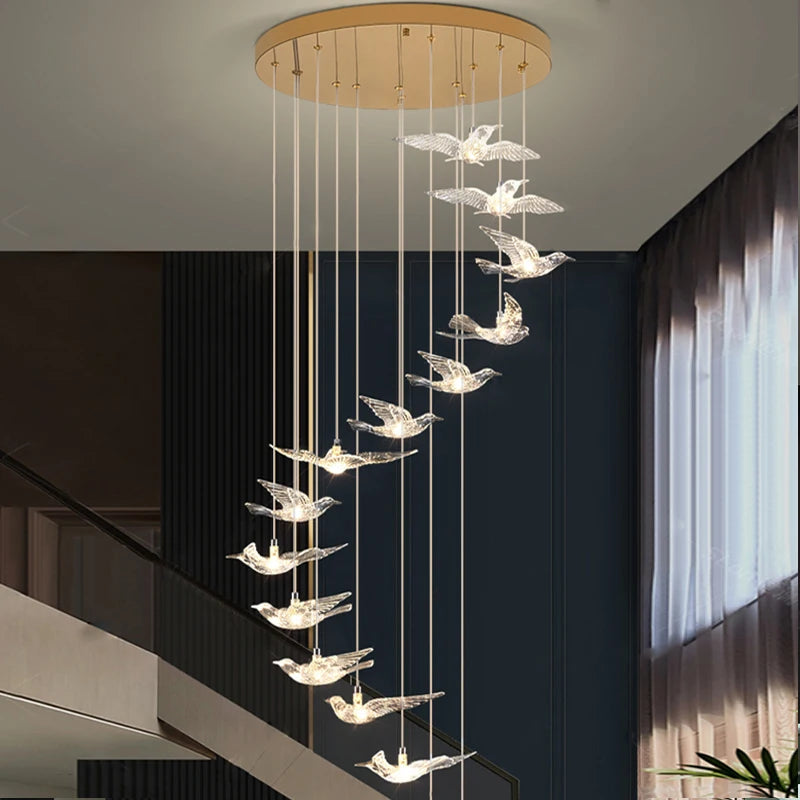
The Bird Spiral Long LED Chandelier for Staircase and Foyer, in gold or chrome, is the LED spiral for a modern stairwell or two-story foyer: a helix of light points on a slim frame, light enough for a rated standard box and sized for 16- to 24-foot spaces. The chrome version suits a cable rail and pale walls; gold pairs with a brass rail.
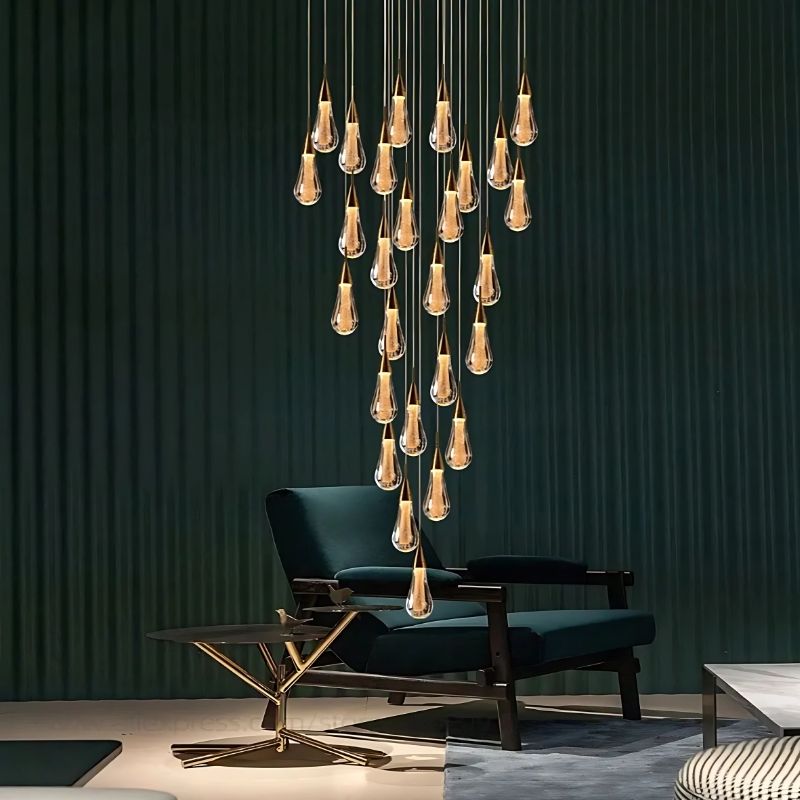
The Spiral Raindrop Staircase Ceiling Lighting is the crystal cascade spiral: raindrop crystals on a helical frame, in versions up to 49 lights, for a formal entry with a chrome or brass rail. Set the LEDs to warm white on first use and plan the structural mount its crystal weight needs.
A third spiral, the Modern Spiral Chandelier for Staircase, is the contemporary helix sized for a 3- to 5-foot well and the fixture most often chosen for a first two-story foyer.
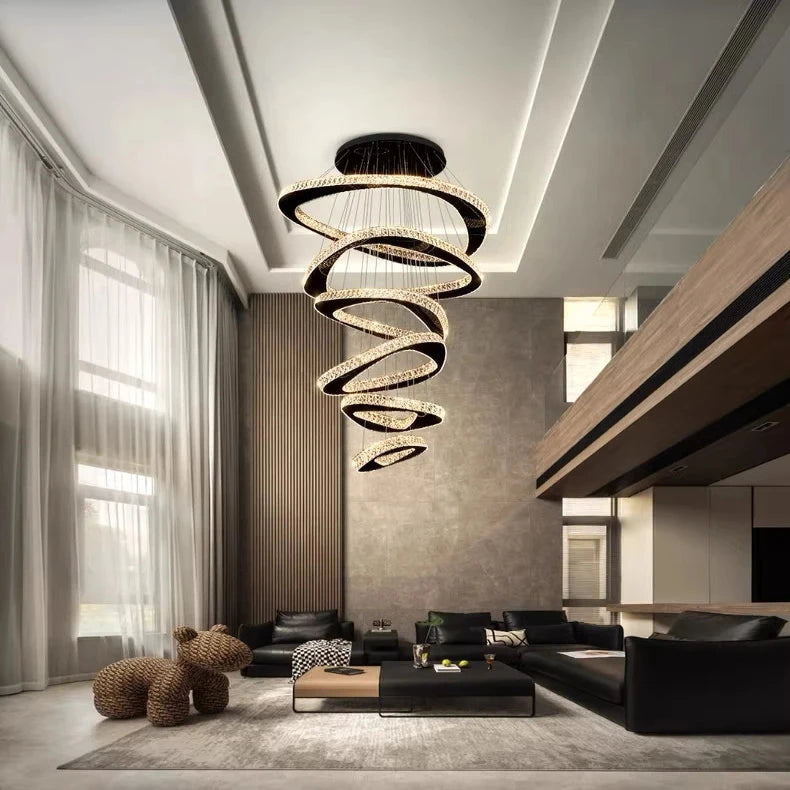
The Twisted Ring LED Light Chandelier for High Ceiling, in black, gold, or silver, is the LED ribbon form at its largest: a twisted band of light for a great room, a grand entry, or a stairwell of 24 feet and up. Its continuous LED gives the brightest, most even output in this list, and it belongs on a remote dimmer.
Vertical cascades for straight wells

The Modern Raindrop Chandelier for Foyer & Staircase, in copper or black, is the straight-fall alternative: a vertical cascade of drops without a twist, for a straight-run stairwell where the stair's own line is the geometry to follow. It gives the same height and sparkle as a crystal spiral in a form that reads still rather than rotating.
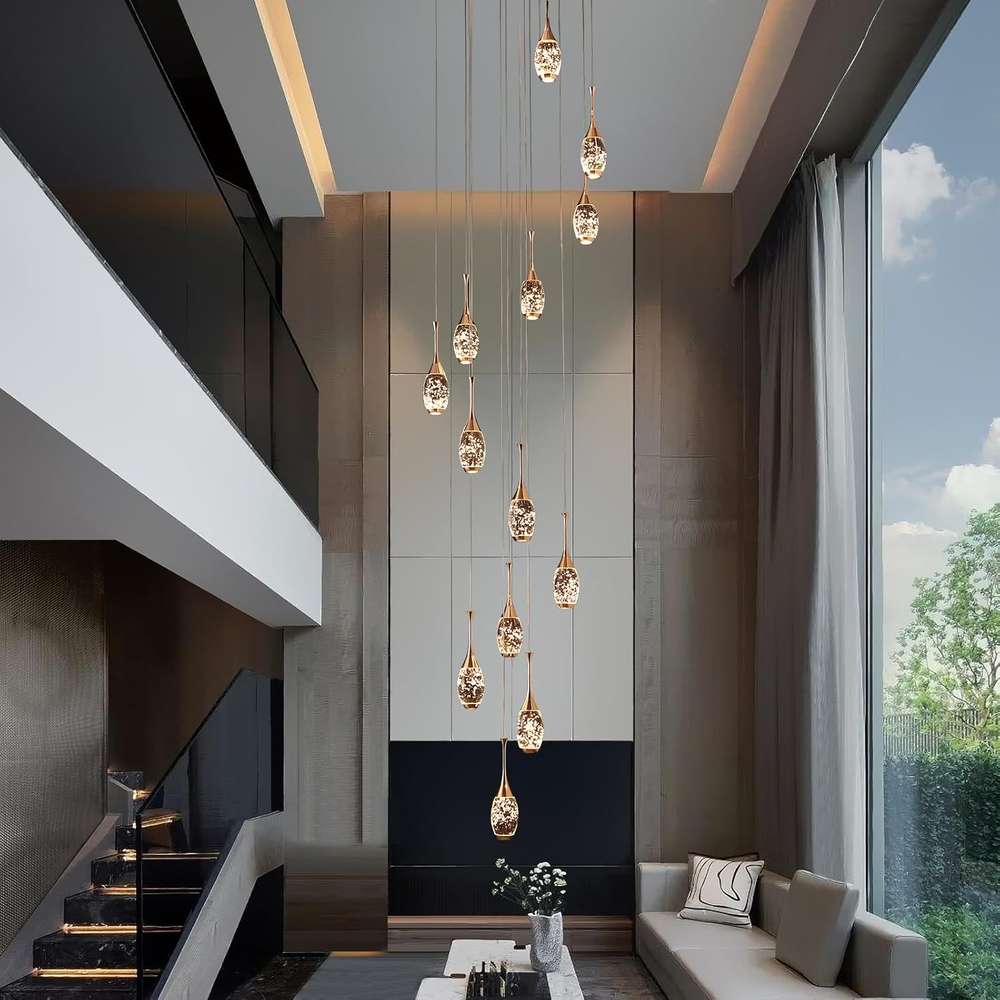
The Setya Long Drop Crystal Chandelier, in gold, black, or chrome, is a vertical crystal composition on long drops for a formal two-story foyer — the choice when a crystal column is wanted but the well is straight and a spiral's rotation would fight it.

The Modern Crystal Light Fixture for Staircase & Foyer & High Ceiling, in gold or chrome with remote control, is the large-scale crystal column for entries of 24 feet and more, where a spiral of that size would need more diameter than most wells allow. Its remote dimming matters at this output.
LED spirals, crystal cascade spirals, and vertical fixtures for stairwells and two-story foyers.
Staircase Chandeliers Two-Story Foyer Crystal Foyer Foyer Lighting
Frequently Asked Questions
What is a spiral chandelier?
A spiral chandelier arranges its lights or crystal along a helix — a curve that winds around a vertical axis as it descends — so the fixture reads as a twist of light from top to bottom. The three common types are the crystal cascade spiral (strands of crystal or glass drops on a spiral frame), the LED ribbon spiral (a continuous band of light coiled into a helix), and the spiral cluster (pendants on cords cut to follow a helical path). All three are tall, narrow fixtures built for stairwells and two-story foyers.
Why are spiral chandeliers used in stairwells?
Because the form matches the space. A stairwell is tall and narrow and the stair rises around it, and a spiral is tall, narrow, and rises around its own axis, so the fixture echoes the stair's movement and fills the height without needing width. It also reads well from every angle — from the floor, from each step, from the landing — because a helix has no front or back, which a flat linear or tiered fixture does not offer.
How tall should a spiral chandelier be?
Use the vertical-fixture rule of 2.5 to 3 inches of body height per foot of ceiling: an 18-foot stairwell takes a spiral 45 to 54 inches tall, a 20-foot foyer 50 to 60 inches, a 24-foot entry 60 to 72 inches. Keep the lowest point 7 feet above every tread and landing beneath it and the body at or above the second-floor line. A spiral with two to three full turns over that height reads as a clear helix; more turns look dense, fewer look like a slant.
How wide should a spiral chandelier be?
Take the open well's narrowest dimension and subtract 24 inches so there is 12 inches of clearance from the rail and wall on each side: a 5-foot well takes a spiral about 36 inches in diameter, a 4-foot well 24 inches, a 3-foot well a slim 12- to 16-inch LED spiral. In a two-story foyer with no stair intrusion, 20 to 36 inches is the usual range; the spiral's height supplies the presence.
Does a spiral chandelier need a spiral staircase?
No. A spiral chandelier is at its best in a curved or spiral stairwell, where the fixture and stair turn together, but it works in a straight-run stairwell and an open two-story foyer as well — the helix simply becomes the vertical focal point the space needs. In a straight stairwell, center the spiral in the open well rather than over the stair so its full turn is visible.
Crystal spiral or LED spiral: which should I choose?
Crystal spirals give sparkle and suit traditional and transitional entries, but they are heavy (40 to 100 pounds), need a structural mount, and take more cleaning. LED ribbon spirals are a continuous band of light, weigh 15 to 40 pounds, mount to a rated standard box, read modern, and give more even light. Spiral clusters of glass pendants sit between the two. Choose crystal for a formal foyer with a brass or chrome rail, LED for a contemporary stairwell with a cable or glass rail.
How heavy is a spiral chandelier?
LED ribbon spirals run 15 to 40 pounds; spiral clusters 20 to 50; crystal cascade spirals 40 to 100 or more. Fixtures over 50 pounds need a ceiling box rated for the load and fastened to a joist or brace bar, and the canopy — which carries the cables — must be rated for the full weight too. Above 18 feet, installation is a two-person scaffold or lift job.
How much light does a spiral chandelier give?
An LED ribbon spiral is often the brightest fixture in the category — 3,000 to 6,000 lumens from a continuous band — while crystal spirals with 15 to 40 small LED points deliver 2,000 to 4,000. Either covers a foyer's ambient need of 2,000 to 4,000 lumens, but neither lights the stair treads directly; add wall lights or step lights for the 5 foot-candles stairs need. Use 2700K to 3000K, CRI 90 or higher, and a dimmer.
Can a spiral chandelier be installed on a sloped ceiling?
Yes, with a slope adapter or a swivel canopy, because the fixture hangs plumb on its cables and only the canopy has to sit flat against the ceiling. A spiral that hangs off-plumb reads as a lean rather than a twist, so check that the axis is vertical after hanging and before the cables are trimmed.
How do I clean a spiral chandelier in a stairwell?
Monthly with an extendable duster from the landing and the floor, and once a year from a scaffold or lift with the power off at the breaker. LED ribbons and metal wipe with a dry or barely damp microfiber cloth; crystal strands are wiped in place with a dry cloth or, on a deep clean, removed and washed in mild soap and water. Never spray cleaner on a hanging fixture.
Choosing a Spiral Chandelier for Your Stairwell
Begin with the well's width, which sets the diameter, and its height, which sets the body and the number of turns; then choose crystal or LED by the rail's finish and by the mounting the ceiling can carry. A spiral sized and mounted that way turns with the stair instead of competing with it, and is the one fixture in the house that looks right from every step.
Compare spirals and other vertical forms in the staircase chandeliers collection and the two-story foyer chandeliers collection. For the full family of tall fixtures the spiral belongs to, read long chandeliers for staircases and high ceilings; for style picks, modern staircase chandeliers.


