

Investing in staircase lighting is one of the most effective ways to transform your stairway. However, incorporating a chandelier in the area involves a delicate balance between aesthetics and functionality. The height at which you hang a chandelier can significantly affect these two principles and potentially impact the overall ambiance. Knowing how to correctly position your staircase lighting is essential in ensuring that your interior design scheme ties together perfectly.
Understanding standard height guidelines for chandelier placement helps whether you're lighting a staircase, foyer, or dining room, though each space has unique safety and clearance requirements.
Read on to identify the optimal heights for hanging your staircase chandelier.
How to Determine the Optimal Chandelier Height for Your Staircase
Staircases are one of the most overlooked areas in a home when it comes to interior lighting. This is quite unfortunate given the safety risks involved. Hanging your staircase chandelier too low can cause obstruction resulting in injury. Meanwhile, hanging it too high can make the space appear dull due to insufficient lighting. The right chandelier size and proper height to hang it are crucial for both safety and creating a focal point in the room. Here's what you should consider when determining the ideal chandelier height for your staircases.
Chandelier Size
Most interior design experts and lighting specialists recommend that larger chandeliers hang higher while smaller light fixtures hang lower. This placement ensures that there's balance and uniform illumination in the space. However, this can be affected by the size and design of your staircases. The chandelier's height should be proportionate to the scale of your stairwell, an elaborate chandelier requires different considerations than a simple fixture.
Here are two great options for staircase chandeliers:
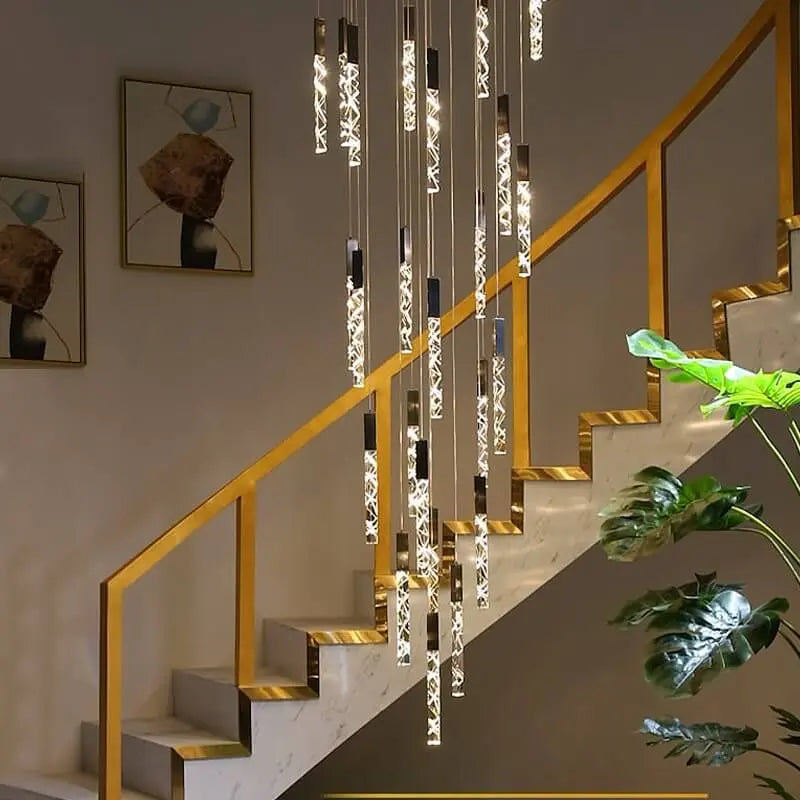
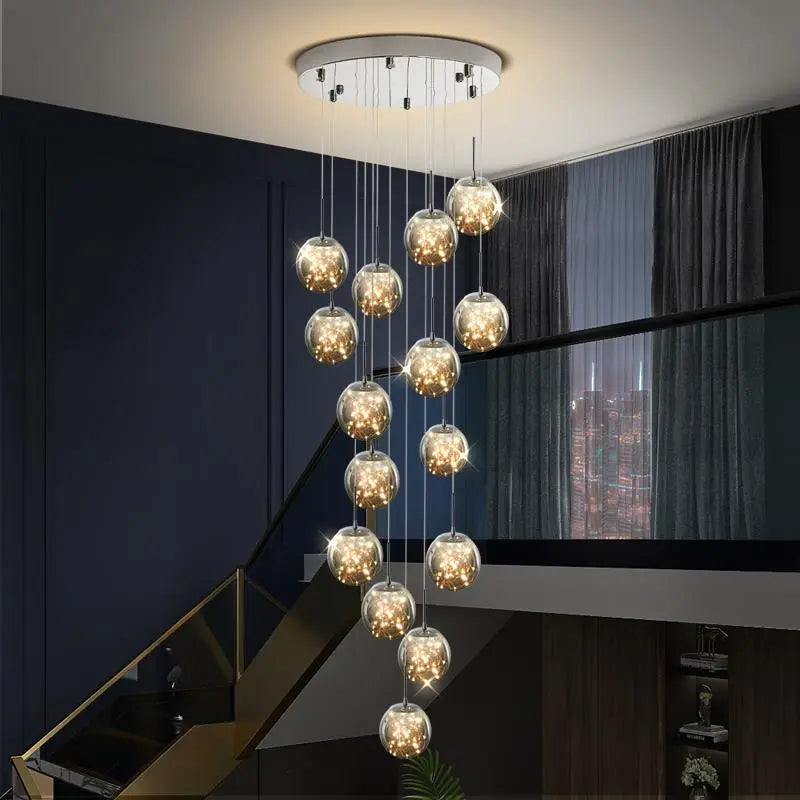
The crystal chandelier on the left is perfect for high ceilings and costs $159.99. It features 16 lights with warm white illumination, creating a luxurious ambiance. The spiral chandelier on the right is great for staircases and is priced at $586.99. It comes with 6 amber glass balls and a golden finish, adding a modern touch to your space. It even comes with a remote control for easy dimming!
Consider Your Ceiling Height
Higher ceilings provide more clearance allowing you to hang your light fixtures lower and choose longer designs. Lower ceilings offer limited space for this and you'll often have to hang your chandelier lower and go for smaller styles and shapes. Be aware that there should be at least seven feet (84 inches) between your floors and the chandelier's bottom to prevent obstruction. Here's a guide for the ideal chandelier length you should pick depending on the ceiling height.
Selecting the right fixture is the foundation of achieving proper height placement and optimal illumination. Browse our collection of staircase chandelier options designed to suit various ceiling heights, stairwell dimensions, and interior design styles.
| Ceiling Height (Feet) | Chandelier Height (Inches) |
|---|---|
| 10 | 25 to 30 |
| 12 | 30 to 36 |
| 14 | 35 to 42 |
| 16 | 40 to 48 |
Pro Tip!
The general rule of thumb is that for every foot of ceiling height, you should account for at least 2.5 inches of the chandelier height. For ceilings above 10 feet, add 3 inches for each additional foot of ceiling height to maintain proper proportion.
Vaulted Ceiling Considerations
Homes with vaulted ceilings or vault designs require special attention. In these spaces, measure the height of your ceiling at its lowest point where people will pass beneath the fixture. Your chandelier should hang ensuring at least 7 feet of clearance from this measurement, not from the peak. Multi-story staircases with vaulted designs often benefit from chandeliers with adjustable chain lengths.
Width of Your Staircase
As mentioned earlier, your staircase design and size can affect the positioning of your chandelier. If your staircase width is larger, you may need to hang the chandelier lower for optimum illumination. You may also require a larger-sized chandelier in this setting. Meanwhile, a narrow staircase is ideal for higher-hang chandeliers. The table size principle used in dining rooms, where you add the length and width to determine chandelier diameter, applies to staircases too. Here's a guide to help you select the ideal chandelier size when factoring your staircase width.
For more detailed guidance on sizing, check out our blog for more tips on choosing the right size and placement.
| Staircase Length (Feet) | Staircase Width (Feet) | Chandelier Diameter (Inches) |
|---|---|---|
| 13 | 8 | 21 |
| 15 | 10 | 25 |
| 18 | 12 | 30 |
Pro Tip!
The general rule of thumb is that the sum of the length and width of your stairway determine the size of chandelier you should fit for your staircase.
Installing fixtures in these elevated spaces requires specialized techniques and safety measures. For detailed guidance on mounting and securing your fixture properly, see our guide on how to install staircase chandeliers on vaulted ceilings to ensure a safe and professional installation.
Design of the Chandelier
The design of the chandelier itself influences hanging height. Elaborate chandeliers with multiple tiers, crystal elements, or ornate arms often need to be hung higher to prevent the lowest decorative elements from becoming obstacles. Streamlined modern chandeliers or those with upward-facing lights can be hung slightly lower since they don't extend as far below the mounting point.
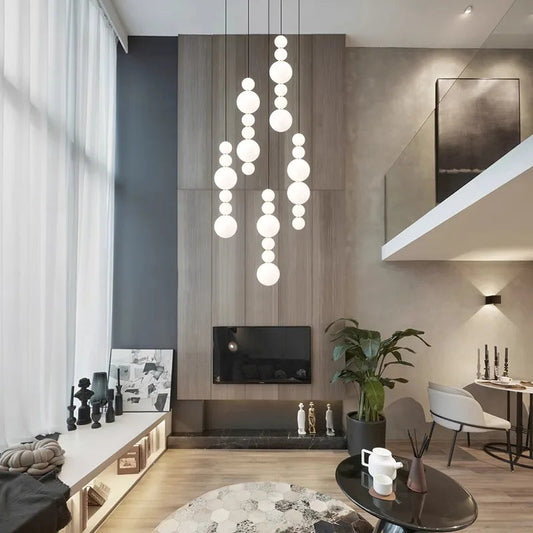
Here's a beautiful chandelier option that works well for staircases:
Check the Luminance Level
How much light does your staircase chandelier emit? This is an essential aspect to consider especially if you've not incorporated layered lighting in this area. As a primary light source, the chandelier will need to hang lower for illumination. However, if there are other light fixtures in the space, it can be hung higher making for a stunning décor centerpiece for your staircase.
When you implement layered lighting with wall sconces, step lighting, or recessed fixtures, your chandelier can be hung at a height that prioritizes aesthetics while supplementary fixtures handle functional task lighting. This flexibility allows the chandelier to serve as a focal point without bearing sole responsibility for illumination.
Creating effective stairway illumination involves more than just chandelier placement—it requires a comprehensive lighting strategy.
Cleaning and Maintenance
You need to consider how often your chandelier will need cleaning when deciding on the positioning. The height of the light fixture should allow for easy maintenance. Remember, it's essential to its longevity. Intricate designs like crystals and ornate arms also require more effort. Hanging your staircase chandelier at optimal height will make the cleaning process quick and easy.
For installations at 9 feet or higher, you may need an electrician or professional service for maintenance. Factor this into your decision when determining the final hanging height.
For more detailed advice on keeping your chandelier in pristine condition, check out our guide on how to clean and maintain your staircase chandelier.
Optimal Height for Hanging Chandeliers Over a Stair Landing
The ideal spot to hang your lights in a stairwell is above your staircase landing. This is the area where two stairs merge before changing direction. The staircase landing is typically darker than other areas of the room making it a good spot for installing the light fixture. But, it also provides enough room to accommodate the staircase chandelier.
Interior design experts recommend placing your chandelier at least two feet above your stair landing. However, you should only hang your light fixture over your staircase landing if the ceiling height above it is at least 9 feet high.
Ideal Chandelier Height for Over the Stair Landing
The ideal chandelier length over the staircase landing should have a length of at least 24 inches but no more than 30 to 36 inches for standard ceiling heights. Ensuring that the space between the stair landing and your light fixture provides enough room to prevent obstruction. Homeowners whose houses have lower ceilings should opt for other light source options like flush mounts due to the limited space.
The Right Chandelier Size for Your Stair Landing
When choosing the proper chandelier size for your staircase landing, you should consider your ceiling height and the width of the area. Be aware that for optimal height placement, ceiling measurements are taken from the landing and not the floor. This ensures you maintain at least 7 feet of clearance for safe passage.
Chandelier Style and Height Recommendations
| Chandelier Style | Minimum Ceiling Height | Recommended Clearance | Best For |
|---|---|---|---|
| Traditional Tiered | 12 feet | 7-8 feet from floor | Grand staircases, formal homes |
| Modern Geometric | 9 feet | 7 feet from floor | Contemporary designs, standard height ceilings |
| Linear/Horizontal | 9 feet | 7 feet from floor | Narrow staircases, modern aesthetics |
| Cascade/Waterfall | 14+ feet | 8-9 feet from floor | Two-story foyers, dramatic spaces |
| Crystal Chandelier | 10+ feet | 7-8 feet from floor | Elegant traditional homes |
| Flush/Semi-Flush | 8 feet | Mounted to ceiling | Low ceilings, compact spaces |
Do's and Don'ts for Hanging Your Staircase Chandelier
The main function of your light fixture is to provide lighting while serving as a focal point. For optimum illumination, you need to place the chandelier at optimal height. Here are some things you shouldn't do when hanging your staircase chandelier:
Turn off power, use special mounting bracket, connect wires carefully, ensure it's level.
- If your staircase is two levels high, your chandelier shouldn't hang below the standard ceiling height. This means that it shouldn't go lower than the second floor.
- For singular staircase levels, your chandelier should hang at least seven feet above the floor. This is primarily done to avoid obstructions that can pose safety risks. You don't want your guests hitting the light fixture as they move up and down the stairs.
- Don't hang the chandelier away from the center if the staircase goes above more than two levels. It should be strategically placed vertically against the window to allow for more natural light. This helps to create a warm and inviting ambiance in the home.
- Go for multi-tiered chandeliers if the staircase covers multiple floors. This helps you achieve balanced and uniform illumination throughout the space while adding elegance appropriate for the scale.
- Measure the height carefully before installing the light fixture. Measure from the landing or floor to the ceiling, then calculate where the bottom of the fixture will hang to ensure you meet the 84 inches minimum clearance requirement.
- Consider consulting an electrician for complex installations, especially in two-story staircases or when adjusting hanging height requires electrical modifications.
If installation sounds complicated, don't hesitate to call a professional. Installing a chandelier can be tricky, especially on a vaulted ceiling. Professional electricians have the tools and experience to handle complex installations safely and efficiently.
When to Hire an Electrician
While some lighting projects are DIY-friendly, staircase installations often require professional expertise. Consider hiring an electrician when:
- Installing a chandelier in a two-story or vaulted ceiling stairwell
- The fixture weighs more than 50 pounds
- The ceiling height exceeds 12 feet (making ladder work dangerous)
- You're replacing an existing fixture with one of significantly different size
- Local codes require professional installation for stairway lighting
An electrician can advise on proper electrical box support and help you achieve the exact hanging height while meeting safety standards.
Match Your Chandelier Height Placement for the Perfect Ambiance
Most homeowners tend to overlook the need for staircase lighting. But it's an essential décor element for every space. Understandably, determining the optimal height for installation can be challenging. But, it's doable. Properly hanging your staircase chandelier involves more than just measurements.
You'll need to take into account other factors like style, the design of the chandelier, and luminance levels. Understanding how height to hang a chandelier affects both form and function ensures you create a space that's both beautiful and practical. This will ensure that you not only hang the staircase chandelier at an optimal height but also strike an excellent balance between aesthetics and practicality.
The same principles that guide chandelier placement in dining rooms, proper proportion, adequate clearance, and consideration of the room's purpose, apply to staircases, though safety becomes even more paramount.
Beyond technical measurements, consider how chandelier placement affects energy flow and balance in your home. Explore the principles of feng shui and staircase chandeliers to create harmonious spaces that align with traditional design philosophies while maintaining functional lighting.
Want more ideas for your staircase lighting? Check out our blog for inspiration. From modern designs to classic styles, you'll find plenty of options to make your home's interior look amazing.
Key Points for Staircase Chandeliers
- Maintain at least 7 feet of clearance between floor and chandelier bottom
- Use the 2.5-inch per foot formula for chandelier height selection
- Add staircase length and width (in feet) to determine chandelier diameter (in inches)
- Position chandelier 2 feet above stair landing when applicable
- Consider layered lighting for flexibility in chandelier placement
- Factor in maintenance accessibility when determining height
- Hire professionals for complex installations and high ceiling work
Frequently Asked Questions
Q: What is the standard height to hang a chandelier in a stairwell?
The standard height requires at least 7 feet (84 inches) of clearance between the floor and the bottom of the chandelier. For stair landings, the chandelier should hang at least 2 feet above the landing surface. The exact height to hang depends on your ceiling height—use the formula of 2.5 inches of chandelier length for every foot of ceiling height.
Q: Can I use the same chandelier height guidelines from my dining room for my staircase?
While the general rule of thumb for chandelier sizing applies to both spaces, staircases require stricter safety considerations. In a dining room, you can hang a chandelier as low as 30-36 inches above the table. In staircases, you must maintain at least 7 feet of clearance from the floor regardless of other factors.
Q: How do I determine chandelier size for a two-story staircase?
Add the length and width of your stairway (measured in feet) to determine the chandelier diameter in inches. The chandelier's height should correspond to your ceiling height using the 2.5-inch per foot formula. The bottom of the fixture should not hang below your second-floor ceiling level.
Q: Should I hang my chandelier lower for better lighting or higher for aesthetics?
This depends on whether you've incorporated layered lighting. If your chandelier is the sole light source, hang it lower within safe parameters (at the 7-foot clearance minimum) for better illumination. If you have supplementary lighting like wall sconces or step lights, you can hang the chandelier higher to prioritize its role as a decorative focal point in the room.
Q: What's the best chandelier style for vaulted ceilings?
For vaulted or vault ceilings, choose chandeliers with vertical drama—cascade styles, multi-tiered designs, or elongated fixtures that fill the vertical space proportionally. Measure your ceiling height at its lowest accessible point to ensure 7 feet of clearance. Adjustable chain-hung fixtures work best for flexibility.
Q: Do I need an electrician to adjust the hanging height of my existing chandelier?
For minor adjustments using existing chain or rod links, a confident DIYer can manage the task. However, if you need to relocate the electrical box, install a longer downrod, or work with a fixture in a hard-to-reach location, hiring an electrician is recommended for safety.


