

Key Takeaways
| Question | Answer |
|---|---|
| How high? | 7 ft to the lowest point in any walkway; 8 ft ceiling → fixture ≤ 12–14 in tall; 9 ft → bottom at 7–7½ ft; vaulted → 7 ft at the lowest point, body rises. |
| How big? | Room L + W (ft) in inches, and 6–12 in narrower than the seating zone; +2–3 in per foot of ceiling over 12 ft. |
| Coffee table or seating group? | Seating group in open plans; coffee table in a traditional rectangle with a round or square table. |
| Off-center box? | Move it for a long-term focal fixture; swag on a chain to a ceiling hook where the ceiling cannot be opened. |
| High ceilings? | Two-tier or double wheels, tiered wrought iron, tall branch forms — 40–100 lb, rated box on structure. |
| Light and finish? | 10–20 lm/sq ft, 2700–3000K, dimmer, lamps + wall lights; black or bronze on white and wood walls, muted metal on greige. |
Quick Facts
- Clearance: 7 ft in walkways; 6 ft 8 in is the floor over a seating group nobody walks through.
- 8 ft ceiling: 12 in available from ceiling to clearance line — low-profile, flush, or semi-flush rustic fixtures only.
- Sizing: 14 × 16 ft → 30 in; 16 × 20 ft → 36 in; 18 × 24 ft → 42 in (36–48 in range for a large seating layout).
- Seating-zone rule: fixture width ≤ narrower side of the sofa-and-chairs rectangle minus 6–12 in.
- Output: 10–20 lm/sq ft ambient — 14 × 16 ft → 2,200–4,500 lm; 6 candle sockets ≈ 3,000 lm; 12 ≈ 6,000 lm.
- Weight: single wheels and branches 20–40 lb (standard box); two-tier wheels and 12-light iron 40–100 lb (fan-rated box or brace bar).
Sizing a Rustic Chandelier to the Room and the Seating Zone
Start with the room formula — length plus width in feet, as inches — and then check it against the furniture, because a living room chandelier hangs over a seating group, not a table. A 14 by 16 foot room takes about 30 inches, a 16 by 20 foot room 36, an 18 by 24 foot room 42, with 36 to 48 inches the working range for a large layout. The seating check: draw the rectangle around the sofa, chairs, and coffee table, and keep the fixture 6 to 12 inches narrower than the rectangle's narrower side so it does not crowd the furniture beneath it. Open forms — branches, wheels, cages — can sit at the top of the range because they do not block sightlines; dense tiered forms sit at the middle. The full method, with dining and foyer variants, is in the chandelier sizing guide; the rustic forms themselves are compared in unique rustic chandeliers.
| Living room | Diameter by formula | Rustic forms that fit | Ceiling needed |
|---|---|---|---|
| Small, 10–12 ft wide (e.g., 11 × 13 ft) | 22–26 in | Compact wagon wheel 24–30 in, round rustic chandelier, rustic bell-jar or cage | 8 ft with a low-profile design |
| Medium, 12–16 ft wide (e.g., 14 × 16 ft) | 28–32 in | Single wagon wheel 30–36 in, branch chandelier, 6–9 light iron | 9 ft |
| Large, 16–22 ft wide (e.g., 18 × 24 ft) | 36–48 in | Two-tier wheel 40–48 in, 12-light tiered iron, large branch | 10 ft and up |
| Vaulted or double-height (e.g., 18 × 24 ft, 16–20 ft ceiling) | 42–56 in with height | Two-tier or double wheel, tiered iron, tall farmhouse or branch form | 12 ft and up; rated mount |
Clearance and Placement: The Rules on One Diagram
8-Foot, 9-Foot, and Vaulted Ceilings
8-foot ceilings: low-profile rustic
An 8-foot ceiling leaves 12 inches between the ceiling and the 7-foot clearance line, so the whole fixture — canopy, stem, body — has to fit in that band in any walkway. That means a flush or semi-flush rustic fixture, a compact wagon wheel of 24 to 30 inches, a round rustic chandelier under 14 inches tall, or a short branch form. Open, airy shapes and clear glass keep the ceiling from feeling lower, and placement matters as much as height: hang the fixture over the sofa-and-coffee-table zone, offset from the circulation path, so the headroom is where people move; over the seating zone itself, 6 feet 8 inches is the practical minimum. Low-ceiling rustic options are in the flush mount chandeliers collection and in flush mount chandeliers for low ceilings.
9-foot ceilings: the full rustic form
Nine feet is the height most rustic fixtures were designed for: 24 inches of room lets a wagon wheel of 30 to 40 inches or a branch chandelier hang with its bottom at 7 to 7½ feet, present over the seating group without cutting the sightline to a window, artwork, or the TV wall. Use a chain or an adjustable rod and set the final drop after the sofa, rug, and coffee table are in, because a thick rug or a tall sofa back changes how the height reads. Warm black metal and mixed wood-and-iron finishes are the usual choice here, and the finish decision for branch forms specifically is in choosing the color and material for a branch chandelier.
Vaulted and double-height ceilings: large rustic chandeliers
From 12 feet up, the problem inverts: clearance is easy and scale is hard. A single-tier fixture sized by the room formula floats near the ceiling and looks small from the sofa, so the fixture needs height as well as width — a two-tier or double wagon wheel of 40 to 48 inches, a tiered wrought iron chandelier with 12 or more lights, or a tall branch or farmhouse staircase-style form whose body bridges the distance from the ceiling toward the seating. Add 2 to 3 inches of diameter per foot of ceiling over 12, keep the lowest point at 7 feet, and let the rest rise; in a room with tall windows or a stone fireplace wall, aligning a tier with the upper third of the glazing or the chimney breast ties the fixture to the architecture and reads from outside at night. If the living room opens to a stair or an upper landing, the fixture is seen from above too, so a form that looks finished from the top — a wheel, not a flat cage — is the right one; the stairwell versions are in farmhouse chandeliers for staircases. These fixtures weigh 40 to 100 pounds and need a ceiling box rated for the load on a joist or brace bar, and a lift or scaffold to hang; the mounting is covered in installing chandeliers on high ceilings.
Coffee Table or Seating Group: Where to Center
Center over the seating group when the sofa and chairs float in an open plan or sit away from the walls: draw a rectangle around the sofa, chairs, and coffee table and put the fixture in its middle, so the light is balanced from every seat and the chandelier defines the living zone inside a larger floor. Center over the coffee table when the room is a traditional rectangle with a table that truly anchors the arrangement — a round or square table under a wagon wheel makes the geometry read as intended. In both cases center on the furniture, not the architectural center of the room, because the room is used at the sofa, not at the walls.
When the ceiling box is not where that puts the fixture — common in older houses and in rooms rearranged since they were wired — there are two answers. For a chandelier that will be the room's focal point for years, move the box to the furniture centerline; in an accessible ceiling it is an electrician's half-day. Where the ceiling cannot be opened, swag: hang the fixture from the existing box on a chain long enough to reach the new center, with a ceiling hook at that point. On a chain-hung rustic fixture the swag reads as part of the design rather than a compromise.
Quick decision: rustic chandelier in a living room
8 ft ceiling: low-profile round, compact wheel, or flush rustic; over the seating zone, off the walkway • 9 ft ceiling: wheel 30–40 in or branch, bottom at 7–7½ ft, on a chain • 12 ft+ or vaulted: two-tier wheel, 12-light tiered iron, or tall branch, 7 ft at the lowest point, rated mount • Open plan: center in the seating rectangle • Traditional room, round table: center on the coffee table • Box off-center: move or swag • Always: L + W in inches, 6–12 in narrower than the seating zone, 2700–3000K on a dimmer, lamps + wall lights.
Layering: Chandelier, Lamps, and Wall Lights
A living room chandelier is the ambient layer, not the only one. Plan it for 10 to 20 lumens per square foot — 2,200 to 4,500 lumens in a 14 by 16 foot room, which six candle sockets at about 500 lumens or a 12-light iron fixture at twice that delivers — with dimmable LED bulbs at 2700–3000K and a dimmer so it runs full for cleaning and low for the evening. Multi-bulb rustic fixtures spread that light more evenly over a seating group than a single source would. Floor and table lamps beside the sofa and chairs add the task layer for reading and keep the room's edges lit when the chandelier is dimmed; match their bases or shades to the fixture — black metal with iron, linen with wood. Wall lights on a dimmer add the accent layer on a fireplace, shelving, or a textured wall and double as a second ambient setting when the chandelier is too much. The room-by-room targets are in how much light does my room need; the whole-home rustic palette in rustic lighting ideas; supporting fixtures in the floor lamps, table lamps, and wall lights collections.
Finish by Wall Color
| Walls | Rustic finish that works | Why | Avoid |
|---|---|---|---|
| White or off-white | Black wrought iron, dark bronze; wood with clear glass for airy farmhouse | Dark metal gives a clear silhouette and grounds a bright palette | Pale or brushed metals that wash out |
| Greige and warm neutrals | Warm black, brushed or muted metal, lighter wood | Texture without a hard break against a soft wall | High-contrast distressed black; chrome |
| Wood walls, beams, wood ceiling | Black or dark bronze; or a wood wheel with black hardware and clear glass | Dark metal keeps the fixture from disappearing; wood wheel reads tone-on-tone | Mid-tone wood that matches the walls exactly |
| Stone fireplace wall | Wrought iron, oil-rubbed bronze | Iron and stone share weight and age | Polished gold |
Whatever the wall, repeat the fixture's metal once elsewhere — lamp bases, the fireplace tools, door hardware — and keep every light source in the room at the same color temperature. Rustic chandeliers over clean-lined modern furniture work by the same rule: one shared element, one metal, and the blend is covered in modern rustic chandeliers.
Rustic Living Room Chandeliers by Ceiling Height
Nine fixtures, grouped by the ceiling they are built for.
8-foot ceilings

The Neva Round Rustic Chandelier is the 8-foot-ceiling rustic fixture: a metal round of about 24 inches that keeps the 7-foot line in a small or medium living room and spreads light evenly over a seating group. Its simple ring softens a room of straight lines and pairs with black or bronze hardware.

The Ivy Rustic Wagon Wheel Chandelier — a wood rim with iron straps, about 39 inches across — is the wheel for a 9-foot living room centered over a round or square coffee table, and on a short chain it also fits an 8-foot ceiling over a seating zone nobody walks through. Its hollow wood rim keeps it in standard-box range.
9-foot ceilings

The Madelyn Rustic Branch Chandelier is the branch form for a 9-foot living room where the limbs can spread over a floating seating group, in frosted glass for softer light or clear for a brighter, more modern read. Hang the lowest sphere at 7 feet and let the branches rise toward the ceiling.
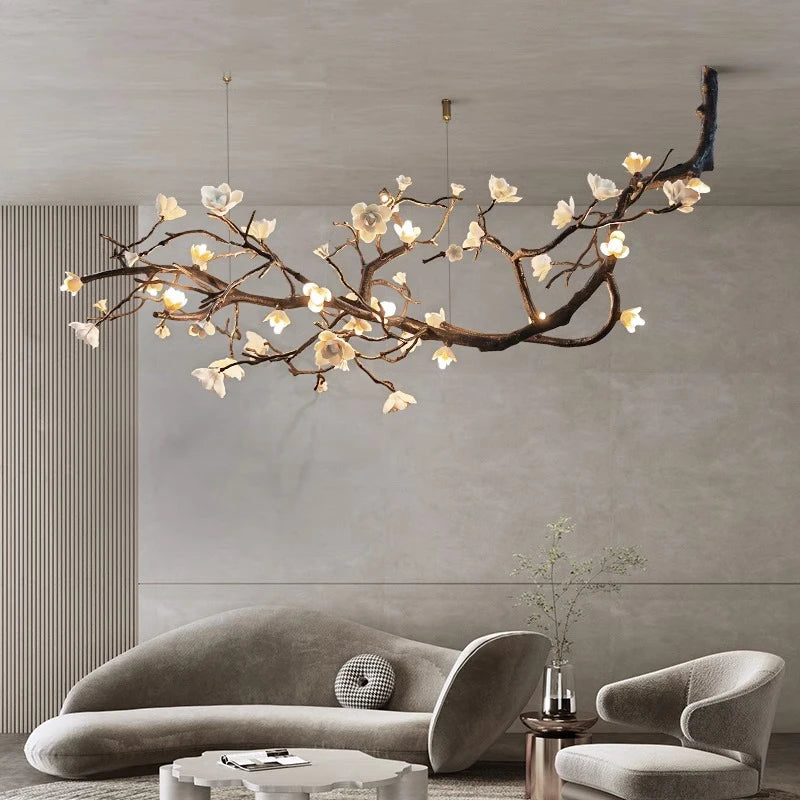
The Minas Dimmable Rustic Tree Branch Chandelier, dimmable from a remote or phone and in several sizes and finishes, is the branch for a living room that changes use through the day — full for daytime, low for evenings — with no wall dimmer to match. Centered over the seating rectangle on a 9-foot ceiling or higher, its black finish suits greige walls and black hardware.
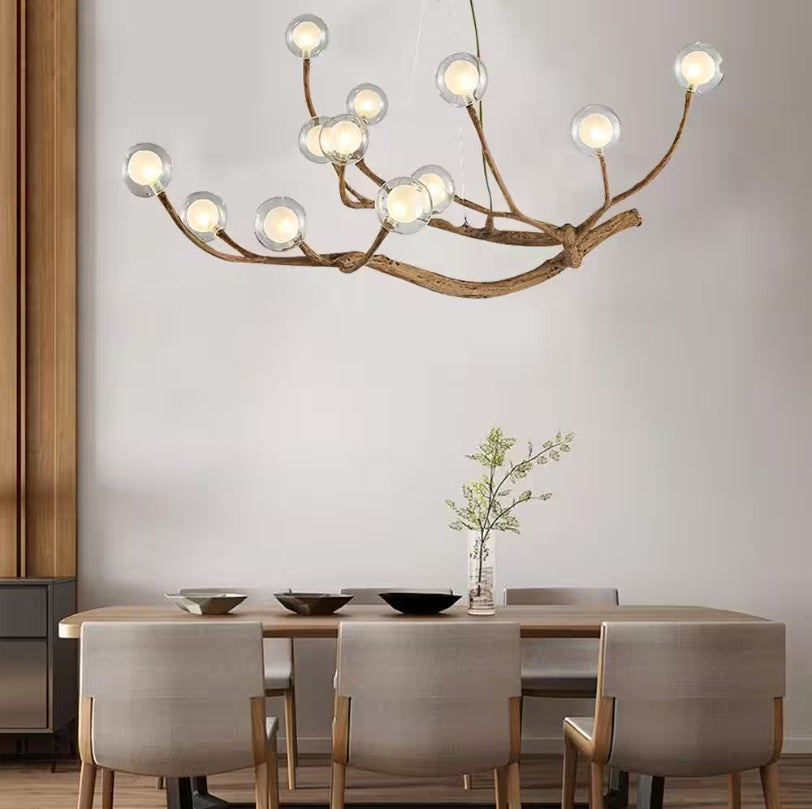
The Appa Rustic Tree Branch Chandelier is the branch with small points of light rather than globes — a sculptural, transitional fixture for a living room with wood furniture and clean upholstery, on a standard dimmer with dimmable bulbs, at 9 feet and up.

The Rustic Wrought Iron Chandeliers 12 Lights, about 44 inches across in black or gold, is the large rustic chandelier for a 16 by 20 foot living room on a 10-foot ceiling or a vaulted one — twelve sockets give roughly 6,000 lumens, enough to light a large room on its own, and the tiered iron form has height as well as width. Its weight calls for a fan-rated box or a brace bar.
Vaulted and double-height ceilings
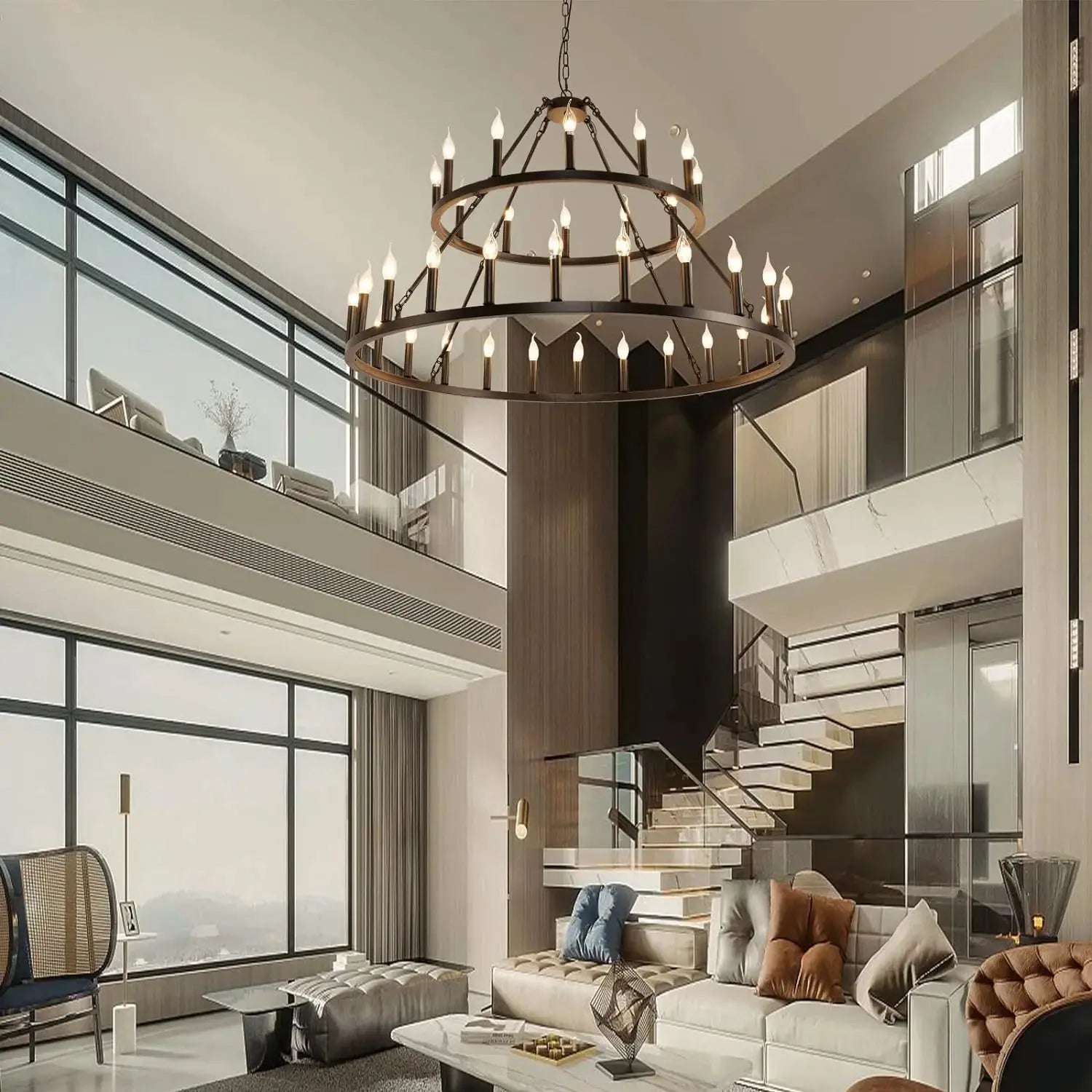
The Rustic 48-inch 2 Tier Wagon Wheel Chandelier is the large rustic chandelier for high ceilings: two metal tiers, 48 inches across, with the height to match a tall stone fireplace wall in an 18 by 24 foot vaulted living room. Align the upper tier with the top third of the windows, keep the lower tier at 7 feet, and plan a two-person, rated-mount installation.

The Binna Double Wagon Wheel Chandelier in matte black is the double wheel with the cleaner, current finish — the answer to whether wagon wheels are still in style — for a double-height living room with black window frames and a clean-lined sectional. It reads finished from an upper landing as well as the floor.
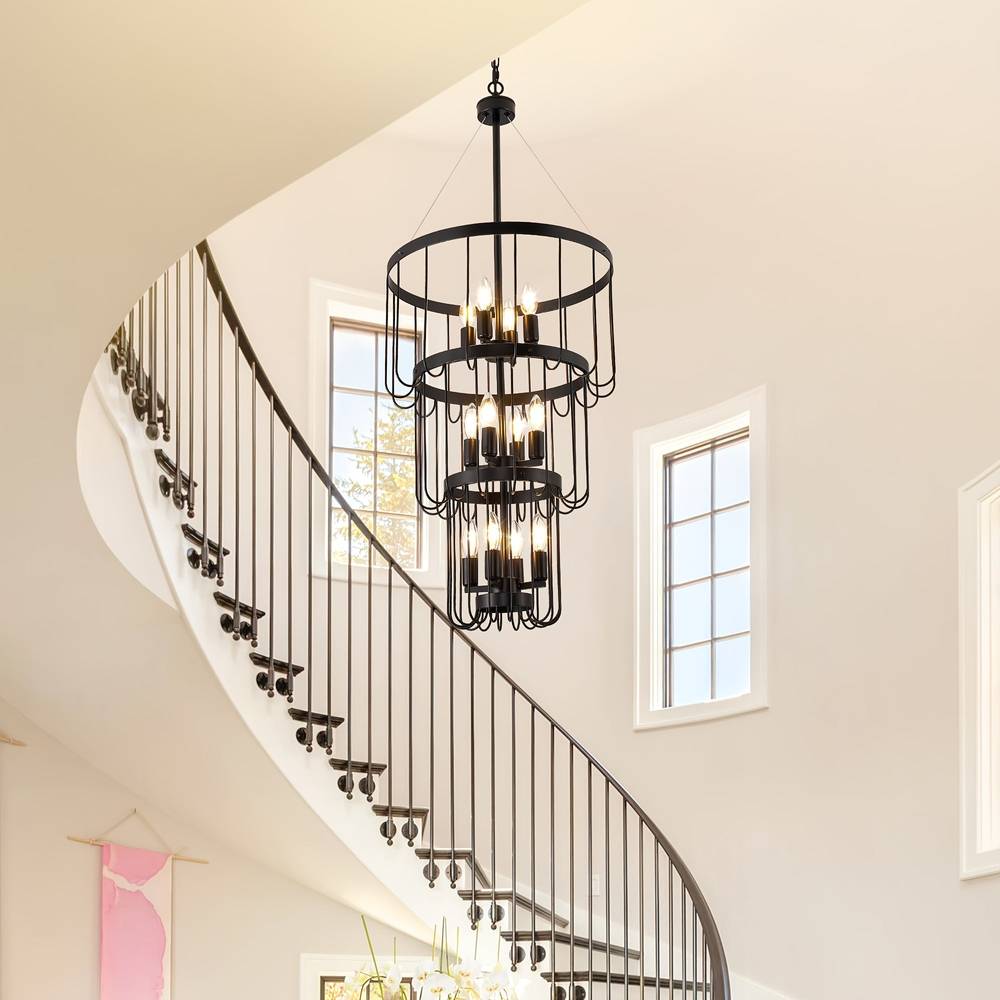
The 12-Light Farmhouse Staircase Chandelier is the tall form: a vertical farmhouse composition built for stairwells that also fills a double-height living room where a wheel would need more width than the seating zone allows. Its height bridges the ceiling and the sofa, and its black finish pairs with the room's hardware.
Low-profile rounds, wagon wheels, branches, and two-tier fixtures for 8-foot to double-height ceilings.
Rustic Chandeliers Living Room Lighting Branch Chandeliers Huge Chandeliers
Checklist: From Measuring to Dimming
- Measure the room's length, width, and ceiling height, and mark the walkways on a sketch.
- Draw the seating rectangle — sofa, chairs, coffee table — and decide: center on the rectangle (open plan) or on the coffee table (traditional room).
- Size: length plus width in inches, then 6 to 12 inches narrower than the rectangle's short side; add 2 to 3 inches per foot of ceiling over 12 feet.
- Check the drop: 7 feet at the lowest point in any walkway; fixture under 14 inches tall on an 8-foot ceiling.
- Check the box: move or swag if it is off the furniture center; fan-rated box or brace bar for anything over 50 pounds.
- Plan two supporting layers — lamps and wall lights — and put the chandelier on a dimmer.
- Choose the finish by wall color and repeat its metal once in the room; use dimmable LED bulbs at 2700–3000K.
Frequently Asked Questions
How high should a rustic chandelier hang in a living room?
At least 7 feet from the floor to the lowest point wherever people walk under it. On an 8-foot ceiling that leaves 12 inches for the whole fixture, so use a flush or low-profile design; on a 9-foot ceiling the bottom can sit between 7 and 7½ feet; on vaulted and double-height ceilings keep the 7-foot minimum at the lowest point and let the body rise into the volume. Over a seating group nobody walks through, 6 feet 8 inches is the practical floor, but 7 feet is safer with tall guests.
What size rustic chandelier do I need for my living room?
Add the room's length and width in feet and use that number in inches as the diameter: a 14 by 16 foot living room takes about 30 inches, an 18 by 24 foot room 42 inches. Then check the seating zone — the fixture should be 6 to 12 inches narrower than the narrower side of the sofa-and-chairs rectangle so it does not crowd the furniture. For ceilings over 12 feet, add 2 to 3 inches per extra foot and choose a fixture with height as well as width.
Should the chandelier be centered over the coffee table or the seating group?
Over the seating group in an open plan or wherever the sofa and chairs float away from the walls: draw a rectangle around the sofa, chairs, and coffee table and center the fixture in it. Over the coffee table in a traditional rectangular room where the table anchors the arrangement, especially a round or square table under a wagon wheel. Center on the furniture, not the architectural center of the room, because that is where the room is used.
What if the ceiling box is not where the chandelier should hang?
Move it, or swag. For a fixture that will be the room's focal point for years, relocating the box to the furniture centerline is the cleaner solution and an electrician's half-day job in an accessible ceiling. Where the ceiling cannot be opened, hang the fixture from the existing box with a chain long enough to reach the new center and a ceiling hook at that point — a common rustic detail that reads as intended with chain-hung fixtures.
What rustic chandelier suits an 8-foot living room ceiling?
A fixture 10 to 14 inches tall or less, so the bottom stays near 7 feet: a low-profile round rustic chandelier, a compact wagon wheel of 24 to 30 inches, a flush or semi-flush rustic cage, or a short branch form. Open, airy shapes and clear glass keep the ceiling from feeling lower; place the fixture over the seating zone rather than the walkway so the headroom is where people move.
Which rustic chandeliers work for high ceilings and large living rooms?
Fixtures with height as well as width: two-tier and double wagon wheels of 40 to 48 inches, tiered wrought iron chandeliers with 12 or more lights, and tall branch or farmhouse staircase-style fixtures. From 12 feet up, a single-tier fixture floats and looks small; a stacked form bridges the distance from ceiling to seating and can align a tier with the upper third of tall windows or the fireplace wall. These fixtures weigh 40 to 100 pounds and need a rated ceiling box on structure and a lift or scaffold to install.
Are wagon wheel chandeliers out of style?
The distressed version is; the form is not. A heavily weathered wheel with faux candles reads as a decade-old farmhouse look, but a clean wood rim with black straps, or a matte black metal wheel with clear globes, is the current rustic living room fixture — it pairs with black hardware and clean-lined furniture and scales to two-tier versions for tall rooms. Choose the simpler finish and the wheel stays in style.
How bright should a living room chandelier be?
10 to 20 lumens per square foot for ambient light — a 14 by 16 foot room needs 2,200 to 4,500 lumens — with lamps and wall lights adding the task and accent layers. Multi-bulb rustic fixtures spread light more evenly than a single source; use dimmable LED bulbs at 2700K to 3000K and a dimmer, so the fixture can run full for cleaning and low for evenings.
Which rustic finish works with white, greige, or wood walls?
Black wrought iron or dark bronze against white walls, for a clear silhouette; brushed or muted metals and lighter wood against greige, so the fixture adds texture without a hard break; black or dark bronze against wood walls and beams, so the fixture does not disappear, or a wood wheel with black hardware and clear glass for a tone-on-tone room. In every case, repeat the fixture's metal once elsewhere in the room.
Can a rustic chandelier work with modern living room furniture?
Yes. Repeat one element between them — the color, the metal, or the line weight — and keep the light at 2700–3000K. A sectional on slim black legs pairs with a black wagon wheel or a black branch chandelier; a wood-and-linen room pairs with a wood wheel. The rustic-modern blend has its own guide, but the short rule is one metal, two materials, a simple finish.
Placing a Rustic Chandelier in Your Living Room
Measure the ceiling before the room, draw the seating rectangle before the diameter, and decide where people walk before you decide how low the fixture hangs. A rustic chandelier placed in that order reads as the room's center rather than an object on its ceiling — and on a tall ceiling, the right fixture is the one with height, not just width.
Browse wheels, branches, and tiered iron in the rustic chandeliers collection and the largest of them in huge chandeliers. For the forms compared, read unique rustic chandeliers; for iron against wood, rustic wood vs wrought iron chandeliers; for the whole-home palette, rustic lighting ideas.


