

A black dining room light does one thing no other finish does: it draws the outline of the dining zone. Whether that outline reads as tailored or heavy comes down to three decisions — whether black suits the room, which black to choose, and what to pair it with — and this guide covers all three, with the sizing and height rules kept to a paragraph and linked out.
Key Takeaways
| Question | Short answer |
|---|---|
| When does a black dining room light work? | Light rooms that need an anchor, modern or transitional rooms with black accents to echo, and open plans where the dining zone needs definition. |
| Which black should I choose? | Matte black for versatility; black and gold with brass or warm palettes; black and wood for rustic rooms; black crystal for modern sparkle. |
| How do I keep it from feeling heavy? | Open frame, correct size, warm light, and black repeated in at least two other elements. |
| Can I mix black with other metals? | Yes — black plus up to two metals. Black and brass is the standard pairing. |
| Warm or cool bulbs? | Warm white, 2700–3000K, frosted or filament LED, on a dimmer. |
| What size and height? | Standard dining rules: one-half to two-thirds of table width; 30–36 in above the table on an 8 ft ceiling. Stay mid-range in size — black reads heavier. |
Quick Facts
- Black reads as an outline, not a metal, which is why it mixes with brass, nickel, and wood more easily than any other finish.
- Matte and satin black hide dust and prints; glossy black shows them in daylight.
- Rule of three: the fixture plus two other black elements in the room.
- Black plus two metals is the limit; a third metal makes the room look accidental.
- Warm light (2700–3000K) softens black; 4000K hardens it.
- Size and height follow the standard dining rules; favor open forms and mid-range sizes because black looks heavier.
When Is Black the Right Choice for a Dining Room Light?
Black fixtures earn their place in three kinds of dining rooms. The first is the light, airy room — pale walls, light floors, a light table — that has no focal point over the table; a black chandelier gives it one without adding another color. The second is the modern or transitional room that already carries black somewhere: window mullions, cabinet pulls, chair legs, a stair rail visible from the table. A black fixture joins that group and the room looks planned. The third is the open-plan house, where the black outline over the table marks where dining happens without a wall.

The usual worry is that a dark fixture will make the room feel smaller or gloomy. In practice a well-chosen black fixture does the opposite: the frame recedes and the glow of the bulbs or glass becomes what the eye lands on. The Pearl Black Glass Grape Chandelier shows the mechanism — a black structure that mostly disappears behind a cluster of lit glass spheres, so the fixture reads as light, not as a black object.
When black is the wrong choice
Black fails in two settings. A room that is already dark — charcoal walls, a dark ceiling, dark wood table and chairs — has nothing for a black fixture to contrast with, and the fixture disappears into the gloom; brass, glass, or white is the better anchor there. And a room where the fixture would be the only black thing in sight tends to look like an afterthought; either add two more black elements (the next sections cover how) or choose a finish the room already has.
Which Black? Matte, Black and Gold, Black and Wood, Black Crystal
"Black dining room lights" covers four distinct finishes, and the choice between them matters more than the choice of shape.
Matte black

Matte black is the default for a reason. It reads as a drawn line rather than a metal, so it sits with brass, nickel, chrome, or wood without competing; it hides fingerprints and dust; and it works in cool and warm palettes alike. It suits modern and Scandinavian dining rooms, rooms with black window frames or hardware, and any room where the fixture should be quiet and graphic. The Qyra Contemporary Circular LED Chandelier is matte black at its simplest — black rings carrying integrated LED, an outline of light over a round or square table.
Black and gold
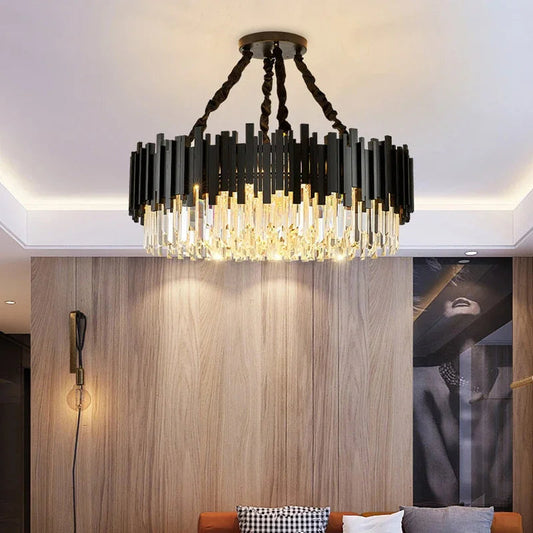
Black and gold adds brass or gold sockets, rings, or inner surfaces to a black frame. The gold warms the fixture and gives it something to talk to — brass cabinet pulls, a gold-framed mirror, a warm oak table — without committing the room to an all-gold piece. It is the finish for transitional dining rooms and for any room whose palette leans warm. The Zen Modern Round Black and Gold Crystal Chandelier combines it with crystal: a black ring, gold inner detail, and crystal drops, which covers black and gold and black crystal in one fixture. The brass dining room chandeliers guide covers the brass side of the pairing.
Black and wood

For farmhouse, rustic, and modern-rustic dining rooms, black metal with wood — a wood beam, wood arms, or a wood-toned shade — gives the definition of black with the warmth of the table. The wood in the fixture does not need to match the table; it needs to sit in the same tone family, warm with warm and gray-washed with gray-washed. Organic black forms do the same job without literal wood: the Orgi Statement Linear Branch Chandelier runs black branches along a line for a rectangular farmhouse table, reading as natural rather than industrial. See the farmhouse chandeliers guide for the wider style.
Black crystal

Black crystal is the way to have sparkle in a dining room that isn't traditional. The black frame keeps the fixture modern; the crystal scatters warm light across the table and ceiling and needs fewer lumens than an opaque shade to feel bright. It suits transitional and modern-glam rooms and open plans with black accents, and it looks out of place only in rustic or ornate traditional rooms. The Lux Linear Dining Room Chandelier is the rectangular-table version — a black linear frame with crystal drops, proportioned to a long table. The black crystal chandeliers guide covers when they work best room by room.
| Finish | Reads as | Best dining rooms | Pair with | Care |
|---|---|---|---|---|
| Matte black | Graphic outline | Modern, Scandinavian, rooms with black hardware or windows | Any metal; light or dark wood | Hides dust and prints |
| Satin / gloss black | Slightly reflective | Glam, formal modern | Brass, chrome | Gloss shows dust in daylight |
| Black and gold | Warm, tailored | Transitional, warm palettes, brass hardware | Brass, warm wood, gold mirror | Wipe gold accents gently |
| Black and wood | Grounded, rustic | Farmhouse, modern rustic, cabin | Wood tables, linen, iron | Dust wood; no wet cleaning |
| Black crystal | Modern sparkle | Transitional, modern glam, open plan | Brass or nickel; glass | Crystal wiped with damp cloth |
Black Fixture Types by Dining Layout
Shape is decided by the table, not the finish, and the full shape rules live in the linear vs round black chandelier guide. In brief: a round or square table takes a round black chandelier, ring, or globe cluster; a rectangular table takes a black linear chandelier or a row of two or three black pendants; a low ceiling takes a black semi-flush or a short-drop ring; and a dining area inside a kitchen or open plan usually reads best with a linear piece that keeps sightlines open. Black has one shape rule of its own: because a dark frame looks heavier than a light one, favor open forms — arms, rings, globes on a slim structure — over solid drums and domes, especially in rooms under 12 by 12 feet.

The Modern Trendy Dining Room Lighting is the open-plan type: a slim black linear fixture that defines the table below it while staying thin enough to look through toward the kitchen or living area. Rectangular black fixtures of this kind are collected under rectangular chandeliers.
Pairing Black With the Table, Chairs, Walls, and Other Metals
A black fixture looks intentional when it has company and looks isolated when it doesn't. Four pairing rules cover most rooms.
| Room element | Rule for a black fixture |
|---|---|
| Other black elements | Rule of three: the fixture plus at least two more — chair legs or bases, window mullions, a curtain rod, cabinet pulls, a picture frame, a lamp base. Small items count. |
| Table | Light table (oak, ash, white, marble): black is the anchor — any of the four finishes. Dark table (walnut, espresso, black): open-frame or glass fixture, black and gold or black and wood to bridge, lighter rug and chairs to balance. |
| Chairs | Black chair legs or frames are the easiest second black element. Upholstered chairs in a light fabric keep a black-fixture-plus-dark-table room from going heavy. |
| Walls and ceiling | Light walls make black read crisp. Dark walls need a fixture with glass, crystal, or gold so it separates from the wall. Keep the ceiling lighter than the walls in either case. |
| Other metals | Black plus up to two metals. Black and brass is the standard pairing; black and nickel or chrome suits cooler modern rooms. Repeat whichever metal you keep in at least one more place. |
| Adjacent rooms | In an open plan, kitchen pendants and living room lights don't need to match the dining fixture, but should share black or the same accent metal so the three read as one scheme. |

Daylight is worth a check before committing to a glossy black. Direct sun through a dining window shows dust on high-gloss surfaces and can throw a hard reflection off them; matte and satin black look the same at noon and at dinner. If the room gets strong afternoon sun on the fixture, choose matte, or add a sheer to soften the light on both the table and the fixture.
Light Quality for Black Fixtures
Black frames light differently from polished metal: the frame absorbs rather than reflects, so the bulbs and glass do all the visible work, and their color and glare matter more. Three settings follow from that. Warm white, 2700K to 3000K, softens the contrast between the dark frame and the lit elements, flatters food and faces, and keeps gold accents from turning cold; 4000K makes a black fixture look harsh and the room feel like an office. Frosted, opal, or filament-style LED bulbs in open-socket black fixtures keep bare-bulb glare out of eye-level sightlines, while clear bulbs belong in crystal fixtures where the sparkle is the point. And a dimmer is not optional: full brightness for homework and cleanup, 30 to 50 percent for dinner. Match dimmable bulbs to a compatible dimmer to avoid flicker and hum, and check the fixture's maximum rating per socket before choosing bulbs.
Size and Hanging Height for a Black Dining Fixture

Black follows the standard dining rules, with one adjustment. Width: between one-half and two-thirds of the table's width, or the room's length plus width in feet as inches — a 12 by 14 foot room suggests about 26 inches. Height: bottom 30 to 36 inches above the table on an 8-foot ceiling, about 3 inches higher per extra foot; in a two-story dining space, keep at least 7 feet (84 inches) of clearance under anything people walk beneath. Brightness: 30 to 40 lumens per square foot across all layers, with the fixture carrying roughly half. The adjustment for black: a dark frame reads visually heavier than a light one, so aim for the middle of the size range rather than the top, and choose an open form if the room is small. The full method is in the black chandelier sizing guide and the chandelier hanging height guide; the general seven-step process is in how to choose dining room lighting.
Mistakes Specific to Black Dining Room Lights
- The only black thing in the room. A lone black fixture looks like an afterthought. Add two more black elements before or with the fixture.
- Solid black over a dark table. A black drum or dome above a walnut table stacks mass on mass. Use an open frame, glass, or a black and gold fixture, and lighten the chairs and rug.
- Sizing up because it's a statement. Black already reads heavier; an oversized black fixture crowds a room that a brass fixture of the same size wouldn't. Stay mid-range.
- Cool white bulbs. 4000K turns a black fixture hard and clinical. 2700–3000K, always.
- Bare clear bulbs at eye level. In an open black frame with no crystal, clear bulbs glare. Use frosted or filament LEDs, or a shaded design.
- Three metals plus black. Black, brass, nickel, and chrome in one room looks accidental. Black plus two metals at most, each repeated.
- Glossy black in direct sun. Shows every speck of dust. Matte or satin near a sunny window.
Quick decision: which black fixture for your dining room
Light room, black hardware, modern: matte black, open frame • Brass pulls or gold mirror, warm palette: black and gold • Farmhouse or wood-heavy room: black and wood or organic black form • Want sparkle without a traditional look: black crystal • Dark table: open frame or glass, black and gold, lighter chairs and rug • Any of these: 2700–3000K, frosted bulbs, dimmer, rule of three.
Matte black, black and gold, black linear, and black crystal chandeliers sized for dining tables.
Black Chandeliers Dining Room Lighting Rectangular Crystal
Frequently Asked Questions
Is a black light fixture a good choice for a dining room?
Yes, in three situations: a light, airy dining room that needs a visual anchor over the table; a modern or transitional room with black window frames, hardware, or chair legs the fixture can echo; and an open-plan space where the black outline marks the dining zone. Black is the wrong choice when the room is already dark — dark walls, dark ceiling, dark wood everywhere — with nothing lighter to set it against, or when the fixture would be the only black object in sight.
What is the difference between matte black and black and gold dining room lights?
Matte black is a single flat finish: it reads as an outline, hides fingerprints and dust, and pairs with nearly any palette, cool or warm. Black and gold adds brass or gold sockets, rings, or accents to a black frame, which warms the fixture and ties it to brass hardware, a gold mirror, or warm wood. Choose matte black for a graphic, quiet look or a room with black hardware; choose black and gold when there is already brass in the room or the palette leans warm.
How do I keep a black chandelier from making the dining room feel heavy?
Keep the fixture visually open — thin arms, an open frame, or globes on a slim structure — rather than a solid black drum or dome. Size it to the room and table rather than up. Light it warm (2700–3000K) so the glow, not the frame, is what the eye lands on. And give the black company: repeat it in at least two other places, such as chair legs, a picture frame, or window trim, so the fixture reads as part of a scheme rather than a dark object hung in a pale room.
How many black elements should a dining room have?
At least three, including the fixture. A black chandelier alone can look isolated; black on the fixture, the chair legs or bases, and one more piece — a framed print, curtain rod, window mullions, cabinet hardware — makes it look intentional. The elements don't have to be large: a black lamp base or picture frame is enough for the third.
Does a black dining room light work with a dark wood table?
Yes, with lighter surroundings to balance the two. Keep walls and ceiling light, put a pale or patterned rug under the table, and use upholstered or light-toned chairs. Choose an open-frame or glass-globe black fixture rather than a solid one so it doesn't stack a dark mass over a dark mass, and light it warm. Black and gold or black and wood fixtures work especially well over dark wood because the warm accent bridges the two.
Can I mix a black dining room chandelier with brass or nickel elsewhere?
Yes. Black is the most mixable fixture finish because it reads as a neutral outline rather than a metal. Black with brass is the standard pairing; black with brushed nickel or chrome works in cooler, modern rooms. The rule is two metals plus black, not three metals: black fixture and brass hardware and nickel faucet is fine, but adding a third metallic finish makes the room look accidental. Repeat whichever metal you keep in at least one more place.
Should a black fixture use warm or cool bulbs?
Warm white, 2700K to 3000K. Warm light softens the contrast between the black frame and the lit bulbs or glass, flatters food and faces, and keeps black and gold finishes from looking cold. Cool white at 4000K makes the black look harsher and the room feel like a workspace. Use frosted or filament-style LED bulbs in open-socket black fixtures to control glare, and put the fixture on a dimmer.
What size and height should a black dining room chandelier be?
The same rules as any dining fixture: width between one-half and two-thirds of the table's width, or the room's length plus width in feet converted to inches; bottom 30 to 36 inches above the table on an 8-foot ceiling, about 3 inches higher per extra foot of ceiling. One adjustment for black: because a dark frame reads visually heavier than a light one, stay at the middle of the size range rather than the top, and favor open forms in smaller rooms.
Is black crystal too much for a dining room?
No — black crystal is the way to have sparkle without a traditional look. The black frame keeps the fixture modern and the crystal scatters warm light across the table. It suits transitional and modern-glam dining rooms and rooms that open onto a living area with black accents. It looks wrong only when the rest of the room is rustic or heavily traditional, or when the fixture is oversized for the table.
Do black light fixtures show dust?
Matte and satin black hide dust and fingerprints better than glossy black or polished metals. Glossy black shows dust in direct daylight, so use it away from a sunny window or plan to wipe it more often. Clean any black fixture with a dry or barely damp microfiber cloth, power off, without abrasive cleaners that can dull the finish.
Choosing Black With Confidence
Black dining room lights work when they are treated as part of a scheme rather than a single bold object: chosen because the room is light or already carries black, in the finish that matches the room's warmth, paired with two more black elements and no more than two metals, and lit warm. Get those right and the standard size and height rules take care of the rest. The fixture then does what black does best — draws the outline of the table and lets the light inside it be the focus.
Browse the black chandeliers collection for all four finishes, or the dining room lighting collection to compare black against brass, gold, and glass over the same table sizes. For the shape decision, see linear vs round black chandeliers; for sizing, the black chandelier sizing guide.


