

Rustic lighting is warm, material-led light — wrought iron, timber, aged brass, seeded glass, branch and lantern forms, 2700K on a dimmer — planned so a room is comfortable at dusk and still usable at night. This guide covers what makes lighting rustic and how it differs from farmhouse, barn, and cabin styles, how to keep it modern, and the fixtures and layouts that work room by room, from living room and dining to kitchen, bedroom, foyer, cabin, and outdoor spaces.
Key Takeaways
| Question | Answer |
|---|---|
| Quickest way to choose a rustic fixture? | Size by the room — length + width (ft) = diameter (in) — then pick one hero form (often a branch) and keep supporting fixtures simple. Start in the rustic chandeliers collection. |
| How high should rustic dining lighting hang? | 30–36 in above the tabletop on an 8 ft ceiling, +3 in per extra foot; linear fixtures at ½–⅔ of the table length. |
| How bright should a rustic living room be? | 10–20 lumens per sq ft across ambient, task, and accent layers — one ceiling fixture, lamps, an accent on texture. |
| Can rustic lighting look modern? | Yes — natural material and warm light with simplified form and fewer pieces; one sculptural organic fixture, the rest plain. |
| What is layered lighting in a rustic room? | Ambient (ceiling), task (lamps, sconces), accent (beams, stone, art) — each on its own control. |
| Do outdoor rustic fixtures need a rating? | Damp-rated for covered porches and pergolas; wet-rated for exposed decks and open structures. |
Quick Facts
- Rustic = natural material + organic or forged form + warm light. Modern rustic simplifies the form; farmhouse cleans the finish; barn borrows agricultural shapes; cabin scales up.
- Sizing: length + width (ft) = diameter (in); over a table, ½–⅔ of table width (or length for linear).
- Height: 30–36 in over a table; 7 ft in walkways; 7 ft over every stair tread.
- Light: 2700K living/bedroom, 3000K kitchen, CRI 90+, dimmers on every overhead.
- Brightness: 10–20 lm/sq ft living and bedroom; 30–40 lm/sq ft over dining and kitchen work zones.
- Outdoor: damp-rated under cover, wet-rated exposed; 2700K to match the interior.
What Makes Lighting Rustic?
Rustic lighting is defined by three things at once: material that is natural or shows the hand — wrought iron, timber, aged brass, blown or seeded glass, rope, antler, stone; form taken from nature or the working building — branches, wagon wheels, lanterns, candle arms, X-frames, gooseneck arms; and warm, diffused light, 2700K to 3000K, usually behind glass or a shade and always dimmable. One of the three makes an accent; all three make a rustic fixture. The style names people search for are variations on that base.
| Style | Materials | Typical forms | Finish | Best in |
|---|---|---|---|---|
| Rustic (umbrella) | Iron, wood, brass, glass, rope | Branch, candle arm, wheel, lantern | Black iron, aged brass, natural wood | Any room with wood, stone, or beams |
| Modern rustic | Same, with cleaner surfaces | Sculptural branch, forged ring, timber linear | Matte black, brushed brass | Open plans, renovated older homes |
| Farmhouse | Black or white metal, linen, brass | Simple geometry, X-frame, drum, lantern | Matte black, white, brass | Kitchens, dining, family rooms |
| Barn style | Steel, enamel, galvanized metal | Gooseneck, dome shade, cage pendant | Black, galvanized, red or green enamel | Kitchens, mudrooms, porches, garages |
| Cabin / lodge | Timber, antler, heavy iron, stone | Large branch, antler, wagon wheel, chain-hung | Dark iron, natural timber | Vaulted great rooms, mountain homes |
Modern Rustic Lighting: Keeping It Current
Modern rustic lighting keeps the materials and the warmth and strips the form down. The reliable method is one nature-referencing silhouette — a branch chandelier, a forged iron ring, a timber linear — in a room where everything else is calm: plain upholstery, pale walls, straight-lined furniture. Then repeat the natural cue once more, a wood tone or warm metal hardware or a stone surface, rather than adding five rustic motifs to the same room. The fixture reads as sculpture, the room reads as designed.
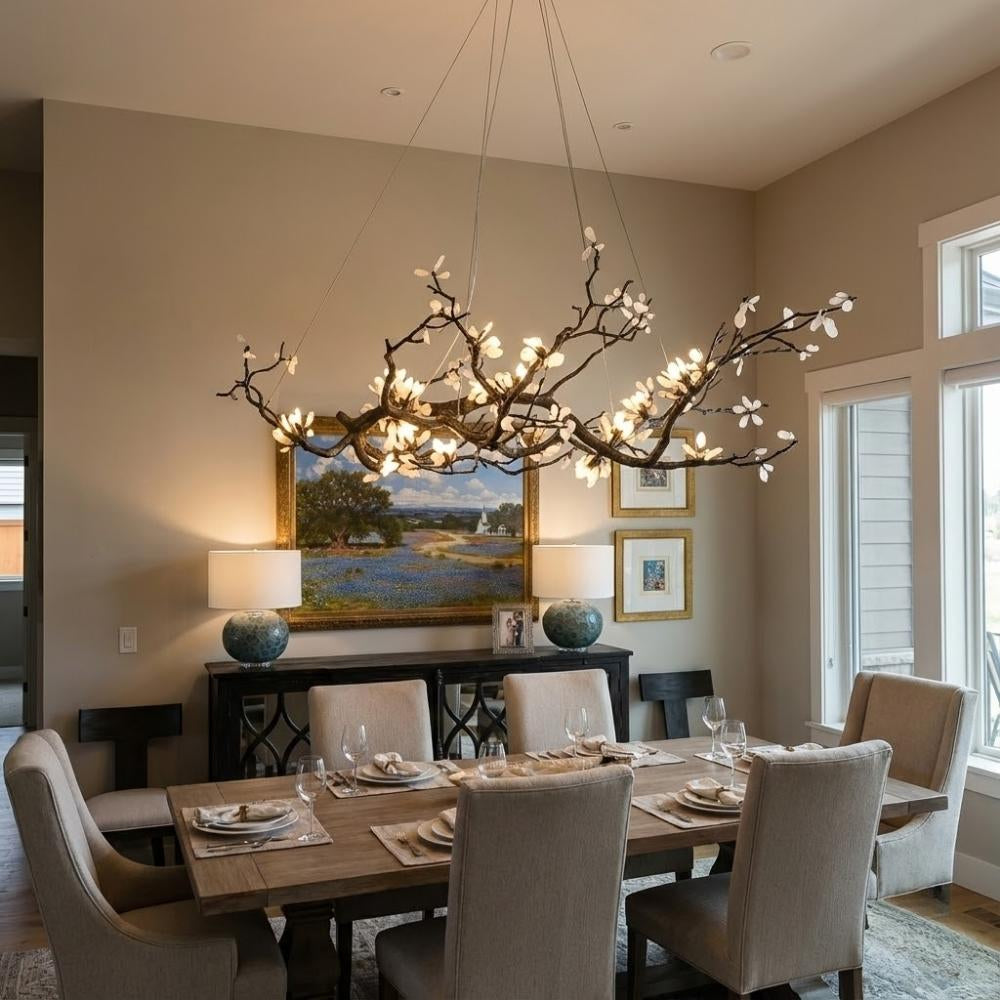
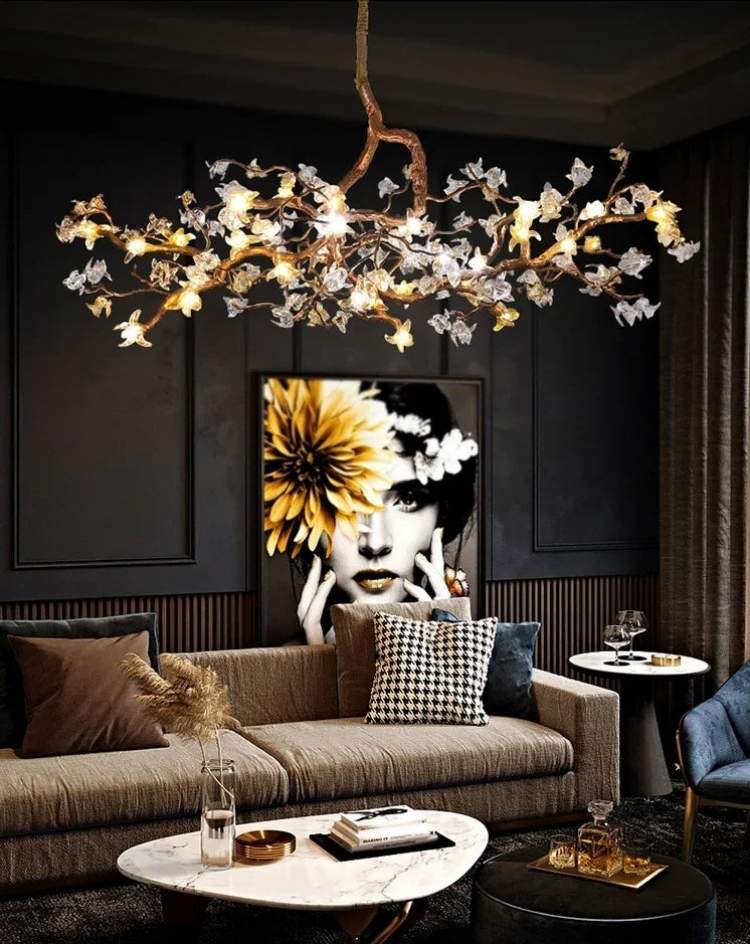
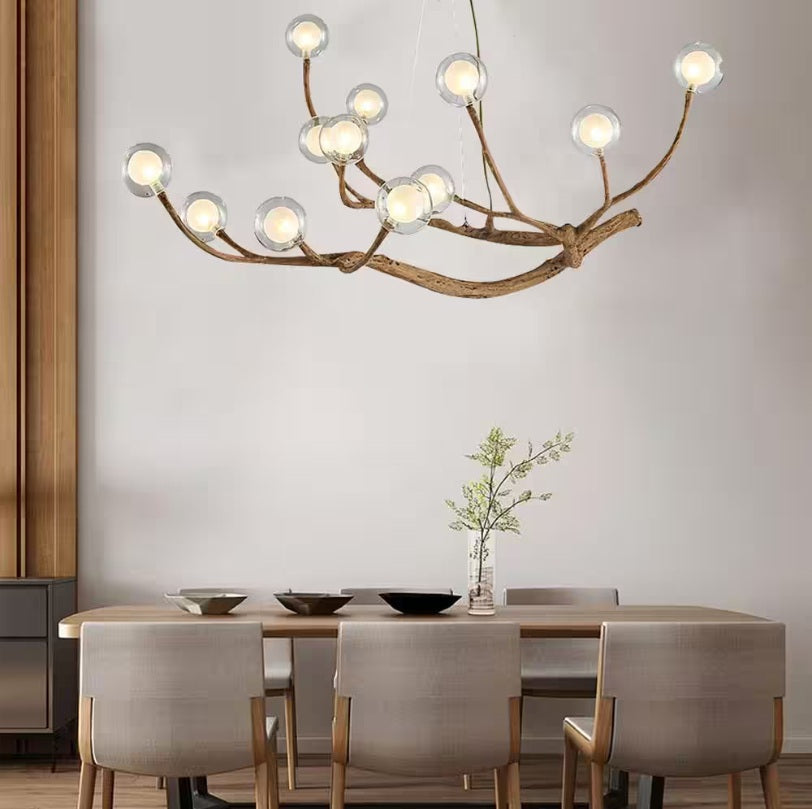
Branch forms are the fastest route to modern rustic because they carry the nature reference in silhouette alone. The Alba Tree Branch Chandelier bridges beams, plaster, and modern furniture with a single fluid form; the Asut Sculptural Branch Chandelier takes the same idea to angular, winter-tree lines for a room that leans contemporary. Scale follows the standard rule — room length plus width in feet as inches of diameter, so a 14 by 16 foot room takes a fixture around 30 inches — and modern rustic pieces are usually integrated LED or dimmable warm bulbs, which keeps the warmth without the amber glare of a bright incandescent. The branch chandelier collection and the guide to rustic chandeliers that look current go deeper; for the material decision, see wood vs wrought iron chandeliers.
Rustic Living Room Lighting Ideas
Everyone wants the warm rustic living room; nobody wants the dark cave. The fix is not more fixtures but a better mix: one ambient source, one or two real task lights where people read, and one accent light that makes the texture look intentional. Aim for 10 to 20 lumens per square foot across those layers — a 250-square-foot room needs roughly 2,500 to 5,000 lumens total — with a dimmer on the overhead so the room runs bright in the afternoon and low at night. The lumens calculator guide works the numbers for any room.
One hero fixture, quiet support
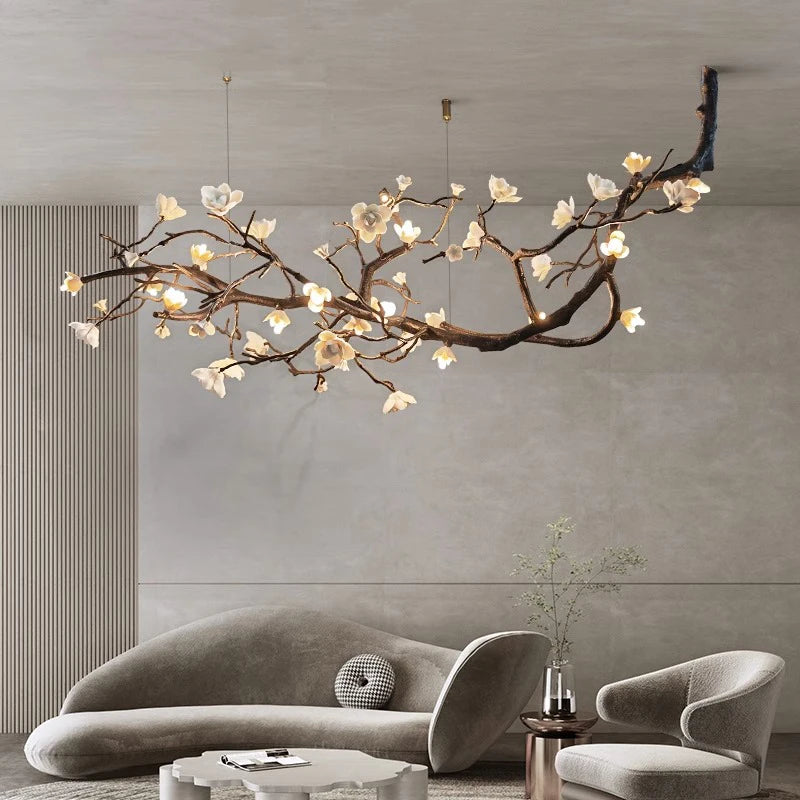
Pick one hero ceiling fixture and let everything else support it. A branch or wrought-iron chandelier like the Minas Dimmable Rustic Tree Branch Chandelier over the seating group, centered on the sofa and coffee table rather than the room; linen or glass-shaded floor and table lamps for reading; a picture light or small directional spot on the fireplace stone, the beams, or art. The supporting pieces stay simpler in form and finish so the chandelier keeps the focal point, and one or two hero fixtures per home is enough in an open plan where a single piece is seen from several zones.
Clearance and low ceilings
Keep the bottom of an open-area fixture 7 feet above the floor so people walk under it. On an 8-foot ceiling that means a wide, shallow profile or a ceiling-mount branch such as the Lio Tree Branch Ceiling Light Fixture, which keeps the silhouette without the drop. Chandelier sizing, placement, and clearance for living rooms specifically are covered in the rustic chandeliers for living rooms guide; the fixtures are in living room lighting.
Rustic Dining Room Lighting Ideas
Rustic dining rooms fail for one reason: the fixture is too small or hung too high. Design around the table first. A single fixture should be one-half to two-thirds of the table's width — a 40-inch table takes a 20- to 27-inch chandelier — and a linear fixture over a rectangular table one-half to two-thirds of the table's length, so an 8-foot table takes a 48- to 64-inch linear with breathing room at each end. Hang the bottom 30 to 36 inches above the tabletop on an 8-foot ceiling, about 3 inches higher per extra foot; the dining chandelier height guide covers the exceptions.

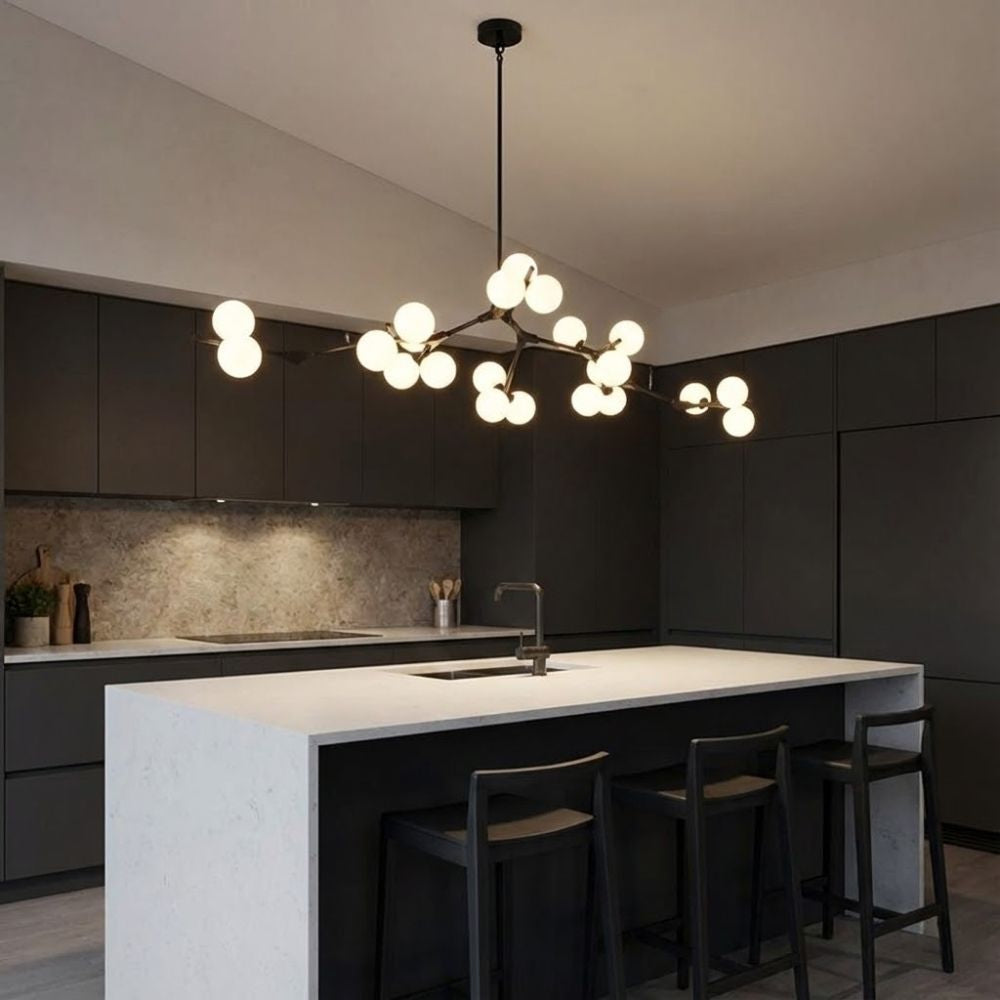
For long tables a linear branch like the Bedya Linear Branch Chandelier spreads light along the full length instead of concentrating it in the middle, and lines up with the chairs so nobody stands into a shade. Plan 30 to 40 lumens per square foot over the dining zone — a 10 by 12 foot area wants roughly 3,600 to 4,800 lumens from the fixture plus any sconces — and remember that rustic shades, seeded glass, and globes diffuse light, so a dimmer earns its place in both directions: up for clarity, down for dinner. In an open plan, repeat the dining fixture's finish in the island pendants so the level reads as one scheme. The dining room lighting collection sorts by shape and scale.
Low and high ceilings over the table
On an 8-foot ceiling, avoid tall chandeliers; a wide, shallow silhouette or a semi-flush rustic piece keeps 7 feet of clearance in walk-through zones while the dining fixture itself hangs lower over the table. In a vaulted or two-story dining space, think in vertical layers: a tiered chandelier that steps down so the light ends 6.5 to 7 feet above the table, or two or three pendants in a row at the same height, which visually lowers the ceiling over the table without touching the rest of the room.
Rustic Kitchen Lighting Ideas
Kitchens are where barn style earns its name. Over the island, two or three barn pendants — enamel dome shades, cage pendants, glass-and-iron lanterns, gooseneck forms — at about two-thirds of the island's length, 30 to 36 inches above the counter; over a kitchen table, a linear branch or iron fixture by the dining rules above; under the cabinets, warm LED strip so the counters are lit without a ceiling full of recessed cans. Use 3000K in the kitchen rather than 2700K so food and work surfaces read clearly, and match the pendant finish to the cabinet pulls and the faucet — black iron with black hardware, brass with brass. The kitchen island pendant guide covers size and spacing, and the farmhouse chandeliers guide covers the dining-table end; fixtures are in kitchen lighting.
Rustic Bedroom Lighting Ideas
A rustic bedroom is lit low, warm, and from the bedside, not from the ceiling. Plan the bedside layer first: iron or turned-wood table lamps with linen shades, or swing-arm wall sconces mounted 30 to 36 inches above the mattress so the light reaches the page without glare. Then the overhead, kept modest — a compact branch, a wrought-iron ring, a wood-and-iron drum, or a semi-flush on a standard ceiling — sized to the room's length plus width in inches and placed over the foot of the bed rather than directly above the pillows. All of it at 2700K on dimmers, with the overhead and the bedside on separate controls. The bedroom chandelier size guide covers over-bed height and clearance; fixtures are in bedroom lighting.
Rustic Lighting for Foyers and Staircases
Foyers and stairwells carry the first impression of a rustic home, and the decision there is proportion: fill the volume without blocking circulation. In a double-height foyer, a tall branch or sculptural fixture hung so its lowest point sits 7 feet above the floor and at or slightly above the second-floor line, checked from the landing as well as the door; size from length plus width, then adjust for the stair and door swings — in a wide entry, more diameter usually reads better than more drop.


The Aurora Branch Staircase Chandelier follows an open stair with a vertical branch form, so the stairwell reads as a designed volume rather than a dark transition; the Madelyn Rustic Branch Chandelier, with its frosted and clear glass balls, suits a single-story entry or a landing where the fixture is seen close up. On a stair run, keep 7 feet over every tread, and in a tight stairwell hold the fixture toward the wall plane so it stays out of the walking line. The farmhouse foyer lighting guide and farmhouse staircase chandelier guide go deeper; fixtures are in farmhouse foyer lighting and staircase chandeliers.

Cabin and Mountain Home Lighting Ideas
Cabins, lodges, and mountain homes are rustic at its heaviest and largest: timber, antler, wrought iron, and stone, in vaulted great rooms that swallow a standard fixture. The great-room chandelier is sized for volume — length plus width in inches, plus 2 to 3 inches per foot of ceiling above 8 feet — and chosen for mass: a wide rustic branch, an antler or wagon-wheel form, or a chain-hung wrought-iron chandelier with candle-style LED bulbs. It hangs from a beam clamp or structural mount rather than a drywall box, keeps 7 feet of clearance, and is supported by iron sconces on log or stone walls, lantern pendants in halls, and lamps at the seating so the corners of a big room aren't lost.

The Appa Rustic Tree Branch Chandelier has the spread for a vaulted room with exposed trusses; the Rustic Wrought Iron Chandelier, 12 Lights is the lodge dining form — candle arms on a forged frame, in black for stone and timber or gold for a warmer room. Keep the light at 2700K throughout so the timber reads warm, not orange, and dim it; a bright warm light in a log room goes amber fast. Wood, antler, and iron at scale are in rustic chandeliers and antler chandeliers; mounting heavy pieces is covered in the huge chandelier guide.
Rustic Outdoor Lighting: Porches, Patios, and Pergolas
Outdoor rustic lighting works where the architecture can carry it — deep porches, covered patios, pergolas, loggias — and the plan is the same as indoors: one overhead hero where people gather, supported by wall lanterns at doors and path lights for safety. The rating decides durability. A covered porch or solid-roofed pergola shielded from direct rain takes a damp-rated fixture; an exposed deck or open pergola needs wet-rated, and with iron and glass the wrong rating shortens the fixture's life quickly. Wrought-iron and lantern forms are the natural outdoor rustic choices, one hero per exterior "room," kept at 2700K so the view from inside to out reads as one scheme, and run on a dusk-to-dawn or motion schedule. Fixtures are in outdoor lights; the outdoor lighting ideas guide and outdoor fixture installation guide cover the rest.
Layering and Dimming a Rustic Scheme
Treat the room like a floor plan: name the activity zones — seating and TV, reading or work, circulation around the edges — and give each at least one controllable source. That usually means a branch or iron fixture for ambient light, a floor lamp for reading, and a wall light or directional accent for art or stone, with the overhead and the perimeter on separate controls so the room shifts from functional to relaxed in two moves. Dimmers matter more in rustic schemes than anywhere else, because warm light that is also bright feels too amber; put a dimmer on every overhead fixture, run lamps on their own switches, and for integrated-LED fixtures confirm the driver's dimmer compatibility so the low end stays stable without flicker.

The switch is part of the finish story too: a brass toggle switch repeats the warm-metal cue at hand height, which is exactly the kind of second natural reference that makes a single rustic fixture look planned. The layered lighting guide covers the three layers in detail.
Rustic Lighting by Room at a Glance
| Room | Hero fixture | Supporting layers | Rules |
|---|---|---|---|
| Living room | Branch or iron chandelier centered on seating | Reading floor lamp, table lamps, accent on stone or beams | L + W (ft) = in; 7 ft clearance; 10–20 lm/sq ft; 2700K dimmable |
| Dining room | Linear branch or iron over rectangular tables; round over round | Buffet lamp, sconces | ½–⅔ table width (or length for linear); 30–36 in above table; 30–40 lm/sq ft |
| Kitchen | Barn pendants over the island | Under-cabinet strip, table fixture | ⅔ island length; 30–36 in above counter; 3000K |
| Bedroom | Compact branch, iron ring, or semi-flush | Bedside lamps or swing-arm sconces first | Overhead over the foot of the bed; 2700K; separate controls |
| Foyer / stair | Tall branch or lantern; vertical form on open stairs | Sconces at landing height, console lamp | 7 ft over floor and treads; bottom at the second-floor line |
| Cabin / great room | Large branch, antler, wheel, or iron on a beam clamp | Wall sconces, hall lanterns, lamps | L + W plus 2–3 in per ft over 8 ft; structural mount |
| Outdoor | Iron or lantern chandelier under cover | Wall lanterns, path lights | Damp under cover, wet exposed; 2700K; on a schedule |
A rustic lighting plan in four steps
1. One hero per main room, sized to length + width in inches • 2. Support it with lamps, sconces, and one accent so corners aren't dark • 3. Keep it warm and dimmable — 2700K living and bedroom, 3000K kitchen, dimmers on every overhead • 4. Repeat one natural cue — wood tone, warm hardware, stone — and stop; one organic form plus quiet support is modern rustic, five motifs is a theme.
Branch, wrought iron, wood, and antler chandeliers, farmhouse foyer fixtures, and lamps for every room.
Rustic Chandeliers Branch Farmhouse Foyer Antler
Frequently Asked Questions
What makes a light fixture rustic?
Three things together: natural or hand-worked materials — wrought iron, timber, aged brass, blown or seeded glass, rope, antler; forms taken from nature or the barn — branches, wagon wheels, lanterns, candle arms, X-frames; and warm, diffused light, 2700K to 3000K, usually dimmable. A fixture with one of the three reads as an accent; with all three it reads as rustic. Modern rustic keeps the materials and warmth but simplifies the form.
What is the difference between rustic, farmhouse, barn, and cabin lighting?
Rustic is the umbrella — natural materials, organic or forged forms, warm light. Farmhouse is rustic cleaned up: black or white metal, simple geometry, linen shades, often with brass. Barn style borrows from agricultural buildings — gooseneck arms, enamel dome shades, cage pendants, galvanized or black metal. Cabin and lodge is the heaviest version: timber, antler, wrought iron, stone, large scale for vaulted rooms. Most homes mix two of them; the finish and the light color are what tie them together.
How do I make rustic lighting look modern?
Keep the material and the warmth, simplify the form, and reduce the count. One sculptural organic fixture — a branch chandelier, a forged ring, a timber linear — in a room with plain upholstery, pale walls, and clean lines reads as modern rustic; five rustic motifs in one room read as a theme. Repeat the natural cue once more (a wood tone, warm hardware, a stone surface), use integrated LED or dimmable warm bulbs, and let the supporting fixtures be quiet.
What is the best rustic lighting for a living room?
One hero ceiling fixture — a branch or wrought-iron chandelier sized to the room's length plus width in inches and centered on the seating — plus two or three supporting layers: a reading floor lamp, a table lamp or two with linen or glass shades, and an accent light on the fireplace stone, beams, or art. Aim for 10 to 20 lumens per square foot across the layers, 2700K, and a dimmer on the overhead so the room works at 4 p.m. and at 10 p.m.
How should rustic dining room lighting be sized and hung?
Width between one-half and two-thirds of the table's width for a single fixture, or one-half to two-thirds of the table's length for a linear fixture over a rectangular table; bottom of the fixture 30 to 36 inches above the tabletop on an 8-foot ceiling, about 3 inches higher per extra foot. Plan 30 to 40 lumens per square foot over the dining zone, and put the fixture on a dimmer — rustic shades and glass diffuse light, so you want headroom for brightness and a low setting for dinner.
What rustic lighting works in a kitchen?
Barn-style or forged pendants over the island — two or three dome, cage, or glass-and-iron pendants at two-thirds the island's length, 30 to 36 inches above the counter — a linear branch or iron fixture over a kitchen table, and warm under-cabinet LED strip for the counters. Use 3000K in the kitchen so food and task areas read clearly, and match the pendant finish to the cabinet pulls and faucet.
What are good rustic bedroom lighting ideas?
Keep it low, warm, and layered: a small rustic ceiling fixture or semi-flush — a compact branch, a wrought-iron ring, a wood-and-iron drum — over the bed, and the working light at bedside: iron or wood table lamps with linen shades, or swing-arm wall sconces mounted 30 to 36 inches above the mattress. Use 2700K dimmable bulbs. A rustic bedroom fails when the overhead is the only light, so plan the bedside layer first.
What lighting suits a cabin or mountain home?
Scale and material: vaulted great rooms take a large branch, antler, wagon-wheel, or wrought-iron chandelier sized to the room's length plus width in inches plus 2 to 3 inches per foot of ceiling over 8 feet, hung from a beam clamp or structural mount, with 7 feet of clearance. Support it with iron sconces on log or stone walls, lantern pendants in halls, and lamps at seating. Warm 2700K light throughout, dimmable, so the timber reads warm rather than orange.
Can rustic chandeliers be used outdoors?
Yes, with the right rating. A covered porch, pergola with a solid roof, or loggia shielded from direct rain takes a damp-rated fixture; an exposed deck or open pergola needs a wet-rated one. Wrought iron and lantern forms are the natural outdoor rustic choices; support the overhead piece with wall lanterns at doors and path lights, keep the light at 2700K to match the interior, and run it on a dusk-to-dawn or motion schedule.
What color light is best for rustic lighting?
Warm white, 2700K in living rooms, bedrooms, and dining rooms, 3000K in kitchens and workspaces, never cooler than 3500K indoors. Warm light makes timber, iron, and brass read as intended; cool light turns them gray. Because warm light can also feel too amber when it's bright, put every overhead rustic fixture on a dimmer and choose CRI 90 or higher so wood grain and stone show true.
Planning Rustic Lighting That Looks Intentional
Rustic lighting works when it is treated as part of the architecture rather than a collection of rustic objects: one strong fixture per main room, supporting light where people read, cook, and walk, warm color on a dimmer, and a single natural cue repeated. The numbers to remember are few — length plus width for size, 30 to 36 inches over a table, 7 feet in walkways, 10 to 20 lumens per square foot in living spaces — and they make the difference between a room that photographs as rustic and one that lives as rustic.
Browse the rustic chandeliers collection for branch, iron, wood, and antler forms, or start by room in living room and dining room lighting. For living-room chandelier placement in depth, see rustic chandeliers for living rooms; for the forms themselves, unique rustic chandeliers.


