

Choosing between a farmhouse round chandelier and a rectangular one gets simpler when the table shape leads: round and square tables take a round fixture, long rectangular tables take a linear one, and the gray zone — a round fixture over a shorter rectangular table — has three conditions. This guide works through the decision, gives exact sizes for 36- to 60-inch round and 60- to 96-inch rectangular tables, and covers visual weight, hanging height, and open-plan rooms. For a style overview first, see the best farmhouse chandeliers guide.
Key Takeaways
| Question | Short answer |
|---|---|
| Round vs rectangular for a rectangular table? | Rectangular or linear follows the footprint and lights end to end — see rectangular chandeliers. Round works only over shorter tables in near-square rooms. |
| Best shape for a round or square table? | Round — ring, wagon wheel, drum, or cage — centered so the seating gathers evenly. |
| What size for a 72 inch table? | Rectangular 72 in: linear 36–48 in long × 10–18 in wide, or round 20–26 in. Round 72 in: round 36–42 in. |
| How wide in general? | Round: ½–⅔ of table width. Linear: ½–⅔ of table length, ¼–½ of table width. |
| How high? | 30–36 in above the tabletop on an 8 ft ceiling, +3 in per extra foot. |
| Open plan? | Size to the dining zone, not the whole floor, then repeat finish and weight in nearby fixtures. |
Quick Facts
- Shape follows the table: round → round; square → round or square; rectangular → linear; oval → round if short, linear if long.
- Round over rectangular is fine when: table ≤ 72 in, room near-square, fixture has visual weight.
- Sizes: round ½–⅔ of table width; linear ½–⅔ of length × ¼–½ of width.
- Room cross-check: length + width (ft) = diameter (in); don't exceed it with a big table in a small room.
- Visual weight: open iron and candle arms to the top of the range; wood beams, dense lanterns, wagon wheels to the bottom.
- Height: 30–36 in above the table; round can sit lower (30–34), linear higher (33–36).
1. Start With Table Shape, Not Fixture Style
In a farmhouse dining room the table is the strongest horizontal element, and the chandelier should read as belonging to it rather than floating overhead as an unrelated object. Table shape is therefore the cleanest starting point: a round table takes a round chandelier; a square table, round or square; a rectangular table, a rectangular or linear fixture; an oval table, round if it is short and a softer linear if it is long. Matching shape to shape doesn't make every other combination wrong — the next section covers the main exception — but it removes most of the guesswork and most of the awkward proportions. If the question is specifically about long tables, the rectangular table chandelier shape guide is the focused companion; for round tables, round dining table lighting.
2. Can You Put a Round Chandelier Over a Rectangular Table?
Yes — it is the most-asked version of this decision, and the answer has three conditions. First, the table is on the shorter side, about 72 inches or less; at that length a round fixture at one-half to two-thirds of the table's width still throws usable light to the end seats. Second, the room is close to square, or the dining zone in an open plan is compact, so a centered round form matches the space as well as the table. Third, the fixture has enough visual weight to anchor the center — an open iron ring at full width, a wagon wheel, a wood-and-metal drum — rather than a thin form that reads as undersized. When those hold, you are choosing a gathered pool of light in the middle over edge-to-edge coverage, which suits a four- to six-seat table and an intimate room.
When they don't hold — a table over 72 inches, eight or more seats, a long narrow room — a round chandelier leaves the end seats underlit and looks small against the table's length, and a rectangular or linear fixture is the clearer choice. Two smaller round fixtures, each centered over half the table, are the compromise for a long table in a home that wants round forms.
3. Are Linear Chandeliers Better for Rectangular Tables?
For six seats and up, yes. A linear or rectangular chandelier follows the table's footprint, spreads light from end to end so every seat is lit, and acts as a visual spine over the runner rug, benches, and sideboard that already run the same direction in a farmhouse room. It also defines the dining zone more clearly in an open plan. Size it to one-half to two-thirds of the table's length and one-quarter to one-half of its width. The exception is the short rectangular table of four to six seats in a near-square room, where a round fixture (section 2) is still an option; and on very long tables, over about 96 inches, one long linear or two matched fixtures keep coverage even.

4. When a Round Farmhouse Chandelier Makes the Most Sense
A round chandelier is the stronger choice when the room needs a central focal point rather than a directional line: round pedestal tables, square breakfast tables, compact dining areas where the seating gathers evenly. Round forms also soften a farmhouse room full of straight lines — rectangular tables, beams, windows, cabinetry — and an open iron ring, a wood-and-metal drum, a wagon wheel, or a round cage does that without turning ornate.

Best situations for a round chandelier
- Round dining tables seating 4 to 6
- Square tables in breakfast nooks
- Smaller dining rooms where a centered fixture feels calmer
- Farmhouse rooms with many straight lines that need a softer counterpoint
- Shorter rectangular tables (60–72 in) in near-square rooms, with a fixture of enough presence
For a true round table, the 60 inch round table chandelier guide is the exact companion.
5. When a Rectangular Chandelier Is the Better Fit
A rectangular chandelier makes sense when the table is long enough that a round fixture would concentrate light in the middle: farmhouse tables seating six, eight, or ten, long tables with benches, rooms with a clearly rectangular footprint, and open plans where the dining zone needs definition. Linear fixtures also read as more structured, which suits a room where the table, runner, sideboard, and millwork all move in one direction. The farmhouse-friendly versions are linear lanterns, wood-and-metal beams, elongated candle-arm frames, and open rectangular cages — warm and grounded without bulk. Compare by format in the dining room lighting collection and rectangular chandeliers.
6. Chandelier Size by Table Size
Once the shape is clear, scale decides whether the fixture swallows the table or disappears above it. The table below applies the standard ranges — round at one-half to two-thirds of table width; linear at one-half to two-thirds of length and one-quarter to one-half of width — to the common farmhouse table sizes, with the low end for dense frames and the high end for open ones.

| Table | Seats | Round chandelier (diameter) | Linear chandelier (length × width) |
|---|---|---|---|
| 36 in round / square | 2–4 | 18–24 in | — |
| 42 in round / square | 4 | 21–28 in | — |
| 48 in round / square | 4–6 | 24–32 in (24–26 dense, 30–32 open) | — |
| 54 in round | 6 | 27–36 in | — |
| 60 in round | 6–8 | 30–40 in (most rooms land 32–36) | — |
| 72 in round | 8 | 36–42 in, or a cluster reading that wide | — |
| 60 in rectangular (36–38 wide) | 4–6 | 18–25 in (round works here) | 30–40 in × 9–18 in |
| 72 in rectangular (36–40 wide) | 6 | 20–26 in (round still works in a near-square room) | 36–48 in × 10–18 in |
| 84 in rectangular (38–42 wide) | 6–8 | Linear preferred | 42–56 in × 10–20 in |
| 96 in rectangular (40–44 wide) | 8–10 | Linear preferred | 48–64 in × 10–22 in |
| 108–120 in rectangular | 10–12 | Two matched fixtures, one per half | 54–80 in, or two fixtures |
Cross-check the table figure against the room: add the room's length and width in feet and read it as inches — a 12 by 14 foot room suggests about 26 inches — and if the table figure exceeds the room figure by much, the room is small for the table and the fixture should stay toward the low end or an open frame. Hanging height is in section 8; the chandelier sizing guide covers rooms without a table.
7. Visual Weight Matters as Much as Inches
Two chandeliers of the same width can feel completely different in a room, and the difference is visual weight: frame thickness, bulb count, material density, wood mass, finish, and how tightly the parts sit. Lighter weight — open iron rings, simple candle arms, thin black frames, minimal wood, fewer bulbs — can run to the top of the size range and suits smaller rooms even when the inches would allow more. Heavier weight — chunky wood beams, dense lantern frames, multi-tier wagon wheels, thick antler or branch silhouettes, big clusters of bulbs — stays at the bottom of the range and earns its place in larger rooms, vaulted ceilings, and long tables where a light fixture would look lost overhead. This is also why a round chandelier succeeds over a shorter rectangular table only when the frame has presence: a thin ring in that spot looks undersized at the same diameter.

8. Hanging Height: Where Comfort and Proportion Meet
A correctly sized chandelier can still feel wrong if it sits too high, too low, or pressed against the ceiling. The reliable starting point is the bottom of the fixture 30 to 36 inches above the tabletop on an 8-foot ceiling, with about 3 inches added for each extra foot of ceiling: 30 to 34 inches at 8 feet, 33 to 36 at 9 feet, and in a vaulted room the look from across the room matters more than the minimum clearance. Round chandeliers tolerate the lower end because their footprint is centralized; long linear fixtures want the upper end so they don't read as a bar across sightlines in a narrow room. The dining chandelier height guide has the exceptions.
9. Open-Concept Dining Rooms: Size to the Zone
Most farmhouse homes put the dining area between the kitchen and the living room, sharing floors and sightlines with both. Size the chandelier to the dining zone — the table, rug, and seating — not to the whole open floor, which is how dining fixtures end up too large for their tables. Then coordinate rather than duplicate: a round dining chandelier pairs with slimmer island pendants; a rectangular dining fixture sits beside simpler living-room fixtures when the finish repeats; black iron, aged brass, and weathered wood are usually enough to connect the plan. Choose the living room lighting alongside the dining fixture rather than room by room.
10. Farmhouse Round and Rectangular Chandeliers to Consider
Six fixtures that show the two shapes in farmhouse materials, with the table each suits.
Round
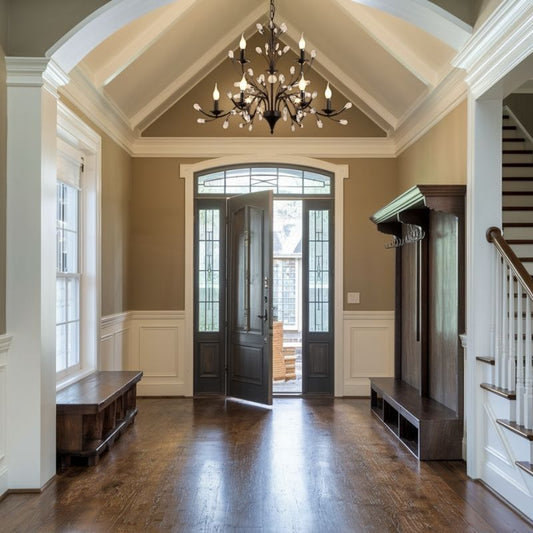

The Wrought Iron Chandelier, 6–9 Lights is the open candle-arm round — light visual weight, so the 6-light suits a 42- to 48-inch table and the 9-light a 54- to 60-inch one or a short rectangular table in a square room. The Rose Wooden Large Rustic Chandelier is the heavy round — a timber ring for a 60- to 72-inch round table in a big or vaulted room. The Ivy Rustic Wagon Wheel Chandelier sits between them: the classic farmhouse wheel, dense enough to anchor a 48- to 60-inch round table or a shorter rectangular one.
Rectangular and linear

The Orgi Statement Linear Branch Chandelier runs branch arms along a line for 72- to 96-inch tables — organic farmhouse without a cage. The Bedya Linear Branch Chandelier is the lighter linear branch for a 60- to 84-inch table, and the Alba Tree Branch Chandelier above, oriented along the table, covers the gray zone — a wide-spreading form that reads linear over a 72-inch table and radial over a round one. The farmhouse chandeliers guide has more of both shapes.
11. Farmhouse Style Changes How Shape Feels
The same geometry carries different farmhouse signals depending on material: a round crystal fixture and a round iron wagon wheel are both circular and say opposite things. Round forms that read well now are black iron rings, wood-and-metal drums, wagon wheels with candle-style bulbs, and open round cages; rectangular forms are linear lanterns, wood beams with exposed bulbs, open black-metal rectangles, and mixed wood-and-iron frames with warm bulbs. In either shape, an edited, clean frame ages better than a heavily themed or distressed one — see the vintage rustic chandelier guide for keeping the look current, and rustic chandeliers for the wider range. For the entry that leads into the dining room, farmhouse foyer lighting and the farmhouse foyer lighting ideas guide cover the matching piece.
12. Round vs Rectangular by Room Scenario
| Scenario | Shape | Size and notes |
|---|---|---|
| Breakfast nook, 42–48 in round table | Round | 21–32 in; keeps the nook centered and softens corners |
| 6-seat table, 60–72 in, standard room | Either | Round 20–26 in with presence, or linear 36–48 in; linear as the table nears 72 in |
| 8-seat table, 84–96 in, open plan | Rectangular | Linear 42–64 in; defines the zone, lights both ends |
| 10–12 seat table, 108 in+ | Rectangular | One long linear or two matched fixtures, one per half |
| Oval table | Round if ≤ 72 in, linear if longer | Rounded-end linear or oval drum; no hard-cornered frames |
| Foyer flowing into dining | Round foyer, either dining | Repeat finish and visual weight, not geometry |
13. Common Mistakes That Make the Wrong Shape Feel Worse
- Choosing by product photo: a fixture can look right online and be the wrong length for the table.
- Ignoring bulb spread: a round fixture over a long table leaves the end seats underlit.
- Too heavy for the ceiling: thick beams and dense lanterns overpower an 8-foot room; a lower-profile frame solves more than downsizing width.
- Sizing to the whole open plan: produces a dining chandelier too large for its table.
- Copying island lighting over the table: islands and tables need different proportions.
Quick decision: round or rectangular
Round or square table: round, ½–⅔ of width • Rectangular ≤ 72 in, near-square room: round with presence (20–26 in) or linear (36–48 in) • Rectangular 84–96 in: linear, ½–⅔ of length • 108 in+: long linear or two fixtures • Oval: round if short, soft linear if long • Always: 30–36 in above the table, open frames larger, dense frames smaller.
Round iron, wagon wheel, and wood forms; linear lantern, beam, and branch fixtures.
Rustic Chandeliers Rectangular Dining Room Branch
Frequently Asked Questions
Can you put a round chandelier over a rectangular table?
Yes, when three things line up: the table is on the shorter side (about 72 inches or less), the room is close to square or the dining zone is compact, and the fixture has enough visual weight — an open iron ring, a wagon wheel, a drum — to anchor the center. Size it to one-half to two-thirds of the table's width, not its length. Over tables longer than about 72 inches, a round chandelier concentrates light in the middle and leaves the ends underlit, and a rectangular or linear fixture becomes the clearer choice.
Are linear chandeliers better for rectangular tables?
For tables of six seats or more, yes. A linear or rectangular chandelier follows the table's footprint, spreads light from end to end so no seat sits in shadow, and reads as a visual spine above the runner, benches, and sideboard that all run the same direction in a farmhouse dining room. Size it to one-half to two-thirds of the table's length and one-quarter to one-half of its width. For shorter rectangular tables of four to six seats in a near-square room, a round fixture is still an option.
What size chandelier for a 72 inch table?
A 72-inch rectangular table (usually 36 to 40 inches wide) takes a linear chandelier about 36 to 48 inches long and 10 to 18 inches wide, or, if you prefer a round fixture, one about 20 to 26 inches in diameter — half to two-thirds of the table's width. A 72-inch round table, which seats eight, takes a round chandelier of about 36 to 42 inches, or a cluster that reads that wide. Hang the bottom 30 to 36 inches above the tabletop on an 8-foot ceiling.
What size chandelier for a 48 inch round table?
About 24 to 32 inches in diameter — one-half to two-thirds of the table's width. Go toward 24 to 26 inches for a dense frame like a wagon wheel or a multi-bulb drum, and toward 30 to 32 inches for an open iron ring or a thin candle-arm form. A 48-inch square table takes the same range, measured across the table, not the diagonal.
How do I choose the right size farmhouse chandelier?
Start with the table: round or square tables take a round fixture at one-half to two-thirds of the table width; rectangular tables take a linear fixture at one-half to two-thirds of the table length and one-quarter to one-half of its width. Cross-check against the room — length plus width in feet as inches of diameter — so a big table in a small room doesn't get an oversized fixture. Then adjust for visual weight: open frames can go to the top of the range, chunky wood beams and dense lanterns stay at the bottom. Hang it 30 to 36 inches above the table, plus about 3 inches per foot of ceiling over 8 feet.
What shape chandelier suits a round table?
A round chandelier — open iron ring, wagon wheel, wood-and-metal drum, round cage, or a round cluster of globes — centered over the table so the seating gathers evenly around it. Round fixtures also tolerate hanging slightly lower because their footprint is centralized. A square or short linear fixture can work over a round table only when it is clearly smaller than the table and reads as a centered object.
What is the safest choice for a long farmhouse table?
A rectangular chandelier — a linear lantern, a wood-and-iron beam, an elongated candle-arm frame, or an open rectangular cage — sized to one-half to two-thirds of the table length. It follows the table, lights both ends, and defines the dining zone in an open plan. On tables over about 96 inches, a long single linear or two matched fixtures, each centered over its half of the table, keep the coverage even.
Should the chandelier match the table shape exactly?
No. It should relate to the table, not copy its outline — a linear fixture over a rectangular table, a round fixture over a round one — at a smaller scale, so the table's edge stays visible around it. Proportional harmony is the goal: the fixture reads as belonging to the table, not as a duplicate of it.
What about an oval farmhouse table?
An oval table takes either shape depending on its length. Under about 72 inches, a round chandelier with enough presence works, sized to the oval's width. Over 72 inches, treat it like a rectangular table and use a soft linear or oval fixture at one-half to two-thirds of its length. Avoid hard-cornered rectangular frames over an oval; a linear branch, a rounded-end lantern, or an oval drum keeps the geometry related.
How high should a farmhouse chandelier hang above the table?
Bottom of the fixture 30 to 36 inches above the tabletop on an 8-foot ceiling — 30 to 34 inches for round fixtures, which tolerate sitting lower, and 33 to 36 for long linear fixtures, which otherwise read as a bar across sightlines. Add about 3 inches for each foot of ceiling height above 8 feet; in a vaulted room, judge the look from across the room, not just the clearance.
The Right Farmhouse Chandelier Starts With the Table
The decision between a round and a rectangular farmhouse chandelier is mostly made by the table: round and square tables settle under a round fixture, long tables under a linear one, and the short rectangular table in a square room is the one real choice. After shape, scale, visual weight, and hanging height do the refining, and a fixture that fits the table, suits the room's size, and hangs at a comfortable height reads as composed rather than decorated.
Compare both shapes in rustic chandeliers and rectangular chandeliers, or start from the table with the 60 inch round table guide and the rectangular table shape guide.


