

Somewhere along the way, kitchen islands outgrew the row of little pendants — larger islands, open floor plans, and kitchens that double as living space have made a single substantial chandelier the more interesting answer. This guide covers when an island chandelier beats pendants, how to size linear and rectangular fixtures to your island's length, and the styles that carry it off, from crystal luxury to wave forms and wrought iron.
Chandelier or Pendants Over the Island?
Both work; they just do different jobs. A row of pendants gives you repeated pools of task light and a rhythmic look — the classic choice, and the right one for many kitchens. A chandelier gives you one continuous fixture: more visual weight, more design presence, and light that spreads along the island's length rather than pooling under each shade.
The chandelier case gets stronger as three things increase. Island length — past about 6 feet, a pendant row needs three or four units to avoid gaps, and a single linear fixture starts looking cleaner than the crowd. Openness — in kitchens that flow into dining and living areas, the island fixture is visible from everywhere, and a chandelier holds that stage better than small repeated shades. The room's ambitions — kitchens that host homework, cocktails, and conversation benefit from a fixture that reads as furniture, not just equipment.
Pendants keep the edge for narrow islands (under about 30 inches of counter depth, where a chandelier's width gets tight), for strict task-first cooking zones, and for budgets where two or three modest pendants undercut one substantial fixture. If that sounds like your kitchen, the companion guide to modern pendant lights for kitchen islands covers the best of that category; for the broader fixture-type decision beyond the kitchen, see chandelier vs. ceiling light.
Sizing a Linear Fixture to Your Island
Island chandeliers follow the island, not the room. Three numbers settle the fit:
Length: one-half to two-thirds of the island. A 6-ft (72 in) island suits a fixture 36–48 inches long; an 8-ft (96 in) island suits 48–64 inches; a 10-ft island carries 60–80 inches. Shorter than half the island and the fixture floats disconnected above it; longer than two-thirds and it crowds the ends where people sit.
Width: inside the countertop, with margin. Keep the fixture at least 6 inches inside each long edge of the counter, so heads and raised glassware clear it and the proportions stay comfortable. On a standard 36–42 inch deep island, that means fixtures up to roughly 24–30 inches wide.
Height: 30–36 inches above the counter. Low enough to relate to the island and light the work surface, high enough to keep sightlines open across it. Taller households and taller ceilings sit at the top of that range; if the island doubles as the main dining spot, the lower end concentrates light where plates land.
| Island Length | Linear Fixture Length | Alternative |
|---|---|---|
| 5 ft (60 in) | 30–40 in | 2 pendants, or one 24–30 in round/rect fixture |
| 6 ft (72 in) | 36–48 in | 2–3 pendants |
| 7 ft (84 in) | 42–56 in | 3 pendants |
| 8 ft (96 in) | 48–64 in | 3 pendants, or two coordinated fixtures |
| 10 ft (120 in) | 60–80 in | Two linear fixtures in series, or 4 pendants |
| 12 ft + (144 in +) | Two fixtures in series preferred | 4–5 pendants |
Very long islands raise a real question: one very long fixture or two in series? Two matched fixtures, each sized to roughly a third of the island and centered over each half, usually beats one extreme length — easier to source, easier to hang level, and the pair reads intentional. Pendant spacing math, if you go that route instead, is covered in the island pendant spacing guide.
The Island-Native Shapes
Linear Chandeliers
The linear chandelier — lights arranged along a horizontal frame or bar — is the shape the kitchen island was waiting for. Its geometry matches the island's: long, narrow, directional. Light distributes evenly along the prep surface with no dark gaps between shades, and the single frame keeps the ceiling line clean where a pendant row can look busy. Designs like the Peli linear island chandelier and the Nina linear chandelier are built exactly to this brief — one continuous fixture, multiple light sources, proportions that follow the counter.

Linear designs are also the most forgiving to install well: one centered canopy (or two suspension points), one level adjustment, and the fixture aligns itself with the island below.
Rectangular and Frame Designs
Where a linear fixture is a bar of lights, a rectangular chandelier is a frame — often with crystal elements, exposed candelabra-style lights, or an open metal box structure. The shape carries more architectural weight than a bar, which suits kitchens that open onto dining space and want the island fixture to hold its own next to a dining room chandelier.

Rectangular crystal designs — like a luxury crystal rectangular chandelier or the longer 150 cm modern crystal rectangular version — bring the sparkle traditionally reserved for the dining room over the island instead. They're the strongest answer to the "kitchen as the new living room" trend: task light below, glamour at eye level. Width discipline matters most with these — keep the frame inside the counter edges with margin, since rectangular fixtures carry visual mass that linear bars don't.
Wave and Sculptural Forms
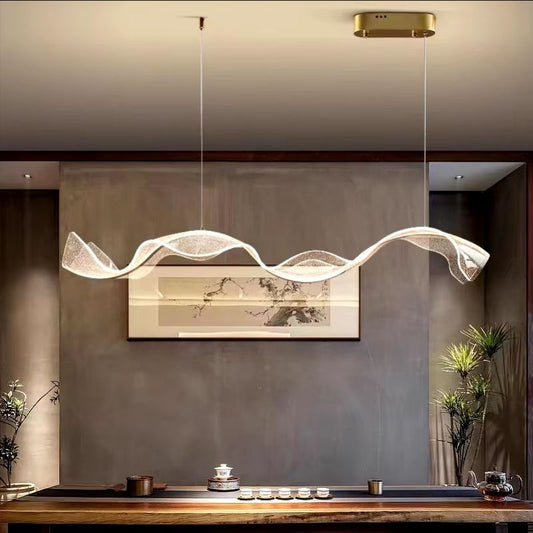
Between the straight bar and the crystal frame sits the sculptural option: fixtures like the Modern Ocean Wave chandelier, whose undulating gold-finish form runs the island's length while refusing to be a straight line. Sculptural linears earn their place in kitchens where the island is the room's centerpiece and the ceiling is otherwise plain — the fixture supplies the architecture. Adjustable brightness and color temperature make the wave design practical as well as decorative.
Black and Contemporary Statement Pieces

Matte black multi-light chandeliers — in the vein of a contemporary black 15-to-21-light design — anchor kitchens built on the black-hardware, black-frame palette. Against white or wood cabinetry the contrast is the point: the fixture draws the room's lines together. These larger multi-light pieces suit generous islands and open plans with 9-foot-plus ceilings, where their spread has room to breathe.
Wrought Iron and Farmhouse Warmth
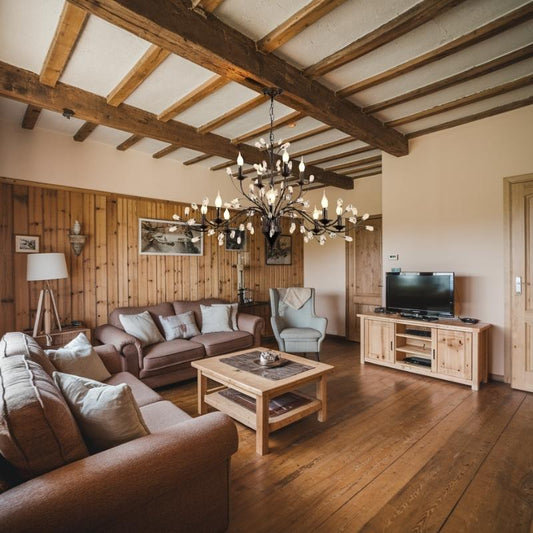
For farmhouse and traditional kitchens, wrought iron candle-style chandeliers bring the dining room's oldest fixture type over the island — visible craft, warm finishes, and a form that pairs naturally with wood counters and shaker cabinetry. Round iron designs suit square-ish islands; for long islands, iron works best in a linear or oval interpretation, or as a matched pair.
Luxury and Designer Island Fixtures
The step up from good to luxury in island chandeliers shows in specific places rather than a general glow. Crystal quality — K9 or better — determines whether the sparkle is sharp or soft. Metalwork tells at the joints: welded and finished versus visibly fastened. Integrated LED with real dimming range (not just on/off at two levels) separates fixtures designed for living from fixtures designed for photographs. And custom sizing availability matters over islands more than almost anywhere, because the fixture-to-island proportion is so visible; the customization service exists for islands whose dimensions don't match stock lengths.
Where the budget allows one lighting splurge in an open-plan home, the island fixture is arguably the right place for it — it's the fixture every sightline finds, in the room where everyone ends up.
Light Quality Over a Work Surface
- Output: the island zone wants roughly 35–50 lumens per square foot of counter — brighter than general room light, since it's a work surface. An 8-ft × 3.5-ft island lands around 1,000–1,400 lumens across the fixture.
- Color temperature: 2700K–3000K warm white keeps food, wood, and people looking right; if the kitchen runs cooler task lighting elsewhere, 3000K is the bridge value.
- CRI 90+: over the surface where produce is judged and plates are styled, color accuracy is not a luxury spec.
- A dimmer is non-negotiable: the same fixture works prep duty at 6 pm and bar duty at 10 pm. Verify LED dimmer compatibility to avoid flicker.
- Downlight component: fixtures with open or downward-facing light sources put more lumens on the counter than fully shaded or up-facing designs — check where the light actually goes, not just how much of it there is.
Installation Notes for Island Fixtures
- Center on the island, not the room. Kitchens rarely put the island at the room's center; the junction box must follow the island. Relocating a box is routine electrician work and worth every penny against a permanently off-center fixture.
- Level is everything on linear designs. A long horizontal fixture makes even a half-inch tilt visible. Two-point suspensions need both drops measured from the counter, not the ceiling, if the ceiling isn't true.
- Check weight against the box. Crystal rectangular and large multi-light designs can pass the 50-pound standard-box rating; a fan-rated or heavy-duty box with blocking is the fix.
- Mock it up first. Painter's tape on the counter marking the fixture's footprint, and a string at the planned height, cost nothing and settle every proportion doubt before drilling.
- Mind the sightline to the range hood. In many layouts the island fixture and the hood share a visual axis — hang the chandelier so its bottom doesn't cut across the hood's face from the main viewing angle.
Coordinating With the Rest of an Open Plan
The island chandelier rarely hangs alone — in open plans it shares sightlines with dining fixtures, living room lighting, and sometimes a foyer piece. The working rule is relation, not repetition: fixtures should share one element (finish, material, or design era) while varying in form. A black linear island fixture, a black-and-glass dining pendant, and black sconces read as a family; three identical fixtures read as a builder's package. Broader planning for these connected spaces is covered in the kitchen island lighting guide, and sizing for each connected room lives in the chandelier size calculator.
Linear, rectangular, crystal, and statement designs suited to kitchen islands.
Kitchen Lighting All Chandeliers Modern Chandeliers Crystal Chandeliers Black Chandeliers Dining Room Custom Sizing
Frequently Asked Questions
Can you put a chandelier over a kitchen island?
Yes — and for islands 6 feet and longer it's often the better choice. A chandelier gives continuous light along the island's length instead of the separate pools a pendant row creates, and it carries more design presence in kitchens that open onto living space. The requirements are practical rather than stylistic: size the fixture to one-half to two-thirds of the island's length, keep its width well inside the counter edges, hang the bottom 30–36 inches above the counter, and make sure the junction box sits centered over the island and rated for the fixture's weight.
What is the best rectangular chandelier for a kitchen island?
The best rectangular fixture is the one whose frame matches your island's proportions: length between one-half and two-thirds of the island's length, width at least 6 inches inside each counter edge. Within those numbers, the choice is character — crystal rectangular designs bring dining-room glamour over the island and suit open plans where the kitchen is on display; open metal frame designs carry architectural weight without sparkle; black rectangular fixtures anchor kitchens built on dark hardware. On a standard 8-foot island, that means frames in the 48–64 inch range.
Chandelier or pendant lights over a kitchen island — which is better?
It depends on the island and the room. Pendants win for narrow islands, strict task-focused cooking zones, and modest budgets — repeated pools of light, easy to space, easy to replace. A chandelier wins as the island gets longer (past 6 feet a pendant row needs three or four units), as the kitchen opens into living space where the fixture is visible from everywhere, and when you want one statement rather than a rhythm. Many long islands do best with a linear chandelier — effectively the two ideas merged: one fixture, multiple light sources along its length.
How long should a linear chandelier be over an island?
One-half to two-thirds of the island's length, centered. A 6-ft island suits a 36–48 inch fixture; an 8-ft island suits 48–64 inches; a 10-ft island carries 60–80 inches. Below half the island's length the fixture looks disconnected from the surface below; beyond two-thirds it crowds the seating at the ends. For islands past about 12 feet, two matched fixtures — each sized to roughly a third of the island and centered over its half — usually look better and hang easier than one extreme length.
How high should a chandelier hang above a kitchen island?
Bottom of the fixture 30–36 inches above the countertop. The lower end concentrates light on the surface and suits islands that serve as the household's dining table; the upper end preserves sightlines across the island and suits taller households and ceilings above 9 feet. Unlike fixtures over walkways, island chandeliers don't need 7 feet of floor clearance — nobody walks through the island — which is why they can hang low enough to do real task-lighting work.
How much light does a kitchen island need?
More than general room lighting — the island is a work surface. A practical target is 35–50 lumens per square foot of countertop, which for a typical 8-ft × 3.5-ft island means roughly 1,000–1,400 lumens delivered by the fixture. Two qualifiers matter as much as the total: choose warm white (2700K–3000K) with CRI 90+ so food and finishes look right, and put the fixture on an LED-compatible dimmer so full brightness serves prep and a low setting serves the evening.
Does the island chandelier need to match the dining room fixture?
Relate, don't match. In open plans the two fixtures share sightlines, so they should share one element — the same metal finish, a common material like glass or crystal, or the same general design era — while differing in form. A crystal rectangular fixture over the island next to a crystal tiered chandelier over the table reads coordinated; the identical fixture twice reads like a package deal. The one non-negotiable across connected spaces is bulb color temperature: pick one warm white value and use it in both.
What style of chandelier works over a farmhouse kitchen island?
Wrought iron candle-style designs are the natural fit — visible craft, warm dark finishes, and a language that pairs with wood counters and shaker cabinets. For long farmhouse islands, look for iron in linear or oval interpretations, or hang a matched pair of round fixtures over each half. The modern-farmhouse variant swaps aged bronze for matte black and curved arms for straighter lines, which bridges into kitchens with black hardware. Whichever direction, warm white bulbs are what make iron fixtures glow rather than loom.
Are crystal chandeliers practical in a kitchen?
More practical than their reputation. Over an island — away from the direct grease plume of the range — crystal fixtures collect ordinary household film rather than heavy cooking residue, and a twice-yearly cleaning keeps them bright, especially in kitchens where the range hood actually gets used. The payoff is significant: refractive sparkle at the center of the home's most-used room. Choose designs with accessible elements rather than densely packed strands, and the maintenance stays a manageable afternoon rather than a project.
Where exactly should the fixture be centered?
Over the island's center point — not the room's, and not the sink's unless the sink happens to sit at center. Measure the island's length and width to find its true middle, and put the fixture's canopy (or the midpoint between two suspension points) directly above it. If the existing junction box sits elsewhere, relocating it is standard electrician work and dramatically cheaper than living with a permanently off-center fixture. Mock the position with painter's tape on the counter before any drilling; proportion mistakes are free to fix at the tape stage.
Wrapping Up
The island chandelier question resolves into three measurements and one style call: half-to-two-thirds of the island's length, width inside the counter edges, bottom at 30–36 inches — then linear, rectangular crystal, sculptural, black, or iron according to the kitchen's character. Past 6 feet of island, one good fixture beats a crowd of small ones.
If pendants still suit your island better, the modern island pendant guide has that side covered. Otherwise, start with the kitchen lighting collection, confirm dimensions with the size calculator, and use the custom sizing service if your island's length falls between stock fixtures.


