

Key Takeaways
| Question | Answer |
|---|---|
| Where should a ceiling light go? | Centered on the room for general light; centered on the furniture — table, island, bed, seating group — for focal or task light, even if that's off the room's center. |
| How low can it hang? | At least 7 feet above the floor in walkways, 30–36 inches above a table or island, and at least 3 feet above a mattress. |
| How far apart should multiple ceiling lights be? | Divide the ceiling height by two — about 4 feet apart on an 8-foot ceiling — with the first row half that distance from the walls. |
| How do you move a ceiling light? | A swag hook (1–4 ft, light fixtures), an offset canopy or medallion (a few inches), a track, or a relocated box with an electrician. |
| Where does a chandelier go in a house? | Over the thing it serves: the dining table, the seating group, the foyer center or two-story void, the stairwell opening, or the bed. |
| Should ceiling lights point up or down? | Down over furniture for task light; up or both at the room's center for even ambient light. |
Quick Facts
- Center a ceiling light on the room for general light, or on the furniture it serves for focal light.
- Clearances: 7 ft above the floor in walkways, 30–36 in above a table or island, 3 ft above a mattress.
- Space recessed or flush ceiling lights at half the ceiling height apart (4 ft on an 8 ft ceiling), first row half that from the walls.
- Pendants in a row: 24–30 inches apart with equal end gaps.
- A swag hook can move a chain-hung fixture 1–4 ft without rewiring; fixtures over ~20 lb should have the box relocated instead.
- Plan brightness in lumens: 10–20 per sq ft in halls, 20–30 in living/dining/bedrooms, 30–40 in kitchens and baths.
The Two Placement Rules Every Room Uses
Every ceiling light placement decision comes down to one question: is the light for the room, or for something in it? A light for the room — general ambient light in a hallway, a bedroom without a defined bed wall, a square living room — goes in the center of the ceiling. A light for something in the room — a dining table, an island, a bed, a seating group — goes centered over that thing, wherever it sits, even if that's off the room's center. The most common placement mistake is putting a dining fixture at the room's center when the table sits a foot to one side; from every chair it looks wrong.
Clearance: How Low Can a Ceiling Light Hang
Placement includes the vertical position. Three clearances cover nearly every case: at least 7 feet from the floor to the bottom of a hanging fixture anywhere people walk; 30 to 36 inches from a tabletop or island counter to the bottom of the fixture above it; and at least 3 feet from a mattress to a fixture over a bed. On an 8-foot ceiling the first rule leaves only about 12 inches for the whole fixture, which is why flush and semi-flush mounts are the answer for walkways and low rooms, while hanging fixtures go over furniture where the clearance rule relaxes. In a two-story foyer, hang the bottom around the second-floor line. The chandelier hanging height guide covers every situation.
Spacing Multiple Ceiling Lights

When one fixture isn't enough — recessed lights, a grid of flush mounts, or a row of pendants — spacing decides whether the room is even or spotty. The working rule for recessed and flush fixtures is to divide the ceiling height by two: an 8-foot ceiling means fixtures about 4 feet apart, a 10-foot ceiling about 5 feet. Set the first row half that distance from the walls (2 feet in on an 8-foot ceiling) so the edges aren't dark, and keep rows parallel to the room's longest wall. For pendants in a row over an island or table, space them 24 to 30 inches apart with equal gaps at the ends.
| Ceiling height | Spacing between recessed / flush fixtures | Distance from walls | Fixtures for a 12 × 15 ft room |
|---|---|---|---|
| 8 ft | ~4 ft | ~2 ft | 6–9 (3 × 2 or 3 × 3 grid) |
| 9 ft | ~4.5 ft | ~2.25 ft | 6 (3 × 2 grid) |
| 10 ft | ~5 ft | ~2.5 ft | 4–6 |
| 12 ft | ~6 ft | ~3 ft | 4 |
Count is a lumens question as much as a spacing one — a room that needs 3,000 lumens from six 500-lumen recessed lights needs the grid above; the same room with one 3,000-lumen central fixture needs only that. The recessed lighting calculator guide works the grid math, and the room lumens guide sets the target.
Ceiling Light Placement Room by Room

| Room | Where to center it | Clearance | Typical fixture | Supporting light |
|---|---|---|---|---|
| Living room | Over the main seating group (not the room center if they differ) | 7 ft floor; shallow body over sofas | Chandelier, semi-flush, or ring | Lamps at seating, sconces |
| Dining room | On the table's center | 30–36 in above the tabletop | Chandelier, pendant, or linear | Buffet lamps, sconces |
| Kitchen | General: room center or grid; task: over island and counters | 30–36 in above island; 7 ft in walkways | Flush/recessed grid + island pendants | Under-cabinet strips |
| Bedroom | Over the bed if it's the focal point; room center otherwise | 3 ft above mattress; 7 ft in walkways | Flush or semi-flush; short-drop over bed | Bedside lamps or sconces |
| Bathroom | Room center for general; over or beside the mirror for task | 7 ft; damp-rated; away from shower zone | Flush mount + vanity lights | Sconces flanking the mirror |
| Hallway | Evenly along the length, first fixture 2–3 ft from each end | 7 ft floor | Flush mounts, 8–10 ft apart | Wall lights |
| Foyer / entry | Room center; two-story: centered in the void | 7 ft floor; second-floor line if two-story | Chandelier or pendant; flush if low | Sconces, console lamp |
| Staircase | Centered in the stairwell opening, clear of the stair | 7 ft above every tread; 6–7 ft above landing | Long-drop chandelier or pendant | Step lights, wall lights |
| Home office | Room center, but not directly above the screen | 7 ft | Flush or semi-flush | Desk lamp |
Living room
Center the ceiling light on the seating group, which is usually where the coffee table sits — not on the room's geometric center if the furniture is pulled to one side. In a large or open-plan living room, one central fixture plus lamps at the seating beats several ceiling fixtures. The living room placement guide covers layouts in detail.
Dining room and kitchen
The dining fixture centers on the table, hung 30 to 36 inches above it. In the kitchen, general light goes in a grid or at the room's center, task light goes directly over the island (pendants spaced 24 to 30 inches) and over counters (under-cabinet strips), and nothing hangs low in the walkways between them. The dining table light fixture guide and island pendant spacing rules go deeper.
Bedroom
If the bed is the room's focal point, center the fixture over it — on the mattress, not the room — with the bottom at least 3 feet above the mattress, which lets a short-drop fixture hang lower than it could in a walkway. If the bed is against a side wall or the room is used as much for dressing as sleeping, a flush mount at the room's center lights the whole space evenly. Bedside lamps or sconces supply the reading light either way. The bedroom chandelier guide covers over-bed placement.
Bathroom, hallway, foyer, stairs
Bathrooms take a damp-rated flush mount at the center for general light and vanity lights at the mirror for task, kept out of the shower zone. Hallways take flush mounts spaced evenly along the length, 8 to 10 feet apart, the first 2 to 3 feet from each end. Foyers center the fixture on the entry space, or in the void of a two-story entry with the bottom at the second-floor line. Stairwells center the fixture in the opening, clear of the stair, with 7 feet over every tread. The foyer fixture type guide and staircase lighting guide cover those spaces.
How Fixture Type Changes Placement
The fixture type sets how much placement freedom you have. Hanging fixtures — chandeliers and pendants — are placed by their drop point and clearance, so they belong over furniture or in tall spaces. Flush and semi-flush mounts have no clearance problem and can go anywhere, including walkways and low rooms. Recessed lights are placed as a grid. Track lighting is the exception that solves placement problems: the track mounts at the existing box and the heads slide and aim wherever the light is needed.
Track lighting: the adjustable option

A track like the Surface Mounted Minimalist Modern Track LED Lighting mounts at the box but lets you position and aim each head along its length — the right choice when the box is off-center, when a room's layout will change, or when you need to light artwork and a seating area from one connection.
Chandeliers and pendants: placed by drop point

Hanging fixtures like the Gold Crystal Ball Chandelier for High Ceiling and Staircase are placed by where their bottom will sit — centered in a stairwell or two-story void, above the 7-foot line, visible from both floors. Their placement freedom is vertical (adjustable drop), not horizontal.
Ceiling-mounted chandeliers: presence without drop
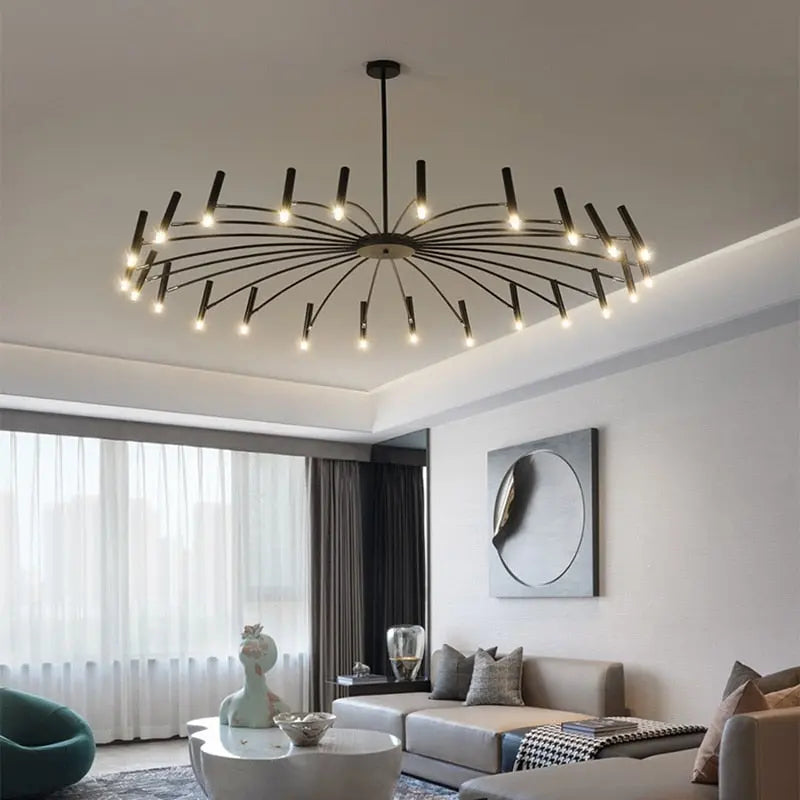
The Berny Ceiling Modern Chandelier, in 12, 18, or 24 lights, mounts directly at the ceiling with a full chandelier form — which means it can be centered on a dining table or seating group on an 8-to-9-foot ceiling where a hanging chandelier's drop would be a clearance problem.
Flush mounts: placed anywhere

A flush mount like the Art Deco Ceiling Light Flush Mount has no clearance constraint, so it goes wherever the placement rule says — the room's center in a hallway or bedroom, in a grid across a larger space — on any ceiling height.

The Lyla Crystal Flush Mount Ceiling Light shows a flush mount that still reads as a designed fixture from below — the right kind for a bedroom center or a low-ceiling dining room where placement is fixed by the room but the fixture should still have presence.
Semi-flush: a little drop, most of the freedom

Semi-flush fixtures like the Modern Close to Ceiling Lights drop 4 to 8 inches, which keeps them clear of walkways on 8-to-9-foot ceilings while adding the ceiling bounce and profile a flush mount lacks — a good middle option for room-centered placement in living rooms and bedrooms. The dining room ceiling lights guide sorts the ceiling-close types by drop.
How to Move a Ceiling Light to a Better Spot
The most common placement problem isn't choosing a spot — it's that the existing box is in the wrong one. A dining fixture centered on the room when the table is offset, a bedroom box that doesn't line up with the bed, a foyer box off the entry's center. There are four fixes, from no-wiring to full relocation.
| Method | How it works | Best for | Electrician needed? |
|---|---|---|---|
| Swag hook | Hang the fixture's chain or cord from the box, run it to a ceiling hook at the right spot, and let it drop there | Chain- or cord-hung chandeliers and pendants moved 1–4 ft | No (hook into a joist or a rated anchor) |
| Offset canopy / medallion | A wide canopy or ceiling medallion covers the box while the drop point sits a few inches off it | Small offsets of 2–8 in | No |
| Track or rail | A track mounts at the box; heads or pendants slide to the correct position along it | Kitchens, living rooms, art walls; any distance along the track's length | Usually no (surface-mount track) |
| Relocate the box | Cut a new box at the correct spot, extend the wiring from the old one, patch the old opening | Permanent fix for any distance; heavy fixtures | Yes |
Two rules for moving a fixture. First, the box still carries the weight: a swag hook holds only the fixture's lateral pull, so the hook must be in a joist or a rated anchor, and heavy fixtures — anything over about 20 pounds — should be relocated properly rather than swagged. Second, a swag or offset changes the drop: measure the new hanging height from the hook, not the box, and re-check the clearance rules. If you're relocating the box for a heavy chandelier, the new box needs the same rating as the old — 50 pounds standard, a joist brace above that. The flush mount installation guide and chandelier installation guide cover the mechanics.
Quick decision: which way to move it
Under 4 ft, light fixture on chain/cord: swag hook • A few inches off: offset canopy or medallion • Room layout might change again: track • Heavy fixture, or a permanent home: relocate the box with an electrician.
Should Ceiling Lights Face Up or Down?
Direction changes what the placement achieves. Downlights — most pendants, recessed lights, shaded chandeliers — put light on the surface below, which is what task placement wants over a table, island, or desk. Uplights — chandeliers with shades or arms pointing up, semi-flush fixtures with an open top — throw light onto the ceiling, where it bounces and spreads for softer, more even ambient light, which suits room-centered placement in living rooms and bedrooms. Many chandeliers do both. As a rule: over furniture, favor down; at the room's center, favor up or both; and in a room with a dark ceiling, uplight is wasted.
Brightness: Lumens, Not Watts

Placement only works if the fixture puts out enough light for its spot. Plan in lumens rather than watts — watts measure consumption, and an LED delivers several times the light per watt of an incandescent. As a baseline, aim for 10 to 20 lumens per square foot in hallways and foyers, 20 to 30 in living rooms, dining rooms, and bedrooms, and 30 to 40 in kitchens and bathrooms. A 150-square-foot living room wants roughly 3,000 to 4,500 lumens across its fixtures; a 10-by-12 kitchen closer to 3,600 to 4,800. Split that between the ceiling light and the supporting layer — a central fixture at 2,000 to 3,000 lumens plus lamps or sconces. Choose warm white (2700–3000K) for living spaces and 3000–4000K for kitchens and baths, at CRI 90 or higher. The room lumens guide sets the target for any size.
Controls That Make Placement Flexible
Good placement gives every fixture its own job; controls let you run them separately. Put the central fixture on a dimmer, keep task lights on their own switch, and in rooms with both, wire them to separate controls so the ceiling light can run low while task lights stay bright. Smart bulbs or fixtures add scenes — a bright "cleaning" setting and a low "evening" one — without rewiring, and motion sensors suit hallways and closets where the light is on briefly.
Installation and Safety Notes
Whatever the placement, confirm the ceiling box is rated for the fixture — standard boxes hold about 50 pounds, and heavier chandeliers need a brace to a joist. Adding a light where none existed, or relocating a box, is an electrician's job. Look for UL-listed fixtures, and for bathrooms, a damp-location rating. Turn off power at the breaker and confirm with a tester before touching wiring.
Flush mounts, semi-flush, ceiling-mounted chandeliers, track, and pendants.
Ceiling Lights Flush Mount Pendants Chandeliers
Frequently Asked Questions
Where should a ceiling light be placed in a room?
Center it on the room if the light is general — a hallway, a bathroom, a bedroom without a defined bed wall, a square living room. Center it on the furniture if the light serves something specific — over the dining table, the kitchen island, the bed, or the main seating group — even when that puts it off the room's geometric center. Keep the bottom of a hanging fixture at least 7 feet above the floor in walkways, 30 to 36 inches above a table or island, and at least 3 feet above a mattress. If the existing ceiling box is in the wrong spot, move the light with a swag hook, an offset canopy, a track, or a relocated box.
What is the best way to arrange multiple ceiling lights in a room?
Space recessed or flush fixtures by dividing the ceiling height in half — about 4 feet apart on an 8-foot ceiling, 5 feet on a 10-foot ceiling — and set the first row half that distance from the walls so the edges aren't dark. Keep rows parallel to the room's longest wall and the grid symmetrical. For pendants in a row over an island or table, space them 24 to 30 inches apart with equal gaps at the ends. Then check the count against lumens: the grid should add up to the room's target (20 to 30 lumens per square foot in living areas, 30 to 40 in kitchens).
How do I move a ceiling light to a different location?
Four ways, from simplest to most permanent. A swag hook lets a chain- or cord-hung fixture drop from a hook at the correct spot while still wired at the existing box — good for moves of 1 to 4 feet with lighter fixtures. An offset canopy or ceiling medallion covers the box while the drop sits a few inches off it. A surface-mounted track installs at the box and lets heads or pendants slide to the right position. For heavy fixtures or a permanent fix, an electrician cuts a new box at the correct spot, extends the wiring, and patches the old opening. A swag hook must be anchored in a joist and only suits fixtures under about 20 pounds.
Where should a chandelier be placed in a house?
Over the thing it serves. In a dining room, centered on the table's center point, 30 to 36 inches above the tabletop. In a living room, centered on the main seating group with at least 7 feet of floor clearance. In a foyer, centered on the entry space — or in the void of a two-story entry with the bottom at the second-floor line. In a stairwell, centered in the opening, clear of the stair, with 7 feet over every tread. Over a bed, centered on the mattress with the bottom at least 3 feet above it. A chandelier never belongs centered on a room whose focal furniture sits elsewhere.
Where should a ceiling light go in a bedroom?
Over the bed if the bed is the room's focal point — centered on the mattress rather than the room, with the fixture's bottom at least 3 feet above the mattress, which is why a short-drop fixture works there even on a standard ceiling. If the bed sits against a side wall, or the room is used as much for dressing as for sleeping, a flush or semi-flush mount at the room's center lights the whole space evenly and keeps walkways clear. Bedside lamps or wall sconces supply reading light either way, and the ceiling fixture should be on a dimmer.
Should ceiling lights point up or down?
Down over furniture, up or both at the room's center. Downlights — most pendants, recessed lights, and shaded chandeliers — put light on the surface below, which is what task placement wants over a table, island, or desk. Uplights — chandeliers with upward-facing arms, semi-flush fixtures with an open top — bounce light off the ceiling for softer, more even ambient light, which suits room-centered placement in living rooms and bedrooms. Many chandeliers do both, and that's the most versatile choice. In a room with a dark-painted ceiling, uplight is largely wasted, so favor down.
How bright should a ceiling light be for its room?
Plan in lumens, not watts. Aim for 10 to 20 lumens per square foot in hallways and foyers, 20 to 30 in living rooms, dining rooms, and bedrooms, and 30 to 40 in kitchens and bathrooms — a 150-square-foot living room wants about 3,000 to 4,500 lumens across its fixtures. Split that between the ceiling light and a supporting layer of lamps or sconces, with the central fixture supplying roughly 2,000 to 3,000. Choose warm white 2700–3000K for living spaces and 3000–4000K for kitchens and baths, at CRI 90 or higher, and put the main fixture on a dimmer.
Placing Ceiling Lights Well
Ceiling light placement follows two rules — center on the room for general light, center on the furniture for focal light — plus the clearances that keep fixtures out of the way and the spacing rule that keeps grids even. Apply them room by room, choose the fixture type that gives the placement freedom you need, and when the existing box is wrong, move the light rather than living with it. Plan brightness in lumens and put the main fixture on a dimmer, and the light will be where the room needs it.
Browse the ceiling lights collection for flush, semi-flush, and track options, or the chandeliers collection for fixtures placed over furniture. For choosing the fixture itself, how to choose ceiling lights covers type and size room by room.


