

Key Takeaways
| Question | Answer |
|---|---|
| Why black? | Clear outline on light ceilings; matches black windows and hardware; spans modern, farmhouse, industrial. |
| Matte, satin, or textured? | Matte is the modern default; satin is softer and easier to clean; textured suits industrial and rustic. |
| Six forms? | Sputnik, glass globe/orb, linear, ring, vertical/staircase, geometric cage. |
| Best walls? | White and warm white (strong outline), greige (softer); on navy or charcoal black recedes. |
| Pair with? | Gold or brass, oak or walnut, opal or amber glass — one warm accent keeps black from feeling flat. |
| Is black going out? | Pure flat black is softening toward warmer pairings, but black as an outline finish remains the most versatile modern choice. |
Quick Facts
- Black fixtures look about 10–15% larger than brass or white ones of the same size — stay mid-range or choose open forms.
- Matte black shows dust and fingerprints more than satin; dust with a dry microfiber monthly.
- Shades decide the light: opal glass gives even glow, clear glass shows the bulb, black metal shades throw light down only.
- Light at 2700–3000K, CRI 90+; switchable LEDs usually ship on 6000K — reset them.
- Black reads strongest within 2–3 ft of another black element (window frame, chair legs, hardware).
- Sizing: room L + W (ft) in inches; ½–⅔ of table width over a dining table.
Why Black Works — and Where It Does Not
Black does three things no other finish does as well. It gives a fixture a crisp silhouette against a white or warm-white ceiling, so even a slim frame reads from across the room. It ties into the black window frames, door hardware, faucets, and furniture legs that have become standard in new construction and renovations. And it sits between styles: the same black globe chandelier works in a modern farmhouse dining room and a mid-century living room. Where black struggles is in dark rooms — against navy, charcoal, or dark wood paneling it recedes and the fixture disappears — and in rooms with no other black at all, where it can look dropped in. The test is simple: if you can point to two other black things in the room, a black chandelier will belong. For the dining-room decision in detail, see black dining room lights.
Matte, Satin, and Textured Black
| Finish | Look | Shows | Best for |
|---|---|---|---|
| Matte black | Flat, no reflection, the cleanest outline | Dust, fingerprints, scuffs | Modern, minimal, Scandinavian, modern farmhouse |
| Satin black | Low sheen, slightly softer | Less dust and marks | Kitchens, family rooms, anywhere it gets touched |
| Textured / sand black | Fine grain, slightly gray | Least | Industrial, rustic, lofts |
| Black + gold interior | Black outside, gold inside shades or sockets | Dust on black only | Dining rooms, transitional rooms |
Black Against Your Walls
Wall color decides whether black is an outline or a shadow. On white and warm white it is at its strongest; on greige and taupe it softens but still reads; on mid-tone wood walls and beams it gives the fixture definition the wood alone would not; on navy, charcoal, or dark green it recedes, and a brass or gold fixture usually works better there. If the ceiling is painted dark, a black fixture becomes a deliberate tone-on-tone — effective in a moody dining room, but no longer a focal point.
Six Modern Black Forms
Sputnik
Rods radiating from a center, tipped with small bulbs or globes. In black it reads as a drawing in the air and suits mid-century living and dining rooms; black-and-gold versions add warmth at the tips.
Glass globe or orb
Black arms or a black canopy carrying opal, clear, or smoked glass spheres. The glass softens the black and gives the most comfortable light of the six — the safest black choice over a dining table or in a bedroom.
Linear
A black bar with pendants, LED, or globes beneath, for rectangular dining tables and kitchen islands. Black makes the line read clearly against white cabinetry; the island version is covered in kitchen chandeliers.
Ring
One or more black LED hoops — the most minimal form, a pure circle drawn on the ceiling. A single ring suits 8- to 9-foot rooms; stacked rings fill taller ones. See modern ring chandeliers.
Vertical / staircase
A black frame taller than it is wide — a rectangle, a spine, a stack — for stairwells and two-story foyers, where black is the clearest finish to read against a white wall from two floors. Sizing is in long chandeliers for staircases and high ceilings.
Geometric cage
An open black frame — a sphere, a lantern, a polyhedron — around bulbs. It is the industrial and modern-farmhouse form, at home with wood tables and brick.
Pairing Black With Gold, Wood, and Glass
Pure flat black everywhere can make a room feel heavy, and designers have been softening it with warmer metals and natural materials. The answer is not to abandon black but to give it one warm partner. Black with gold or brass — at the sockets, inside the shades, on the canopy — is the most common pairing and the subject of black and gold chandeliers. Black with oak or walnut reads Scandinavian or modern rustic. Black with opal glass is soft and modern; with amber or smoked glass, warm and retro. Keep it to black plus one: black with gold and wood and amber glass at once starts to look busy.
| Room | Black form | Partner | Size / height |
|---|---|---|---|
| Dining room | Globe/orb, linear, sputnik | Opal glass or gold accents; wood table | ½–⅔ of table width (linear ⅔–¾ of length); 30–36 in above |
| Living room | Ring, sputnik, cage | Oak or walnut, linen | Room L + W in inches; 7 ft clearance |
| Kitchen island | Linear, globe pendants | White cabinets, brass hardware | 60–70% of island length; 28–34 in above |
| Entry / foyer | Cage, globe, vertical | Black door hardware, wood floor | Room L + W; above door height |
| Stairwell | Vertical, long spine | White walls, black rail | Body at or above second-floor line |
| Bedroom | Ring, flush globe | Warm wood, linen | Room L + W; flush on 8 ft ceilings |
| Hallway | Flush linear, small cage | Black door hardware | ≤ ⅓ of hallway width |
Sizing: Black Reads Heavier
The room formula is the same as for any chandelier — length plus width in feet, as inches, over open floor; half to two-thirds of the table width over a dining table — but black adds visual weight, so a black fixture looks roughly a size larger than a brass or white one of the same dimensions. Stay at the middle of the range for dense forms such as cages and stacked rings, and use the top of the range only for open ones such as sputniks and single rings. Large black chandeliers — the "large black chandelier" search — are best in tall rooms where the outline has space around it; in an 8-foot room, a wide but shallow black ring or flush globe cluster gives presence without crowding. The calculator is at chandelier size calculator.
Light, Shades, and Color Temperature
A black fixture absorbs rather than reflects, so the light comes entirely from what the frame carries. Opal and frosted glass give an even glow and soften the black; clear glass shows the bulb and sparkles against it; black metal shades throw light only downward, which is right over an island and wrong as a room's only source. Keep the color at 2700–3000K — warm white gives black depth, while 4000K and above makes it read harsh and the room clinical — with CRI 90 or higher. Integrated-LED black fixtures with switchable color usually ship on 6000K and should be reset on first use. Dimming follows the usual rule: built-in remote, or an LED-rated wall dimmer matched to the driver.
Is Black Going Out of Style?
Pure, flat, everything-black is giving way to warmer pairings: trend reports for 2026 point designers toward softer, warmer metals and natural materials instead of matte black alone. That is a shift in how black is used, not a retreat from it. Black remains the most versatile outline finish for modern rooms, and black paired with a warm accent — gold sockets, wood, opal or amber glass — is exactly where current interiors are going. A black fixture chosen with one warm partner and matched to the black already in the room will not look dated in five years.
Quick decision: which modern black chandelier
Mid-century room: black sputnik or black-and-gold sputnik • Dining table: black with opal globes, or a black linear over a rectangular table • 8–9 ft living room: black ring or flush globe cluster • Kitchen island: black linear • Stairwell or two-story foyer: black vertical rectangle or long spine • Industrial or modern farmhouse: black cage • Dark walls: choose brass instead • Always: one warm partner, 2700–3000K, mid-range size for dense forms.
Modern Black Chandeliers by Form
Six modern black fixtures, one or more for each form.
Sputnik and glass
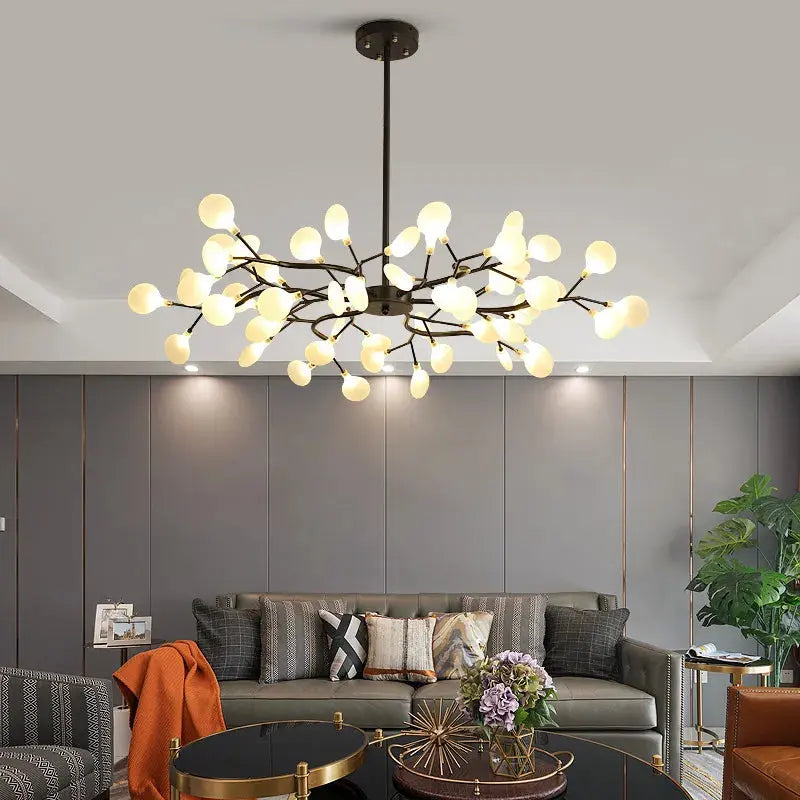
The Sputnik Branch Firefly Chandelier, in black with gold, is the black sputnik with a warm partner built in: thin branches tipped with small lights, for a mid-century living or dining room on a 9-foot ceiling or higher.

The Modern Minimalist Bubble Glass Orb Chandelier, in black or gold with remote dimming, carries glass orbs on a minimal black frame — the softest black form, comfortable over a dining table or in a living room where people sit under it.
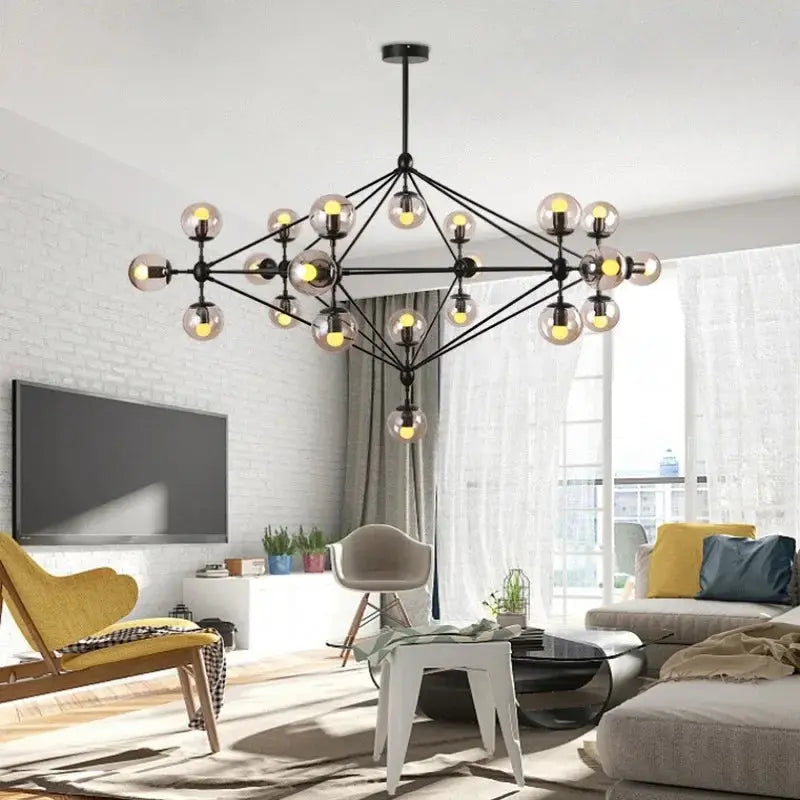
The Contemporary Black Chandeliers 15/21 Heads, in 15- or 21-head versions with glass shade options including gradient blue, is the large black statement for a living room, entry, or open-plan space — a wide spread of heads that reads as a black outline from across the room.
Linear, ring, and vertical
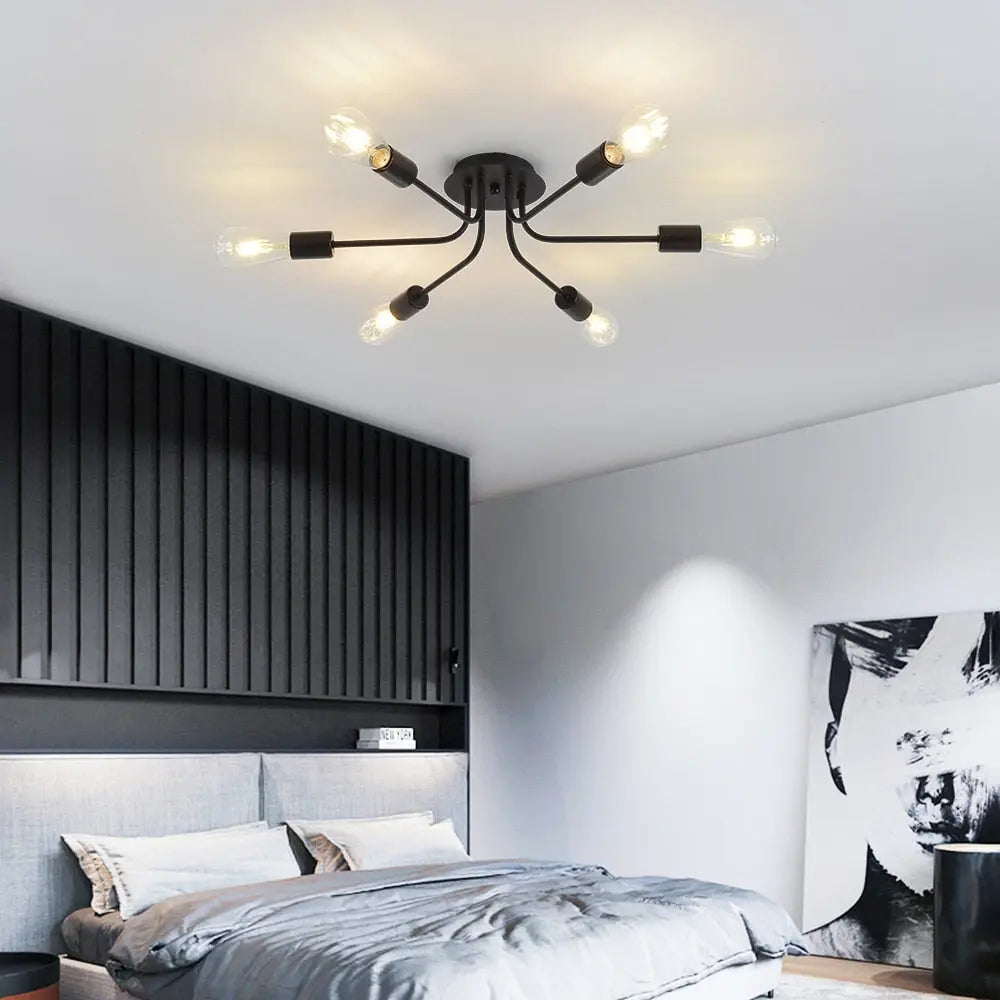
The Flush Mount Linear Chandelier in black is the low linear form for a kitchen, a long dining table on an 8-foot ceiling, or a hallway — a clean black line mounted close to the ceiling.
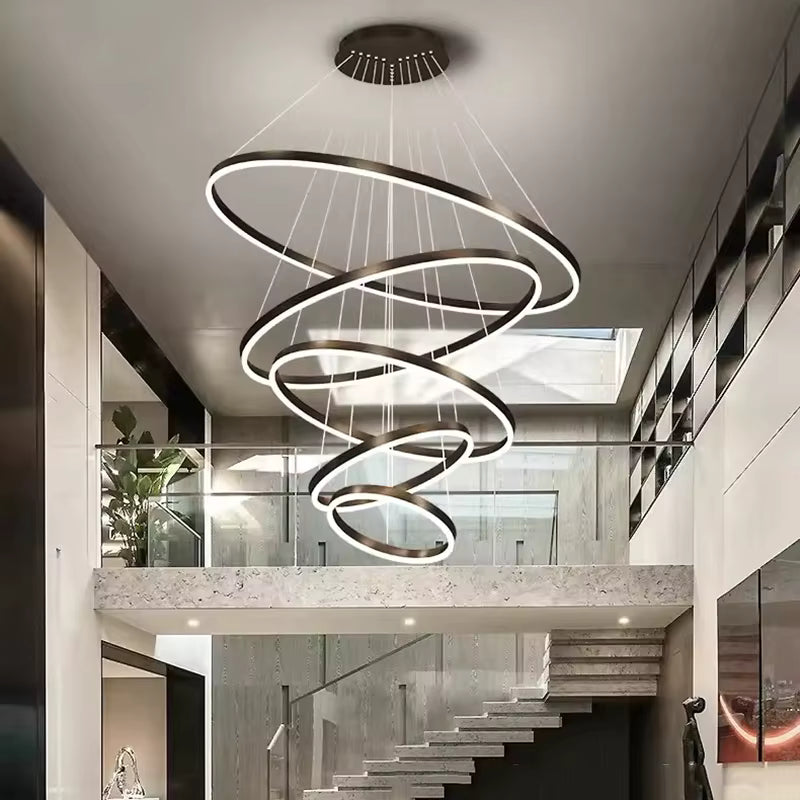
The Aysan Modern Ring Chandeliers in black draws one or more circles on the ceiling with integrated LED and remote dimming — one ring for an 8- or 9-foot room, stacked rings for taller living rooms and entries.
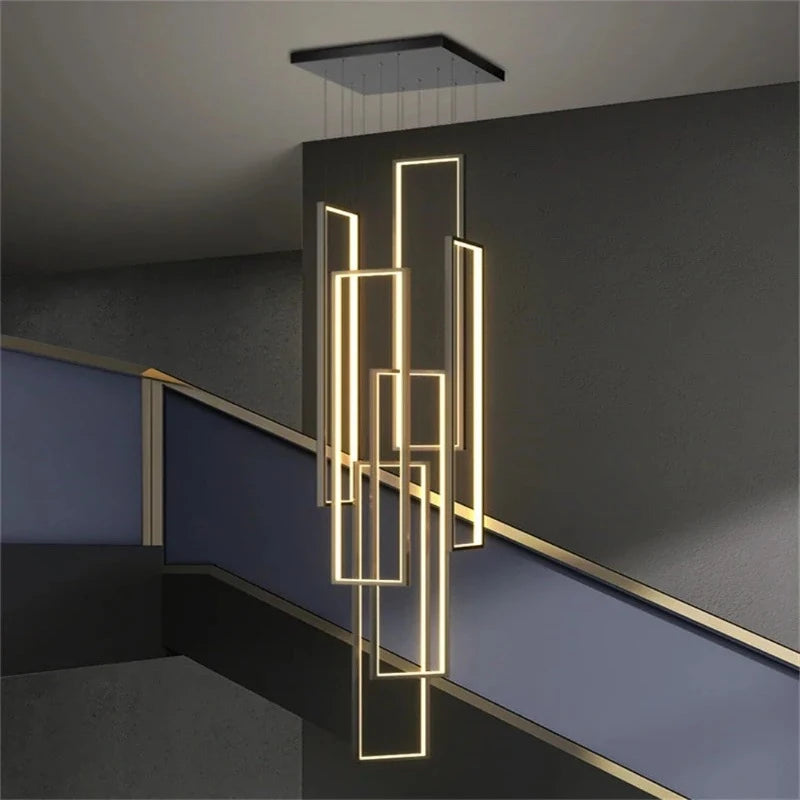
The Modern Large Vertical Rectangle Chandelier for Staircase in black is the vertical form for a stairwell or two-story foyer: an LED frame taller than it is wide, the clearest finish to read against a white stair wall from two floors.
Black sputnik, globe, linear, ring, vertical, and cage designs for every room.
Black Chandeliers Modern Chandeliers Dining Room Staircase
Frequently Asked Questions
Are black chandeliers still in style?
Yes. Pure flat black everywhere is softening toward warmer pairings, but black used as an outline finish — matched to black windows and hardware and paired with gold, wood, or warm glass — remains one of the most versatile modern choices.
What rooms suit a black chandelier?
Any room that already has black in it — window frames, hardware, furniture legs — and walls light enough for an outline to show: dining rooms, living rooms, kitchens, entries, stairwells, and bedrooms. In dark-walled rooms a black fixture recedes.
Matte black or satin black?
Matte black gives the cleanest modern outline but shows dust and fingerprints; satin black has a low sheen, looks slightly softer, and is easier to keep clean in kitchens and family rooms.
What wall colors go with a black chandelier?
White and warm white give the strongest outline; greige and taupe soften it; mid-tone wood walls work. On navy, charcoal, or dark green, black recedes — a brass or gold fixture usually works better there.
Should a black chandelier match my black hardware?
It should repeat it. A black fixture reads strongest when two or three other black elements are nearby; the exact shade does not need to match, but mixing black with bronze nearby can look like a mismatch.
Does a black chandelier make a room look smaller?
It adds visual weight, so a black fixture looks about a size larger than a brass or white one. In small or low rooms choose open forms such as a single ring or sputnik, or a flush design, and stay mid-range on size.
What goes well with a black chandelier?
One warm partner: gold or brass accents, oak or walnut, or opal or amber glass. Black plus one reads intentional; black with several accents at once looks busy.
What size black chandelier do I need?
Add the room's length and width in feet and use that number in inches over open floor, or half to two-thirds of the table width over a dining table. Because black reads heavier, stay mid-range for dense forms.
What bulbs suit a black chandelier?
Warm white LED at 2700–3000K, CRI 90 or higher. Opal glass gives an even glow; clear glass with a filament bulb sparkles against black; black metal shades direct light down only.
How do I clean a matte black chandelier?
Turn off the power and dust monthly with a dry microfiber cloth. For marks, use a barely damp cloth and dry immediately; avoid polish or abrasive cleaners, which leave shiny patches on matte finishes.
Choosing a Modern Black Chandelier
Count the black already in the room, check the wall color, pick the form for the surface and the ceiling, and give the fixture one warm partner. A black chandelier chosen that way reads as the room's line drawing rather than a dark object on the ceiling.
Browse the full range in the black chandeliers collection and modern forms in modern chandeliers. For black in a dining room specifically, read black dining room lights; for the two-finish look, black and gold chandeliers.


