

Black and gold is the mixed-metal pairing that has outlasted every other, because the two finishes do opposite jobs on one fixture: black draws the outline, gold catches the light. This guide explains the four ways the combination is built, which version suits which room and which hardware, and how to pair a black and gold chandelier with walls, table, and the other metals already in the house.
Key Takeaways
| Question | Answer |
|---|---|
| Why does black and gold work? | Black defines the shape and controls glare; gold reflects light and adds warmth. One finish should dominate (70–80%). |
| What are the four combinations? | Black frame + gold accents; gold frame + black shades; two-tone arms; black-and-gold crystal. |
| Which version for black hardware? | Black-dominant with gold accents. |
| Which version for brass hardware? | Gold-dominant with black shades or caps. |
| Which rooms? | Dining rooms and foyers first; kitchens (black-dominant), living rooms, bedrooms (gold-dominant). |
| Light and size? | 2700–3000K, CRI 90+, dimmer; sizing unchanged — ½–⅔ of table width, 30–36 in above the table. |
Quick Facts
- Dominance ratio: one finish on roughly 70–80% of visible surface, the other as a repeated accent.
- Hardware rule: repeat the fixture's dominant metal in the door handles and faucet; the accent metal can stand alone.
- Metal count: black + gold + at most one more (chrome or nickel) in the same room.
- Walls: black-dominant on pale and warm-neutral walls; gold-dominant on navy, charcoal, green.
- Light: 2700–3000K keeps gold warm; above 4000K gold reads green. Frosted bulbs on black frames with exposed sockets.
- Care: dry microfiber, damp cloth only; no ammonia, no paper towels on plated gold.
Why Black and Gold Works on One Fixture
Most two-metal fixtures fail because both metals are trying to do the same thing. Black and gold succeed because they do different things. Matte black absorbs light: it makes the fixture's outline read clearly against a ceiling or a window, and it keeps exposed sockets and arms from glaring. Gold reflects light: it picks up the bulbs and the daylight and gives the fixture warmth and a sense of material. Put together, the black gives the chandelier its shape and the gold gives it its life, and neither competes with the other.
The combination also solves a decorating problem. Black hardware and brass or gold hardware are the two most common choices in current American homes, and many houses have both — black door handles from one renovation, a brass faucet from another. A black and gold chandelier belongs to both, which is why designers list mixed metals, and brass with matte black specifically, among the leading directions for 2026. The condition is proportion: the pairing reads as intended when one finish dominates and the other repeats as an accent, and as a mistake when the two are equal and fight for attention.
The Four Ways Black and Gold Are Combined
1. Black frame with gold accents
The frame, arms, and canopy are matte black; the sockets, the central hub, the arm tips, or the inner surface of a shade are gold. This is the most common version and the easiest to place, because the fixture's outline is black and reads with black hardware, while the gold appears as the fixture's own detail rather than a second metal the room has to answer. It suits kitchens, modern dining rooms, stairwells, and foyers, and it pairs with matte black door handles, cabinet pulls, and window frames.
2. Gold frame with black shades or caps
The arms and body are gold or brass; the shades, globe caps, or bulb covers are black. The gold dominates, so the fixture is warmer and reads toward transitional, and it pairs with brass hardware. On a dark wall — navy, charcoal, deep green — this is the version to choose, because the gold frame stays visible where a black one would vanish. It suits dining rooms, living rooms with brass accents, and bedrooms.
3. Two-tone arms
Each arm is black for part of its length and gold for the rest, or alternating arms are black and gold. The split is graphic and reads unmistakably contemporary, which makes it the version for a modern open-plan room where the fixture is meant to be noticed from the living area. Because neither metal dominates, match the room's most visible hardware to black and let gold appear once more somewhere — a picture frame, a table base.
4. Black and gold crystal
A black or gold frame carries clear, smoked, or black crystal, and the second metal shows in the canopy, chain, or hub. Crystal changes the balance: the frame metal frames the sparkle, so the fixture reads more formal and belongs in a transitional dining room, a foyer, or a formal living room. Black crystal on a gold frame is the darkest, most dramatic version; clear crystal on a black frame with a gold canopy is the lightest. The black crystal chandeliers guide covers the crystal side in detail.
Which Version for Which Room and Hardware
| Room | Version | Pair with | Wall color | Form |
|---|---|---|---|---|
| Dining room, pale walls | Black frame, gold accents | Black chairs or table base; gold flatware or candlesticks | White, off-white, warm gray | Multi-arm, ring, or linear over rectangular tables |
| Dining room, dark walls | Gold frame, black shades | Brass hardware, wood table | Navy, charcoal, forest green | Multi-arm or crystal |
| Kitchen | Black frame, gold accents | Black pulls, brass faucet | Any | Linear over island or peninsula; ceiling-mounted over open floor |
| Foyer / two-story entry | Black frame, gold accents or black-and-gold crystal | Black stair rail with brass details, or brass rail | Pale or warm neutral | Vertical cascade, sputnik, tiered crystal |
| Living room | Gold frame, black shades or two-tone | Black-framed sofa, brass lamps | Warm neutral | Sputnik, ring, ceiling-mounted |
| Bedroom | Gold frame, black caps | Brass bedside lamps, black bed frame | Pale or muted | Small globe cluster or ceiling-mounted |
| Open-plan kitchen + living | Same version in both zones | One dominant metal across both | Consistent | Linear over island, sputnik or ring over living |
The table follows two rules. First, the fixture's dominant metal repeats in the room's most visible hardware — the door handles, the faucet, the stair rail — so that the fixture looks like it was chosen for the room. Second, the accent metal can stand alone or repeat once; it does not need to be matched everywhere. A black-dominant chandelier with gold sockets in a room with black handles and a single brass lamp is complete. For the dining-room-specific questions of when black is the right finish at all, and how black pairs with the table and chairs, the black dining room lights guide is the reference; this article assumes black is already in play and covers the gold.
Pairing With the Other Metals in the House
Black and gold are already two metals, so the room has budget for at most one more. A nickel or chrome faucet alongside a black and gold chandelier reads as a considered three-metal scheme; add a fourth — chrome cabinet pulls and nickel door handles — and the room looks assembled over several renovations. If the house already has chrome and nickel in the sightline, choose the black-dominant version with small gold accents, so the chandelier introduces one strong metal and a whisper of a second rather than two strong ones.
Brass and gold count as one metal for this purpose; the difference between a brass faucet and a gold-finished chandelier is tone, not category, and warm brass and gold read together at 2700–3000K. Copper is close enough to gold to pass in a warm room and clashes in a room with cooler tones. The brass dining room chandeliers guide covers the brass side; the crystal chandelier finishes guide compares gold, chrome, black, and silver on crystal.
Quick decision: which black and gold chandelier
Black hardware, pale walls: black frame with gold accents • Brass hardware or dark walls: gold frame with black shades • Contemporary open plan: two-tone arms, black in the hardware • Transitional dining or foyer: black-and-gold crystal, frame metal matched to the rail or handles • Room already has chrome or nickel: black-dominant, small gold accents • Every version: 2700–3000K, frosted bulbs on exposed sockets, dimmer.
Light Quality for a Two-Finish Fixture
Color temperature decides whether the gold reads as gold. At 2700K to 3000K a gold finish warms and the black frame reads as a clean outline; at 4000K gold turns greenish and at 5000K it reads as pale brass, while the black frame turns cold. Keep every bulb in the fixture at one warm value and choose a CRI of 90 or higher so the finish and the table beneath it show true. Black frames with exposed sockets need frosted or opal bulbs: the dark frame makes a bare filament read brighter by contrast than it would on a gold or white fixture. A dimmer is standard for any dining chandelier and matters more here, because the gold accents are at their best at 50 to 70 percent in the evening. The chandelier mood lighting guide covers dimmer and driver matching.
Black and Gold Chandeliers by Combination
Six fixtures that show the four combinations across dining, foyer, and open-plan rooms.
Black frame, gold accents
The Zentra Black and Gold Chandelier, in 6 to 10 lights, is the textbook black-frame-gold-accent fixture: black arms with gold at the sockets and hub, in a multi-arm form that suits a dining table or a standard-ceiling foyer. The 6-light size covers a 42-inch round table; the 10-light version spreads for a large dining room or entry.

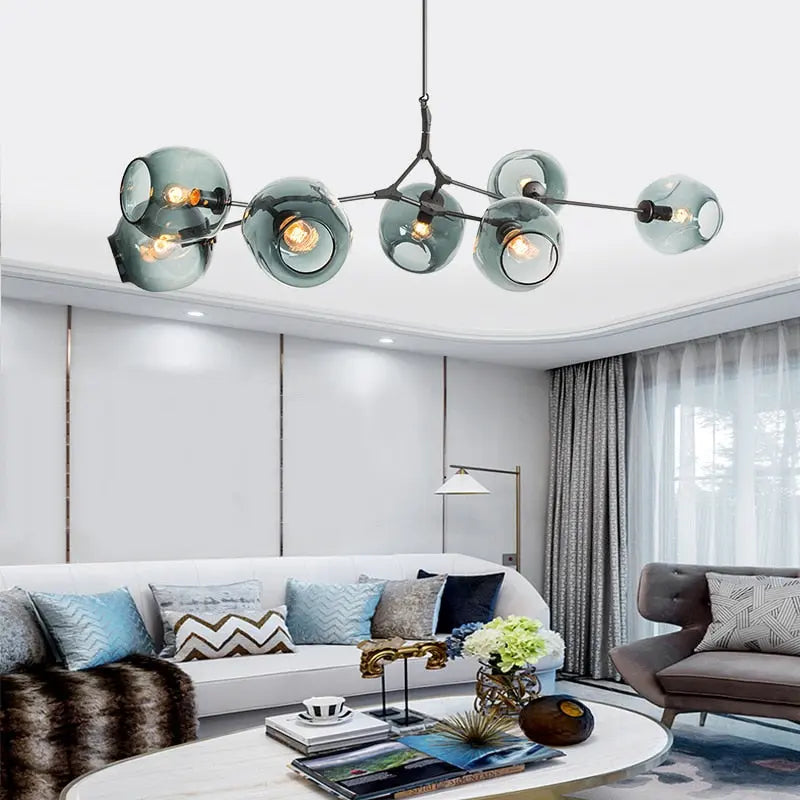
The 8 Light LED Glass Ball Chandelier Black/Gold puts the pairing on a sputnik of glass globes: black or gold arms with glass spheres that diffuse the LEDs, so the exposed-socket glare problem of a dark frame does not arise. It is the version for a modern dining room or an open-plan living area where the fixture is seen from several angles.
Gold frame with black elements and two-tone
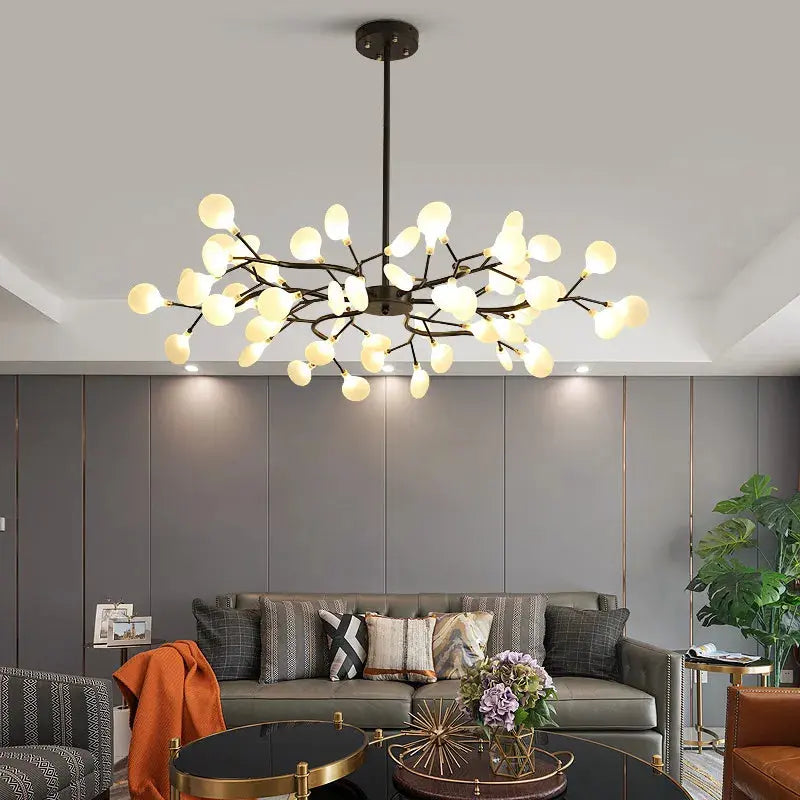
The Sputnik Branch Firefly Chandelier Gold&Black is the two-tone branch form: organic arms in gold and black tipped with small LED points. Its split reads contemporary, and its spread suits an open-plan kitchen and living area or a dining room with a 9-foot ceiling or higher, where the fixture is meant to be the room's focal point.

The Contemporary LED Spoke Pendant Light Fixture, in its black-and-gold option, is the linear version of the pairing: a bar of LED-tipped spokes for a rectangular table or a kitchen island, where the black frame reads with black pulls and the gold tips repeat a brass faucet. It is the kitchen pick on this list and follows island pendant spacing rules over a counter.
Black-and-gold crystal and stairwell
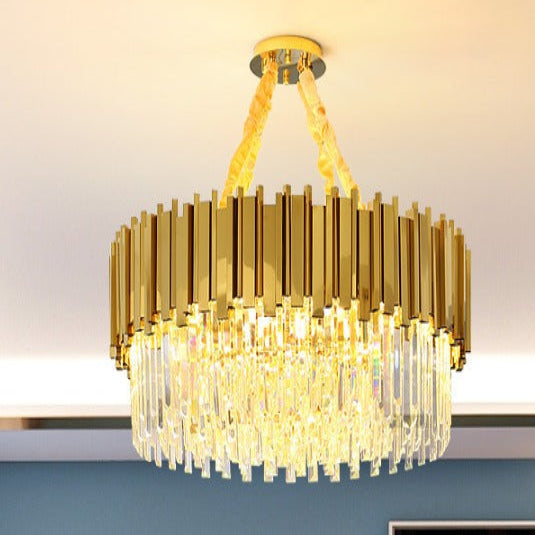
The Zen Modern Round Black and Gold Crystal Chandelier is the crystal version: a round frame in black or gold carrying crystal, sized for a dining table or a formal living room. It is the fixture for a transitional room that wants the sparkle of crystal with the outline of black and the warmth of gold, and it pairs with a brass stair rail or gold-framed mirror in a foyer.
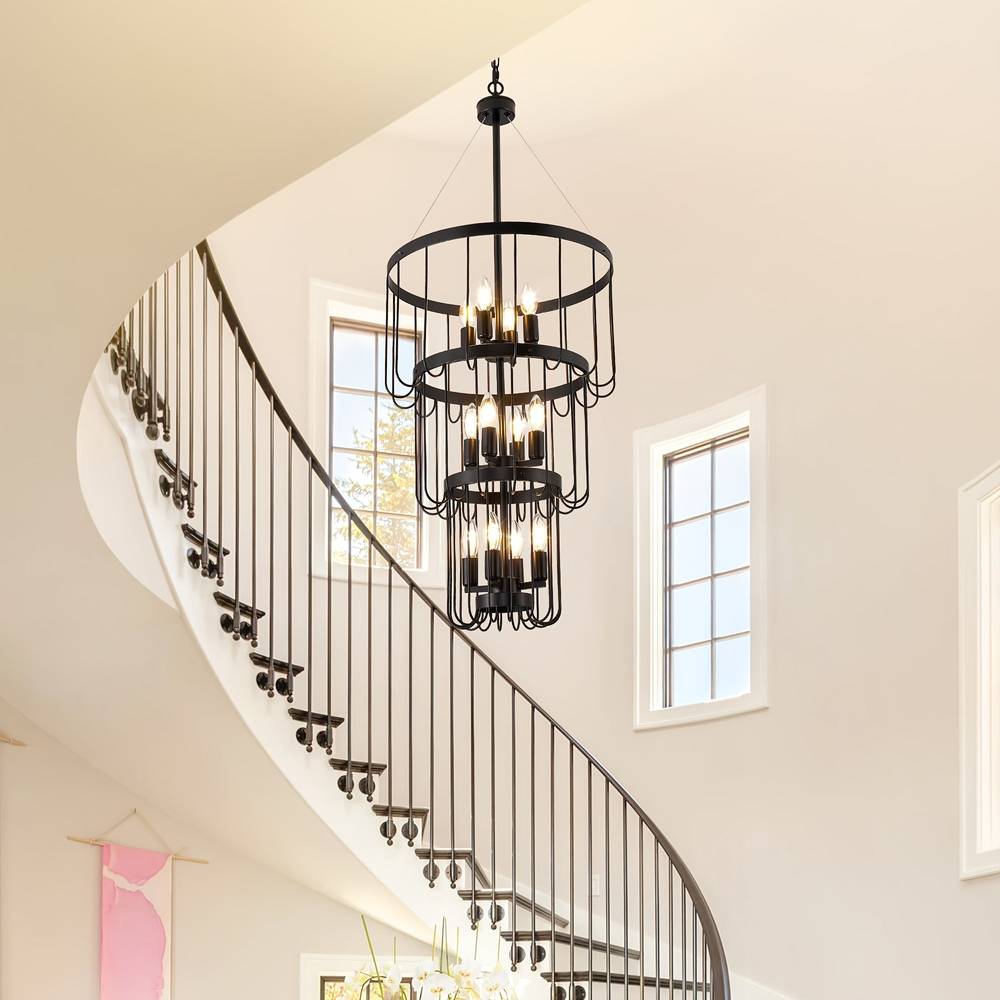
The 12-Light Farmhouse Staircase Chandelier, in its black-and-gold option, is the stairwell and two-story-foyer fixture: a vertical multi-tier form whose black frame gives the long drop a clear outline from the landing while the gold keeps it from reading heavy. It pairs with a black stair rail that has brass details, the most common two-metal combination in a current entry.
Black-frame, gold-frame, two-tone, and crystal designs for dining rooms, foyers, and open-plan homes.
Black Chandeliers Gold Chandeliers Dining Room Foyer
Size, Height, and Shape Do Not Change With Finish
A black and gold chandelier is sized and hung like any other: half to two-thirds of the table width for a round fixture, half to three-quarters of the table length for a linear one, 30 to 36 inches above the tabletop, and 7 feet of clearance over a walkway or a stair tread. The one finish-specific note is that a black-dominant fixture reads slightly larger than a gold one of the same diameter, because the dark outline is more visible against the ceiling, so a black-and-gold fixture at the small end of the size range still holds the table. Shape follows the table — round over round, linear over rectangular — and the linear vs round black chandelier guide makes that choice; the black chandelier sizing guide covers the diameter arithmetic in full.
Frequently Asked Questions
Do black and gold go together in a chandelier?
Yes, and the pairing is one of the most stable in lighting because the two finishes do opposite jobs: matte black defines the fixture's outline and absorbs glare, while gold catches light and adds warmth. The combination reads as intentional when one finish dominates — roughly 70 to 80 percent of the visible surface — and the other appears as a consistent accent, such as gold sockets on a black frame or black shades on a gold frame. Mixed-metal fixtures pairing brass or gold with matte black are a named 2026 direction.
What are the ways black and gold are combined on one chandelier?
Four patterns cover almost every black and gold chandelier: a black frame with gold accents at the sockets, hub, or tips (the most common and the easiest to pair with black hardware); a gold frame with black shades or black-capped globes (warmer, suits brass hardware); two-tone arms where each arm is half black and half gold (graphic, suits contemporary rooms); and black and gold crystal, where a black or gold frame carries clear or smoked crystal and the second metal appears in the canopy or chain.
Which rooms suit a black and gold chandelier?
Dining rooms first — the fixture sits above a table where its two finishes can repeat in chairs, flatware, and the table base — then foyers and stairwells, where black gives the outline a two-story drop needs and gold keeps it from reading heavy. Living rooms with black-framed furniture and brass accents take one well; bedrooms usually want the gold-dominant version. Kitchens take the black-dominant version with gold accents, matched to black pulls and a brass faucet.
Should I match a black and gold chandelier to my cabinet hardware?
Repeat one of the two finishes, not both. If the room's hardware is matte black, choose a black-dominant chandelier with gold accents; the gold then reads as the fixture's own detail. If the hardware is brass or gold, choose a gold-dominant chandelier with black shades or caps. A room that already has black and gold hardware can take either, but keep the fixture's dominant metal the same as the most visible hardware — usually the door handles and the faucet.
What wall colors work with a black and gold chandelier?
The pairing works on almost every wall because black and gold each anchor to a different side of the palette. On white and pale walls the black outline reads crisp and the gold adds warmth; on dark walls — navy, charcoal, forest green — the gold does the work and the black frame recedes, so choose a gold-dominant fixture. Warm neutrals (greige, taupe, warm gray) suit either. The one combination to avoid is a black-dominant fixture on a black wall, where the outline disappears and only the gold accents float.
Can I mix a black and gold chandelier with chrome or nickel elsewhere?
One additional metal is fine; two is not. Black, gold, and one of chrome or brushed nickel — say, a nickel faucet — reads as a considered three-metal scheme. Black, gold, chrome, and nickel together looks accidental. If the room already has chrome and nickel, choose a black-dominant chandelier whose gold reads as a small accent, so the fixture adds one strong metal rather than two.
How do I size a black and gold chandelier for a dining table?
Sizing does not change with finish: half to two-thirds of the table width for a round chandelier, half to three-quarters of the table length for a linear one, hung 30 to 36 inches above the tabletop. The one finish-specific note is that a black-dominant chandelier reads slightly larger than a gold one of the same diameter because the dark outline is more visible, so a black-and-gold fixture at the small end of the range still holds its own over the table.
What color light suits a black and gold chandelier?
2700K to 3000K. Warm white brings out the gold and keeps the black frame from reading cold; at 4000K and above gold looks greenish and the fixture loses its warmth. Choose a CRI of 90 or higher, put the fixture on a dimmer, and use frosted or opal bulbs on black-framed fixtures with exposed sockets, since the dark frame makes bare bulbs read brighter by contrast.
Is a black and gold chandelier modern or traditional?
The finish pairing is neutral; the form decides. A black-and-gold sputnik, ring, or linear fixture reads modern or mid-century; a black-and-gold multi-arm candle chandelier reads transitional; black-and-gold crystal reads traditional-leaning transitional. That is why the combination is useful in a home that mixes eras — the same two finishes can run through a modern kitchen fixture and a transitional dining chandelier and tie them together.
How do I keep gold and black finishes looking good?
Dust both with a dry microfiber cloth and wipe with a damp cloth only; never use ammonia or abrasive cleaners, which strip the lacquer on gold and leave marks on matte black. Gold on a chandelier is a plated or lacquered finish over metal, so it does not tarnish like solid brass, but it scratches, so avoid paper towels. Matte black shows fingerprints less than gloss black and is the easier of the two to maintain.
Choosing the Right Black and Gold Chandelier
Start with the hardware you already have, because it decides which metal should dominate; then let the wall color and the room confirm it, and let the form — multi-arm, sputnik, linear, or crystal — set the style. A black and gold chandelier chosen in that order looks like it was made for the room, and it has the useful property of belonging to both the black-hardware rooms and the brass-hardware rooms in a house that has both.
Compare the combinations in the black chandeliers collection and the gold chandeliers collection, or go to dining room lighting for fixtures already sorted by table use. For the decision of whether black belongs over your table in the first place, read the black dining room lights guide.


