

Las lámparas de araña sputnik de cristal sustituyen las bombillas expuestas por globos difusores —transparentes, esmerilados, opal o tintados— y ese único cambio transforma la luminaria de una declaración gráfica nítida a una luz más suave y habitable. La silueta de estallido de estrellas se mantiene. El deslumbramiento desaparece.
Tres familias de estilos dominan la categoría moderna de lámparas sputnik de cristal: racimos de burbujas, matrices de globos y diseños con acabado esmerilado. Parecen relacionados a primera vista, pero cada uno resuelve un problema diferente en una habitación diferente. Esta guía cubre lo que los separa, dónde encaja cada uno y cómo dimensionarlos y combinarlos con el resto de su interior. Si desea ir directamente a la compra, la colección completa de lámparas de araña sputnik y la colección dedicada de lámparas de araña de burbujas contienen todas las luminarias mencionadas en este artículo.
Qué diferencia a un sputnik de cristal de un sputnik clásico
Una lámpara de araña sputnik clásica —el tipo que definió finales de la década de 1950— utiliza brazos metálicos delgados con bombillas expuestas. La fuente de luz es visible, la geometría se lee nítida y la habitación registra una fuerte forma gráfica en el techo. (Para el contexto histórico completo de esa época, consulte nuestra guía principal: ¿Qué es una lámpara de araña Sputnik?)
Una lámpara de araña sputnik de cristal mantiene la geometría radial pero reemplaza la bombilla expuesta con una carcasa de cristal, una esfera, una lágrima o una "burbuja" redondeada. El cristal hace tres cosas a la vez:
- Difunde la luz. El filamento de la bombilla se vuelve invisible. Los puntos brillantes se convierten en orbes suaves y brillantes.
- Añade masa visual. Una punta de bombilla de 1.5" se convierte en un globo de 4" o 6" — la luminaria parece más pesada y escultural.
- Elimina la referencia de época. Sin bombillas expuestas, la forma ya no se lee explícitamente de mediados de siglo, sino contemporánea, de transición o moderna, dependiendo de la metalistería.
Ese tercer punto es la razón por la que las lámparas de araña sputnik de cristal se han convertido en la interpretación moderna por defecto de la forma. Mantienen la silueta sin encajar la habitación en una era de diseño específica.
Los tres principales estilos de Sputnik de cristal
Antes de entrar en las luminarias individuales, las tres familias de estilos y para qué es mejor cada una:
| Estilo | Geometría | Calidad de la luz | Ideal para |
|---|---|---|---|
| Sputnik de Burbujas | Racimo — globos a diferentes alturas y espaciado ajustado | Resplandor suave y multipunto | Entradas destacadas, comedores modernos, hostelería |
| Sputnik de Globos | Radial — brazos de igual longitud, globos espaciados uniformemente | Difusión uniforme y que llena la habitación | Comedores estándar, salas de estar, islas de cocina |
| Sputnik Esmerilado | Cualquiera — definido por el acabado del cristal, no por la disposición de los brazos | Más suave, más relajado | Dormitorios, comedores íntimos, zonas de baja luminosidad |
Burbuja y globo son categorías estructurales: describen cómo están dispuestos los brazos. Esmerilado es una categoría de acabado: describe el propio cristal. Las tres se superponen: existe un sputnik de globo esmerilado, y también un sputnik de burbuja transparente. Las etiquetas importan principalmente para el lenguaje de compra, pero comprender las diferencias subyacentes facilita mucho la decisión de compra.
Lámparas de araña Sputnik de burbujas: geometría de racimo y luz suave
Una lámpara de araña sputnik de burbujas organiza múltiples esferas de cristal a diferentes alturas alrededor de un núcleo central, imitando la forma en que las burbujas suben y se agrupan en el agua. Los brazos suelen ser más cortos que en un estallido de estrellas clásico, y los globos están más espaciados, lo que da como resultado una lectura densa, escultural y tridimensional en lugar de plana y gráfica.
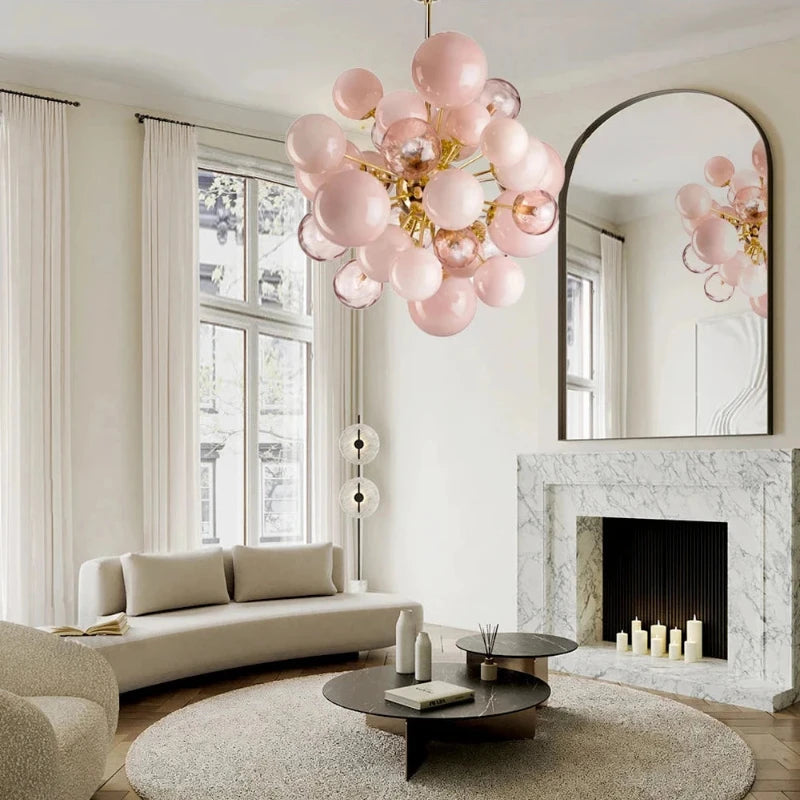
La forma de burbuja es la evolución más reciente de la categoría sputnik. Comenzó a aparecer ampliamente en el diseño residencial alrededor de 2015 como una polinización cruzada entre la geometría sputnik de mediados de siglo y las lámparas colgantes italianas de "burbujas" de la década de 1980 diseñadas por Pamela Sunday y otros. La interpretación moderna elimina cualquier decoración específica de la época y presenta el racimo como un objeto escultural puro.
Dónde funcionan los Sputnik de burbujas
- Vestíbulos y entradas de dos pisos. La profundidad vertical de una luminaria de burbujas agrupadas se adapta a espacios de doble altura donde un estallido de estrellas plano parecería aislado.
- Comedores modernos. Los racimos de burbujas atraen la vista hacia la mesa sin dominarla; los globos difunden la luz directamente sobre la comida y las caras.
- Interiores de hostelería. Restaurantes, salones de hotel y espacios comerciales boutique utilizan lámparas de araña sputnik de burbujas como piezas centrales porque se fotografían bien y se leen instantáneamente como "diseñadas".
La lámpara de techo Anya Modern Bubble Glass Flush Mount Light es la forma de burbuja adaptada a un perfil de montaje empotrado: la misma disposición de globos agrupados comprimida para techos de menos de 244 cm (8 pies). Para techos más altos donde el grupo puede colgar libremente, la lámpara de araña de cristal negro en forma de uva Pearl Black muestra la misma lógica con cristal negro ahumado para paletas más oscuras.

Para una mirada más profunda a cómo funcionan las luminarias de burbujas fuera de la categoría sputnik, consulte nuestra colección completa de lámparas de araña de burbujas.
Lámparas de araña Sputnik de globo: el estándar moderno
Una lámpara de araña sputnik de globo utiliza brazos de igual longitud que terminan en esferas de cristal de idéntico tamaño, la traducción más directa de la forma original de estrella en cristal. Los brazos irradian uniformemente, los globos se asientan en un solo plano (o muy cerca de él), y la luminaria se lee simétrica y equilibrada en lugar de agrupada.

Esta es la forma que la mayoría de la gente imagina cuando oye "lámpara de araña sputnik de cristal moderna". Es el caballo de batalla de la categoría, lo suficientemente neutra como para adaptarse a interiores de transición y contemporáneos, lo suficientemente estructurada como para anclar un comedor sin abrumarlo. La lámpara de araña de esfera de cristal sputnik moderna se envía en versiones de 12 y 15 luces y en cinco opciones de color que incluyen plata, negro, rojo y beige, cubriendo la mayoría de las paletas con las que un comprador podría estar trabajando.
Diámetro del globo y cobertura lumínica
El diámetro del globo afecta directamente cómo se ve la luminaria en una habitación. Tres rangos comunes:
- Globos pequeños (2.5–3.5" / 6–9 cm): Se ven delicados, casi como joyas. Ideales para habitaciones de tamaño mediano donde se desea presencia sin peso.
- Globos medianos (4–5" / 10–13 cm): El tamaño más común, equilibrado, escalado para lámparas de 10 a 12 luces estándar sobre mesas de comedor estándar.
- Globos grandes (6"+ / 15 cm+): Llamativos. Ideales para vestíbulos con techos altos, comedores de gran tamaño o grandes salones de planta abierta.
La Lámpara de Araña de Bolas de Cristal LED de 8 Luces en Negro/Dorado se encuentra en el rango de globos medianos y muestra cómo un menor número de luces con globos más grandes se lee más denso que un mayor número de luces con globos más pequeños, un truco útil para habitaciones donde se desea presencia sin la fragmentación visual de más de 15 bombillas pequeñas.
Esmerilado, transparente y ópalo: comparación de la difusión de la luz
La variable más importante en cualquier lámpara de araña sputnik de cristal —más importante que el número de brazos o el acabado— es el propio cristal. Tres acabados dominan el mercado y se comportan de forma muy diferente.
| Tipo de cristal | Visibilidad del filamento | Salida de luz | Riesgo de deslumbramiento | Ambiente |
|---|---|---|---|---|
| Cristal transparente | Totalmente visible | 100% (sin pérdida) | Alto | Nítido, gráfico, contemporáneo |
| Cristal esmerilado | Oculto, halo visible | 85–90% | Bajo–medio | Suave, equilibrado, de transición |
| Cristal ópalo | Oculto, brillo uniforme | 75–85% | Muy bajo | Suave, tranquilo, íntimo |
| Ahumado / tintado | Ligeramente visible | 60–75% | Bajo | Melancólico, atmosférico, dramático |
El error más común del comprador es elegir el cristal transparente para un comedor porque se fotografía mejor, y luego vivir con el deslumbramiento todas las noches durante años. Si los invitados se sientan en la mesa durante dos o tres horas seguidas, el esmerilado o el ópalo es casi siempre la elección correcta.
Diseños Sputnik de cristal de color y tintados
Más allá del cristal transparente, esmerilado y ópalo, una subcategoría más pequeña utiliza cristal de color o tintado — gris ahumado, ámbar, aguamarina, azul o rosa. Estos funcionan para compradores que desean un sputnik escultural que introduzca un acento de color en lugar de leerse como una luminaria neutra.
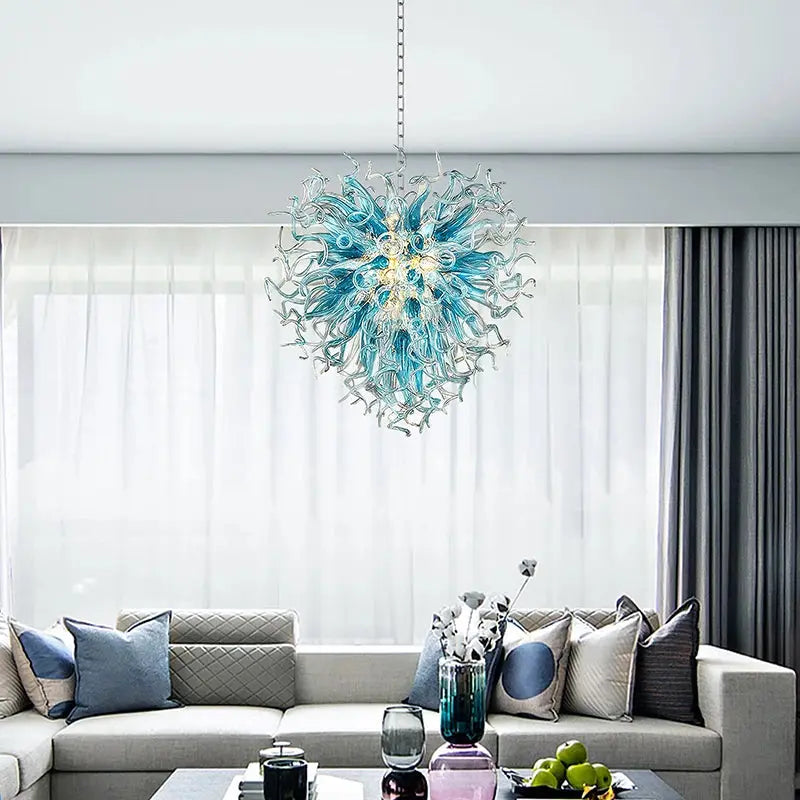
La Lámpara de Araña de Cristal Azul Aguamarina Moderna es el ejemplo más claro de cómo un sputnik de cristal tintado cambia las reglas del juego: en lugar de ser un elemento neutro que combina con todo, la luminaria se convierte en un acento de color deliberado que debe coordinarse con la paleta de la habitación. Esta es una elección de diseño más audaz —y más arriesgada para renovaciones centradas en el valor de reventa— pero también es una de las pocas formas de hacer que un sputnik moderno se sienta genuinamente personal en lugar de un elemento de catálogo predeterminado.
Una regla útil para las lámparas de araña sputnik de cristal tintado: el color ya debe aparecer en algún otro lugar de la habitación, como una alfombra, una obra de arte, cojines o azulejos de la cocina. Si solo aparece en la lámpara de araña, la luminaria parece aislada. Si hace eco de uno o dos elementos más, se lee como intencionada.
Dimensionamiento de lámparas de araña Sputnik de cristal
Las lámparas de araña sputnik de cristal siguen las mismas reglas de tamaño que las sputnik estándar, pero con un ajuste importante: los globos de cristal añaden peso visual. Una sputnik de globo de cristal de 81 cm (32") se ve más grande que una sputnik de bombilla expuesta de 81 cm (32"), aunque el diámetro de la medida sea idéntico. Ajuste la fórmula ligeramente hacia abajo para compensar.
| Habitación / Espacio | Diámetro recomendado | Tamaño del globo | Número de luces |
|---|---|---|---|
| Rincón de desayuno | 46–61 cm (18–24") | 8–10 cm (3–4") | 6–8 globos |
| Comedor estándar | 66–91 cm (26–36") | 10–13 cm (4–5") | 10–12 globos |
| Comedor grande / planta abierta | 91–112 cm (36–44") | 13–15 cm (5–6") | 12–15 globos |
| Vestíbulo de dos pisos | 81 cm (32") o más | 13–20 cm (5–8") | 15-20+ esferas |
| Dormitorio (sobre la cama) | 20-28" (51-71 cm) | 3-4" (8-10 cm) | 6-10 esferas (solo esmeriladas) |
Para comedores específicamente, cuelgue la parte inferior de la esfera más baja a 30-36" (76-91 cm) por encima de la mesa. Para dormitorios, eleve el espacio libre a al menos 32" (81 cm) por encima de la superficie de la cama; cualquier persona que se siente debe poder despejar la luminaria cómodamente.
Nuestra Calculadora de Tamaño de Candelabro calcula automáticamente las dimensiones de la habitación.
Calidad de la luz: Bombillas, LED y atenuación para Sputniks de cristal
Las lámparas de araña sputnik de cristal se comportan de manera diferente a las sputniks de bombilla expuesta en lo que respecta a la iluminación. Tres factores importan:
Temperatura de color
Las esferas de cristal calientan ligeramente el color percibido: una bombilla de 3000 K en una esfera esmerilada se percibe más cerca de los 2900 K porque la difusión enmascara los tonos más fríos del espectro. Para comedores, esto significa que 3000 K es casi siempre la elección correcta. Subir a 3500 K puede llevar la habitación al territorio de "cafetería de oficina", especialmente con cristal esmerilado u opalino.
Para obtener más información sobre la temperatura de color en la iluminación residencial, consulte nuestra guía completa de temperatura de color.
Vatios y calor de las bombillas
Las esferas de cristal cerradas retienen más calor que las bombillas expuestas. Siempre verifique la clasificación de vatios máxima en la hoja de especificaciones del producto y nunca la exceda. Para las bombillas LED, esto rara vez es un problema (los LED funcionan fríos), pero para cualquier bombilla incandescente o halógena de reemplazo, haga los cálculos: una bombilla incandescente de 60 W dentro de una esfera esmerilada de 4" calentará el cristal más allá de 65 °C (150 °F), lo que con el tiempo puede romper el sello y acortar la vida útil de la bombilla.
Compatibilidad con atenuadores
La mayoría de los candelabros de cristal sputnik de nuestra colección vienen con drivers LED regulables. Empareje el tipo de regulador con el driver que figura en la hoja de especificaciones: TRIAC, ELV o 0-10V. Los reguladores no coincidentes causan un parpadeo que es especialmente visible a través del cristal esmerilado, donde el más mínimo pulso se convierte en un brillo intermitente en lugar de una luz constante.
Dónde funcionan mejor las lámparas de araña Sputnik de cristal, habitación por habitación
Comedor
El mejor caso de uso. Las esferas de cristal difunden la luz sobre la mesa sin proyectar sombras duras en los rostros. Las esferas esmeriladas u opalinas son más amables para las cenas largas que el cristal transparente. Las sputniks de esfera redonda se adaptan a mesas redondas y cuadradas; las sputniks de cristal lineales se adaptan a mesas rectangulares. Explore la colección más amplia de iluminación de comedor para luminarias relacionadas.
Vestíbulo de dos pisos
Los sputniks de racimo de burbujas brillan aquí: la profundidad vertical de un racimo de varias esferas llena la altura de un espacio de dos pisos sin la torpeza de una sola estrella sobredimensionada. La lámpara de araña Sputnik Gold Glass Dandelion muestra cómo un diseño de cristal de mayor extensión se lee a escala.

Para más opciones específicas para dos pisos, vea nuestra colección de candelabros para vestíbulos de dos pisos.
Sala de estar
Los sputniks de esferas de tamaño mediano (10-15 luces, 71-81 cm / 28-32" de diámetro) funcionan bien como pieza central, especialmente en habitaciones de planta abierta donde la lámpara de araña necesita anclar una zona de asientos sin estar ligada a un mueble específico.
Isla de Cocina
Las sputniks de cristal lineales son la mejor opción para las islas rectangulares. Dos colgantes de esfera más pequeños colocados uno al lado del otro también funcionan para islas de más de 244 cm (8 pies) de largo. Mantenga las esferas esmeriladas u opalinas aquí; el cristal transparente sobre una isla de cocina coloca la bombilla directamente en la línea de visión de cualquier persona sentada en el mostrador.
Dormitorio
Los Sputniks de esfera esmerilada más pequeños (6-10 luces, 51-71 cm / 20-28" de diámetro) sobre la cama funcionan sorprendentemente bien en dormitorios modernos, reemplazando la pantalla de tambor o el plafón más típicos. Siempre esmerilado u opalino aquí; el cristal transparente directamente encima de la cama se ve áspero.
Baño (zona de tocador)
Los Sputniks de burbujas más pequeños en configuraciones de 4 a 6 luces funcionan sobre tocadores dobles o bañeras exentas. Confirme que la luminaria está clasificada para lugares húmedos antes de instalarla en cualquier baño.
Cuidado y mantenimiento de lámparas de araña Sputnik de cristal
Las lámparas de araña Sputnik de cristal requieren un mantenimiento ligeramente superior al de las versiones con bombillas expuestas, ya que las esferas acumulan polvo y la difusión hace que cualquier capa sea visible. Tres hábitos las mantienen como nuevas:
- Limpiar el polvo mensualmente. Un paño de microfibra en cada esfera tarda unos tres minutos en una luminaria de 12 luces. Omitir esto durante seis meses convierte las esferas esmeriladas de un brillo suave a un tinte grisáceo.
- Limpieza profunda dos veces al año. Retire las esferas individualmente, lávelas con jabón suave y agua tibia, séquelas con un paño sin pelusas y vuelva a instalarlas. Nunca rocíe el limpiador directamente sobre una luminaria mientras está montada, ya que el líquido se escurre por los brazos hacia el cubo y daña el cableado.
- Evite los limpiadores a base de amoníaco en metales. Los acabados de latón y oro tienen una fina laca que el amoníaco elimina. Use agua y jabón suave también en el metal; cualquier cosa más fuerte acorta la vida útil del acabado.
Sputnik de Cristal vs. Otras Lámparas de Araña de Cristal
Las lámparas de araña sputnik de cristal forman parte de una categoría más amplia de lámparas de araña de cristal. Las diferencias importan cuando estás comprando:
| Tipo | Característica distintiva |
|---|---|
| Lámpara de araña Sputnik de cristal | Brazos radiales con esferas de cristal en las puntas |
| Candelabro de burbujas (no sputnik) | Las esferas se agrupan libremente sin estructura radial, sin sistema central de cubo y brazo |
| Candelabro de cristal | Piezas de cristal facetadas (no esferas) que captan y refractan la luz |
| Cluster de colgantes de cristal | Múltiples colgantes de cristal caen de un dosel; sin geometría radial |
| Colgante de globo | Una sola esfera de cristal en un tallo, sin múltiples brazos |
Si está comparando precios, nuestras colecciones de candelabros de burbujas, candelabros de cristal y candelabros modernos cubren las categorías adyacentes.
Preguntas frecuentes
¿Qué es una lámpara de araña sputnik de burbujas?
Una lámpara de araña sputnik de burbujas organiza múltiples esferas de cristal a diferentes alturas alrededor de un núcleo central, imitando la forma en que las burbujas suben y se agrupan. Los brazos suelen ser más cortos y las esferas están más densamente espaciadas que en una sputnik radial clásica, lo que le da a la luminaria un aspecto escultural y tridimensional en lugar de una explosión plana.
¿Cuál es la diferencia entre un sputnik de globo y un sputnik de burbujas?
Las sputniks de globo tienen brazos de igual longitud y esferas de tamaño idéntico dispuestas radialmente en un solo plano, aproximadamente; la luminaria se percibe simétrica y estructurada. Las sputniks de burbujas varían la longitud de los brazos y el espaciado de las esferas para crear una cascada agrupada y multicapa.
¿Son las lámparas de araña Sputnik de cristal adecuadas para comedores?
Sí, a menudo son la mejor opción de candelabro para comedores porque las esferas de cristal difunden la luz sobre las caras y la mesa sin un deslumbramiento fuerte. Las esferas esmeriladas u opalinas funcionan mejor que el cristal transparente en comedores donde los invitados se sientan durante largos períodos.
¿Las esferas de cristal transparente causan deslumbramiento?
Pueden hacerlo. Las esferas de cristal transparente ocultan la bombilla visualmente, pero aún producen puntos de luz nítidos que pueden ser incómodos a la altura de los ojos. Para comedores y cualquier espacio donde los invitados se sienten cerca del accesorio, las esferas esmeriladas u opalinas suelen ser mejores opciones.
¿Qué tamaño de esferas funciona mejor en una lámpara de araña sputnik?
Las esferas de 4 a 5 pulgadas (10 a 13 cm) son el tamaño más común y se adaptan a luminarias estándar de 10 a 12 luces sobre mesas de comedor estándar. Las esferas más pequeñas (3 pulgadas/8 cm) se adaptan a habitaciones medianas; las esferas más grandes (6+ pulgadas/15 cm+) se adaptan a vestíbulos y espacios de gran tamaño.
¿Puedo usar bombillas LED en un candelabro sputnik de cristal?
Sí, y deberías. Los LED funcionan fríos, encajan de forma segura dentro de las esferas cerradas y duran de 15 a 25 veces más que las bombillas incandescentes. Confirme el tipo de base de la bombilla (E12 o E26) en la página del producto antes de realizar el pedido.
¿Son regulables las lámparas de araña Sputnik de burbujas?
La mayoría lo son. Haga coincidir el tipo de atenuador (TRIAC, ELV o 0-10V) con el controlador LED que se indica en las especificaciones del producto. Los atenuadores no coincidentes causan un parpadeo que es especialmente visible a través del cristal difusor.
¿Dónde puedo comprar un candelabro Sputnik de cristal?
Nuestra colección de candelabros Sputnik y nuestra colección dedicada de candelabros de burbujas cubren diseños de burbujas, globos, esmerilados y tintados. Envío gratuito a todo el mundo y devoluciones en 20 días en cada pedido. Contáctenos para solicitudes de tamaño o acabado personalizados.
Elegir su lámpara de araña Sputnik de cristal
Las lámparas de araña Sputnik de cristal resuelven un problema específico mejor que cualquier otra categoría de iluminación: le brindan el impacto escultural de una lámpara de araña clásica sin el deslumbramiento que hace que los accesorios con bombillas expuestas sean incómodos en los espacios habitables. Los grupos de burbujas agregan profundidad a los vestíbulos; los conjuntos de esferas proporcionan una difusión uniforme para los comedores; los acabados esmerilados suavizan la luz para los dormitorios y las zonas íntimas; el cristal tintado agrega personalidad donde los accesorios neutros se sentirían anónimos.


