

A kitchen table is not a dining room table, and it shouldn't be lit like one. It's smaller, it usually sits under a standard 8-foot ceiling, it's a few steps from the stove, and it's used for breakfast, homework, and coffee as much as for dinner. The fixture over it needs to be sized to a compact table, hung where it clears the space, easy to keep clean near cooking, and coordinated with whatever hangs over the island. This guide covers all of it — fixture type, size, height, style, and the island question — for eat-in kitchens and breakfast nooks.
Key Takeaways
| Question | Answer |
|---|---|
| What size light fixture for a kitchen table? | One-half to two-thirds of the table's width — typically 18 to 28 inches for a 36-to-48-inch kitchen table. |
| How high should it hang over a kitchen table? | The bottom of the fixture 30 to 34 inches above the tabletop, slightly lower than a dining room's upper limit. |
| What fixture type fits an 8-foot kitchen ceiling? | A semi-flush, a short-drop pendant, or a compact ceiling-mounted chandelier. |
| What materials work near cooking? | Glass, metal, and simple crystal that wipe clean; avoid fabric shades and dense crystal strands. |
| Should it match the island pendants? | Share the finish, vary the form — same metal, different shape, same warm color temperature. |
| How bright should a kitchen table light be? | About 2,000 to 2,500 lumens at 2700–3000K on a dimmer, so it works for breakfast and homework as well as dinner. |
Quick Facts
- Kitchen tables are typically 36–48 inches; their fixtures are 18–28 inches, a size or two smaller than dining room fixtures.
- Kitchen table fixture bottom: 30–34 inches above the tabletop.
- Most kitchens have 8-foot ceilings, which limits table fixtures to semi-flush and short-drop designs.
- A kitchen table fixture near the cooktop needs wiping every 1–2 months versus about once a year in a dining room.
- Table fixture and island pendants should share a finish but differ in form.
- Target 2,000–2,500 lumens over a kitchen table, dimmable to 30–40% for dinner.
How a Kitchen Table Differs From a Dining Table
Four things change the fixture. Scale: kitchen tables run 36 to 48 inches — a 42-inch round or a 36-by-60-inch rectangle is typical — so the fixture is a size or two smaller than a dining room's. Ceiling: most kitchens have 8-foot ceilings, which limits drop and points toward semi-flush and short-drop designs. Environment: the table is near the cooktop, so the fixture collects cooking film and should be easy to wipe. And use: a kitchen table works from 7 a.m. to 10 p.m., which means the fixture has to give bright, practical light for breakfast and homework and soft light for dinner — a dimmer is non-negotiable.
Sizing the Fixture to a Kitchen Table
The dining-room proportion holds — one-half to two-thirds of the table's width — but at kitchen scale the numbers are small enough that many fixtures marketed for dining rooms are too large. A 36-inch round table takes an 18-to-24-inch fixture; a 42-inch table 21 to 28 inches; a 48-inch table 24 to 32. For a rectangular kitchen table, size a linear fixture or a pair of pendants to one-half to two-thirds of the length, and keep individual pendants small — 8 to 12 inches each — so they don't crowd a narrow table.
| Kitchen table | Fixture size | Best form | Drop on 8 ft ceiling |
|---|---|---|---|
| 36" round or square (2–4 seats) | 18–24" | Single pendant or small drum | Semi-flush or short pendant |
| 42" round (4 seats) | 21–28" | Single pendant, small ring, or compact chandelier | Semi-flush or short drop |
| 48" round (4–6 seats) | 24–32" | Small ring, cluster, or compact chandelier | Short drop |
| 36 × 60" rectangular | 30–40" linear or 2 pendants | Compact linear or pendant pair | Short-drop linear |
| Breakfast nook bench table (30 × 48") | 24–32" linear or 1–2 pendants | Small linear or single pendant centered | Short drop; watch bench-side clearance |
Height and Clearance in an Eat-In Kitchen
Hang the bottom of the fixture 30 to 34 inches above the kitchen table — slightly lower than a dining room's 36-inch upper limit, because the table is smaller and the fixture should feel intimate rather than distant. On a standard 8-foot ceiling, that leaves a shallow envelope, so a semi-flush, a short-drop pendant, or a compact chandelier with a low profile is the practical choice. Two kitchen-specific clearance checks: if the table sits beside a walkway to the back door or the fridge, keep the fixture centered on the table so it doesn't intrude into the path, and if one side is a built-in bench, make sure someone standing up from the bench doesn't rise into the fixture — a fixture centered on the table rather than the bench solves that. The hanging height guide covers the general rules; low ceiling dining room light ideas covers the 8-foot fixtures in depth.
Fixture Types That Work Over a Kitchen Table
Compact Crystal and Glass for a Kitchen That Wants a Focal Point
A kitchen table can carry a small statement fixture — and crystal and glass suit the setting because they wipe clean. Choose a compact form with closed or smooth elements rather than dense open strands that trap cooking film, and keep the size to the table.

The Gaia Kitchen Crystal Chandelier, in silver or gold, is built for exactly this placement — a linear crystal fixture proportioned for kitchen tables and islands, with a form that reads as a focal point in an open kitchen without the maintenance of a formal cascade.
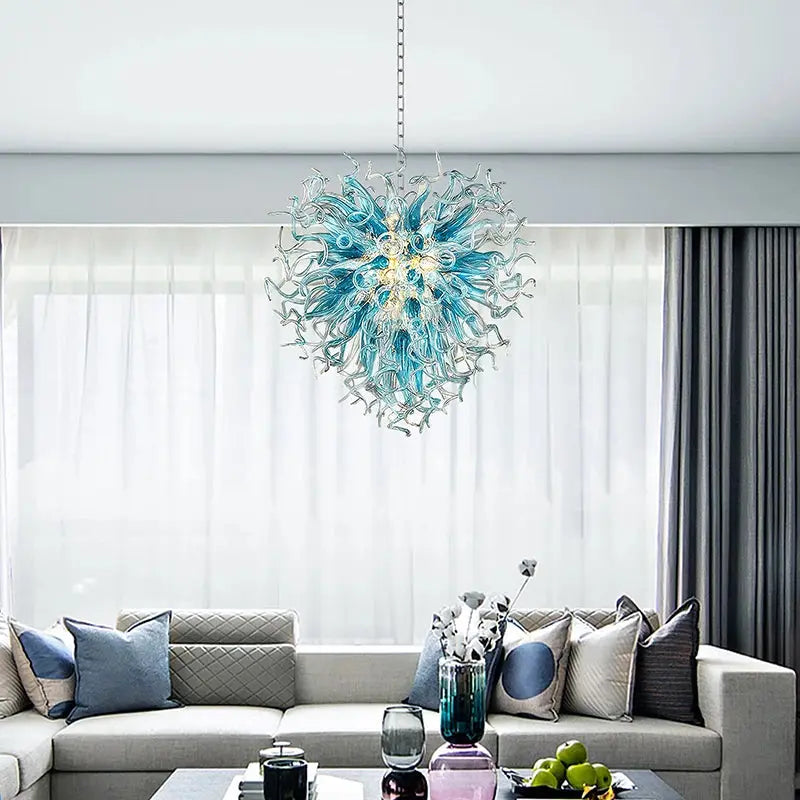
The Modern Aqua Blue Glass Chandelier is a compact glass fixture with a touch of color — right-sized for a round kitchen table in a contemporary or coastal kitchen, with smooth glass that wipes clean.
Rustic and Farmhouse Forms for Casual Kitchens
Farmhouse and rustic kitchens suit wrought iron, wood, and branch forms over the table, and the compact versions of those fixtures scale to a kitchen table well. Look for open metalwork or simple globes rather than fabric shades, which absorb cooking odors.
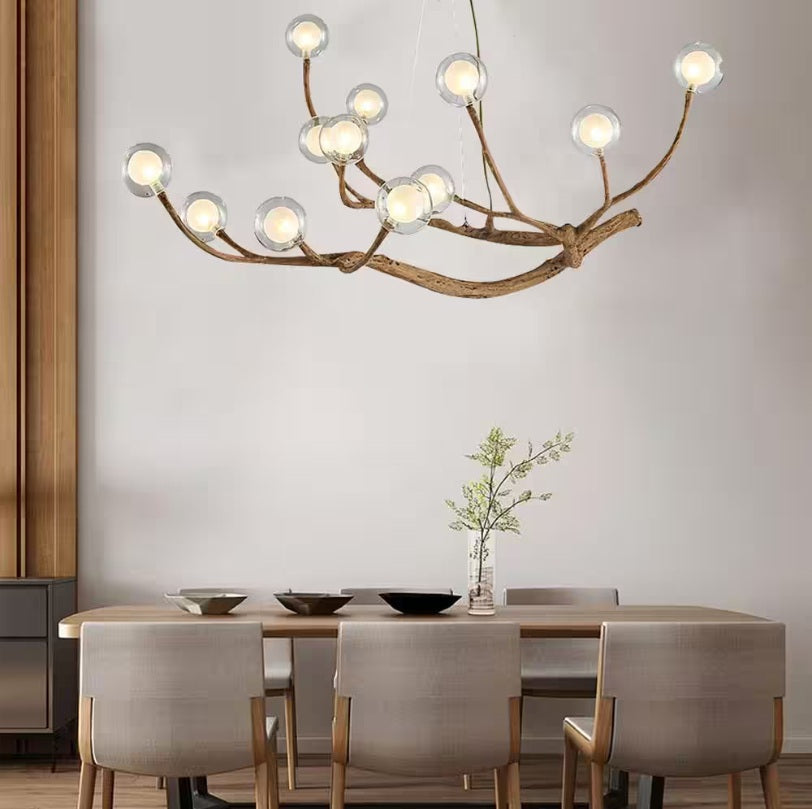
The Appa Rustic Tree Branch Chandelier is a compact branching form — organic character for a kitchen table in a farmhouse or transitional kitchen, at a scale that doesn't overwhelm a 42-inch round.
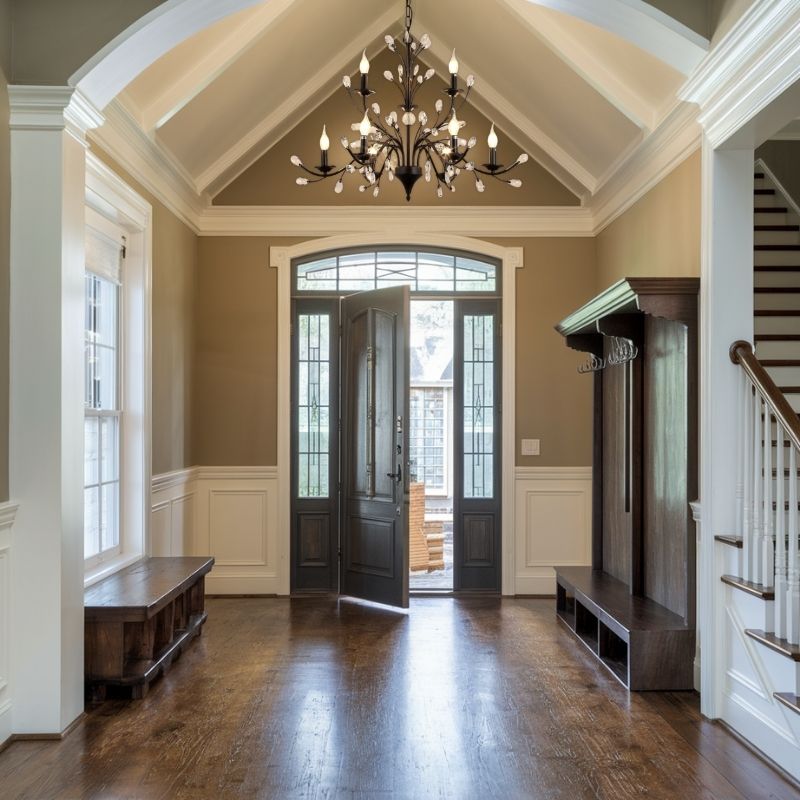
The Wrought Iron Chandeliers (6/9 Lights) come in two sizes, which matters here — the 6-light version suits a kitchen table where the 9-light would suit a dining room. Wrought iron with glass wipes clean and suits farmhouse, rustic, and Mediterranean kitchens.
Mid-Century and Modern Forms for Contemporary Kitchens
Sputnik and globe fixtures are natural kitchen-table lights in modern and mid-century kitchens: compact, bright, and easy to keep clean, with exposed-bulb or glass-globe forms that give practical light for breakfast and homework.
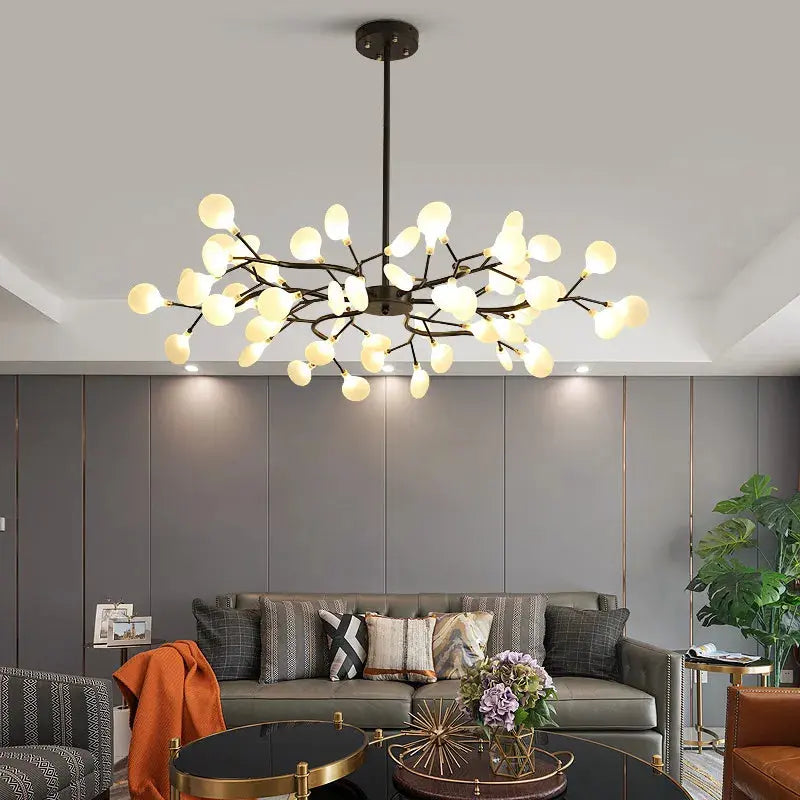
The Sputnik Branch Firefly Chandelier, in gold or black, is a compact sputnik with a branching twist — a mid-century kitchen-table fixture that gives bright, even light from many small points and coordinates naturally with black or brass island pendants.

The Mia Round Branch Crystal Ceiling Chandelier, in gold or silver, is a round ceiling-mounted form — it centers over a round or square kitchen table without needing drop, which makes it one of the more useful shapes for an 8-foot kitchen ceiling.
The Island Question: Coordinating Table and Island Lighting
Most eat-in kitchens have two light fixtures in one sightline: the pendants over the island and the fixture over the table. They shouldn't match — two identical fixtures a few feet apart look like a mistake — but they must relate. The reliable rule is to share a finish and vary the form: black island pendants with a black-framed table fixture in a different shape; brass pendants with a brass chandelier. Keep both at the same warm color temperature. If the island pendants are simple, the table fixture can be the kitchen's statement; if the island pendants are bold, keep the table fixture quieter. The matching chandeliers and pendants guide covers the pairing logic, and how to choose pendant lights for a kitchen island handles the island side.
| If the island pendants are… | Choose a table fixture that… |
|---|---|
| Simple glass or metal, matte black | Shares the black finish in a different form — a small ring, branch, or compact chandelier — and can be the statement |
| Brass or gold globes | Uses brass or gold in a compact chandelier or cluster; warm metals throughout |
| Bold, sculptural, or oversized | Stays quiet — a single glass pendant or semi-flush in the same finish |
| Crystal | Uses a smaller crystal or clear-glass form so the two fixtures read as a family |
| None (no island or no pendants) | Can be whatever the kitchen's style calls for — the table fixture leads |
Light Quality for a Table Used All Day
A kitchen table needs two lighting modes and a dimmer to move between them: bright for breakfast, homework, and bills — roughly 2,000 to 2,500 lumens over the table — and soft for dinner at 30 to 40 percent. Choose warm white at 2700 to 3000K; kitchens often run cooler overhead light for cooking, but the table is a place to sit, and warm light there keeps it from feeling like part of the work zone. Aim for CRI 90 or higher so food and faces render true. Under-cabinet lights and the island pendants handle task lighting; the table fixture's job is comfortable, adjustable light for the people sitting under it.
Kitchen table light checklist
Size: ½–⅔ of the table width, typically 18–28" • Height: 30–34" above the table • Form: semi-flush or short drop on 8 ft • Material: glass, metal, or simple crystal — easy to wipe, no fabric • Light: 2,000–2,500 lumens, 2700–3000K, CRI 90+, on a dimmer • Finish: matches the island pendants; form differs.
Keeping a Kitchen Table Fixture Clean
A fixture near the cooktop collects grease film faster than one in a dining room — expect to wipe it every month or two rather than once a year. Choose materials that make that easy: glass, metal, and smooth crystal wipe with a damp microfiber cloth; open wire frames dust quickly; fabric shades and densely strung crystal don't. Running the range hood while cooking cuts the buildup substantially. For the cleaning method itself, the glass chandelier cleaning guide covers glass and the crystal chandelier cleaning guide covers crystal.
Breakfast Nooks and Bench Seating
A breakfast nook — a table tucked into a corner or bay with a built-in bench — has its own rules. The table is usually small and often rectangular, so a single pendant or a short linear fixture centered on it works best. Center the fixture on the tabletop, not on the nook's ceiling, since the table often sits off-center in the alcove. Keep the fixture compact and the drop short so anyone sliding along the bench or standing up from it doesn't meet the fixture. And use a semi-flush or a small pendant on a short cord; a nook's ceiling is often lower than the main kitchen's, or sloped under a bay window, in which case an adjustable canopy is essential. The small-space lighting approach applies here in spirit: compact, centered, and out of the way.
Compact chandeliers, pendants, and semi-flush fixtures sized for eat-in kitchens and nooks.
Kitchen Lighting Dining Room Pendants Rustic
Frequently Asked Questions
What is the best light fixture for a kitchen table?
A single centered fixture sized at one-half to two-thirds of the table's width — typically 18 to 28 inches for a 36-to-48-inch kitchen table — in a form that suits the kitchen and wipes clean. On the usual 8-foot kitchen ceiling, that means a semi-flush, a short-drop pendant, or a compact chandelier hung with its bottom 30 to 34 inches above the tabletop. Glass, metal, and simple crystal are the practical materials near cooking. Use warm white 2700 to 3000K on a dimmer so the table works for breakfast and homework as well as dinner, and coordinate the finish with the island pendants.
What size light fixture goes over a kitchen table?
One-half to two-thirds of the table's width. A 36-inch round or square kitchen table takes an 18-to-24-inch fixture, a 42-inch table 21 to 28 inches, and a 48-inch table 24 to 32 inches. For a rectangular kitchen table, size a compact linear fixture or a pair of small pendants to one-half to two-thirds of the table's length, keeping each pendant 8 to 12 inches so it doesn't crowd a narrow top. Kitchen tables are small enough that many fixtures sold for dining rooms are oversized — check the diameter against the table before buying.
How high should a light hang over a kitchen table?
Hang the bottom of the fixture 30 to 34 inches above the kitchen tabletop — a little lower than a dining room's upper limit of 36 inches, because a kitchen table is smaller and the fixture should feel close and intimate. On an 8-foot ceiling, that leaves a shallow envelope, so choose a semi-flush, a short-drop pendant, or a compact low-profile chandelier. Center the fixture on the table rather than the room, and if one side is a bench, make sure someone standing up from it doesn't rise into the fixture.
Should the kitchen table light match the island pendants?
Relate, don't match. Two identical fixtures a few feet apart look like a mistake; two fixtures that share a finish but differ in form look like a plan. Choose a table fixture in the same metal as the island pendants — black with black, brass with brass — in a different shape, and keep both at the same warm color temperature. If the island pendants are simple, the table fixture can be the kitchen's statement; if the pendants are bold, keep the table fixture quieter. That shared-finish, different-form approach is what makes an eat-in kitchen read as one room.
Can you put a chandelier over a kitchen table?
Yes, if it's compact. A small chandelier — 18 to 28 inches, in a low-profile or ceiling-mounted form — suits a kitchen table well and gives the eat-in area a focal point. The constraints are the same as any kitchen-table fixture: size to one-half to two-thirds of the table's width, keep the bottom 30 to 34 inches above the tabletop, choose materials that wipe clean near cooking (glass, metal, simple crystal rather than dense strands or fabric), and put it on a dimmer. Ceiling-mounted chandeliers are especially useful here because they deliver chandelier presence without the drop an 8-foot ceiling can't spare.
How do you light a breakfast nook?
With one compact fixture centered on the table, not on the nook's ceiling. Breakfast nook tables are small and often sit off-center in a corner or bay, so a single pendant or a short linear fixture sized to the tabletop and centered on it works best. Keep the drop short — the bottom 30 to 34 inches above the table — so anyone sliding along the bench or standing up from it stays clear, and use a semi-flush or a small pendant on a short cord. If the nook's ceiling is sloped under a bay window, choose a fixture with an adjustable canopy.
What color light is best over a kitchen table?
Warm white, 2700 to 3000K. Kitchens often run cooler overhead light for cooking tasks, but the table is a place to sit and eat, and warm light there keeps it from feeling like part of the work zone. Pair the warm temperature with a dimmer so the fixture can run bright — about 2,000 to 2,500 lumens — for breakfast, homework, and bills, then drop to 30 or 40 percent for dinner. Choose bulbs or integrated LED at CRI 90 or higher so food and faces render true, and keep the island pendants at the same warm temperature so the two fixtures agree.
Lighting the Kitchen Table
The kitchen table takes the dining room's rules at a smaller scale and a lower ceiling: one centered fixture sized at one-half to two-thirds of the table, hung 30 to 34 inches above it, in a short-drop or semi-flush form that fits 8 feet, made of materials that wipe clean near the stove, on a dimmer that gets used from breakfast to dinner. Relate it to the island pendants by finish rather than form, keep everything warm, and the eat-in kitchen becomes a place people choose to sit rather than a corner of the work zone.
Browse the kitchen lighting collection for fixtures scaled to eat-in kitchens, or the dining room lighting collection filtered to smaller sizes. For the island side of the pairing, kitchen island pendant spacing rules covers height, spacing, and count.


