

Good lighting changes how a living room feels and functions more than almost any other single element. The right approach layers several kinds of light, sizes fixtures to the room, and uses warm, dimmable sources to shift the space from bright and practical by day to soft and welcoming at night. Here are the living room lighting ideas that make the biggest difference, from the core layering method to styling for your specific room.
Layered Lighting: The Foundation of a Well-Lit Living Room
A living room that feels right almost never relies on a single light. It layers several kinds working together, and understanding these layers is the key to every idea that follows.

- Ambient (general). Ceiling fixtures, chandeliers, or recessed lights give overall, even brightness — the baseline that lets you move safely and sets the mood.
- Task (functional). Floor and table lamps deliver focused light for reading, working, or hobbies. Put them where you actually do those things.
- Accent (decorative). Wall sconces, LED strips, and uplighting highlight architecture and artwork, adding the depth that makes a room feel intentional.
- Statement (focal). A sculptural chandelier or oversized pendant anchors the room visually while still providing light.
Most people stop at the first layer and wonder why the room feels flat. Combining all four — each ideally on its own switch or dimmer — is what separates a room that's merely bright from one that feels finished. Explore the full range in our living room lighting collection.
Ambient Lighting: An Even Glow Across the Room
Ambient light is the base of the scheme and should fill the room without harsh shadows or dark corners.
Ceiling Fixtures and Chandeliers
A ceiling fixture or chandelier lights the whole room and sets the design direction. For a contemporary space, a clean sculptural piece like the Arten Modern Acrylic Chandelier brightens the room with modern lines, while a warmer, organic look might call for the Appa Rustic Tree Branch Chandelier.
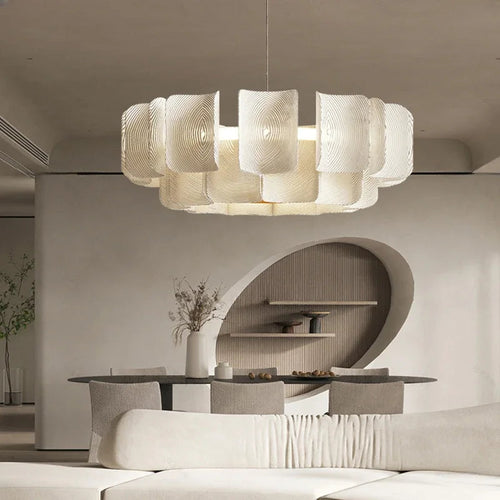
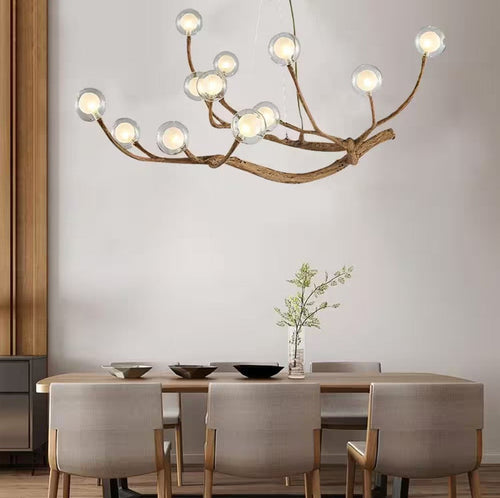
For standard 8 to 9-foot ceilings, flush or semi-flush fixtures work best. Higher ceilings allow dramatic pendants or chandeliers that create vertical impact.
Recessed Lighting for a Clean Look
Recessed lights provide even illumination without visible fixtures — space them 4 to 6 feet apart for consistent coverage. This suits contemporary rooms where you want the architecture to lead. Combine recessed lighting with other layers, though; on its own it can feel flat and uninviting.
Task Lighting: Function Where You Need It
Task lighting gives you bright enough light for specific activities. Position it where you actually read, work, or pursue hobbies.
Floor lamps serve double duty as task and ambient light depending on placement and shade. Position them behind or beside seating for the best reading light; tripod styles suit midcentury and Scandinavian rooms. Table lamps on side tables and consoles create pools of light that make a room feel layered and homey — use warm-toned shades for a candlelight-like glow, and bulbs around 40 to 60 watts equivalent for comfortable light rather than harsh brightness.
Accent Lighting: Depth and Visual Interest
Accent light adds depth and draws attention to a room's best features — the layer that makes a room feel designed rather than simply functional.
Wall sconces give directional light that creates shadow and depth. Install them flanking a fireplace, framing artwork, or brightening dark corners, mounted around 60 to 66 inches from the floor. Plug-in versions suit renters and anyone avoiding electrical work. Pair the main fixture with pieces from our wall lights and sconces collection for that second layer.
LED strips hidden behind shelving, under low sofas, along ceiling coves, or behind a TV create contemporary, indirect effects. Use warm white (2700–3000K) for a cozy atmosphere or cool white (4000K+) in ultra-modern spaces.
Statement Lighting Ideas for a Living Room
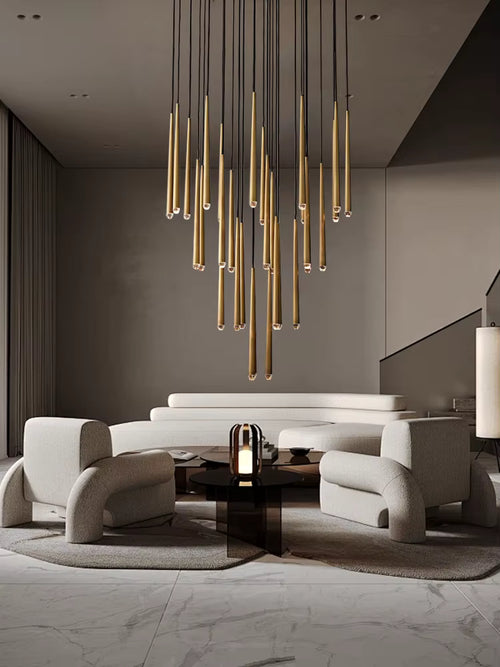
One of the most searched living room questions is what to use as a statement fixture — the sculptural focal point that defines the room. A statement light works hardest over the main seating zone, where its scale and silhouette anchor the sofa layout. Branch and linear designs, oversized pendants, and bold geometric chandeliers all serve this role.
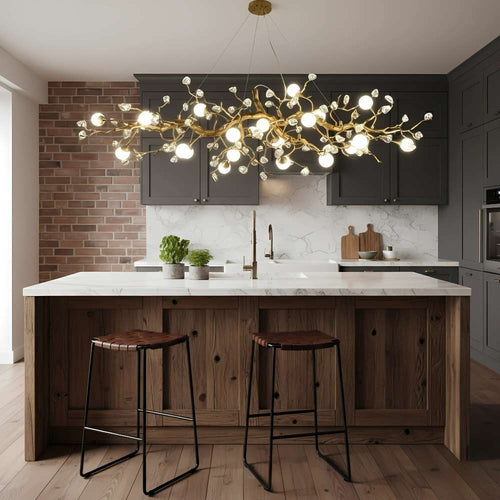
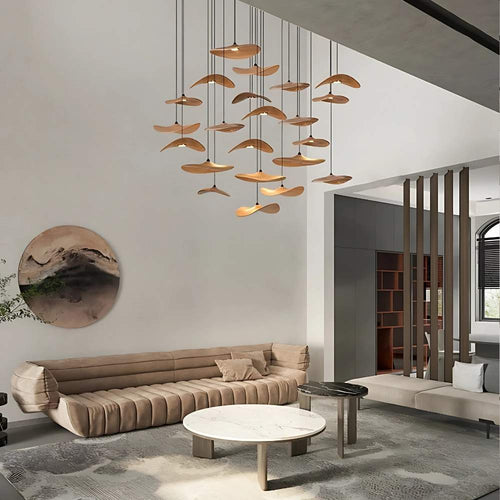
The Orgi Statement Linear Branch Chandelier suits a long seating area or an open-plan lounge, while the Bidi Multi Light Pendant Chandelier groups multiple pendants into a single sculptural cluster. For more focal pieces, browse the statement chandeliers collection. A statement fixture is where scale matters most — too small and it looks lost above the seating; matched to the sofa layout, it defines the whole room.
Cozy Living Room Lighting: Getting the Warm Glow Right
A frequent goal is a living room that feels genuinely cozy, and that comes down to color temperature and control more than fixture choice. Warm white light in the 2700K to 3000K range is what makes a seating area feel welcoming — it's the candlelight-adjacent glow that reads as relaxing after dark, where cooler light feels clinical.
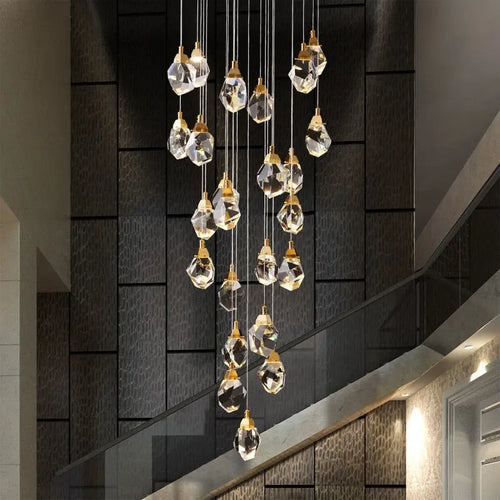
To build a cozy scheme: choose warm white (2700–3000K) bulbs across ambient and accent layers, put the main fixture on a dimmer so you can drop the level in the evening, and add low sources — table lamps and sconces — so light comes from several points at seating height rather than one bright ceiling fixture overhead. A warm-toned piece like the Modern Crystal Chandelier for Living Room on a dimmer, supported by a couple of lamps, is a reliable recipe for a cozy result.
Setting Mood with Light Control
The best living room lighting adapts through the day. Dimmers on overhead fixtures and lamps let you go bright for cleaning, medium for conversation, low for movie watching, and very low for background glow — a single upgrade that changes how you use the room. Smart bulbs take it further, letting you save scenes: a bright cool "morning" setting, a warm dim "evening" one, an "entertainment" scene with accents raised, and a "reading" scene with task light emphasised.
Color Temperature and Mood
| Temperature | Feel | Best for |
|---|---|---|
| 2700K | Warm, candlelight glow | Relaxing, intimate seating areas |
| 3000K | Soft white, homey | General living areas |
| 4000K | Cool white, energizing | Contemporary spaces, morning light |
| 5000K | Daylight, crisp | Task areas, art viewing |
Mix strategically: warmer bulbs (2700–3000K) in ambient and accent layers for coziness, cooler (3500–4000K) in task lighting where you need to see clearly.
Living Room Lighting by Room Size
Small Living Rooms
In compact rooms, strategic lighting makes the space feel larger. Use wall sconces and pendants that save floor space, keep window treatments light to let in daylight, position mirrors opposite windows to bounce light, and choose fixtures scaled to the room — an oversized chandelier overwhelms a small space. A cleaner piece like the Modern Aqua Blue Glass Chandelier or a compact pendant keeps proportions in check.
Large Living Rooms
Big rooms need strategy to feel warm rather than cavernous. Zone the lighting into a conversation area, a reading nook, and an entertainment area so the space feels intimate; layer generously across ceiling, mid-height, and floor; and add a sculptural statement piece to fill vertical space. Seven to ten sources (lamps, sconces, and ceiling fixtures counted together) typically suit a large living room.
High-Ceiling Living Rooms
Tall rooms need fixtures that fill vertical volume. Long pendants or chandeliers hung 7 to 8 feet from the floor, multiple recessed lights to cover the distance, and wall sconces at varied heights all bring light down to human scale. A piece built for the job, like the Contemporary Chandelier for High Ceiling Living Room, anchors the upper volume without looking lost.
Living Room Lighting by Design Style
Modern and Contemporary
Contemporary rooms favour clean lines, minimalism, and sculptural elements: geometric chandeliers with metal finishes, recessed lighting, LED strips, and sleek floor lamps. A piece like the Lio Modern Tree Branch Ceiling Light works as both light source and conversation piece. Compare more streamlined options in our modern chandeliers collection.
Midcentury and Retro
Midcentury rooms suit arc floor lamps curving over seating, sputnik chandeliers with radiating arms, cone pendants, and warm brass or black finishes with organic, sculptural forms.
Minimalist
Minimalism calls for restraint: simple geometric shapes, hidden or recessed light, white, black, or natural-wood finishes, and multi-functional pieces that double as art. Fewer, higher-quality fixtures make more impact than many decorative ones.
Rustic and Organic
Warmer, textural rooms suit branch-inspired and natural forms — pieces like the Minas Dimmable Rustic Tree Branch Chandelier soften a room's lines and pair well with wood, stone, and layered textiles.
Energy-Efficient Living Room Lighting
Modern schemes should be efficient. LED bulbs last 15 to 25 years and use about 75% less energy than incandescent — a higher upfront cost that pays back quickly. Maximise natural daylight with reflective surfaces and light window treatments, use motion sensors in less-used spaces, and consider solar shades that cut heat while letting diffused daylight through.
Building Your Living Room Lighting Plan
- Start with ambient light — make sure the overhead fixture or recessed lights cover the whole room.
- Add task lighting — floor and table lamps beside seating and reading areas.
- Layer in accents — sconces, LED strips, or uplighting for depth.
- Add a statement piece — one sculptural or oversized fixture as the focal point.
- Install dimmers — control for different times and activities.
- Balance the light — distribute sources evenly; avoid one bright zone and dim corners.
- Work with daylight — position fixtures to compensate for the room's darkest times.
- Test before committing — use plug-in fixtures to trial placement before hardwiring.
Common Living Room Lighting Mistakes
- Using only overhead light. It creates harsh shadows and a flat feel — always layer.
- The wrong bulb temperature. Cool 5000K bulbs feel sterile in a lounge; warm 2700–3000K is welcoming.
- Wrong fixture heights. Hang chandeliers at least 7 feet off the floor; set table-lamp shades near eye level when seated.
- Ignoring dimmers. Fixed brightness means the room never feels quite right.
- Forgetting glare. Position seating so lamps don't reflect on the TV; use shades that direct light up and down.
Chandeliers, ceiling lights, statement pieces, and sconces for every room.
Living Room Lighting Statement Chandeliers Modern Wall Lights
Living Room Lighting Questions, Answered
What is the best lighting for a living room?
The best living room lighting layers three types: ambient light from a ceiling fixture or chandelier for overall brightness, task light from floor and table lamps beside seating for reading, and accent light from wall sconces or LED strips for depth. Aim for five to ten sources at different heights, use warm white bulbs (2700–3000K) for a welcoming feel, and put major fixtures on dimmers so the room adapts from bright by day to soft at night. Adding one statement fixture over the main seating zone gives the room a focal point. This layered approach covers every activity while keeping the space flexible.
What lighting styles work best for a cozy living room?
Coziness comes mostly from warm color temperature and control rather than a particular fixture style. Use warm white bulbs in the 2700–3000K range across your ambient and accent lights, put the main fixture on a dimmer, and add several low light sources — table lamps and wall sconces at seating height — so the glow comes from multiple points rather than one bright overhead light. Warm-toned lampshades, LED strips tucked behind shelving, and a dimmable chandelier all reinforce the effect. The formula is simple: warm light, dimmers, and layered low sources make a living room feel relaxed and inviting after dark.
What are the best statement lighting ideas for a living room?
A statement fixture works best over the main seating zone, where its scale and silhouette anchor the room. Strong options include an oversized sculptural chandelier, a linear branch design over a long sofa or open-plan lounge, a cluster of pendants grouped as one form, or a bold geometric fixture in a metal finish. The key is scale — the piece should relate to the sofa arrangement, not just the center of the ceiling, so it reads as intentional rather than lost. In a high-ceiling room, choose something with vertical depth to fill the volume. Keep it on a dimmer so a dramatic fixture can also be a soft one in the evening.
How many lights should a living room have?
Most living rooms need five to ten light sources depending on size. A typical setup includes one overhead fixture or chandelier, two to four table or floor lamps, and two to three accent lights such as sconces or LED strips. Small rooms sit at the lower end of that range, while large or high-ceiling rooms need more sources — often seven to ten — spread across ceiling, mid-height, and floor to feel cohesive. The goal isn't maximum brightness but light from multiple directions and heights, which is what removes dark corners and gives the room depth.
Should living room lights be warm or cool?
Warm white (2700–3000K) works best in living rooms because it creates a cozy, inviting atmosphere for a space built around relaxation. Reserve cooler white (around 4000K) for contemporary rooms where you deliberately want a crisp, energised feel, or for task lighting where you need to see clearly. A good approach is to keep ambient and accent light warm and use slightly cooler light only where you read or work, while keeping the color temperature consistent within a sightline so adjacent lights don't clash. When unsure, go warmer — cool light tends to feel clinical in a lounge.
How do you make a dark living room brighter?
Add multiple light sources at different heights rather than one brighter ceiling fixture. Floor and table lamps fill the corners overhead light misses, wall sconces add light at eye level, and LED strips behind shelving or furniture lift dark zones. Use light-colored lampshades, position mirrors opposite windows to bounce daylight, and keep window treatments sheer to maximise natural light during the day. Layer ambient, task, and accent light together, and choose higher-lumen LED bulbs where you need more output. The combination of more sources, reflective surfaces, and even distribution brightens a dark room far more effectively than a single powerful fixture.
What size chandelier for a living room?
Add your room's length and width in feet, then read that total as inches of diameter for the ideal chandelier. For example, a 12 by 16-foot room (28 feet total) suits roughly a 28-inch chandelier. Ensure at least 7 feet of clearance from the floor to the bottom of the fixture in walkways. In a large or high-ceiling room, lean toward the larger end so the fixture doesn't look lost, and consider a design with vertical depth. In a small room, stay proportional so the fixture doesn't crowd the ceiling. When choosing between two sizes over a defined seating zone, the larger usually looks more intentional.
What are affordable modern lighting options for a living room?
Affordable modern living room lighting starts with the layers that cost the least: quality LED bulbs at the right warm temperature, a few well-placed floor and table lamps, and plug-in LED strips for accent light — none of which need an electrician. For fixtures, clean-lined modern chandeliers and pendants come at a wide range of price points, so you can get a contemporary sculptural look without a premium spend, especially during sales. The most cost-effective approach is to invest in one statement fixture over the seating area and keep the supporting task and accent layers simple, since the focal piece drives most of the room's style while the inexpensive layers do the practical work.
What type of ceiling light is best for a living room?
It depends on ceiling height and how the room is used. For standard 8 to 9-foot ceilings, a flush or semi-flush mount gives clean overhead coverage without hanging into the space; for taller ceilings, a chandelier or pendant with vertical presence anchors the room better. If the living room needs a clear focal point over the seating, a chandelier is the stronger choice; if you want the architecture to lead and plan to layer in lamps and sconces, a lower-profile ceiling light or recessed lighting works well. Whichever you choose, pair it with task and accent layers rather than relying on the ceiling light alone.
Bringing Your Living Room Lighting Together
The living room lighting ideas that matter most come down to a few principles: layer ambient, task, and accent light rather than relying on one fixture; size the main piece to the seating area; use warm, dimmable light for a cozy feel; and add a statement fixture as a focal point. Whether your room leans modern, midcentury, minimalist, or rustic, that framework makes the space feel intentional and complete.
Start with our living room lighting collection for the main fixture, add depth with wall sconces, and use the chandelier size calculator to get the scale right.


