

An oversized chandelier is one deliberately scaled larger than the standard sizing formula suggests — chosen because the room's volume, ceiling height, or sightlines would make a correctly sized fixture disappear. Done well, it anchors a great room, fills a double-height foyer, or gives a large dining room a real center. Done badly, it crowds the ceiling and dominates everything beneath it. This guide covers when to go oversized, how far, whether to go wide or tall, and the visual-weight rules that keep a big fixture from overwhelming the room.
Key Takeaways
| Question | Answer |
|---|---|
| What is an oversized chandelier? | A fixture deliberately scaled larger than the standard sizing formula gives, because the room's volume or ceiling height would make a formula-sized fixture look small. |
| When should you go oversized? | Ceilings of 12 feet or more, double-height foyers and stairwells of 16–25 feet, and great rooms with long sightlines. |
| How big should it be? | Room length plus width in feet as inches, times 1.25 above 10-foot ceilings; in a void, the larger of that and one-third of the room's width. |
| Wide or tall? | Wide for broad rooms seen from one level (great rooms, dining); tall for voids seen from two levels (foyers, stairwells). |
| How do you keep big from feeling heavy? | Choose visually light forms — open rings, strung glass, branch spreads — over dense cascades; go one step lighter in form and one size larger. |
| What clearances apply? | At least 7 feet from the floor in walkways, 30–36 inches above a table, and the second-floor line in a two-story foyer. |
Quick Facts
- Oversizing starts to make sense around 12-foot ceilings and becomes necessary in 16–25-foot double-height spaces.
- Sizing: (length + width in feet) as inches × 1.25 for ceilings over 10 feet.
- A 20 × 24 ft great room with a 14 ft ceiling suits a 48–56 inch chandelier.
- Wide forms suit rooms seen from one level; tall forms suit voids seen from two levels.
- A 48-inch open ring and a 48-inch crystal cascade occupy the same diameter but carry very different visual weight.
- On standard 8–9 ft ceilings, go at most one size up and choose a visually light form.
What "Oversized" Actually Means
Oversized is relative, not absolute. A 36-inch chandelier is oversized in a 10-by-12-foot dining room with an 8-foot ceiling and undersized in a 20-by-24-foot great room with a 16-foot ceiling. The term describes a fixture scaled past what the standard formula would give, on purpose, because the standard formula was written for standard rooms. The moment ceilings pass 10 feet or a room opens into a double-height volume, the formula under-sizes — a fixture that looks correct on paper looks like it's stranded near the ceiling in practice. Oversizing is the correction.
That also defines the limit. Oversizing works when it's proportional to the room's volume; it fails when it's proportional to ambition. The room decides how big is right, and the tests below tell you where the line is.
When to Go Oversized (and When Not To)
| Room condition | Go oversized? | Why |
|---|---|---|
| Ceiling 12 ft or higher | Yes | Standard formula under-sizes; the fixture needs more mass to hold the volume |
| Double-height foyer or stairwell (16–25 ft) | Yes, tall | The fixture must read from two levels and fill vertical space |
| Great room or open plan, 10–12 ft | Yes, wide | Long sightlines make a correctly sized fixture look small |
| Large dining room, 9–10 ft, big table | Modestly | Size to the table (½–⅔ width) and lean to the top of the range |
| Standard room, 8–9 ft ceiling | Rarely | Go up one size at most, and only with a visually light form |
| Small room, any ceiling | No | Oversizing crowds the space; use one well-sized fixture instead |
On standard ceilings, the honest answer is usually "one size up, visually light." A 26-inch ring in a room the formula gives 22 inches reads intentional; a dense 36-inch cascade in the same room reads like a mistake. The statement chandeliers for standard ceilings guide covers how to get impact without oversizing when the ceiling won't support it.
How Far to Oversize: The Numbers
Start with the room formula — length plus width in feet, read as inches of diameter — then adjust for height. For ceilings over 10 feet, multiply by 1.25; for double-height spaces, use the larger of that figure and one-third of the room's width. A 20-by-24-foot great room with a 14-foot ceiling gives 44 inches from the formula and 55 from the 1.25 multiplier — a 48-to-56-inch fixture. A 14-by-16-foot two-story foyer gives 30 from the formula and 37 from the multiplier; treat 36 to 40 inches as the target and add vertical drop to fill the height.
| Room | Ceiling | Formula | ×1.25 / ⅓ width | Oversized target |
|---|---|---|---|---|
| 12 × 14 ft dining | 10 ft | 26" | 32" | 28–32", or size to table |
| 16 × 20 ft living | 12 ft | 36" | 45" | 40–48" wide |
| 20 × 24 ft great room | 14 ft | 44" | 55" | 48–56" wide |
| 14 × 16 ft foyer | 18 ft (two-story) | 30" | 37" / 56" | 36–44" wide, 5–8 ft drop |
| 10 × 12 ft stairwell | 20 ft | 22" | 28" / 40" | 28–36" wide, 6–10 ft drop |
Two limits hold regardless of size: at least 7 feet from the floor to the fixture's bottom in any walkway, and 30 to 36 inches above a tabletop. In a two-story foyer, hang the bottom around the second-floor line so it reads from both levels. The high ceiling chandelier buying guide works through the height math in full.
Going Wide: Oversized Fixtures for Broad Rooms
Wide oversized chandeliers spread horizontally across a broad ceiling plane with a relatively shallow body. They suit great rooms, open-plan living areas, and large dining rooms — spaces seen from one level, where the ceiling is wide and the fixture needs to hold that width without hanging deep into the room. The best wide forms are visually open: branch spreads, rings, sculptural compositions, and strung or clustered elements that let the eye pass through.

The Noa Flower Branch Chandelier is an oversized wide form — branching arms and blossoms that spread across a great room or large dining ceiling with an open structure that keeps the size from feeling heavy.

The Sage Marble Chandelier is a sculptural wide fixture with marble-effect elements — a large-scale centerpiece for an open-plan living or dining area where the ceiling plane is broad and the fixture is seen from across the room.
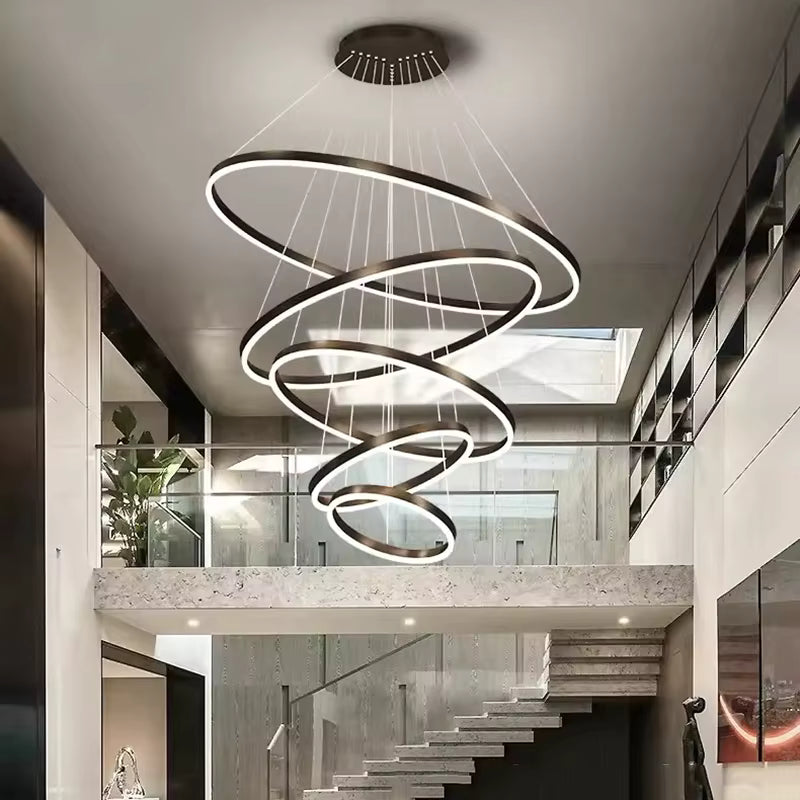
The Aysan Modern Ring Chandeliers are the cleanest way to go wide — illuminated rings, available in multiple finishes, that hold a broad ceiling with almost no visual mass. Stacked, they also work tall.

The Esle Modern Pearl Necklace Chandelier strings glass spheres in a wide, draped form — oversized in span, light in weight, suited to a large dining room or open living space.
Going Tall: Oversized Fixtures for Vertical Spaces
Tall oversized chandeliers trade width for drop. They suit double-height foyers, stairwells, and any void seen from two levels, where the fixture's job is to fill vertical space and read well from the front door and the upper landing alike. Cascades, long drops, spirals, and vertical rectangles all do this; the footprint stays compact so the fixture doesn't crowd the stair or entry below.

The Cleo Bubble Staircase Chandelier is a tall cluster of glass bubbles — oversized in height, compact in footprint, with a lightness that suits a stairwell or two-story foyer without blocking the view up or down.

The Large Foyer Lighting for High Ceiling and Entryway is a tall crystal cascade built for double-height entries — the classic oversized-tall form, with drop measured in feet rather than inches. For more vertical options, see the two-story foyer chandeliers and staircase chandeliers collections.
Visual Weight: The Rule That Keeps Big From Becoming Heavy
Size and visual weight are different things, and oversizing succeeds by separating them. A 48-inch open ring and a 48-inch dense crystal cascade occupy the same diameter but read completely differently — the ring lets the eye pass through, the cascade stops it. In a room that can only just support an oversized fixture, choose the form with less visual weight: open frames over solid bodies, glass and thin metal over dense crystal, branches and strung elements over drums. In a room with volume to spare, weight can go up. The statement piece traits guide covers the design side of this.
Visual-weight ladder (lightest to heaviest)
Open ring → strung glass / necklace → branch spread → glass bubble cluster → sculptural open form → multi-pendant cluster → linear crystal → crystal cascade → dense tiered chandelier. Go one step lighter than you think the room needs, and one size larger.
Oversized Chandeliers Room by Room
- Great room: wide and open — a ring, branch, or sculptural spread at 44–56 inches over the main seating group; supplement with lamps so the fixture isn't the only light.
- Double-height foyer: tall — a cascade or long drop with the bottom at the second-floor line and 7 feet of floor clearance; the 2-story foyer guide has the sizing.
- Stairwell: tall and compact — spiral, vertical rectangle, or bubble column; keep the footprint clear of the stair and 7 feet above every tread.
- Large dining room: wide but sized to the table — ½–⅔ of table width, top of the range, 30–36 inches above the tabletop.
- High-ceiling living room: wide — hold the seating area's width, keep the body shallow so the room doesn't feel capped; the living room sizing guide covers open layouts.
- Primary bedroom, high ceiling: modest — one size up, light form, over the bed, on a dimmer.
The Practical Side of Going Big
Oversized fixtures weigh more, ship in more pieces, and hang higher than standard ones, so a few checks come before ordering. Confirm the fixture's stated weight against the ceiling box — standard boxes are rated around 50 pounds, and anything heavier needs a reinforced brace tied to a joist. Measure the ceiling height at the exact mounting point, not the room's highest point. Plan access for cleaning and bulb changes at height, or choose integrated LED so bulb changes don't come up. And budget for professional installation; oversized fixtures at height are not a ladder job. The extra large chandelier guide covers weight, mounting, and delivery in detail, and installing chandeliers on high ceilings covers the installation steps.
Wide and tall large-scale fixtures for high ceilings, foyers, stairwells, and great rooms.
Oversized Chandeliers Statement Chandeliers Large Foyer Staircase
Frequently Asked Questions
What is an oversized chandelier?
An oversized chandelier is a fixture deliberately scaled larger than the standard sizing formula would give, chosen because the room's volume, ceiling height, or sightlines would make a formula-sized fixture look small or stranded near the ceiling. Oversized is relative to the room, not an absolute size — a 36-inch fixture is oversized in a small dining room and undersized in a great room with a 16-foot ceiling. The term applies once ceilings pass about 10 to 12 feet, or in double-height foyers, stairwells, and open-plan great rooms with long sightlines.
When should you use an oversized chandelier?
When the room has the volume to absorb it: ceilings of 12 feet or higher, a double-height foyer or stairwell of 16 to 25 feet, or a great room or open-plan space with long sightlines where a correctly sized fixture would disappear. In large dining rooms with 9-to-10-foot ceilings, size to the table and lean toward the top of the range rather than truly oversizing. On standard 8-to-9-foot ceilings, go at most one size up and choose a visually light form. In small rooms, don't oversize at all.
How big should an oversized chandelier be?
Start with the room formula — length plus width in feet as inches of diameter — then multiply by 1.25 for ceilings over 10 feet, and in double-height spaces use the larger of that figure and one-third of the room's width. A 20-by-24-foot great room with a 14-foot ceiling lands at 48 to 56 inches; a 14-by-16-foot two-story foyer at 36 to 44 inches wide with 5 to 8 feet of drop. Whatever the size, keep 7 feet of clearance from the floor in walkways and 30 to 36 inches above a table.
Should an oversized chandelier be wide or tall?
Wide for broad rooms seen from one level — great rooms, open-plan living, large dining rooms — where the fixture needs to hold a wide ceiling plane with a shallow body. Tall for vertical spaces seen from two levels — double-height foyers and stairwells — where the fixture needs to fill height and read from the entry and the upper landing alike. Wide forms include rings, branch spreads, linear fixtures, and strung glass; tall forms include cascades, long drops, spirals, stacked rings, and vertical rectangles.
Can an oversized chandelier work with a standard ceiling?
Modestly. On an 8-to-9-foot ceiling, go at most one size up from the formula and choose a form with little visual weight — an open ring, strung glass, or a branch spread rather than a dense cascade — so the fixture reads intentional rather than crowded. Keep the body shallow to preserve 7 feet of floor clearance, or hang it over a table where the 30-to-36-inch rule applies instead. For real impact on a standard ceiling, a visually striking correctly sized fixture usually beats an oversized one.
How do I keep a large chandelier from overwhelming the room?
Separate size from visual weight. Choose open, see-through forms — rings, branches, strung glass, thin metal — over dense bodies and heavy crystal cascades, so the fixture reads large without stopping the eye. Keep the body shallow in rooms seen from one level and the footprint compact in stairwells. Hang it at the correct height rather than too low, put it on a dimmer, and add lamps or sconces so it isn't the only light source. If the room can only just support an oversized fixture, go one step lighter in form and one size larger in diameter.
What ceiling height needs an oversized chandelier?
Oversizing starts to make sense around 12 feet and becomes necessary in 16-to-25-foot double-height foyers and stairwell voids. Between 10 and 12 feet, apply the 1.25 multiplier to the room formula and lean toward the top of the range. Below 10 feet, size normally and use visual character rather than scale for impact. The real threshold depends on room width and sightlines as much as height — a wide great room at 11 feet may want an oversized fixture where a narrow room at 12 feet does not.
Going Oversized, Correctly
An oversized chandelier is a proportion decision: the room's volume sets how big, the room's shape sets whether wide or tall, and visual weight decides whether big reads as intentional or heavy. Apply the formula with the height multiplier, keep the clearance rules, choose open forms in rooms that can only just carry the scale, and confirm weight and mounting before ordering. The result is a fixture that holds the room rather than crowding it.
Browse the oversized chandeliers collection by direction — wide or tall — or start with large modern and contemporary chandeliers if the room's style is clean and current.


