

Key Takeaways
| Question | Answer |
|---|---|
| What is it made of? | Multi-port canopy, pendant cord sets, sockets, globe fitters, glass globes, LED bulbs, and a rated ceiling box. |
| Hardest part? | Weight and wiring: many glass globes get heavy fast, and the canopy connection is mains electrical work. |
| Is it safe? | With UL-listed parts, LED bulbs, a rated box, and an electrician for the house connection, yes; with mixed unlisted parts and incandescent bulbs, no. |
| DIY or buy? | DIY suits small clusters of 3–9 globes and a custom look; buy for large clusters, cascades, integrated dimming, or certified fixtures. |
| What does 36 inches fit? | A room around 16 × 20 ft over open floor, or a round table of about 54–72 in. |
| Glass ball sizes? | 4–6 in globes for small clusters; 6–10 in for larger fixtures; match the fitter opening to the socket. |
Quick Facts
- Common globe fitter openings: 2¼ in, 3¼ in, and 4 in — the globe neck must match the socket fitter.
- Hand-blown globes weigh roughly 0.5–2 lb each; ten 8-in globes plus hardware can exceed 20 lb.
- Use LED bulbs only — G9, E12, or E26 to match the socket; they run at a low temperature inside closed glass.
- Multi-port canopies come in 3, 5, 7, 9, and 12+ ports; the canopy, not the ceiling box alone, must carry the full weight.
- Clearance: 30–36 in above a tabletop; 7 ft over walkways.
- Sizing: room length + width (ft) in inches; ½–⅔ of a round table's width.
What a DIY Bubble Chandelier Actually Is
Almost every DIY "glass ball" or "glass globe" chandelier is built the same way: a multi-port canopy mounted to the ceiling box, with several pendant cord sets passing through its ports, each cord ending in a socket that holds a glass globe on a matching fitter. The cords are cut to different lengths so the globes hang at staggered heights, which is what gives the cluster its cloud-like shape. Variations swap the canopy for a linear bar (a linear bubble chandelier over a table) or hang the globes from a branching frame — but the parts list stays the same. The style choices themselves — cluster, linear, sputnik, cascade, minimal — are compared in 10 bubble chandelier ideas; this page is about building one.
Parts List
| Part | What to choose | Watch for |
|---|---|---|
| Glass globes | Clear, frosted, or tinted; 4–6 in for small clusters, 6–10 in for larger ones; open neck to fit the socket | Neck/fitter size; weight per globe; hand-blown pieces vary slightly |
| Fitters and sockets | Fitter sized to the globe neck (2¼, 3¼, or 4 in); socket base to match bulbs | Mixed fitter sizes on one fixture look uneven |
| Pendant cord sets | UL-listed cord sets, fabric or clear cord, long enough for the deepest drop | Cords rated for the bulb and the weight; grip that holds the length |
| Multi-port canopy | 3, 5, 7, 9, or 12+ ports; round for clusters, linear bar for tables and islands | Canopy weight rating; enough room inside for the connections |
| Ceiling box | Standard box for light builds; fan-rated box or brace bar above 50 lb | The box must carry the full fixture weight |
| Bulbs | LED only, 2700–3000K, dimmable if on a dimmer | Incandescent bulbs overheat inside closed glass |
| Dimmer | LED-rated, matched to the bulbs | Non-LED dimmers cause flicker and buzz |
Planning the Layout
Start on the floor, not the ceiling. Decide the spread of the cluster — the room's length plus width in feet, used as inches, over open floor, or half to two-thirds of a round table's width — and mark that circle on a sheet of paper or cardboard laid where the fixture will hang. Place a coin or paper disc for each globe inside the circle to see the density; three to nine globes is a manageable first build. Then set the drops: keep the lowest globe 30 to 36 inches above a tabletop or 7 feet over a walkway, and step the others up in 3- to 6-inch increments so no two globes sit at the same height side by side. Add up the weight of every globe, socket, and cord and check it against the canopy and the ceiling box ratings before buying anything. A linear version over a table or island follows the same steps with a bar canopy sized at about two-thirds of the surface length.
Assembly Sequence
The safe order is: confirm the ceiling box rating, or have an electrician install a fan-rated box or brace bar if the fixture will be heavy; thread the cord sets through the canopy ports and set each cord grip to its planned length, longest first; fit the sockets and fitters; install LED bulbs; attach the globes last, once the cords are set, so glass is not handled while cords are being adjusted. The final connection of the canopy to the house wiring is mains electrical work — with the power off at the breaker and every connection made inside the box to code. Unless you are qualified, this is the step to hand to a licensed electrician; it is usually a short visit once the fixture is assembled. Mounting and installation details for bubble fixtures are covered in how to clean, install, and maintain a bubble chandelier.
Safety: Where DIY Builds Go Wrong
Four things cause most problems. Unlisted parts: cords and sockets without a UL or equivalent listing may not be rated for the load or the heat — use listed cord sets and canopies throughout. Heat: incandescent and halogen bulbs inside closed glass globes run hot enough to crack glass and degrade cords; LED bulbs avoid this. Weight: a cluster of hand-blown globes gets heavy quickly, and a standard plastic or shallow box is not designed for it — check the rating and use a brace bar or fan-rated box above 50 pounds. Wiring: several cords meeting in one canopy means several connections in a small space; poor connections are a fire risk, which is why the house connection belongs to a qualified person. A plug-in swag version with a UL-listed plug-in cord set avoids hardwiring entirely, at the cost of a visible cord.
DIY or Ready-Made?
| DIY build | Ready-made bubble chandelier | |
|---|---|---|
| Best for | Small clusters of 3–9 globes; a custom mix of globes or colors | Large clusters, cascades, linear fixtures, integrated LED |
| Certification | Only the individual parts are listed | The whole fixture is tested as one unit |
| Dimming and color | Bulb-based, wall dimmer | Often remote dimming and switchable color |
| Weight engineering | Your calculation | Designed and rated by the maker |
| Time | Planning, sourcing, a weekend, plus electrician | Installation only |
| Look | Hand-assembled, individual | Consistent globes, matched finishes, finished canopy |
| Returns and warranty | Per part | Whole fixture |
DIY is worth it for a small, personal cluster — a few globes over a reading chair or a breakfast nook — or when you want an unusual mix of glass. Once the design grows beyond about ten globes, needs a cascade over 4 feet, a linear bar with even spacing, integrated dimming, or a fixture that will pass a home inspection or insurance check without questions, a ready-made bubble chandelier is the better result. The picks below cover the layouts people most often try to build.
What Size Is a 36-Inch Bubble Chandelier For?
A 36-inch bubble chandelier — a common size in searches — suits a room of about 16 by 20 feet over open floor (16 + 20 = 36), or a round dining table of roughly 54 to 72 inches, where the fixture sits at half to two-thirds of the table width. In a two-story foyer it reads well at 36 inches with enough height around it; in a 12 by 12 foot room it will crowd the ceiling. The full sizing method, with more examples, is in the bubble chandelier size guide.
| Spread | Room (open floor) | Round table | Globe count (typical) |
|---|---|---|---|
| 18–20 in | 8 × 10 to 10 × 10 ft | 36–40 in | 3–7 |
| 24–28 in | 12 × 12 to 12 × 16 ft | 42–54 in | 7–15 |
| 30–32 in | 14 × 16 to 14 × 18 ft | 48–60 in | 12–25 |
| 36 in | 16 × 20 ft | 54–72 in | 15–37 |
| 40–48 in | 18 × 22 ft and up; tall foyers | 60–84 in | 25–60+ |
Quick decision: build or buy
3–9 globes over a nook, chair, or small table: DIY with UL-listed cord sets and a rated canopy • Custom mix of colored globes: DIY, LED only • 10+ globes or a 36-in+ cluster: ready-made • Linear over a table or island: ready-made linear bubble • Stairwell cascade: ready-made • Remote dimming or switchable color: ready-made • Always: rated box, LED bulbs, electrician for the house connection.
Ready-Made Bubble Chandeliers for the Layouts People Build
If the DIY plan grows beyond a small cluster, these fixtures deliver the same layouts as tested, finished pieces.
Clusters and compact bubbles
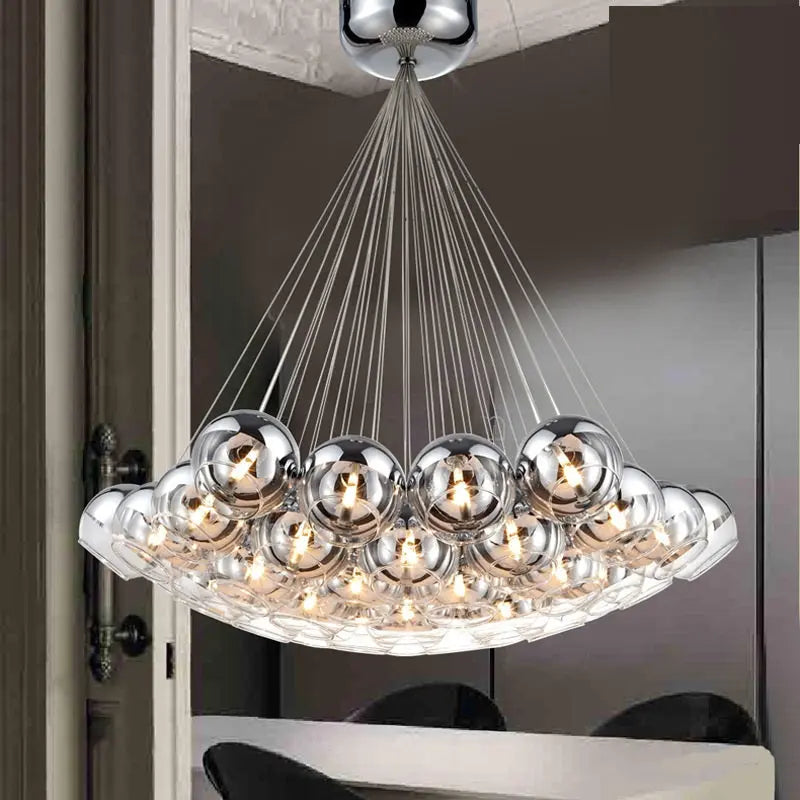
The Quinn Bubble Chandelier Light is the controlled clear-glass cluster many DIY builds aim for — decorative, refined, and sized for living rooms, bedrooms, and simpler interiors.

The Nora Bubble Cluster Chandelier is the cloud-like cluster at full scale, with globes at staggered heights — the result a large DIY build tries for, already balanced and rated.
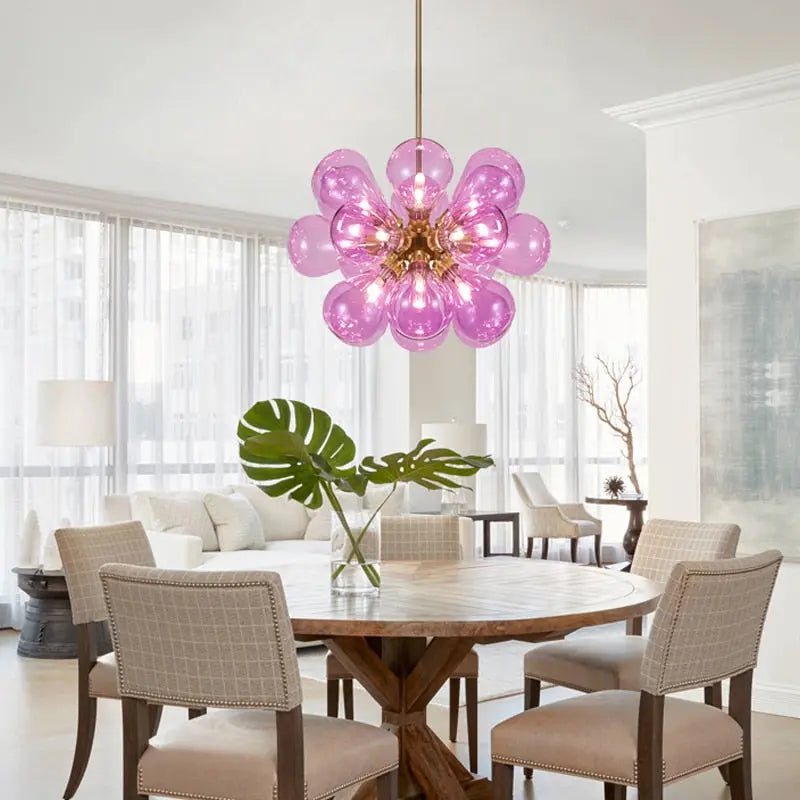
The Nadine Pink Bubble Chandelier delivers the colored-glass cluster without sourcing matching tinted globes — pink glass that gives a bedroom or dining room a softer, expressive focal point.
Linear, sputnik, branching, and cascade
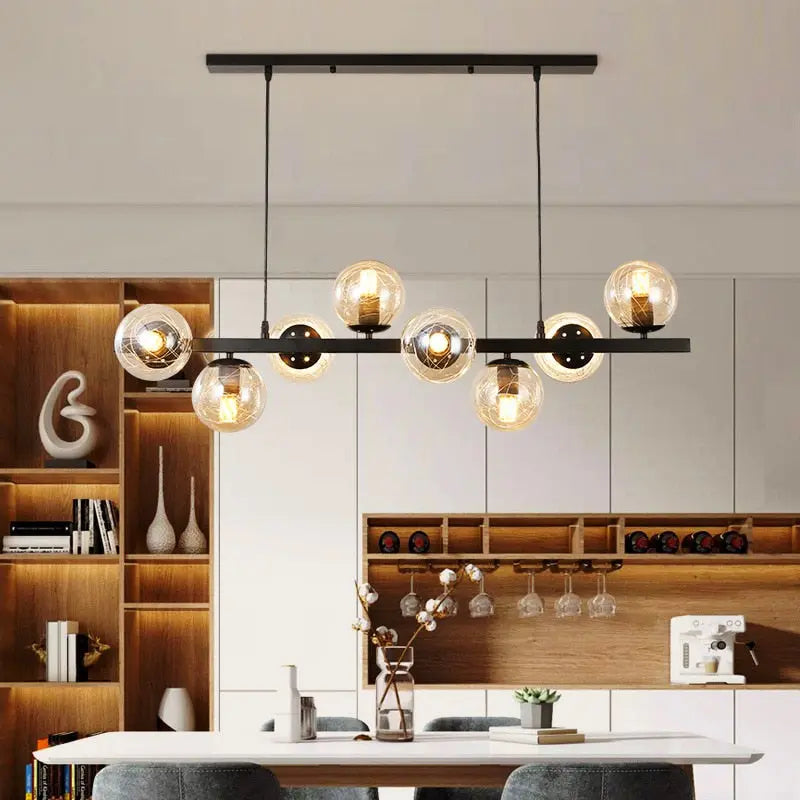
The Modern Bubble Chandelier for Dining Room, in black or gold, is the linear bubble layout over a dining table — even spacing along a bar that is hard to get right with separate cords.
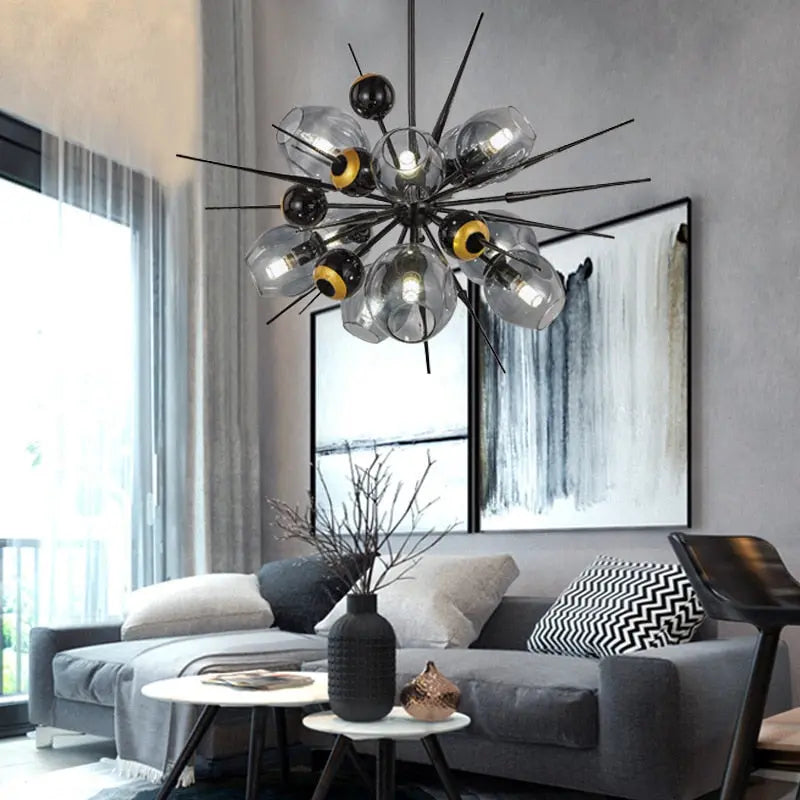
The Laura Bubble Sputnik Chandelier puts glass orbs on rigid arms — a structure a DIY cord build cannot reproduce — for living rooms and open-plan spaces.
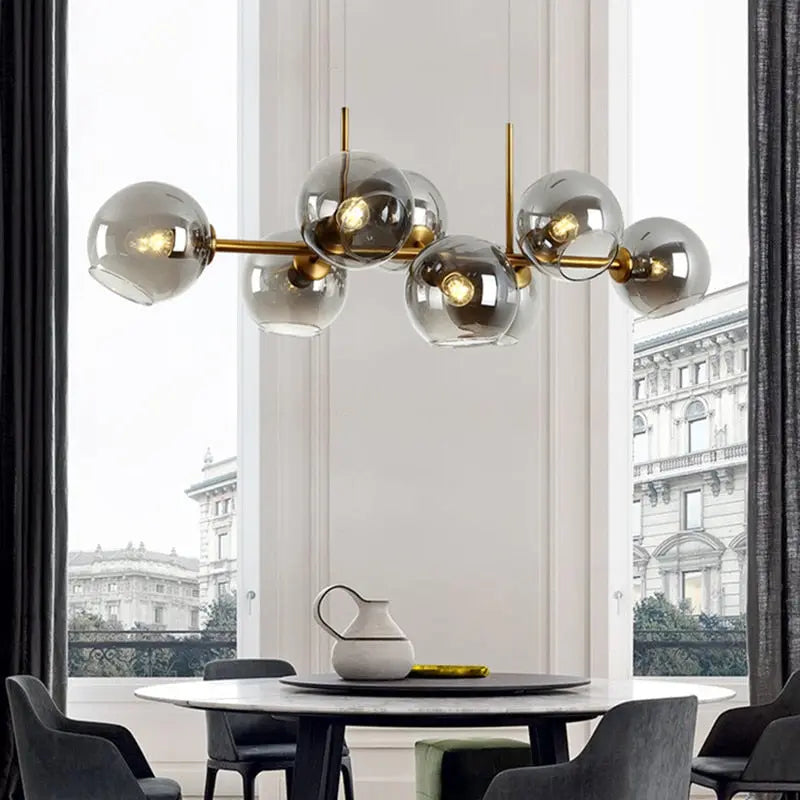
The Branching Bubble Chandelier arranges dozens of glass bubbles on branching arms in 33- and 44-inch sizes — the "branching bubble chandelier" look at a scale well beyond a DIY build.

The Contemporary Bubble Cascade Chandelier is the cascade for a tall entry or stairwell — long drops and many globes, where weight and cable engineering matter most.
Clusters, linear, sputnik, branching, and cascade bubble fixtures — tested and ready to install.
Bubble Chandeliers Pendant Lighting Dining Room Staircase
Glass, Light, and Upkeep
Whether built or bought, the glass decides the light: clear globes sparkle and show the bulb, frosted and opal globes diffuse glare, tinted globes add color but absorb some light. Use LED bulbs at 2700–3000K with CRI 90 or higher, and a dimmer matched to the bulbs. Clean globes every one to three months with the power off — dust, then wash removable globes in mild soapy water and dry fully. Tinted glass and color choices are covered in colored glass chandeliers; LED options in energy-efficient LED bubble chandeliers.
Frequently Asked Questions
Can I make my own bubble chandelier?
Yes, with a multi-port canopy, UL-listed pendant cord sets, sockets, glass globes on matching fitters, and LED bulbs, mounted to a ceiling box rated for the weight. The connection to the house wiring should be made by a licensed electrician unless you are qualified.
What do I need for a DIY glass ball chandelier?
Glass globes with open necks, fitters and sockets that match the neck size, UL-listed pendant cord sets, a multi-port canopy (round or linear), LED bulbs, a rated ceiling box, and an LED-rated dimmer if you want dimming.
How many globes should a DIY bubble chandelier have?
Three to nine for a first build is manageable in weight and wiring. Larger clusters add weight and connections quickly; beyond about ten globes a ready-made fixture is usually the better choice.
Is a DIY chandelier safe?
It can be, with listed parts, LED bulbs, correct weight ratings, and a qualified electrician for the house connection. Mixed unlisted parts, incandescent bulbs in closed glass, and under-rated boxes are the common hazards.
What bulbs should I use in glass globes?
LED bulbs only, in the base the socket takes (G9, E12, or E26), at 2700–3000K. Incandescent and halogen bulbs can overheat inside closed glass.
How heavy is a bubble chandelier?
Hand-blown globes weigh about 0.5 to 2 pounds each, so ten 8-inch globes plus hardware can exceed 20 pounds. Above 50 pounds, use a fan-rated box or a brace bar on a joist.
How high should a bubble chandelier hang?
The lowest globe 30 to 36 inches above a tabletop and at least 7 feet above the floor in walkways.
What room is a 36-inch bubble chandelier for?
About 16 by 20 feet over open floor, or a round table of roughly 54 to 72 inches. It can also suit a two-story foyer with enough height around it.
Can I make a plug-in bubble chandelier?
Yes, using a UL-listed plug-in cord set and a swag hook, which avoids hardwiring. The cord stays visible along the ceiling and wall.
Is it cheaper to build or buy a bubble chandelier?
For a small cluster of a few globes, building can cost less; for larger clusters, linear bars, and cascades, the parts, rated hardware, and electrician time often add up to more than a ready-made fixture with matched glass and a single warranty.
Building or Buying Your Bubble Chandelier
Start with the plan — spread, globe count, drops, weight — and let it tell you which way to go: a few globes and a custom look make a good weekend build; a large cluster, a linear bar, or a stairwell cascade is a job for a tested fixture. Either way, the rated box, LED bulbs, and a qualified electrician for the connection are not optional.
Compare ready-made layouts in the bubble chandeliers collection. For style ideas, read 10 bubble chandelier ideas; for sizing, the bubble chandelier size guide.


