

Outdoor wall lights do three jobs at the same time: they light the path to your front door, they protect the entry point at night, and they finish the architecture of the facade. Choosing the wrong fixture means uneven coverage, glare in the wrong direction, premature corrosion, or — worst — a light that looks dramatic in product photos and disappointing on the actual wall.
This guide covers the four decisions that matter when buying an outdoor wall sconce: weather rating, size, finish, and beam direction. Then it walks through 11 fixtures from our wall lights collection — modern, vintage, motion-activated, and statement designs — and where each one belongs.
The Four Decisions Before You Buy
Before looking at any specific fixture, four technical and design decisions narrow the catalog from "everything" to "the right one." Skip any of these and you'll end up either replacing the fixture in 18 months or living with a result that looks wrong.
| Decision | What It Determines |
|---|---|
| 1. IP rating | Whether the light survives rain, snow, and humidity in your specific install location |
| 2. Size and projection | Whether the fixture looks proportionate to the door, garage, or wall section |
| 3. Finish | How well the fixture coordinates with door hardware, siding color, and architecture |
| 4. Beam direction | Whether the light points up, down, both, or wraps the wall — affects ambiance and security |
Decision 1: IP Rating and Wet Location Safety
An IP (Ingress Protection) rating tells you exactly how much water and dust a fixture can survive. The number has two digits — first digit for solids, second for liquids. For outdoor wall lights, only the second digit matters in practice.
| IP Rating | Protection Level | Right For |
|---|---|---|
| IP23 | Light spray, no direct rain | Fully covered porches only |
| IP44 | Splash-protected, indirect rain | Covered porches, side entries with overhang |
| IP54 | Splash + dust protection | Garage walls, covered patios |
| IP65 | Direct rain, jets of water | Exposed facades, uncovered walls (most common outdoor) |
| IP67 | Temporary submersion (1 m / 30 min) | Coastal homes, near pools, ground-level fixtures |
For most American homes, IP44 is the minimum for any covered porch and IP65 is the standard for any exposed wall. Coastal addresses (within 1 mile / 1.6 km of saltwater) should add a corrosion-resistant finish — marine-grade stainless steel or powder-coated aluminum — regardless of IP rating. Salt air will eat brass and untreated steel within 2–3 years.
Decision 2: Sizing — Get the Proportion Right
The single most common outdoor wall light mistake is buying a fixture that's too small for the wall. A fixture that looks "right" in a product photo at a desk usually reads tiny once mounted on a 2-story facade. Use these proportions:
| Application | Fixture Height | Mounting Height |
|---|---|---|
| Single fixture beside front door | ¼ to ⅓ of door height (≈ 18–24" / 46–61 cm) | Center 66–72" (168–183 cm) above ground |
| Pair flanking double doors | ¼ of door height each (≈ 16–22" / 41–56 cm) | Center 66–72" (168–183 cm) above ground |
| Garage door flanking pair | ⅓ of garage door width per fixture | 6–12" (15–30 cm) above garage door top |
| Patio / outdoor seating | 12–18" (30–46 cm) | 72–84" (183–213 cm) above patio surface |
| Statement / 2-story facade | 28"+ (71 cm+) | Center between floors |
Projection matters too — how far the fixture sticks out from the wall. Narrow walkways, side entries, and tight clearance areas need flush-style fixtures with projection under 5" (13 cm). Open patios and garage walls can take deeper projections (6–10" / 15–25 cm) without feeling intrusive.
Decision 3: Finish — Match the Architecture
An outdoor wall light is one of the most visible exterior elements after the door itself. Its finish should repeat a metal already in use — door hardware, house numbers, mailbox, gutters. Mixed-metal facades work, but only when the mix is intentional.
| Architecture Style | Best Finish | Avoid |
|---|---|---|
| Modern / Contemporary | Matte black, brushed aluminum, brushed nickel | Antique brass, oil-rubbed bronze |
| Mid-Century Modern | Polished brass, matte black, walnut accent | Wrought iron, distressed bronze |
| Farmhouse / Cottage | Aged bronze, vintage iron, weathered brass | Polished chrome, RGB color-changing |
| Mediterranean / Spanish | Antique bronze, hammered iron, copper | Brushed nickel, stainless steel |
| Coastal / Cape Cod | Brushed nickel, marine-grade stainless, white | Brass (corrodes in salt air) |
| Industrial / Loft | Matte black, raw steel, gunmetal | Polished gold, decorative finishes |
| Colonial / Traditional | Polished brass, oil-rubbed bronze, black | Brushed aluminum, RGB |
Decision 4: Beam Direction
How the light leaves the fixture changes the entire effect on the wall. Four common patterns:
- Down-only: Light goes straight down. Useful over door numbers and address signage. Creates a dark wall above the fixture.
- Up-and-down (bidirectional): Cleanest modern look. Light splits into two cones — one up the wall, one down. Reads dramatic and architectural.
- Open-top / lantern style: Light spreads in all directions through a glass diffuser. Traditional, warm, soft.
- Wall wash: Light spreads sideways across the wall to highlight texture (brick, stone, stucco). For accent purposes only.
For front entries, up-and-down is usually the strongest choice — it lights faces approaching the door and creates the architectural "bookend" effect on the facade. Lantern style suits traditional homes; down-only suits minimal modern facades; wall wash is reserved for feature walls.
11 Outdoor Wall Lights from Our Catalog
The fixtures below are pulled from our wall lights collection. Each entry covers what it actually is, where it belongs, and where it doesn't.
1. Brushed Nickel Outdoor Wall Lights
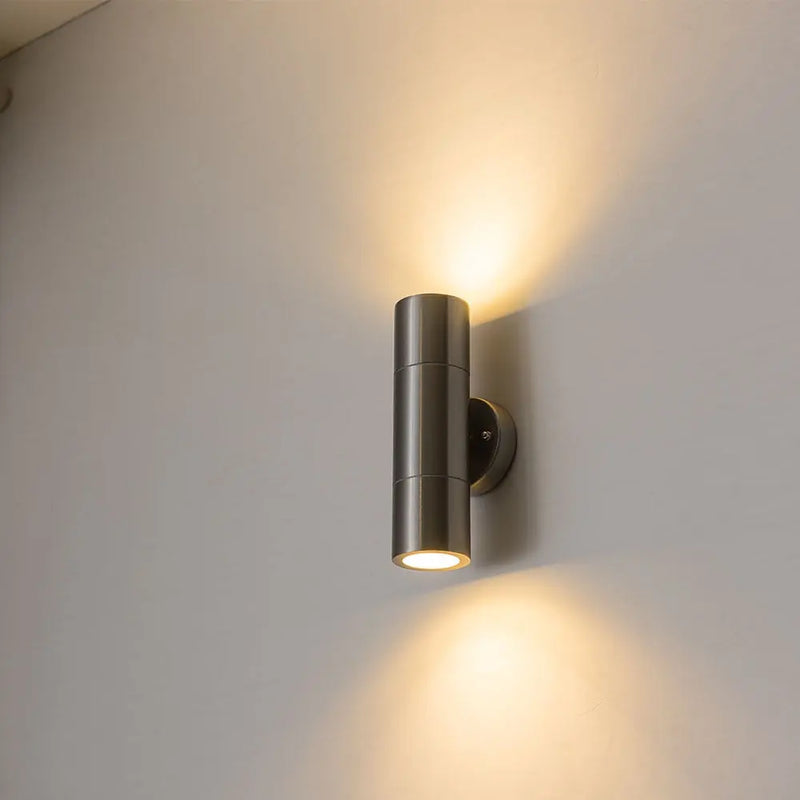
A bidirectional up-and-down sconce in brushed nickel. The brushed finish is more forgiving than polished nickel — fingerprints, water spots, and minor wear don't show. Best for: coastal and Cape Cod homes (the brushed nickel resists salt air better than brass), modern and contemporary facades. Skip if: you have a traditional or farmhouse home where antique finishes dominate. View product ($64.99).
2. Siena Outdoor Contemporary Wall Lights

Geometric, crisp, linear — the Siena reads as architectural rather than decorative. Bidirectional output makes it work either as a single fixture beside a door or as a flanking pair on garage walls. Best for: contemporary, minimalist, or industrial facades; new construction; modern garages. Skip if: the home leans traditional, colonial, or farmhouse — the lines are too sharp. View product (from $145.99).
3. Large Modern Outdoor Wall Lights

Sized for tall walls. Most outdoor sconces look stranded on 2-story facades; this one is built for them. The scale lets it carry the visual weight of a tall entry without needing a flanking pair. Best for: 2-story modern homes, double-height entries, contemporary new construction. Skip if: the wall is shorter than 12 feet (3.7 m) — the fixture will overwhelm it. View product (from $249.99).
4. Senia Vintage Outdoor Wall Light
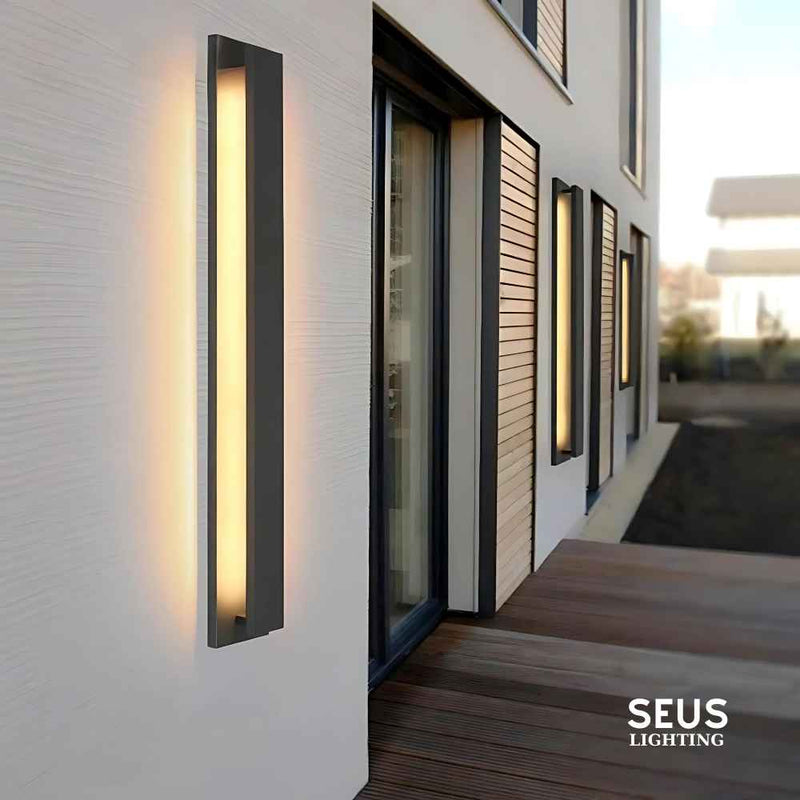
Traditional lantern silhouette in an antique finish. Reads warm and period-appropriate the moment it's mounted. Best for: farmhouse, colonial, traditional, and cottage-style homes; covered porches; older neighborhoods where modern fixtures look out of place. Skip if: the architecture is contemporary or mid-century — the lantern shape will fight the home's lines. View product (from $129.99).
5. Geometric Outdoor Wall Mount Light Fixture

A sculptural angular form that reads as architectural sculpture during the day and a directional light at night. Stronger visual presence than a typical bidirectional sconce. Best for: modern facades where the entry needs a focal point; architect-designed homes; statement entries. Skip if: the home already has multiple decorative exterior elements — the geometry will compete. View product (from $159.99).
6. Aluminum Motion Sensor Outdoor Wall Sconce

Security-first sconce with built-in motion detection — the light triggers when someone approaches. Aluminum body resists corrosion in most climates including coastal. Best for: side entries, garage walls, back doors, secondary entries where you want the light only when needed. Skip if: the fixture is for a front entry where you want consistent ambient light — motion-only sconces leave the entry dark when no one is there. View product ($119.99).
7. Polina LED Moon Wall Light

A pure circle — no arms, no fittings showing — that reads as a glowing disc on the wall. The cleanest modern silhouette in our outdoor catalog. Best for: minimalist, contemporary, and Japandi-leaning facades; designer-led new builds; zen garden entries. Skip if: you need significant downward task light — the circle distributes light evenly rather than directing it. View product (from $249.99).
8. Loft LED Outdoor Globe Wall Light

Globe-style sconce with frosted diffusion — soft, warm light without glare points. The most affordable fixture in this list at under $40 sale price, but the proportions read more expensive than the price suggests. Best for: rental properties, secondary doors, side patios, anywhere the lighting needs to look intentional without a $200 price tag. Skip if: you want a dramatic statement piece — this is a quiet workhorse. View product ($39.99).
9. Industrial Outdoor Wall Light
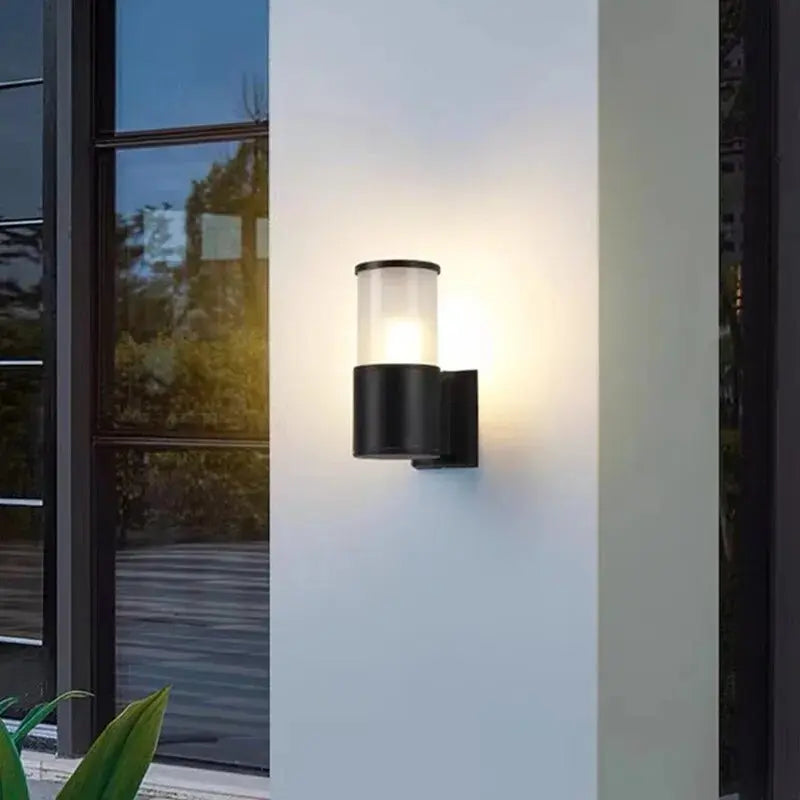
Black metal cage form. Reads loft, warehouse, and industrial — the visual language of converted commercial spaces. Best for: industrial-style homes, urban lofts, modern farmhouse with black trim, exposed-brick exteriors. Skip if: the home leans traditional, coastal, or transitional — the cage detail will read out of place. View product ($53.99).
10. Judin Modern Outdoor Wall Sconce
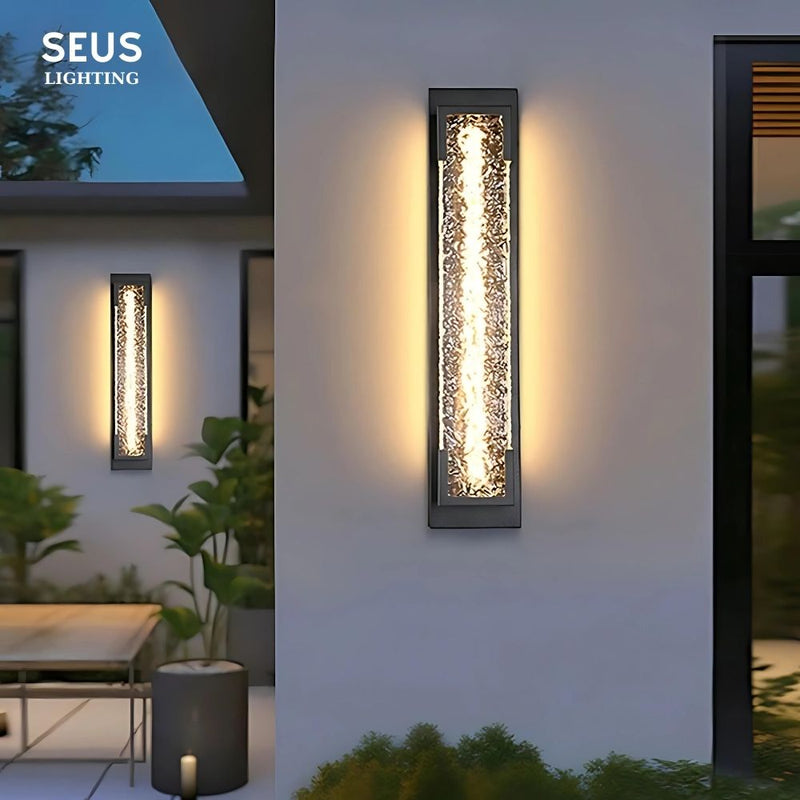
Mid-priced architectural sconce. The form is restrained enough to disappear into the background and let the architecture lead — exactly what most modern homes need from exterior lighting. Best for: contemporary homes where the lighting should support, not lead; multi-fixture installations (matched pair on garage, plus single at front door); designer-led new construction. Skip if: the entry needs a single statement piece — this fixture is meant to repeat. View product (from $239.90).
11. Waterproof Outdoor Moon Wall Light

The Polina Moon's heavy-duty cousin — same circular silhouette, higher IP rating, sized for direct-rain exposure. Use this version for walls without overhead protection. Best for: coastal homes, exposed back walls, pool-area facades, climates with heavy rain or snow. Skip if: the install is under a deep porch overhang — the lower-IP Polina will look identical and cost less. View product (from $319.99).
Quick Reference: Match the Fixture to the Use
| If You Need… | Pick |
|---|---|
| Modern minimalist statement | Polina LED Moon, Geometric Wall Mount |
| Traditional warmth | Senia Vintage |
| Coastal salt-air resistance | Brushed Nickel, Aluminum Motion Sensor |
| Tall 2-story facade | Large Modern Outdoor |
| Security-first side entry | Aluminum Motion Sensor |
| Industrial / loft style | Industrial Outdoor |
| Budget under $50 | Loft LED Globe |
| Direct-rain exposed wall | Waterproof Outdoor Moon |
| Matched pair across multiple walls | Judin Modern, Siena Contemporary |
Installation and Wiring
Outdoor wall lights need a junction box rated for damp or wet locations — typically marked WP (weatherproof) on the box itself. Indoor junction boxes will not pass inspection and will trap moisture against the wiring. If you're replacing an existing exterior fixture, the box is usually already rated. If you're adding a fixture where one didn't exist before, expect to hire a licensed electrician — running new exterior cable through siding involves both code compliance and waterproofing decisions a homeowner shouldn't guess at.
For a step-by-step look at the install process for an existing junction box, see our wall light installation guide. For homes where the wiring is older or non-standard, our guide on installing wall lights in old homes with limited wiring covers the common workarounds. If a fixture flickers after install, our flickering wall lights troubleshooting guide walks through driver, dimmer, and bulb mismatches.
Color Temperature for Outdoor Wall Lights
Outdoor wall lights work best at 2700K–3000K — warm white. Cooler temperatures (4000K+) read as commercial parking-lot lighting and instantly cheapen residential exteriors. The exception is security-focused side and back entries, where 3500K reads alert and clinical (which is the point) without crossing into harsh.
For a deeper look at Kelvin selection across the home, see our complete lighting color temperature guide.
Maintenance
Outdoor wall lights collect dust, pollen, and — depending on location — salt residue and insect debris. Three habits keep the finish lasting:
- Wipe quarterly. Microfiber cloth on the fixture body. Skip pressure washing — the spray can drive water past the IP seal even on IP65 fixtures.
- Inspect gaskets annually. The rubber seals where the fixture meets the wall are the first failure point. Replace any cracked or compressed gaskets.
- Avoid ammonia-based cleaners on metal. Brass, gold, and bronze finishes have a thin protective lacquer that ammonia strips. Use water and mild soap.
Frequently Asked Questions
What IP rating do outdoor wall lights need?
IP44 is the minimum for any covered porch. IP65 is the standard for any wall directly exposed to rain. IP67 is required for coastal homes within 1 mile (1.6 km) of saltwater or for fixtures near pools and ground level.
How high should an outdoor wall light be mounted?
Center the fixture 66–72 inches (168–183 cm) above ground for front-door sconces. For garage-flanking pairs, mount 6–12 inches (15–30 cm) above the garage door top. For patio fixtures, 72–84 inches (183–213 cm) above the patio surface.
What size outdoor wall light do I need beside my front door?
The fixture should be roughly one-quarter to one-third of the door's height. For a standard 80-inch (203 cm) door, that's an 18–24 inch (46–61 cm) fixture. For a flanking pair, slightly smaller — around one-quarter of the door height each.
Can outdoor wall lights be installed in coastal areas?
Yes, but choose marine-grade stainless steel, powder-coated aluminum, or brushed nickel finishes. Brass and untreated steel will corrode within 2–3 years in salt air. The Brushed Nickel and Aluminum Motion Sensor sconces in this collection are both suited for coastal install.
Should outdoor wall lights be on a motion sensor?
Side and back entries — yes. Motion sensors save energy and improve security where consistent light isn't needed. Front entries — no. The front of the house benefits from steady ambient light that doesn't startle visitors or leave the entry dark.
What color temperature is best for outdoor wall lights?
2700K–3000K (warm white) for residential entries and patios. 3500K is acceptable for security-focused side and back entries. Anything above 4000K reads commercial and undercuts the home's curb appeal.
How many outdoor wall lights do I need at the front entry?
Single fixture for asymmetric entries (door without sidelights or with one-sided sidelight). Flanking pair for symmetrical entries with double doors or balanced sidelights on both sides. The pair version creates the strongest "framed entry" effect.
Are outdoor wall lights LED-only or can they use traditional bulbs?
Most fixtures in this collection ship with integrated LED or accept E26 LED bulbs. Confirm the bulb base type on the product page. LED is strongly recommended for outdoor use — they run cool inside enclosed housings, last 15–25 times longer than incandescent, and tolerate temperature swings better.
Can I dim outdoor wall lights?
Many can, if the fixture's LED driver is dimmable and you pair it with a matching dimmer (TRIAC, ELV, or 0–10V — listed in the product specs). Mismatched dimmers cause flicker that becomes especially visible at low output.
Where can I buy these outdoor wall lights?
All 11 fixtures are in our wall lights collection with free worldwide shipping and 20-day returns. For sizing or finish questions, reach our team at +1 845-316-5012 Monday through Friday, 10 AM–4 PM ET, or through our contact page.
Closing
The right outdoor wall light is rarely the most dramatic option in the catalog. It's the fixture that matches the architecture, survives the climate, fits the wall proportions, and points light where it needs to go. Get those four decisions right and the fixture quietly does its job for fifteen years. Get any one of them wrong and you'll be replacing it after eighteen months.


