

Basements have a fixed lighting problem most homeowners don't realize until they're already living with it. Standard ceiling fixture placement that works in living rooms and bedrooms produces flat, shadow-heavy basements where corners read as caves and central seating areas feel exposed. The fix isn't more light; it's the right kind of light in the right places. Layered illumination, ceiling-height-appropriate fixtures, and damp-rated specifications where moisture matters — get those three right and a basement reads as legitimate living space rather than the unfinished room beneath the house.
This guide covers basement lighting from the practical decisions homeowners face when finishing or upgrading a lower level: how to handle low ceiling heights (the most common basement constraint), which fixture types work in damp environments, where recessed lights belong versus track lighting versus pendants, and how to layer the three lighting types across different basement zones. Browse our ceiling lights collection and pendant lighting collection for fixtures that work in basement applications. Free worldwide shipping and 20-day returns.
Why Basement Lighting Differs From Standard Room Lighting
Basements have four characteristics that most other rooms don't share, and each affects the lighting decisions:
- Lower ceilings. Most finished basements run 7–7'6" (213–229 cm) ceilings rather than the 9 ft (274 cm) standard for main floors. The 18–24" (46–61 cm) difference rules out most chandeliers and pendants and pushes decisions toward flush-mount, semi-flush, recessed, and track fixtures.
- Limited or no natural light. Egress windows provide some daylight but not enough to carry the room. Artificial light has to do nearly all the work, which means more total lumens and a stronger ambient layer than upstairs rooms need.
- Moisture exposure. Basements run higher humidity than upstairs floors, particularly during summer or in regions with high water tables. Standard residential fixtures aren't always rated for the conditions; some basement applications require damp-rated specifications.
- Multi-purpose zones. Most finished basements include several distinct functional areas (media room, bar, home gym, laundry, storage) in a single open space. Each zone needs its own lighting strategy — one fixture type doesn't cover the room.
The implication: basements need more fixtures than upstairs rooms, lower-profile fixture types, and zone-specific lighting strategies. Trying to light a finished basement with a single overhead fixture produces the cave effect that gives basements their reputation.
Working Around Low Basement Ceilings
The most common basement lighting constraint is ceiling height. Building code typically requires 7 ft (213 cm) minimum for habitable basement space, and many older homes run exactly at that minimum. Hanging fixtures designed for 9 ft (274 cm) ceilings produces fixtures that hit walking heads or feel oppressive overhead.
The working rule: subtract 7 ft (213 cm) head clearance from your basement ceiling height. The result is your fixture drop budget. A 7 ft ceiling leaves zero drop — flush-mount and recessed only. An 8 ft ceiling leaves 12" (30 cm) — semi-flush works, compact pendants work over fixed surfaces (bars, kitchen islands) where nobody walks. A 9 ft+ ceiling allows standard pendants and small chandeliers.
Fixture Types by Basement Zone
Most finished basements include three to five functional zones in a single open space. Each zone has different lighting requirements, and the right fixture type varies by zone:
| Zone | Best fixture type | Lumen target |
|---|---|---|
| Media / TV area | Recessed dimmable + accent | 100–300 lm (dimmed for viewing) |
| Bar / kitchenette | Compact pendants + under-cabinet | 600–1,000 lm at counter |
| Home gym | Track or LED panel, cool tone | 800–1,500 lm overhead |
| Reading / lounge area | Floor lamp + warm semi-flush | 400–800 lm at seating |
| Game room / pool table | Linear pendant or track over table | 1,000–1,500 lm at surface |
| Laundry / utility | Flush-mount LED panel, damp-rated | 800–1,200 lm overhead |
| Storage areas | Wire-cage shop lights or strips | 600–1,000 lm |
| Hallway / stairs | Recessed or wall sconce, motion-sensor | 200–400 lm |
Most basements need 4–8 distinct lighting zones controlled on separate switches. Putting everything on a single switch produces either “everything on, way too bright” or “everything off, way too dark.” Zone-specific control lets you light the media area dim while the bar stays bright.
Recessed Lighting: The Workhorse of Finished Basements
Recessed (can) lights are the strongest single fixture type for finished basements because they sit fully within the ceiling, consume zero vertical space, and distribute light evenly when properly spaced. Six recessed cans across an open basement at 4–6 ft (122–183 cm) spacing provide stronger ambient coverage than any single fixture could achieve.
Three considerations when planning recessed lighting:
- Spacing: The general rule is to space recessed cans at half the ceiling height. A 7 ft (213 cm) ceiling spaces cans at 3.5 ft (107 cm) intervals; an 8 ft (244 cm) ceiling at 4 ft (122 cm). Closer spacing produces brighter result; wider spacing leaves dark zones.
- Trim type: Standard reflector trims throw direct downward light (good for general ambient). Wall-wash trims angle the light toward walls (useful for darker corners or accent walls). Adjustable trims (gimbal or eyeball) let you redirect the cone after installation.
- Beam angle: Wide beam (60°+) for general ambient; narrow beam (25–40°) for task lighting over specific surfaces (kitchen counter, pool table). Most residential basement applications use wide beam for ambient and narrow beam selectively for task zones.
Recessed cans need to be IC-rated (insulation-contact rated) if they sit in ceilings with insulation directly above — common in basements that share insulation with the floor of the level above. Non-IC fixtures in IC applications create fire hazards.
Track Lighting for Flexible Basement Coverage
Track lighting solves the problem of needing multiple light points without committing to permanent fixture locations. A 6–8 ft (183–244 cm) track with 4–6 adjustable heads lets you direct light wherever the basement layout currently needs it — and redirect when furniture moves.
Three places track lighting works particularly well in basements:
- Open basements with shifting furniture layouts. If the basement gets reconfigured every year or two (different gym setups, different media arrangements), track lighting adapts without rewiring.
- Bar areas needing focused light at specific positions. Track over a bar with adjustable heads pointing at the back bar, the work surface, and the seating positions covers all three lighting needs from a single circuit.
- Art or display walls. Track aimed at a feature wall (gallery, display shelves, wine racks) provides directional accent lighting without dedicated wall sconces.
The drawback of track lighting in basements: it adds 4–6" (10–15 cm) of fixture drop below the ceiling, which matters in 7 ft (213 cm) ceiling applications. For low-ceiling basements, low-profile track or rail systems mounted as close to the ceiling as possible work better than bulkier traditional track.
Damp-Rated Fixtures for Basement Moisture Zones
Basements run higher humidity than upstairs floors. Most finished basement living areas don't reach the moisture levels that require damp-rated fixtures, but specific zones do. Three areas need damp-rated specifications:
| Zone | Rating required | Why |
|---|---|---|
| Laundry room | Damp-rated | Steam and humidity from washer/dryer |
| Basement bathroom (general area) | Damp-rated | Standard bathroom moisture exposure |
| Above bathtub or shower | Wet-rated | Direct water spray exposure |
| Wine cellar (active humidification) | Damp-rated | Sustained 50–70% humidity |
| Sauna or steam room | Wet-rated, sauna-specific | High temperature plus moisture |
| Unfinished basement / utility | Damp-rated recommended | Variable humidity, occasional moisture |
For finished basement living areas (media room, bar, lounge, gym), standard residential fixtures work fine in most climates. In coastal regions, regions with high water tables, or basements with documented moisture issues, damp-rated specifications across the whole basement add safety margin without significant cost.
Compact Pendants Over Bars and Surfaces
Pendants generally don't fit in low-ceiling basements, but compact pendants over fixed surfaces (bars, kitchen islands, pool tables) work because the pendant hangs above a surface where nobody walks. Two pendant scenarios that work in basements:
Susi Modern Linear Pendant
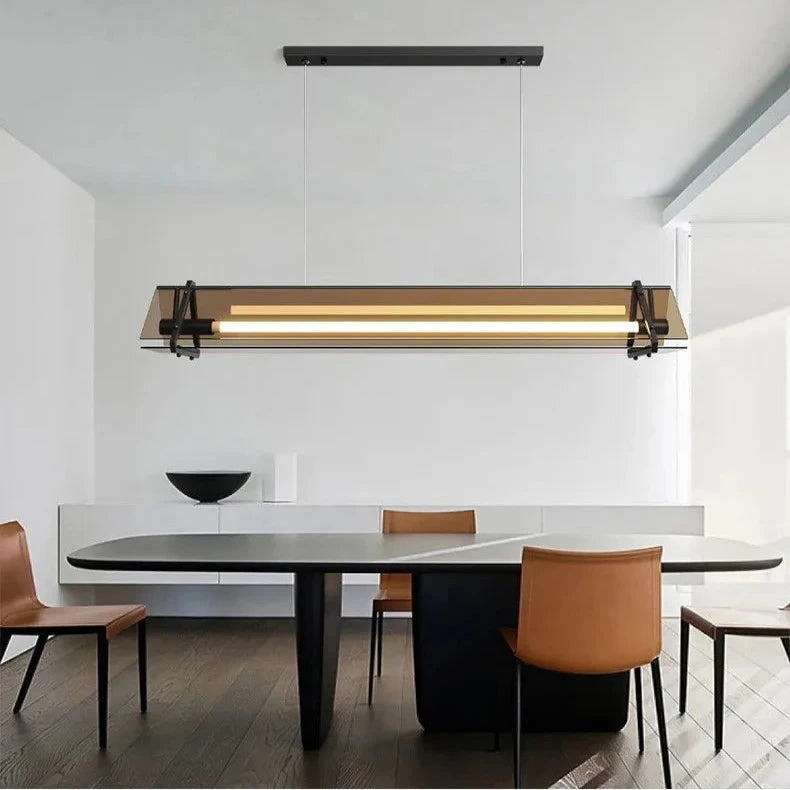
The Susi Modern Linear Pendant works well over basement bars (39" version) or pool tables (51" version). The frosted glass diffuser produces glare-free light along the surface, and the linear form sits compactly close to the ceiling.
Modern Minimalist Bubble Glass Orb

The Modern Minimalist Bubble Glass Orb works in 8 ft+ (244+ cm) ceilings as the central ambient fixture. The 8 frosted orbs distribute light without harsh shadows, and the remote dimming handles the wide range of brightness needs across basement activities (full bright for cleaning, dim for movie nights).
Egress Window Lighting and Daylight Maximization
Most finished basements have one or more egress windows — required by code for any habitable basement bedroom and common in living areas. Egress windows provide some natural light, but the basement's below-grade position means the light is limited and angled rather than direct.
Three approaches to maximize daylight in basement spaces with egress windows:
- Reflective window wells. White or light-colored window well materials reflect more light into the basement than dark or natural materials. The difference can produce 30–50% more daylight at the window.
- Light-colored ceiling and walls. Basement spaces with white or near-white ceilings reflect the limited natural light back into the room. Dark ceilings absorb daylight and amplify the cave effect.
- Daylight-spectrum LED supplementation. 5000K+ LED fixtures positioned near egress windows simulate the daylight quality entering through the window. The combination reads as more natural light than the egress window alone provides.
Avoid heavy curtains or window treatments on basement egress windows during daytime — the limited daylight is too valuable to cover. For privacy concerns, use frosted glass film or light-filtering shades that block sightlines without blocking light.
Color Temperature Strategy for Basement Living
Basements lack the natural daylight cycling that regulates color perception in upstairs rooms. The lighting has to do all the work, and getting color temperature right matters more than in spaces with windows.
| Basement zone | Color temperature | Reason |
|---|---|---|
| Media / lounge / bar | 2700–3000K | Warm, residential, supports relaxation |
| Home gym | 4500–5000K | Cool, alerting, mirrors daylight |
| Game room / pool table | 3500–4000K | Neutral, accurate color reading |
| Laundry / utility | 4000–5000K | Cool, supports detail work and cleaning |
| Storage / unfinished | 3500–4000K | Neutral, finds items quickly |
| Hallway / stairs | 3000–3500K | Transition between residential and utility |
Avoid 2700K everywhere in the basement — the uniformly warm color reads as oppressive when there's no daylight to break it up. Mix warm zones (lounge) with neutral or cool zones (gym, laundry) for visual variation that prevents the monotone feeling that gives basements their reputation.
Common Basement Lighting Mistakes
One central fixture for the whole basement
The single most common basement lighting mistake. One fixture in the middle of an open basement produces flat illumination with dark corners and inadequate task light at any specific zone. Always distribute multiple fixtures across the space.
Standard pendants in 7 ft (213 cm) ceilings
Pendants designed for 9 ft (274 cm) ceilings hang 18–24" (46–61 cm) below the canopy. In 7 ft basements, that puts the pendant at 5–5.5 ft (152–168 cm) above the floor — below standing eye level. Use flush-mount or semi-flush in low-ceiling basements.
All-warm color temperature throughout
2700K everywhere makes basements feel dim and oppressive because there's no daylight contrast. Mix warm lounge zones with neutral or cool task zones for variation.
No dimming control
Basement activities range from full-bright cleaning to dim movie watching. Without dimmers, you're stuck with a single brightness level. Wire dimmable LEDs and dimmer switches from the start.
Skipping damp-rated fixtures in laundry rooms
Standard fixtures in laundry rooms eventually fail because of steam exposure from washers and dryers. Damp-rated fixtures cost slightly more upfront and last decades longer.
Ignoring egress window light
Even modest egress window daylight contributes to a less cave-like basement feel. Heavy curtains or dark window treatments waste the limited daylight available.
Common Questions Basement Lighting Buyers Ask
How many recessed lights do I need in my basement?
The general rule: space recessed cans at half the ceiling height. A 7 ft (213 cm) ceiling spaces cans at 3.5 ft (107 cm); an 8 ft (244 cm) ceiling at 4 ft (122 cm). For a typical 600 sq ft (56 m²) basement with 8 ft ceilings, that's roughly 6–8 cans for ambient coverage.
Can I use pendant lights in a basement with low ceilings?
Yes, but with constraints. In 7 ft ceilings, pendants only work above fixed surfaces (bars, pool tables) where nobody walks underneath. In 8 ft ceilings, compact pendants with 12" (30 cm) drop or less work. Standard pendants need 9 ft+ (274+ cm) ceilings.
What's the best basement track lighting setup?
For an open basement, a 6–8 ft (183–244 cm) track with 4–6 adjustable heads handles ambient lighting and lets you redirect light when furniture moves. Position the track to allow head adjustment toward both general ambient and specific zones (bar, art wall, display shelves).
Do basement lights need to be damp-rated?
Living areas in finished basements (media, bar, lounge, gym) generally don't need damp-rated fixtures in normal climates. Laundry rooms, basement bathrooms, wine cellars with active humidification, and basements in coastal or high-water-table regions need damp-rated specifications. Above tubs and showers requires wet-rated.
How bright should basement lighting be?
Total target: 80–100 lumens per square foot for finished basement living areas; 50–75 for storage; 100–150 for laundry, gym, and detail-work zones. A typical 600 sq ft (56 m²) finished basement needs 50,000–60,000 total lumens distributed across all fixtures.
What color temperature should basement lighting be?
Mix temperatures by zone. Warm 2700–3000K for lounge and bar areas; neutral 3500–4000K for game rooms and storage; cool 4500–5000K for home gyms and laundry. Avoid uniform warm temperature throughout — basements need temperature variation to feel less monotone.
Can I use track lighting instead of recessed lights in a basement?
Yes, with trade-offs. Track lighting offers more flexibility (redirect heads when furniture moves) but adds 4–6" (10–15 cm) of fixture drop below the ceiling. Recessed cans sit fully within the ceiling but commit to fixed positions. Many basements use both: recessed for general ambient, track for accent or task.
Should basement lighting be on dimmers?
Yes. Basement activities range from full-bright (cleaning, cooking, working out) to dim (movie watching, late-evening lounging). Dimmers let you cover the full range from a single fixture installation. Match dimmer type (TRIAC, ELV, or 0–10V) to the LED driver listed on the fixture specifications.
What lighting works best for a basement home gym?
Bright, cool overhead lighting (4500–5000K, 800–1,500 lumens overhead) with no glare on workout equipment. LED panel fixtures or track lighting with multiple wide-beam heads work well. Avoid warm 2700K in gyms — the warm temperature reads as evening-relaxation cue and fights workout intensity.
What about basement bar lighting?
Layer three sources: under-cabinet LED strip on the back bar (task), 1–2 compact pendants over the bar surface (focal/ambient), and warm dimmable accent (mood). The under-cabinet handles drink-mixing visibility; the pendants provide the visual focus; the accent supports atmosphere during use.
How do I maximize natural light in a basement?
Three approaches: white or light-colored window wells reflect more daylight into the basement; light-colored ceilings and walls reflect available daylight back into the room; daylight-spectrum LED (5000K+) near egress windows simulates the daylight quality. Avoid heavy curtains on egress windows during daytime.
Can I install basement lighting myself?
Replacement of an existing fixture is often DIY-feasible if you're comfortable with electricity. New installations (recessed cans, track systems, wiring runs across an unfinished ceiling) require running new wiring and adding junction boxes — hire a licensed electrician, and confirm permits if your jurisdiction requires them. Damp-rated and wet-rated installations always require professional electrical expertise.
Putting It All Together for Your Basement
The shortcut version: distribute multiple fixtures across the basement in zone-specific patterns rather than relying on a single central fixture, use recessed cans for general ambient (spaced at half the ceiling height), add track lighting where flexibility matters, use compact pendants over fixed surfaces (bar, pool table) where ceiling height allows, mix color temperatures by zone (warm in lounge areas, cool in gyms and laundry), and dim everything that can be dimmed. The combination handles nearly every basement application from media rooms to home gyms.


