

The entry is the first space guests see and the last one you pass through every day, yet it rarely gets the lighting attention it deserves. This guide walks through how to choose the right fixtures for the space you actually have — whether that's a compact apartment entry, a narrow hallway-style entrance, or a welcoming front hall — with practical sizing numbers, placement heights, and honest advice about which fixture types earn their place.
Start With What Your Entry Actually Needs
Before browsing fixtures, take three measurements: ceiling height, floor dimensions, and the amount of natural light the space receives. These three facts eliminate most of the wrong choices immediately and point you toward fixtures that will genuinely work.
Ceiling height is the biggest constraint. A hanging fixture in a 7.5-foot entry becomes an obstacle rather than a design feature — anyone tall will duck past it, and the space feels cramped rather than welcoming. Floor dimensions determine appropriate fixture scale: a wide statement piece dwarfs a narrow entry, while a small fixture disappears in a generous front hall. Natural light determines how hard your fixtures need to work. An entry with sidelights and a transom window needs less daytime illumination than a windowless interior entry, which depends entirely on artificial light around the clock.
It also helps to think about what happens in this space. You put on shoes, check a mirror, find keys, greet guests, and sort mail. Each of these small tasks benefits from light at the right height — which is exactly why the best entries layer a ceiling fixture with wall-mounted lighting rather than relying on a single overhead source.
Choosing Between Fixture Types
Five fixture categories cover nearly every entry situation. Here's how they compare and when each one makes sense.
| Fixture Type | Minimum Ceiling | What It Does Best | Watch Out For |
|---|---|---|---|
| Flush mount | Any height | Even general light in low-ceiling entries; clean, unobtrusive look | Can feel flat as the only light source — pair with sconces |
| Semi-flush | 8 ft | More presence than a flush mount without sacrificing headroom | Check the fixture's actual drop; some hang lower than photos suggest |
| Small chandelier | 9 ft | A focal point that sets the tone for the whole home | Needs the size formula — undersized chandeliers look like an afterthought |
| Pendant | 9 ft | Focused light over a console table; works singly or in pairs | Keep 7 ft clearance in walking paths, 30–36 in above table surfaces |
| Wall sconce | Any height | Eye-level light for mirrors and depth; frees up ceiling and floor space | Placement height matters — too high and the effect is lost |
Sizing the Main Fixture
The most reliable sizing method is decades old and still works: measure the room's length and width in feet, add them together, and use that number in inches as the fixture's diameter. A 6 × 8 ft entry points to a fixture around 14 inches wide. A 10 × 12 ft front hall suits something near 22 inches.
| Entry Dimensions | Target Fixture Diameter | Sensible Fixture Types |
|---|---|---|
| 4 × 6 ft (apartment entry) | 10–12 inches | Flush mount, compact semi-flush |
| 6 × 8 ft (compact entry) | 13–15 inches | Semi-flush, small pendant |
| 8 × 10 ft (standard entry) | 17–19 inches | Semi-flush, small chandelier, pendant |
| 10 × 12 ft (generous entry) | 21–24 inches | Chandelier, statement semi-flush |
| 12 × 14 ft (front hall) | 25–28 inches | Chandelier — and consider adding sconces |
Two practical adjustments to the formula: airy, open designs (a sputnik, an open-cage lantern) can run a size larger because they occupy space visually without blocking it. Dense, solid designs (a drum shade, a bowl fixture) should stay at or slightly under the target because they read heavier than their measurements suggest.
For hanging height, the rule is simple and non-negotiable in walking paths: keep the lowest point of the fixture at least 7 feet above the floor. If your ceiling is 9 feet, that leaves up to 2 feet of fixture-plus-chain to play with. If it's 8 feet, you have 12 inches — which is why semi-flush fixtures dominate that ceiling range.
Wall Sconces: The Underused Workhorse
If entries have one consistently missed opportunity, it's the walls. A ceiling fixture alone lights the floor well and faces poorly — anyone checking a mirror before heading out stands in their own shadow. Sconces solve this by putting light at eye level, where it flatters faces, brightens the mid-height of the room, and adds the layered depth that makes a small space feel considered rather than utilitarian.
A sconce, for anyone encountering the term for the first time, is simply a light fixture mounted to the wall rather than the ceiling — the modern descendant of the candle brackets that lit hallways before electricity. Today's versions range from exposed-bulb minimalist designs to shaded traditional arms, and most importantly for entries, they take up zero floor space.
Where and How High to Mount Them
| Placement | Mounting Height (to fixture center) | Notes |
|---|---|---|
| Flanking a mirror | 60–66 inches from floor | Position at roughly eye level, 36–40 inches apart for even face lighting |
| Along a hallway-style entry | 60–66 inches from floor | Space fixtures 6–8 feet apart to avoid dark gaps |
| Beside the door | 66 inches from floor | A single sconce works if wall space is limited to one side |
| Above a console table | Adjust so the bottom clears table decor | Pairs well with a table lamp for a warm evening glow |
Choose sconces that share a finish or design language with your ceiling fixture. They don't need to come from the same collection — matching too literally can look like a builder's package — but a brass chandelier with matte black industrial sconces pulls the space in two directions. One shared element, whether finish, shade material, or general era, keeps the room coherent. Browse the wall lights collection for options across styles.
Pendants Over a Console Table
If your entry includes a console table — the landing zone for keys, mail, and a decorative bowl or two — a pendant above it creates a small vignette that anchors the whole space. Hang it so the bottom sits 30 to 36 inches above the table surface. That's low enough to relate visually to the table, high enough that a table lamp or vase beneath it doesn't crowd.
In entries without a table, pendants still work as the main fixture in place of a chandelier, particularly narrow-profile designs in tighter spaces. A pair of matched pendants can also solve the awkward long-and-narrow entry that a single centered fixture leaves half-dark: space them evenly along the length, each maintaining the 7-foot walking clearance.
When a Chandelier Makes Sense
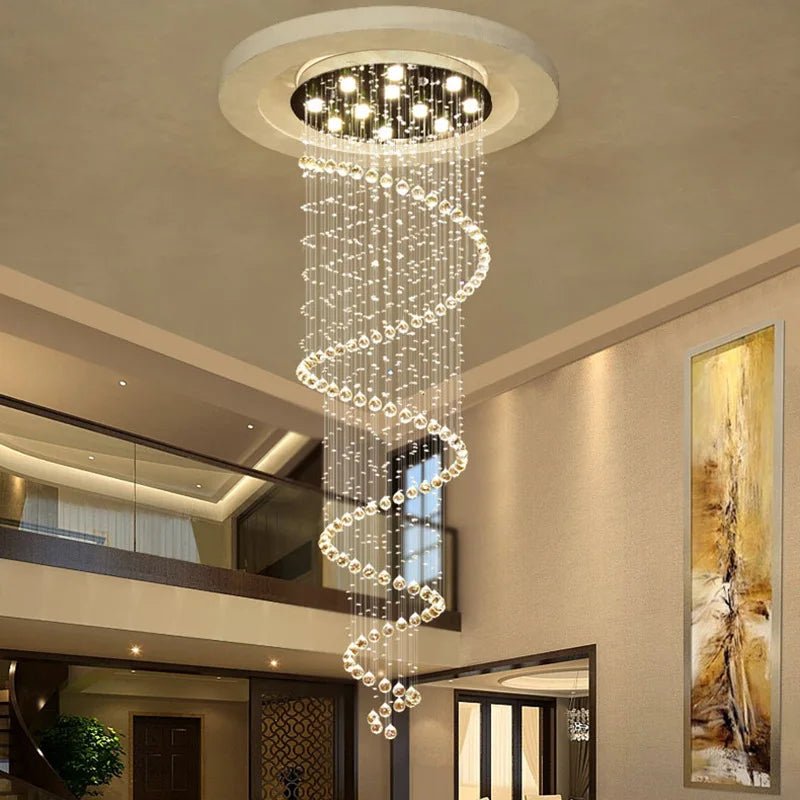
A chandelier in the entry announces the home's character before a guest sees any other room, which is exactly why it's worth getting right. The threshold question is ceiling height: at 9 feet you can hang a compact chandelier and keep the 7-foot clearance; below that, a semi-flush fixture delivers similar presence without the headroom problem.
Style should take its cue from what's visible from the entry. If the sightline runs into a modern open-plan living area, a clean-lined or geometric design bridges naturally. If the entry opens onto traditional millwork and a staircase with turned balusters, a classic candle-style or crystal design belongs. The entry fixture doesn't need to match the rest of the house — but it shouldn't argue with what's visible from the front door.
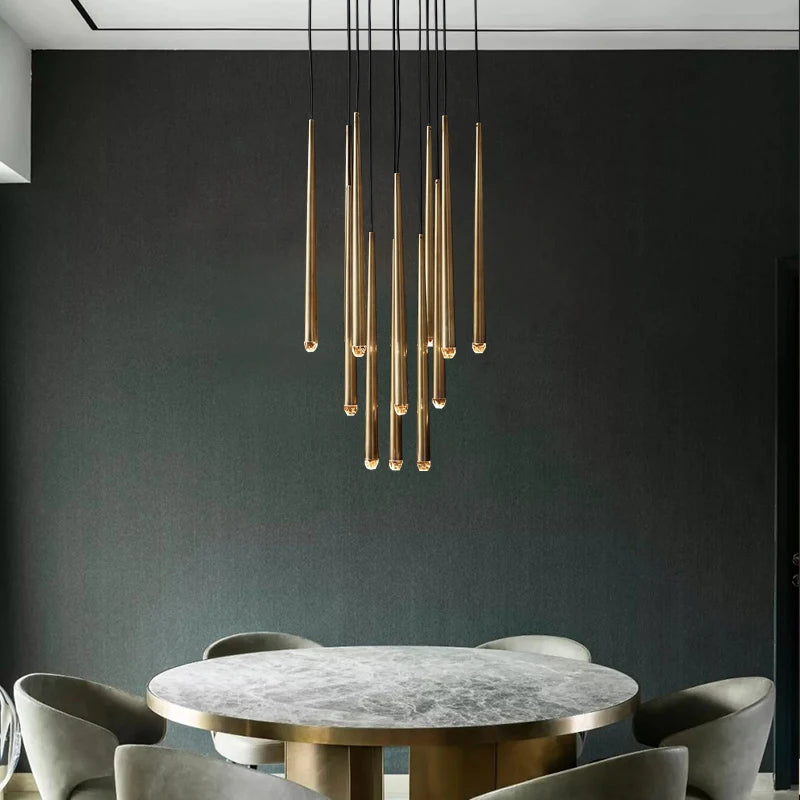
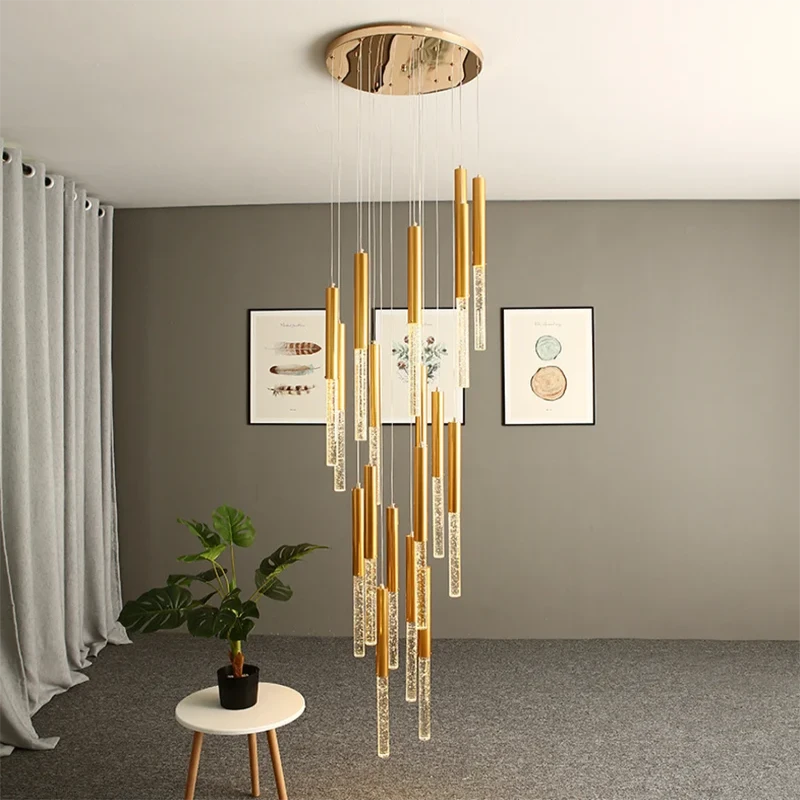
If you're seeing yourself from a second-floor landing or an open staircase above the entry, the fixture will be viewed from above as well as below — check that the top isn't a tangle of wires and mounting hardware. Fixtures designed for two-story spaces handle this gracefully; see the chandelier collection for a range of options, and the foyer light sizing guide if your entrance runs taller than a single story.
Brightening a Dark Entry
Interior entries with no window are the hardest case: they're dark at noon and darker at night, and a single ceiling fixture leaves the corners gloomy. A few fixes, in rough order of impact:
- Raise the total light output. A windowless entry needs its fixtures to do all the work. Aim for roughly 20 lumens per square foot as a floor, and don't hesitate to exceed it — an 8 × 10 entry comfortably absorbs 1,600–2,400 lumens across its fixtures.
- Add a second light source at a different height. Sconces or a table lamp break up the top-down shadow pattern that makes a space feel cave-like even when the lumen count is adequate.
- Hang a mirror opposite or adjacent to the brightest light. A mirror effectively doubles a light source and adds the depth a windowless room lacks.
- Lighten the surfaces. Pale walls and a light-colored runner reflect far more light than dark finishes. The same fixtures can feel twice as bright after a wall color change.
- Choose bulbs deliberately. Warm white (2700K–3000K) keeps the space inviting; high CRI (90+) keeps skin tones and wood finishes looking natural rather than gray.
- Put the lights on a smart switch or timer. A dark entry that greets you already lit at 6 p.m. changes how the whole home feels on arrival.
Layering: Making the Pieces Work Together
The entries that feel genuinely welcoming almost never rely on one light source. The working pattern is three layers: a ceiling fixture for general illumination, wall or table lighting at eye level for warmth and function, and — where the space allows — a small accent such as a picture light or uplight to add depth after dark.
In practice, for a standard entry, that might mean a semi-flush ceiling fixture, one pair of sconces flanking the mirror, and a small lamp on the console. Each layer switches independently, so the space can run bright when you're searching for dropped keys and soft when the evening winds down. A dimmer on the ceiling fixture is the single cheapest upgrade in this whole category — it turns one fixed light level into a full range.
Smart Controls Worth Having
The entry benefits from smart lighting more than most rooms, for one practical reason: your hands are usually full when you use it. Three features earn their cost here. A schedule or sunset trigger that turns the lights on before you arrive home. A voice command or phone control for the grocery-armload moments. And scene presets — one bright setting for departures and cleaning, one soft setting for evenings — that replace fiddling with a dimmer.
Smart bulbs are the simplest entry point and work in any existing fixture; smart switches are the cleaner long-term answer because they keep the wall switch functional for everyone in the household. Either way, confirm dimmer compatibility with LED bulbs before buying — mismatched pairs are the usual cause of flicker.
Installation Notes
- Cut power at the breaker, not just the switch, and verify with a non-contact voltage tester before touching wiring.
- Swapping a fixture on an existing box is a reasonable DIY job; running new wiring for added sconces is electrician territory in most cases.
- Check the junction box rating before hanging anything heavy. Standard boxes carry fixtures up to 50 pounds; most entry fixtures fall well under this, but larger chandeliers may not.
- Mock up the placement first. Painter's tape at the planned sconce height, or a cardboard circle at the fixture's diameter taped to the ceiling, costs nothing and catches sizing mistakes before the drill comes out.
- Two people for anything over about 25 pounds — one to hold, one to wire.
Common Mistakes to Avoid
- Sizing down out of caution. The most frequent entry lighting mistake is a fixture one or two sizes too small. Use the length-plus-width formula and trust it.
- Hanging fixtures in head range. Anything below 7 feet in a walking path will be hit eventually.
- One overhead light and nothing else. The result is a shadowed face in the mirror and dark corners. One pair of sconces transforms this.
- Mixing color temperatures. A cool-white ceiling bulb next to warm-white sconces makes the space feel off in a way most people sense but can't name. Pick one temperature — warm white for entries — and use it everywhere.
- Ignoring the view from above. If a staircase or landing overlooks the fixture, its top surface is part of the design.
- Skipping the dimmer. For the cost of a takeout dinner, a dimmer makes one fixture behave like three.
Related Guides
- How Big Should a Foyer Light Be — sizing math for taller, grander entrance halls and two-story spaces.
- Foyer Lighting: Making a Grand Entrance — a broader look at entrance hall design.
- Chandelier Size Calculator — sizing reference tables for every room in the house.
Browse fixtures suited to compact entries and grand entrances alike.
Entryway Ceiling Lights Foyer Lighting Wall Lights Pendant Lighting Flush Mount All Chandeliers
Frequently Asked Questions
How do I choose the right lighting for my entryway?
Start with three measurements: ceiling height, floor dimensions, and available natural light. Ceiling height narrows the fixture category — flush mounts for anything under 8 feet, semi-flush at 8–9 feet, chandeliers and pendants at 9 feet and above. Then size the fixture by adding the room's length and width in feet and using that sum in inches as the diameter (a 6 × 8 ft space suits a fixture around 14 inches). Finally, plan at least two light sources: a ceiling fixture for general light and wall sconces or a table lamp at eye level, so the mirror is usable and the corners don't fall dark. Warm white bulbs (2700K–3000K) in every fixture keep the first impression inviting.
What is a sconce?
A sconce is a light fixture mounted directly to the wall rather than hung from the ceiling or placed on a surface. The name comes from the bracket candleholders that lit corridors before electric light; the modern version holds a bulb behind a shade, inside a glass diffuser, or exposed on a decorative arm. Sconces matter in entries because they put light at eye level — flattering for mirrors, welcoming for guests — and they occupy no floor or ceiling space, which makes them one of the few fixtures that work in even the narrowest entrance. Standard mounting height is 60–66 inches from the floor to the fixture's center.
What kind of light fixture is best for an entryway?
It depends primarily on ceiling height and secondarily on floor space. For ceilings under 8 feet, a flush mount is the practical choice, ideally supplemented by sconces. At 8–9 feet, semi-flush fixtures add presence without a headroom penalty. At 9 feet and above, a small chandelier or pendant becomes possible and gives the entry a genuine focal point. Wall sconces complement any of these at every ceiling height. In terms of light output, aim for roughly 20 lumens per square foot as a baseline, more if the space has no windows.
How do I light an entryway with no windows?
Treat artificial light as the entire lighting budget rather than a supplement. Raise the total output — an 8 × 10 windowless entry comfortably uses 1,600–2,400 lumens across its fixtures. Add a second source at a different height (sconces or a console lamp) to break up top-down shadows. Hang a mirror near the brightest fixture to effectively double it and add depth. Keep wall and floor finishes light, since pale surfaces reflect substantially more light than dark ones. Finally, put the lighting on a timer or smart schedule so the space is already lit when you walk in — a dark windowless entry at arrival is what makes these spaces feel unwelcoming.
What size light fixture for an entryway?
Add the room's length and width in feet; that sum in inches is the target fixture diameter. A 4 × 6 ft apartment entry suits a 10–12 inch fixture, a 6 × 8 ft entry around 14 inches, an 8 × 10 ft entry 17–19 inches, and a 10 × 12 ft front hall 21–24 inches. Open, airy designs can run one size larger since they occupy space visually without blocking it; dense drum or bowl fixtures should stay at or under the target. Keep the lowest point of any hanging fixture at least 7 feet above the floor.
How high should entryway lights hang?
For fixtures in walking paths, maintain a minimum of 7 feet from the floor to the fixture's lowest point — this is the rule that determines whether a hanging fixture is possible at all at your ceiling height. Over a console table, hang a pendant so its bottom sits 30–36 inches above the table surface. Wall sconces mount with their center 60–66 inches from the floor, roughly eye level, which is where they do their best work for mirrors and faces.
Should entryway lighting match the rest of the house?
It should relate, not match. The entry fixture is visible alongside whatever rooms open off it, so it shouldn't argue with those sightlines — a starkly industrial pendant next to a traditional living room reads as a mistake rather than a statement. The practical approach is to share one element with the adjacent visible spaces: finish color, material, or general design era. Within the entry itself, the ceiling fixture and sconces should also share a common thread, though buying them as a literal matched set can look generic. One consistent bulb color temperature throughout is non-negotiable for coherence.
Can I put a chandelier in a small entryway?
Yes, if the ceiling allows it. The constraint is clearance rather than floor area: you need 9 feet of ceiling height to hang even a compact chandelier while keeping 7 feet of walking clearance beneath it. In a small entry with a qualifying ceiling, choose a chandelier with an open, airy structure — a mini lantern or a small open-frame design — sized by the length-plus-width formula, which for small entries typically lands between 12 and 16 inches. If your ceiling is under 9 feet, a semi-flush fixture provides a similar decorative presence without the clearance problem.
How many lights does an entryway need?
Two sources is the practical minimum for a space that feels finished: one ceiling fixture for general light and one eye-level source — sconces or a lamp — for depth and mirror use. Three layers (adding an accent such as a picture light) is the comfortable ceiling for most entries. In terms of brightness, target roughly 20 lumens per square foot, split across the sources: for an 8 × 10 entry, that's around 1,600 lumens total, perhaps 1,000 from the ceiling fixture and the rest from sconces. Windowless entries benefit from exceeding this baseline.
Are smart lights worth it for an entryway?
The entry is arguably the room where smart control pays off most, because the space is used hands-full and in passing. The three features worth having: a sunset or schedule trigger so the lights are on before you arrive; voice or phone control for grocery-armload moments; and scene presets that switch between a bright functional setting and a soft evening one. Smart bulbs are the cheapest starting point and fit existing fixtures; smart switches are the better permanent answer because the wall switch keeps working normally for guests and family. Verify LED dimmer compatibility to avoid flicker.
Wrapping Up
Good entry lighting comes down to a handful of dependable numbers — the length-plus-width sizing formula, 7 feet of walking clearance, sconces at 60–66 inches, warm white bulbs throughout — applied with attention to what your specific space needs. Layer at least two light sources, put the main fixture on a dimmer, and let the style take its cue from the rooms visible beyond the entry.
For taller two-story entrance halls, the sizing rules scale up considerably — see our guide on how big a foyer light should be. And for fixture browsing, start with the entryway ceiling lights collection or explore foyer lighting for larger spaces.


